 Blog
Blog

Introduction
Many people are drawn to voice acting because they’ve been told they have a great voice. Friends, family, or colleagues may have commented that they sound like they belong on the radio, in commercials, or even in animated films. While receiving those compliments is encouraging, they often create a common misconception: that having a naturally pleasant voice is all it takes to succeed in the industry.
In reality, professional voice acting is a skill that combines performance, storytelling, technical knowledge, business understanding, and continuous learning. A distinctive voice may help you stand out initially, but it is your ability to interpret scripts, adapt to different projects, deliver authentic performances, and market yourself professionally that keeps clients coming back.
The good news is that these skills are not something you’re simply born with. They can be learned, practised, and refined over time. Whether you dream of voicing commercials, audiobooks, corporate narration, animation, eLearning, video games, or documentaries, developing your craft through structured learning can dramatically shorten your learning curve.
That’s exactly where a platform like Voice Master Academy comes in. Rather than leaving aspiring voice actors to piece together information from countless videos, blogs, and online forums, it provides a structured learning experience designed to help students build a strong foundation from the very beginning.
A Great Voice Is Only the Beginning
The voice-over industry has evolved significantly over the past decade. Clients today expect far more than someone with a pleasant speaking voice.
They look for talent who can:
- Interpret a script naturally.
- Understand the intended audience.
- Deliver believable emotions.
- Follow creative direction.
- Record broadcast-quality audio from home.
- Meet deadlines consistently.
- Communicate professionally throughout a project.
Someone may have a fantastic voice but still struggle if they lack these essential skills. Likewise, many successful voice actors don’t necessarily have what people would describe as a “perfect” voice. Instead, they know how to connect with listeners, adapt their delivery, and solve clients’ problems.
That’s one of the biggest lessons aspiring voice actors often discover. Voice acting is less about sounding impressive and more about communicating effectively.
Why Learning on Your Own Can Be Challenging
The internet has made information more accessible than ever. A quick search can uncover thousands of videos, podcasts, articles, and social media posts about voice acting.
While this abundance of free content is valuable, it can also become overwhelming.
Beginners often find themselves asking questions such as:
- Which microphone should I buy?
- Do I need acoustic treatment?
- Should I create a demo before auditioning?
- Which voice-over genre suits me best?
- How do professionals actually find work?
- What should I learn first?
Without a clear learning path, it’s easy to jump between topics without developing the core skills that truly matter.
Many aspiring voice actors spend months researching instead of improving. Others invest in expensive equipment before understanding performance fundamentals. Some become discouraged because they aren’t sure whether they’re making progress.
A structured course helps remove that uncertainty by presenting information in a logical order, allowing students to build confidence one step at a time.

Voice Acting Is a Collection of Skills
Professional voice actors don’t rely on talent alone. They develop a broad range of abilities that work together.
These include:
Performance
Learning how to interpret scripts, create believable emotions, maintain energy, and adapt to different styles.
Recording
Understanding microphones, recording software, acoustics, and audio quality without becoming overwhelmed by technical jargon.
Auditioning
Knowing how to approach scripts efficiently, make creative choices, and submit auditions professionally.
Business
Understanding pricing, client communication, branding, marketing, and long-term career development.
Each area contributes to building a sustainable voice-over career. Ignoring any one of them can make progress much more difficult.
Why Self-Paced Learning Works for Many People
One of the biggest challenges adults face when learning a new skill is finding time.
Work commitments, family responsibilities, study, and everyday life often make it difficult to attend scheduled classes.
That’s why self-paced learning has become such a popular option.
Instead of trying to keep up with a weekly timetable, students can:
- Learn whenever it suits them.
- Revisit lessons as often as needed.
- Pause and continue at their own pace.
- Focus more time on challenging topics.
- Progress confidently without feeling rushed.
This flexibility allows learners to fit voice-over training around their existing lifestyle while maintaining steady progress.
Finding Your Place in the Industry
One of the most interesting features of Voice Master Academy is its Niche Finder, an interactive tool designed to help aspiring voice actors identify areas of the industry that may suit their voice, personality and goals.
Many beginners assume they should try to voice everything. In reality, different areas of voice-over call for different performance strengths, and understanding where you may be best suited can provide a much clearer starting point.

 VoiceEditSuiteHome Studio AnalysisHow your room really sounds, measured.Reverb, noise floor and hum measured. Free.See how it works
The Niche Finder uses a short 10-question quiz to suggest a primary niche and a secondary niche to explore. It also identifies areas that may be less suitable for the moment and provides a personalised 90-day action plan aimed at helping the learner work towards their first paid booking.
Rather than guessing where to begin, aspiring voice actors can use those recommendations as a starting point for deciding which skills to develop and which areas of the industry to explore first.

Learning in a Structured Way Builds Confidence
Confidence doesn’t usually come from buying better equipment or reading another article online.
It comes from understanding what you’re doing and knowing why you’re doing it.
Structured learning allows students to:
- Build one skill before moving to the next.
- Practise techniques in a logical sequence.
- Avoid common beginner mistakes.
- Develop better recording habits.
- Gain a clearer understanding of how the industry works.
Instead of wondering whether they’re learning the right things, students can focus on improving their abilities step by step.
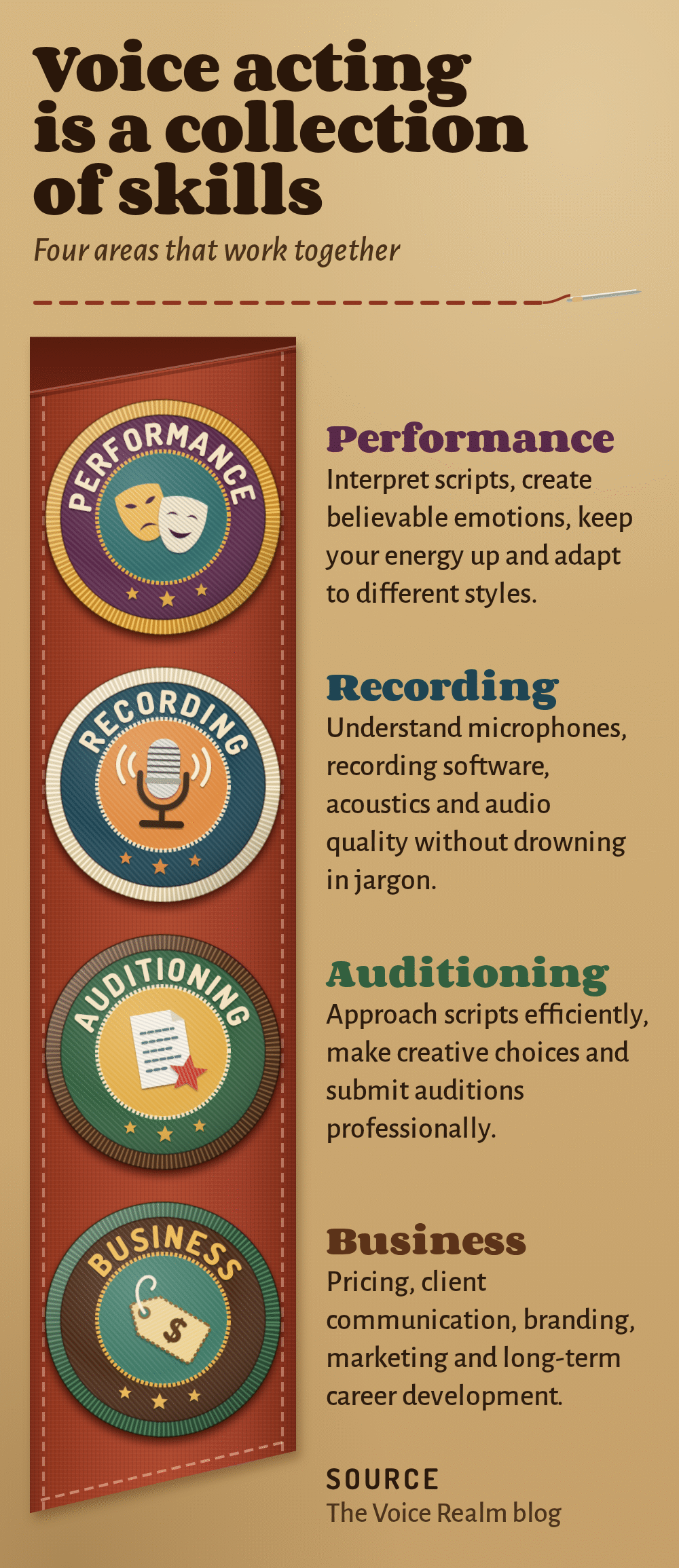
Four skills, one career © The Voice Realm
A Certificate That Recognises Your Achievement
Completing a comprehensive course is an accomplishment worth celebrating.
Upon successfully completing the Voice Master Academy course, students receive a certificate of completion, recognising the time and dedication they’ve invested in developing their voice-over skills.

While a certificate alone won’t secure voice-over work, it represents an important milestone. It demonstrates a commitment to learning and provides students with a sense of achievement as they continue building their careers.
More importantly, the real value lies in the knowledge, confidence, and practical skills gained throughout the course.
A Risk-Free Way to Explore Voice Acting
Starting something new can feel like a big commitment, especially if you’re unsure whether voice acting is the right fit.
That’s why Voice Master Academy offers Module 1 free, allowing prospective students to experience the course before deciding whether to continue.
It’s an opportunity to explore the learning style, understand the course structure, and gain valuable insights into the profession without feeling pressured to commit immediately.
For many aspiring voice actors, it’s an ideal first step towards discovering whether voice-over is a career they’d like to pursue.
Building Skills That Last
Voice acting isn’t about quick shortcuts or overnight success. Like any creative profession, it rewards those who continue learning, practising, and refining their craft over time. The strongest voice actors understand that success isn’t built on natural ability alone. It’s built through consistent improvement, curiosity, and a willingness to keep learning as the industry evolves.
Voice Master Academy provides a structured pathway for anyone who wants to move beyond simply having a pleasant voice and start developing the practical skills needed to work confidently in today’s voice-over industry. Whether your goal is to record your first audition, explore different genres, improve your performance techniques, or gain a better understanding of the business, structured learning can help you progress with greater confidence and purpose.
If you’ve been thinking about taking your first step into voice acting, there’s never been a better time to begin. Start with the free first module, discover where your voice naturally fits, and explore the self-paced courses available through Voice Master Academy. Every lesson is designed to help you build skills that will continue to serve you throughout your voice-over career, whether you’re pursuing it professionally or simply developing your passion for performance.
Join the Discussion
Have you ever considered voice acting, or are you already taking your first steps into the industry? What do you think is the most important skill for a new voice actor to develop: performance, recording, confidence, or business knowledge?
Share your thoughts in the comments below. We’d love to hear about your voice-over journey.
Ready to get booked?
See the jobs open right nowAbout Sarah Robbins
Sarah Robbins writes for The Voice Realm about finding voice over work, home studios, casting and the business side of voice acting.