 Blog
Blog

The voice-over has been recorded. The performance sounds right, the pacing works, and the project is moving toward completion. Then somebody notices something in the script.
Perhaps a product feature has changed. A legal team wants different wording. A name needs to be corrected, or a stakeholder who was not involved in the original approval has suggested a better sentence. Sometimes the change is substantial, but often it looks almost insignificant on the page.
The request may sound simple: “Can we just change these few words?” Usually, the answer is yes. Script changes are a normal part of creative production, and professional voice actors are accustomed to recording revised material.
What can be less obvious is that changing words after recording has begun is not quite the same as changing them in a document before anybody has stepped up to the microphone. Once a script has been recorded, the words have become a performance with a particular pace, tone, rhythm and relationship with everything around them.
The audio may also have been edited, synchronized with video, divided into individual files or sent through an approval process. That does not mean clients should be afraid to make changes, but it does mean there are better ways to manage them.
With clear communication, sensible version control and enough context for the voice actor, even late changes can be handled smoothly. The objective is not to prevent a script from ever changing, but to make those changes as clear and manageable as possible.
Script Changes Are a Normal Part of Production
Few creative projects move from first draft to final delivery without somebody changing their mind about something. Copy is refined, facts are updated and stakeholders sometimes hear a sentence differently once it is spoken aloud.
Voice-over can also reveal weaknesses in a script that were difficult to notice on screen. A sentence may look perfectly natural in a document but feel awkward when spoken, while two phrases may repeat the same idea without anybody noticing during a silent review.
A technical term may interrupt the rhythm of a paragraph, or a call to action may suddenly feel too long when heard alongside the visuals. Hearing a professional performer interpret the copy can expose details that were not obvious during writing and review.
That is one reason it is useful to think of voice-over as part of the production process rather than simply the final act of reading approved words. The goal is not to create a workflow in which nobody is ever allowed to change a word.
Instead, make sure that when a change is necessary, everyone knows exactly what changed, why it changed and what needs to happen next. That approach leaves room for creative improvements without allowing a straightforward update to become unnecessarily confusing.
A Script Change Is Not Always the Same as a Correction
One of the most useful distinctions in voice-over production is the difference between correcting an error in the recording and changing the script itself. The two situations may both require new audio, but the reason for recording that audio is different.
If a voice actor accidentally misses a word that appeared in the approved script, reads the wrong line or makes another clear recording error, the performer may simply need to correct the original recording. If the words themselves have changed after the agreed version was recorded, the actor is being asked to record material that was not part of the original performance.
Terminology is not completely universal across the industry. One performer may call a rerecorded section a pickup, another may use “retake,” and another may categorize the request as a revision.
What matters more than the label is understanding why the new recording is required. That distinction helps clients and performers discuss revisions more clearly and avoids treating every request for new audio as though it were exactly the same kind of change.
Why Three New Words Can Affect an Entire Sentence
Suppose the original script says, “Our platform helps your team work faster.” After recording, the sentence becomes, “Our new platform helps your entire team work smarter.”
Only a few words have changed, and editing individual words into the existing recording might initially seem like the easiest solution. In practice, however, speech does not behave like text in a word processor.
A performer anticipates what is coming next, and the rhythm of “your team” may be different from “your entire team.” Changing “faster” to “smarter” can alter the emphasis of the sentence, while the actor’s inflection at the beginning may also have been influenced by the original ending.
For that reason, rerecording the complete sentence can sometimes produce a more natural result than attempting to replace isolated words. In other situations, the actor may benefit from recording an even larger section so the revised line flows naturally into the sentences around it.
Providing the complete sentence, and sometimes the sentences immediately before and after it, gives the performer useful context. It helps them understand where the replacement belongs and how the new wording should connect with the existing performance.
The point is not that every tiny edit becomes a major production. Often it does not, but the number of changed words alone does not always tell you how much audio should be rerecorded.
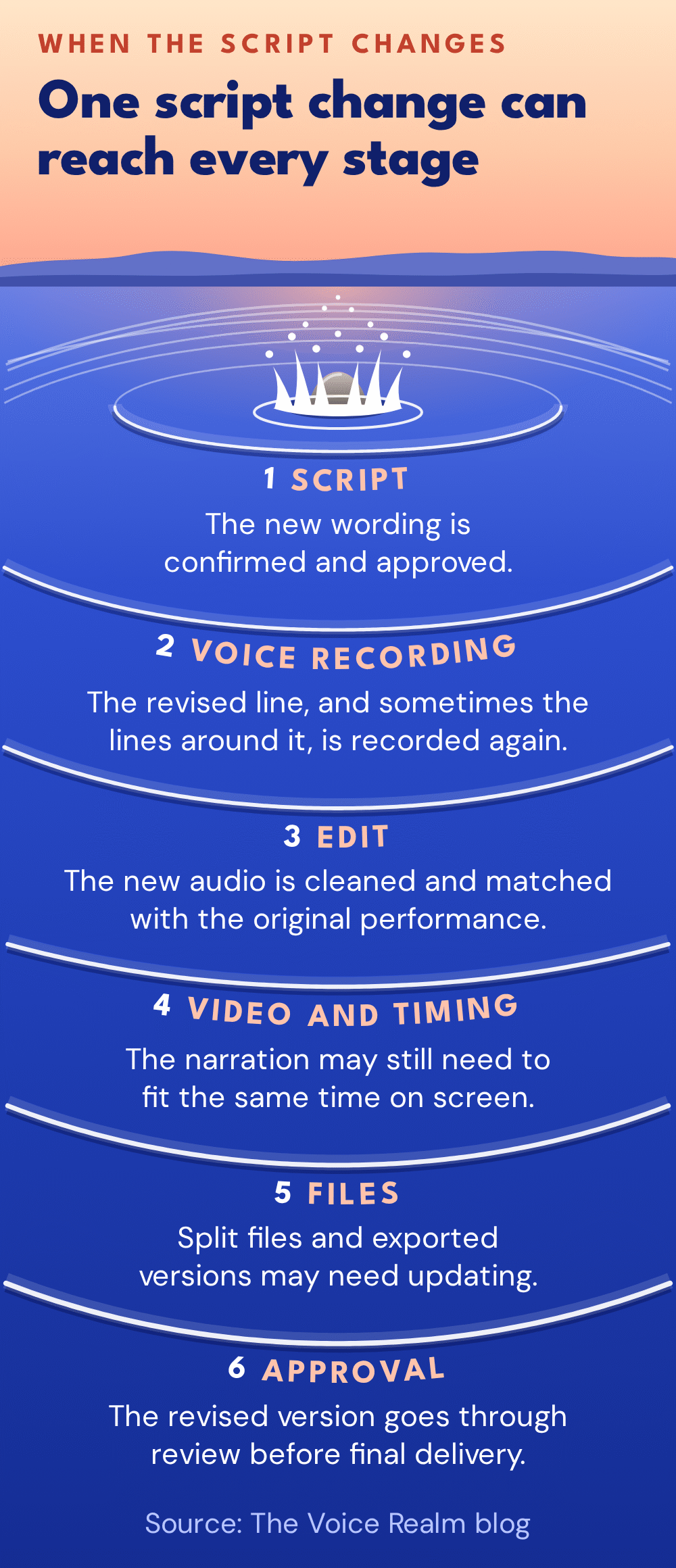
Where a few new words can travel © The Voice Realm
Matching the Original Performance Matters
Imagine recording a sentence today and then trying to reproduce it exactly next week. You may remember what you said, but matching precisely how you said it can be surprisingly difficult.
A voice actor faces the same challenge when returning to an existing project. The revised line needs to sound as though it belongs beside the original recording rather than as though it was inserted days or weeks later.
That can mean listening for pace, vocal energy, pitch, emphasis and emotional intention. The performer may review the original audio before recording the new section so the transition sounds as natural as possible.
There are physical considerations as well because the human voice naturally varies from day to day. Time of day, fatigue, vocal condition and other ordinary factors can subtly influence how somebody sounds.
Good context makes the matching process easier. Sending the actor the relevant original audio, the surrounding script and clear instructions about what has changed gives them a much stronger reference than simply sending three replacement words in an email.
The Audio May Already Be Part of Something Bigger
Voice-over rarely exists completely on its own, and by the time a script change arrives, the recording may already have moved into another stage of production. Understanding where the audio is in that process can make a significant difference to how an update should be handled.
An editor may already have cleaned the audio, adjusted spacing, selected takes or divided a long recording into separate files. A video editor may have positioned narration against animation or live-action footage, while an e-learning producer may have inserted individual files into different slides or modules.
That means the most useful question is not simply, “How many words changed?” It is also worth asking, “Where is this audio now?”
A revised sentence that has not yet been edited into anything may be extremely straightforward to replace. The same sentence can require more coordination if it has already been synchronized with visuals, exported into multiple versions or approved as part of a larger production.
Knowing the production stage helps everyone decide the simplest way to handle the update. It can also help the client determine whether changing the wording is the best solution or whether another adjustment elsewhere in the production would be easier.
Timing Can Make a Small Change More Important
Timing becomes particularly important when narration accompanies video. If an original sentence takes seven seconds to deliver and the revised sentence naturally takes nine, those additional two seconds have to come from somewhere.
The actor might be able to increase the pace slightly, but there is a point at which speeding up begins to affect clarity and performance. The alternative may be adjusting the edit, changing the animation or refining the wording so the idea fits the available space.
For video projects, providing the voice actor with the required timing for each section can also make it easier to record narration that fits the visuals.
Which solution makes sense depends on the project. This is why timecodes can be extremely useful when requesting revised lines for synchronized content.
Instead of telling the actor only that a sentence has changed, tell them if it still needs to fit into the same duration. That one piece of information can affect how they approach the entire replacement and help avoid another round of changes after the new audio arrives.
Version Control Becomes Surprisingly Important
One of the easiest ways for a simple revision to become confusing is for several versions of the script to start circulating. The problem is rarely that somebody deliberately uses the wrong document; it is usually that several files all appear to be the current one.
There is the original script, followed by the version containing the client’s changes. Somebody else emails another copy with comments, while a third person fixes a typo but forgets to include a change from the previous version.
Before long, the voice actor may be looking at Script_FINAL_v2_NEW.docx while the producer is reviewing Script_FINAL_v3_APPROVED.docx. A complicated software system is not required to prevent this, but there does need to be one clearly identified current version.
Use a clear filename or version number, highlight revised wording and avoid sending several partially updated documents in separate messages. If a sentence has been removed entirely, mark that clearly too rather than relying on the performer to compare two lengthy documents line by line.
For larger projects, a simple change log can also be useful. It might identify the page or section, the old wording, the new wording and any timing or pronunciation notes associated with the change.
That small amount of organization can save far more time than it takes to create. More importantly, it reduces the risk of somebody recording or approving wording that has already been replaced.
Bring Stakeholder Feedback Together
Another common complication occurs when several people are involved in approving a project. Each person may have a legitimate reason for requesting a change, but the timing of those requests can make a considerable difference.
Marketing may approve the original script before legal requests different wording. The product team then updates terminology, while somebody from senior management asks whether the closing line can be rewritten.
Sending those requests to the actor one at a time can create several rounds of recording even when the changes could have been combined. Whenever the schedule allows, consolidate feedback before requesting the next recording.
Give the relevant stakeholders an opportunity to review the same version and combine their changes into one clear update. This does not mean waiting indefinitely for every possible opinion, because production still needs deadlines.
Instead, create an obvious approval point so the team understands that the script is about to move into recording. A useful question is, “Is everyone who needs to approve the wording comfortable with this version being recorded?”
That can prevent the actor from recording version two on Monday, version three on Tuesday and version four on Wednesday. When feedback can reasonably be combined, one organized revision is usually easier for everyone than several separate requests.
When a Revision Really Is Simple
Not every script change creates a chain reaction, and sometimes a correction genuinely is quick and straightforward. A standalone line that has not yet been placed into the final production may be particularly easy to update.
Perhaps the client changes a single word, the actor rerecords the sentence, and the new file simply replaces the old one. There may be no meaningful effect on timing, editing or anything else in the production.
Other projects are more complicated, which is why revision arrangements can vary depending on the performer and the work involved. Some performers may include limited minor revisions, while others handle client-requested script changes separately.
Clients therefore do not need to assume that every adjustment will become complicated. At the same time, it is useful not to assume that every post-recording rewrite is identical to correcting an error in the original recording.
Clear expectations make the process easier for both sides. The client understands how changes will be handled, and the performer understands what the project requires if the approved material later evolves.
When a Revision Becomes a New Version
At the other end of the spectrum, a project can change so substantially that describing the new work as a minor revision no longer makes much sense. The project may retain the same name while the actual material has become significantly different.
Perhaps the opening has been rewritten, two sections have moved, a new product benefit has been introduced and the call to action is completely different. At that point, the actor may effectively be looking at a substantially new script.
Where that dividing line sits will depend on the project and the arrangement with the performer. There is no need for a client to decide alone whether a change technically qualifies as “small” or “large.”
 VOICEMASTERACADEMYLearn the craft in order.Module one is freeStart module oneTwenty modules, start to finish.
Instead, send the updated script and explain what has happened. The performer or production team can then determine what needs to be rerecorded and the most practical way to approach it.
That conversation becomes much simpler when all of the changes are clearly marked. It also helps both sides understand the actual scope of the update rather than judging it only by the number of revised words.
Do Not Make the Actor Hunt for the Changes
Sending a completely new script with the message “There are just a few changes in here” creates unnecessary work if nobody identifies where those changes are. On a long narration, the performer may have to compare the new document with the original line by line.
That process takes time and introduces the possibility that a changed word, number or sentence will be missed. Highlighting revised text gives the performer a much clearer starting point.
If your document system tracks changes clearly, use that feature. For a short project, listing the changes in the message itself may be even easier.
It is also helpful to distinguish between text that changed and text that is simply being shown for context. If you send three sentences because the middle sentence needs to be replaced, make it obvious that only the middle one contains new wording.
The easier it is for the performer to understand the request, the easier it is for them to concentrate on making the new recording match. Clear markup is a small production habit that can prevent surprisingly large misunderstandings.
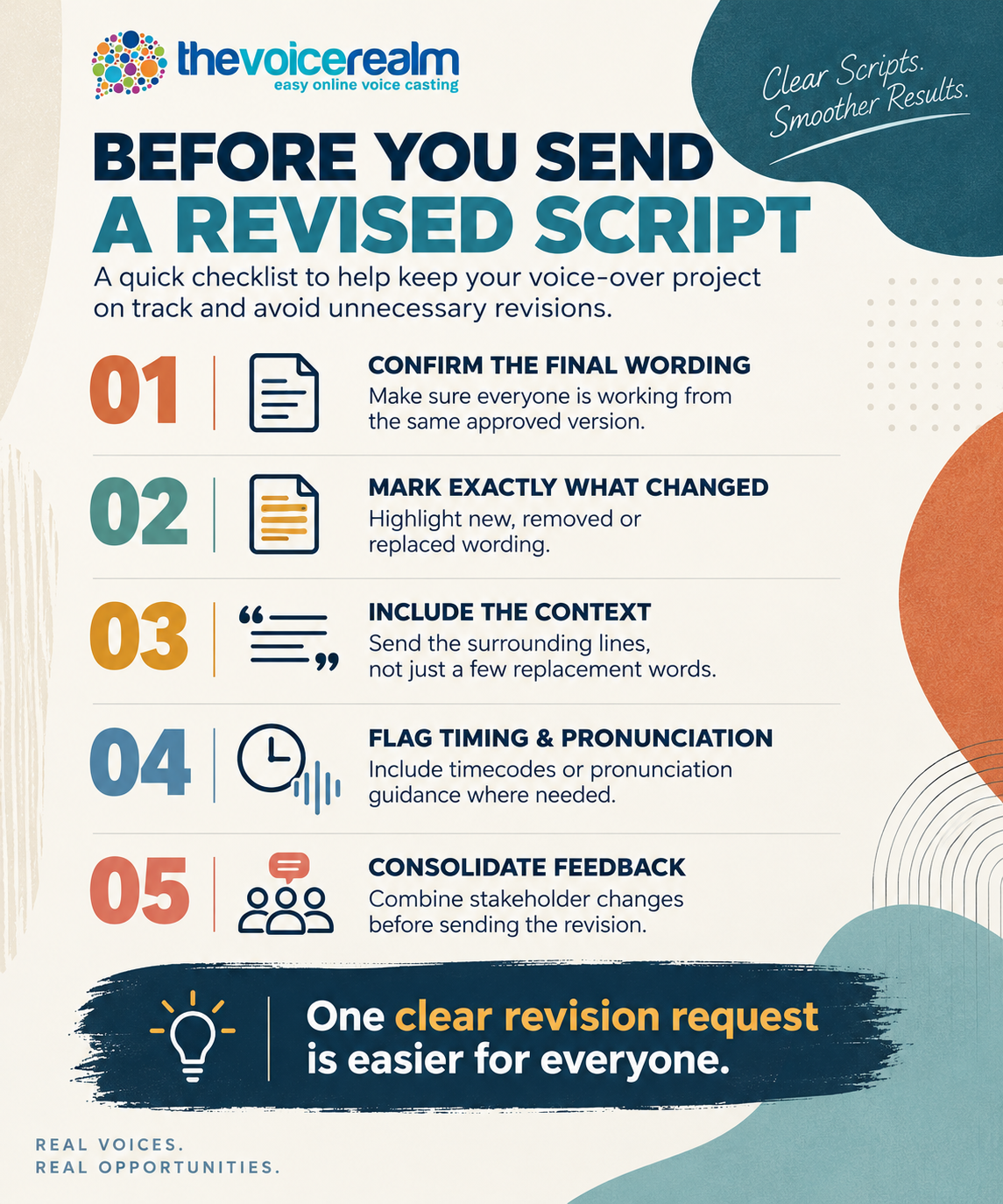
A clear revision request helps voice actors understand exactly what changed and keeps the production moving smoothly.
Send Context, Not Just Replacement Words
A request such as “Please record ‘available everywhere from October’” leaves several unanswered questions. The performer does not know what comes before the phrase, what follows it or how important the information is within the wider message.
Is October the key information, or is “everywhere” the point that needs emphasis? Is the sentence part of a calm corporate narration or the final call to action in an advertisement?
Instead, send the surrounding section and mark the revised wording. If there is an existing recording, provide enough information for the actor to identify the relevant moment.
For video, include a timecode when appropriate. For projects consisting of many individual files, include the file name or section number so the performer does not have to determine where the new line belongs.
Technical material may also require new pronunciation guidance if revised wording introduces unfamiliar terminology. Context is particularly important because a replacement line needs to sound like part of the original performance rather than a separate recording.
The actor is not simply pronouncing new words. They are reconnecting those words to an existing creative decision and trying to make the transition as smooth as possible.
Pronunciation Changes Deserve Attention Too
Sometimes the written script has not technically changed at all, but the client’s preferred pronunciation has. Brand names, surnames, abbreviations, locations and specialist terminology can all create uncertainty.
Even familiar words may have more than one accepted pronunciation depending on region, industry or brand preference. The easiest solution is to provide pronunciation guidance before recording whenever a word might reasonably be ambiguous.
A short audio reference can be particularly useful for brand names and unusual terminology because it removes the limitations of trying to describe a sound in writing. If a new script version introduces additional names or technical terms, check those at the same time as the wording.
That prevents the revised recording from accidentally creating another revision request of its own. It also gives the performer confidence that they are using the pronunciation the client actually wants rather than making an educated guess.
Last-Minute Changes Sometimes Really Are Necessary
No amount of preparation can eliminate every late change, and some updates simply cannot wait. A price can change, a launch date can move, legal wording can be updated or a factual error may be discovered that cannot remain in the final version.
A product feature might also be renamed after the original recording session. In those situations, the priority should be accuracy rather than proving that the script was previously approved.
The useful question is how to make the required update as efficiently as possible. First, confirm the exact final wording and identify everywhere the change appears.
Then determine whether the change affects timing or surrounding sentences and consolidate any other outstanding feedback before sending the revision request. Finally, give the performer the information they need to match the existing recording, which may include the original audio, surrounding lines, timecodes, pronunciation guidance and a clear deadline.
A genuine last-minute change does not have to become a last-minute scramble. An organized request can make an unavoidable update considerably easier to manage.
Consider the Project’s Future Before Recording
Some voice-over projects are likely to change more often than others. Recognizing that possibility at the beginning can make future updates much easier.
A brand film tied to a specific campaign may remain unchanged once it is approved. An e-learning course, software tutorial or product demonstration may need updates as information changes over time.
If future updates are likely, scripts can be divided into logical sections and audio can be organized with clear filenames so individual parts are easier to identify. It may also be useful to maintain a pronunciation guide for recurring names and terminology.
When the same performer returns months later, those references can help maintain consistency across new material. They can also make it easier for a new producer or stakeholder to understand decisions that were made during the original recording.
This does not mean designing an entire production around hypothetical future changes. It simply means recognizing when content is likely to evolve and organizing the project accordingly.
Read the Final Script Aloud Before You Send It
One of the simplest quality checks costs nothing and requires no special software: read the script aloud. Silent reading and spoken language are not the same experience, so hearing the words can reveal issues that are easy to overlook on screen.
Preparing a clearly organized script before the session can also make the recording process smoother for both the client and the voice actor.
A sentence that appears concise in a document may be difficult to say naturally. Punctuation that looks correct grammatically may create an awkward rhythm when spoken, while repeated words or unexpectedly long phrases can become much more obvious.
You do not have to perform the script like a professional voice actor. Simply speak it at a comfortable pace and listen to how the words actually sound.
If you stumble over the same sentence twice, take another look at it. The voice actor may be able to deliver it perfectly, but the stumble could also be telling you something useful about the writing.
Reading aloud can also reveal whether a section feels considerably longer than expected. Catching that before recording gives the writer an opportunity to refine the copy without asking the performer to solve a timing problem later.
Check the Details That Are Most Likely to Change
Before final approval, pay particular attention to information that carries a higher risk of being updated. Dates, prices, statistics, URLs, product names, job titles, promotional offers and contact information are all worth checking one more time.
A beautifully written paragraph may remain unchanged for years, while one incorrect date can require a new recording immediately. Numbers deserve particular attention because they can look deceptively similar during proofreading.
Confirm whether percentages, currencies and dates are current and whether they should be spoken in a particular way. If the script contains a web address or telephone number, verify it rather than assuming it was copied correctly from an earlier document.
Small factual details are often exactly the things that trigger late revisions. A final check does not guarantee that nothing will ever change, but it can catch changes that were already knowable before recording began.
Decide Who Gives Final Script Approval
For projects with several stakeholders, somebody needs to know when the script has genuinely reached the recording stage. Without that responsibility, every participant may assume somebody else has completed the final check.
The voice actor can then receive the document only for another stakeholder to realize afterward that they were reviewing an older version. Establishing one final approval point reduces that risk.
The person giving final approval does not necessarily need to have written the script. Their job is to confirm that the appropriate people have reviewed the current version and that this is the version intended for recording.
This is particularly valuable when a project has moved through several departments. Marketing, legal, product and senior management may all care about different parts of the copy, so everyone needs to know which version has actually been approved.
A clear approval point does not eliminate creative flexibility. It simply gives everyone a shared understanding of which script has moved from draft to recording version.
Agree on How Revisions Will Be Handled
Revision arrangements can vary, which is precisely why it is useful to understand how changes will be handled before recording begins. Different projects can involve different expectations depending on the amount of material, production requirements and the nature of the requested change.
Clients booking through The Voice Realm can check the current rates for script revisions when changes or additions are needed after recording. Knowing this in advance makes it easier to understand what happens if an approved script later changes.
That conversation is much easier before the first recording than after a revision suddenly becomes urgent. It can also prevent assumptions on either side about what is included in the original project.
Clear expectations support a better working relationship. The client knows how the production will respond if the scope changes, while the performer has a clear understanding of what may be required if new material is introduced.
The Goal Is Not Zero Revisions
A perfectly managed voice-over project can still require a revision. Creative work evolves, people hear things differently once they become real, and sometimes the first recording reveals an opportunity to improve the finished piece.
Trying to eliminate every possible revision could actually make production slower if teams become afraid to make sensible improvements. The better objective is to eliminate avoidable confusion while making necessary changes easy to manage.
That means starting with the strongest script possible, getting the right approvals and clearly marking any later changes. It also means giving the performer enough context to record new material efficiently and consistently.
When those habits are in place, a revision becomes what it should be: a manageable part of production rather than a disruption. The project can continue moving forward even when the words need to evolve along the way.
A Smoother Revision Starts Before the First Take
The easiest script change to manage is often the one everyone has prepared for. Before recording begins, confirm that the correct version has been supplied and that the important details have been checked.
Review names, numbers, dates and pronunciations. Make sure the people who need to approve the wording have had an opportunity to do so, and tell the voice actor about any timing or technical restrictions that affect the performance.
If something changes afterward, there is no need to panic. Identify the revised wording, consolidate the feedback and send the actor the context they need to make the new recording fit naturally with the original.
A professional voice-over workflow is not defined by whether a project ever needs a second take. It is defined by how clearly everyone communicates when the project evolves and how efficiently those changes are incorporated.
Ready to Bring Your Final Script to Life?
Once your script is ready for recording, finding the right performer is the next step. The Voice Realm connects clients with pre-screened professional voice actors across a wide range of accents, styles and voice-over categories, helping clients audition talent and find a voice that suits the project.
If the script changes along the way, clear communication can keep the production moving smoothly. Send the performer the updated wording, show them exactly what changed and provide enough context to make the revised recording feel like it was always part of the original.
Photo by Soundsitive Studio on Unsplash
Sources: unsplash.com.
Ready to get booked?
See the jobs open right nowAbout Sarah Robbins
Sarah Robbins writes for The Voice Realm about finding voice over work, home studios, casting and the business side of voice acting.