Blog
Blog
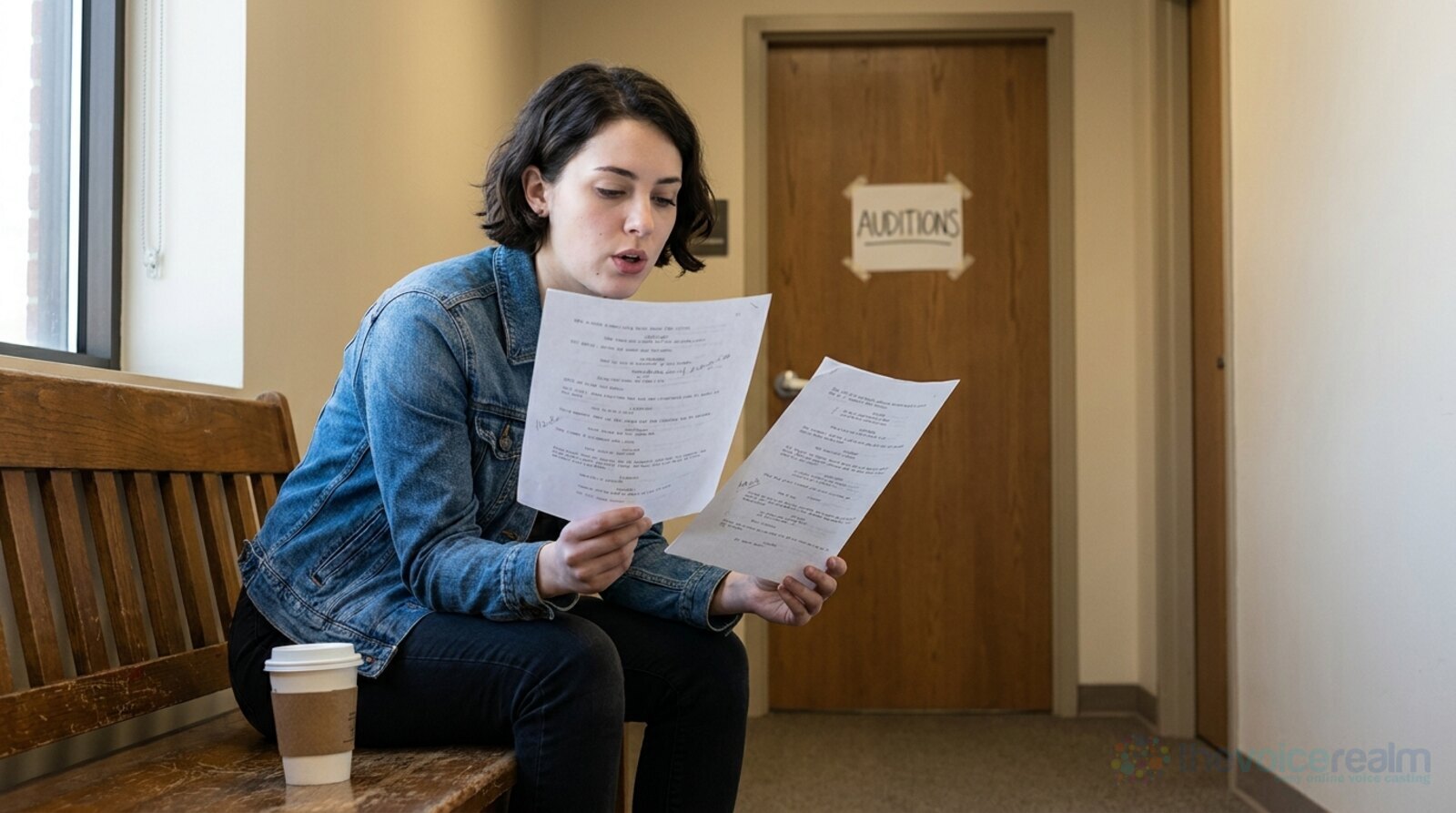
This one’s for anyone who’s ever been handed a script they’ve never seen and asked to read it right now. Maybe it’s a live audition, a directed session where the client rewrites a line on the spot, or a casting that lands with a two hour turnaround. Cold reading is the skill underneath all of them, and the good news is that it’s a skill. You can practise it, measure it and get noticeably better at it in a few weeks.
Below you’ll find what’s actually happening when you read aloud, how to train your eyes to stay ahead of your voice, what to look for in the first minute with new copy, and how to recover when a word trips you up.
Why a cold read feels harder than it is
Most of the panic in a cold read comes from one fear: that you’ll get to a word and not know what it is or how it lands. So you slow down, you read word by word, and the read goes flat. The listener hears someone reading, which is the one thing a voice over shouldn’t sound like.
Here’s the thing to hold onto. Nobody in the room expects a cold read to be the finished performance. A casting director listening to a first pass is checking whether you understood the copy, whether your instinct for the character is in the right neighbourhood and whether you can take a note. A director who changes a line mid-session wants to hear the new line make sense. Neither is waiting for a flawless take.
That shifts the goal. You aren’t trying to be perfect on sight. You’re trying to sound like you mean what you’re saying, from the first sentence, while your eyes do some quiet work in the background.
© The Voice Realm
Your eyes are already a few words ahead
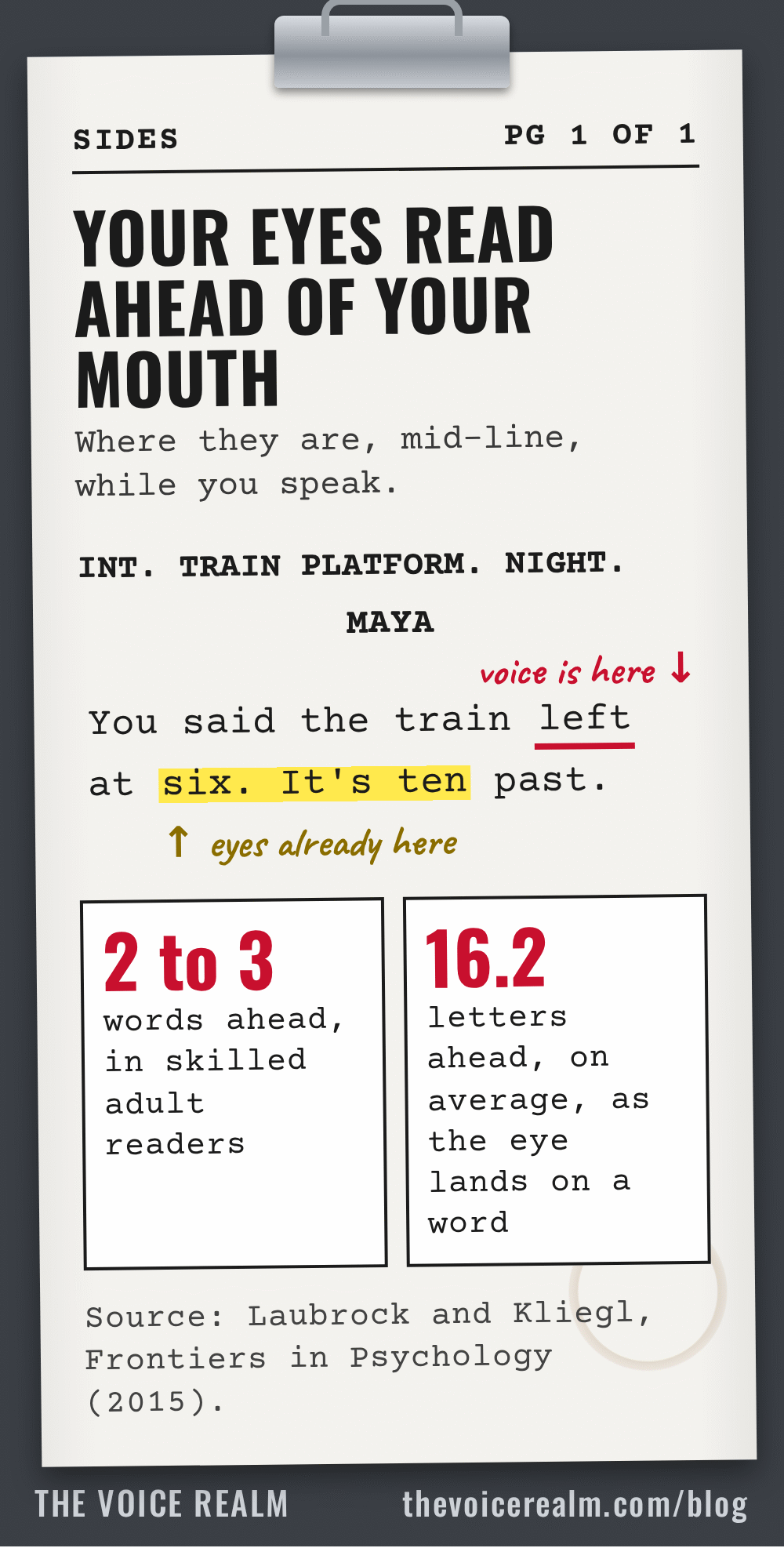
When you read aloud, your eyes and your voice aren’t on the same word. Your eyes run ahead, collect the next chunk of the sentence, and hand it to your mouth a beat later. Researchers call the gap the eye-voice span, and it’s been measured for over a century.
In a 2015 study in Frontiers in Psychology, Jochen Laubrock and Reinhold Kliegl tracked the eyes and voices of adults reading aloud. They note that the early researcher Guy Buswell found the span to be “on the order of 15 letters (or two to three words) for college students.” Their own measurements landed close to that: when the eye arrived on a new word, “the distribution at first fixation onset had a mean of 16.2 letters.”
Two to three words doesn’t sound like much. It’s enough, though. That small lead is what lets you see a question mark coming and lift the line, or spot the word “but” and get ready to turn the thought. When the span shrinks, usually because you’re nervous or the copy is dense, you lose that warning and start reading word by word. When it widens, you sound like you’re talking.
So the practical aim of cold reading practice is simple to say: keep your eyes a phrase ahead of your mouth, even when the copy is new and the stakes feel high.
Train your eyes to stay a phrase ahead
The fastest way to get better at reading aloud is to read aloud, every day, from material you didn’t choose. Your eyes learn to scan ahead when they’re regularly surprised. Ten minutes a day beats an hour on Sunday.
Mix up what you read. A page of a novel teaches you dialogue and rhythm. A newspaper article teaches you long sentences with a clause tucked in the middle. Product packaging and appliance manuals are brilliant for the dry, technical copy that turns up in e-learning and corporate work. Children’s picture books are great for big, playful reads. If you only ever practise on commercial copy, you’ll freeze the first time an audition hands you a medical narration.
A few drills that work:
- The sliding card. Hold an index card over the text and slide it along just behind your voice, so the words you’ve already said disappear. It stops your eyes drifting back and trains them to live in front of the voice.
- Phrase by phrase. Before you say anything, glance at the sentence and find the natural phrase breaks. Then read it in those chunks, one look per phrase. You’ll feel the span widening.
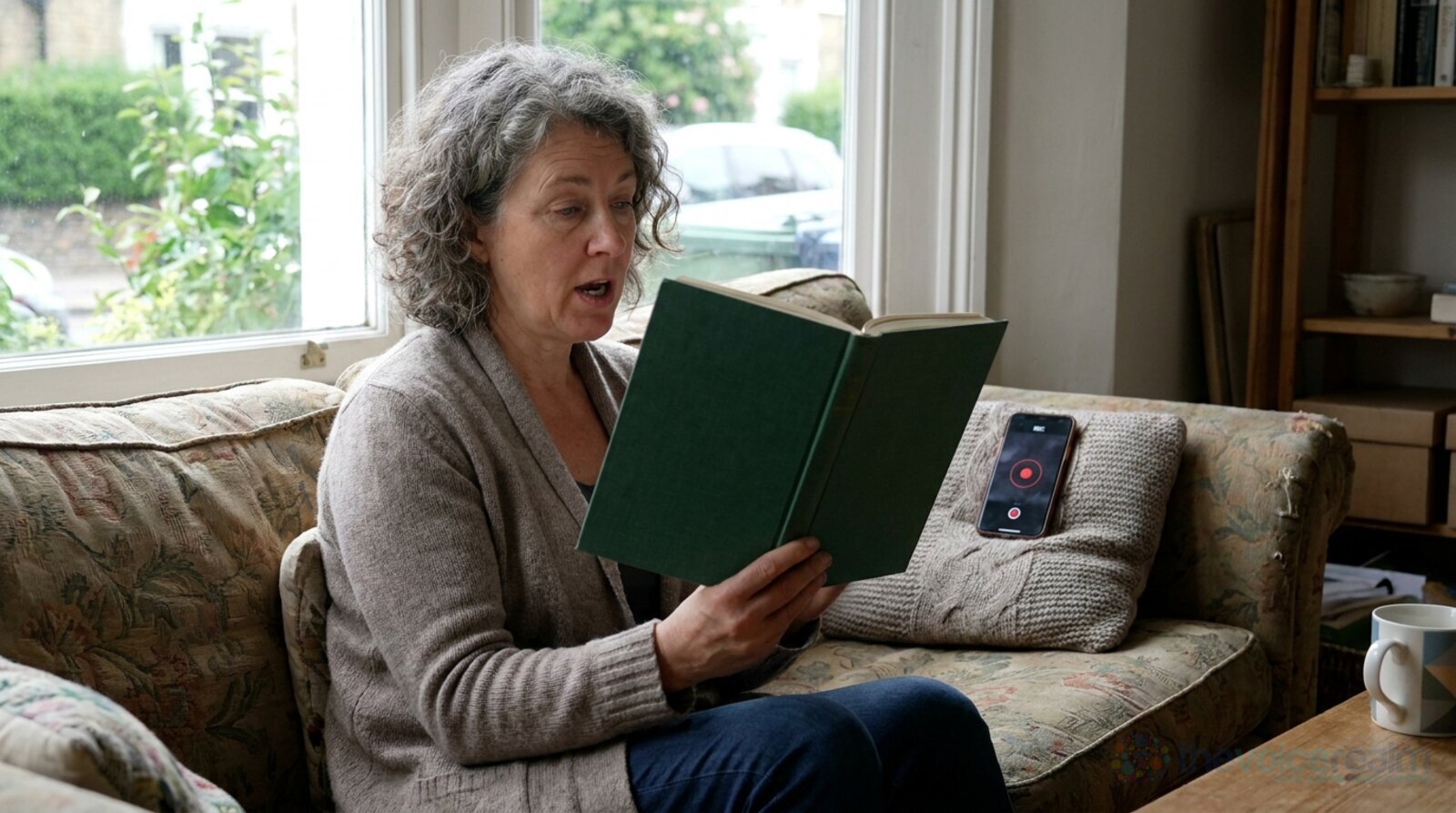
- Record and listen tomorrow. Listening straight away, you hear what you meant. Listening the next day, you hear what you did. Mark every spot where the read went word by word.
Keep a log of the hesitations. After two or three weeks you’ll see the list getting shorter, and the copy you once found dense will start to feel ordinary.
© The Voice Realm
Reading the copy for clues before you speak
Most cold reads come with a little time, even if it’s only a minute. Use it to read the whole script once, silently and fast, for meaning. You aren’t learning lines. You’re finding out what happens.
The page tells you a lot if you look for it. Punctuation is the writer’s direction: a full stop after one word means they want it to land, a run of commas means a breathless list, an ellipsis means a thought trailing off. Repeated words are usually the point of the script. A brand name or product name is almost always the most important word in a commercial, so find it and decide how you’ll say it before you start.
Read any direction that came with the casting, too. If the specs say “warm, real, not announcery”, that’s your first choice made for you. If there’s a character description, take one detail from it and play it. Parentheticals inside the script, like “(beat)” or “(laughs)”, are part of the copy and nobody wants to hear you read them aloud, which happens more than you’d think on a nervous first pass.
Last, look for the turn. Nearly every script has a moment where the thought changes direction: the problem becomes the solution, the joke lands, the character changes their mind. If you know where the turn is before you start, you can build towards it, and that alone makes a cold read sound rehearsed.
© The Voice Realm
When the director hands you new copy
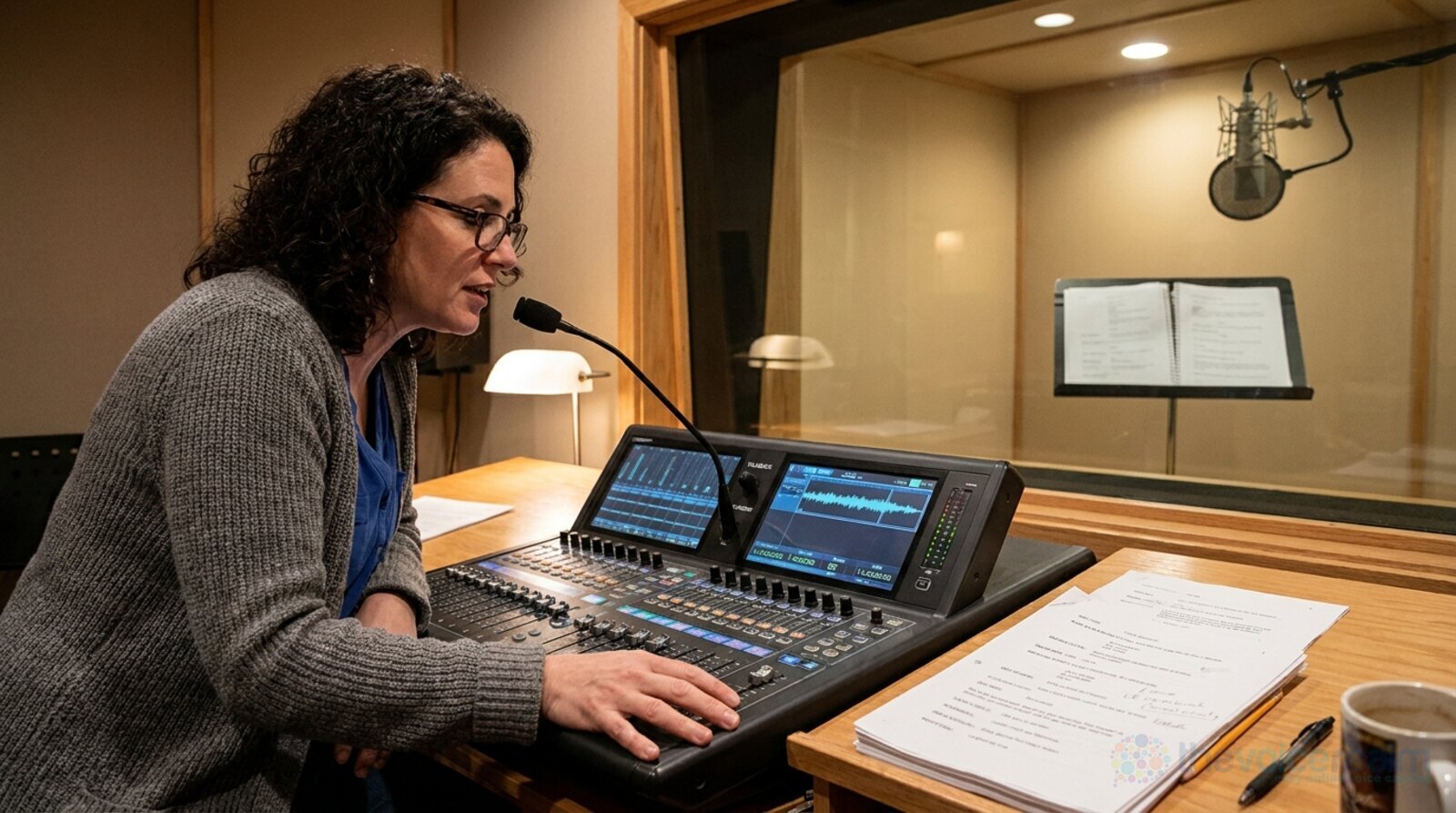
In a directed session, the copy will change. A client hears the first take and realises the line’s too long, or legal asks for a new disclaimer, or the director wants to try a version where the character is angrier. You’ll be handed new words and asked to go again within seconds.
 VoiceEditSuiteClean it up, check it, send it.Loudness NormalizerScript AccuracyRate CalculatorSee the suiteThe studio check is free to try.
This is where cold reading skill pays for itself. The trick is to treat the change as a note, not a new script. Ask what’s changed and why, if it isn’t obvious. Read the new line once in your head. Then keep everything about your read that the director liked and change only what the new words need. Clients love an actor who can absorb a change without the energy dropping, because it keeps the session moving and the budget on track.
If you’re sent changes during a remote session, mark them straight onto your script so you don’t drift back to the old wording on the next take. Our guide to marking up a script with breaths, emphasis and turns shows the symbols that work at speed, and the same marks help on any cold read where you’ve got thirty seconds with a pencil.
© The Voice Realm
Stumbles, and what to do with them
You will trip over a word. Everyone does. What you do next decides whether anyone remembers it.
In a live session, don’t apologise and don’t stop dead. Pause, go back to the start of the sentence or the phrase, and carry on in the same energy. The engineer can cut a clean pickup in seconds, and an actor who recovers without fuss is easy to work with. A run of “sorry, sorry, can I go again” eats session time and tells the room you’re rattled.
You get another go
Stumble, breathe, take it again from the top of the line. Edit the best take together and send something that sounds like a first read, not a fifth one. Don’t polish the life out of it.
Keep the train moving
Pause, pick up from the start of the sentence and keep the same energy. No apology speech. Directors remember how you recovered far longer than the word you missed.
If one word keeps catching you, it’s usually a pronunciation you aren’t sure of rather than a reading problem. In an audition you can look it up before you record. In a session, ask. “Is it MOH-bee-us or MAY-bee-us?” takes three seconds and saves a retake. Writers and clients mispronounce their own brand names often enough that they’re usually glad someone checked.
And if a sentence is genuinely awkward to say, say so politely. You’ll often be the first person to read it aloud, and a small rewrite suggestion from the actor is a normal part of most sessions.
A sixty second drill for every day
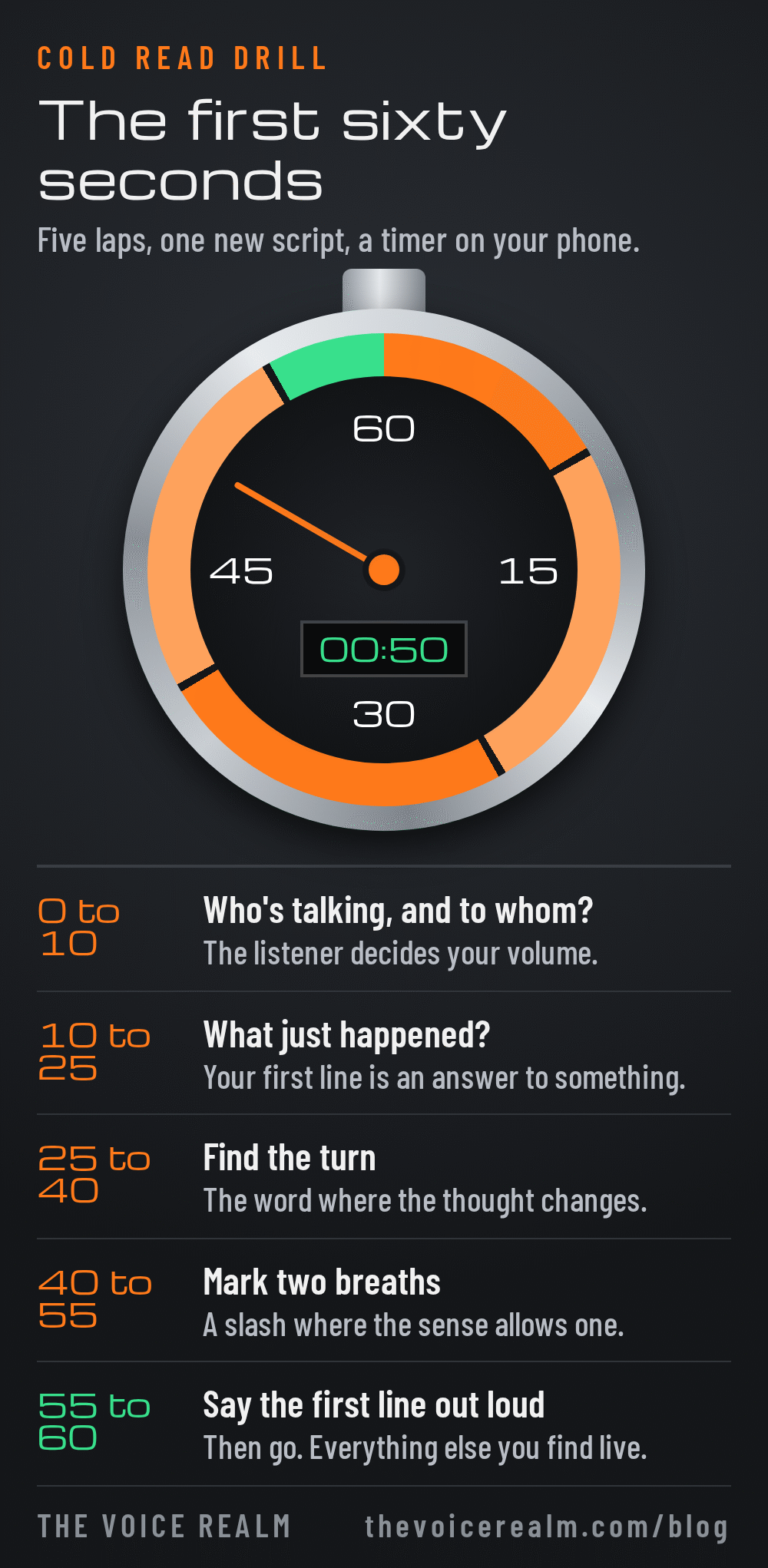
Here’s a routine that pulls all of this together, and it only needs a phone and a source of copy you’ve never read. Pick something from a different genre each day: a product page, a news story, a scene from a play, a set of instructions. Set a sixty second timer, prepare, then record the read as soon as it goes off.
Don’t stop if you stumble. The point is to practise the recovery as much as the read. When you’re done, put the recording away until the next day.
When you listen back, score yourself on two things only: did it sound like you meant it, and where did your eyes fall behind your voice? Write the second one down. Over a month, those notes become a map of exactly the copy that throws you, and you can practise more of that. If you’re aiming to turn more of your auditions into bookings, this daily minute is one of the cheapest upgrades there is.
Once the drill feels easy, shorten the prep to thirty seconds. Then try it with copy that’s been printed small or sent as a blurry phone photo, because one day that’s exactly what you’ll be given.
© The Voice Realm
Cold reading gets easier the more often you’re surprised
There’s no secret trick to sight reading. It’s your eyes learning, through repetition, to stay a phrase ahead and to spot the shape of a sentence before you’re inside it. Read aloud every day, from things you didn’t choose, and record yourself often. Look for the turn and the product name before you start. When you stumble, pick it up cleanly and keep going.
If you’re just starting out and want structured practice with feedback on your reads, Voice Master Academy’s voice over course for beginners walks you through script reading step by step. And when you’re ready to put it to work, the voice over jobs board has fresh copy to read cold most days.
Sources: Laubrock, J. and Kliegl, R., “The eye-voice span during reading aloud”, Frontiers in Psychology, 2015.
Ready to get booked?
See the jobs open right nowAbout Sarah Robbins
Sarah Robbins writes for The Voice Realm about finding voice over work, home studios, casting and the business side of voice acting.