Blog

You’re halfway through a podcast on the train, the host says “this episode is brought to you by” and, for some reason, you don’t skip. You keep listening because it doesn’t sound like an ad. It sounds like someone you trust telling you about a thing they found. That’s the whole craft of the podcast ad read, and it’s harder than it sounds.
This guide is for voice actors who’ve been asked to voice a podcast ad, or who’ve spotted podcast sponsorship scripts in their castings and want to know how they differ from a radio spot. It’s also for anyone who hosts their own show and has just landed a first sponsor. It covers the two kinds of podcast ad, why the quiet ones work, how to turn a page of talking points into something that sounds like you, and the honesty rules that apply when the words are “I love this.”
Two kinds of podcast ad, and which one you’ll be hired for
Spotify’s advertising guide splits podcast ads into two families, and the split tells you a lot about the job. The first is the host read: “Ads created and voiced by a show’s host usually read in the style of the show.” The second is the one most voice actors are booked for, the announcer read: “Pre-recorded by an actor or producer made just for the podcast environment.”
The two have different lengths, too. The same guide says “Host Read ads are most effective when lasting no more than :60” while “Voice talent ads are most effective when they’re fewer than :30.” So if you’re the voice actor rather than the host, expect a short script that has to land quickly, often dropped into dozens of different shows, each with its own tone.
That’s the trick of the announcer read. You’re a guest in someone else’s living room. The listener has just been hearing two friends chat about films or a true crime case, and suddenly there’s you. If you arrive sounding like a car dealership on the radio, they reach for the skip button. If you arrive sounding like you belong in that room, they listen.
Host reads are a job for voice actors too, more often than you’d think. Plenty of working voice actors host their own shows, branded podcasts hire a professional host, and some companies hire a voice actor to record a “host style” read that sits at the top of a show they produce. Everything below applies to both.

© The Voice Realm
Why the ad that sounds least like an ad works best
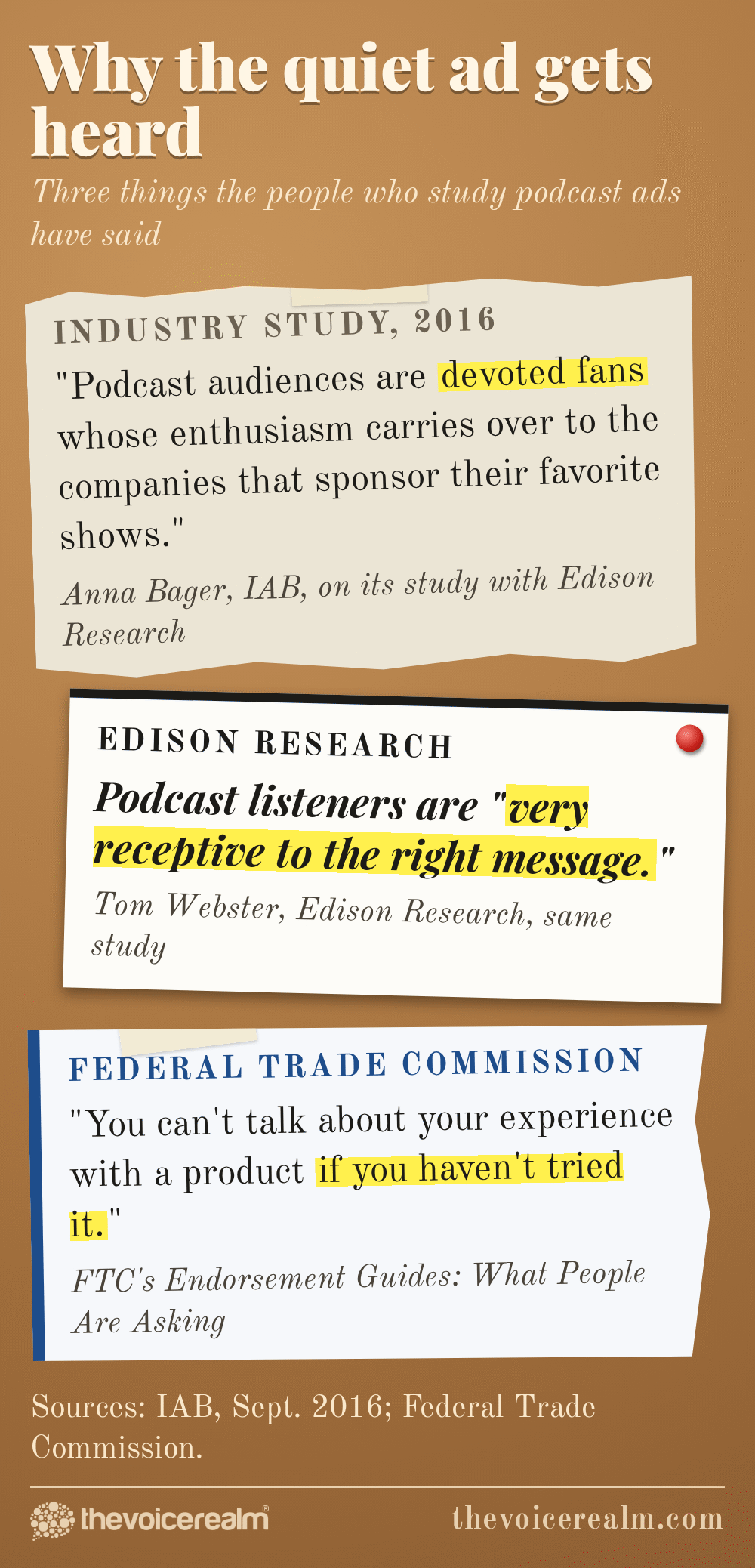
The research on this has pointed the same way for years. Back in 2016, a study by the Interactive Advertising Bureau and Edison Research found that “listeners prefer sponsorship messages and host mentions of products and services to pre-recorded advertisements” during podcasts. The same survey found that 65% of podcast fans were more willing to consider buying things they learned about during a podcast.
Nielsen came back to it in 2020. After more than 260 surveys across 240 brands, it reported that ads read by the host drove more brand recall than ads that weren’t. Radio Ink summed the study up in its headline: host read ads in podcasts work.
And the money has followed. The IAB and PwC reported that US podcast ad revenue climbed 17.6% in 2025, to $2.9 billion, outpacing digital audio as a whole. That’s a lot of sponsors who need someone to read their copy, and a lot of copy that will only work if the read sounds human.
The lesson for you: the listener has a very good ear for the moment a person turns into a salesperson. Your job is to never let them hear that moment.
© The Voice Realm
Read it like you’re passing on a tip
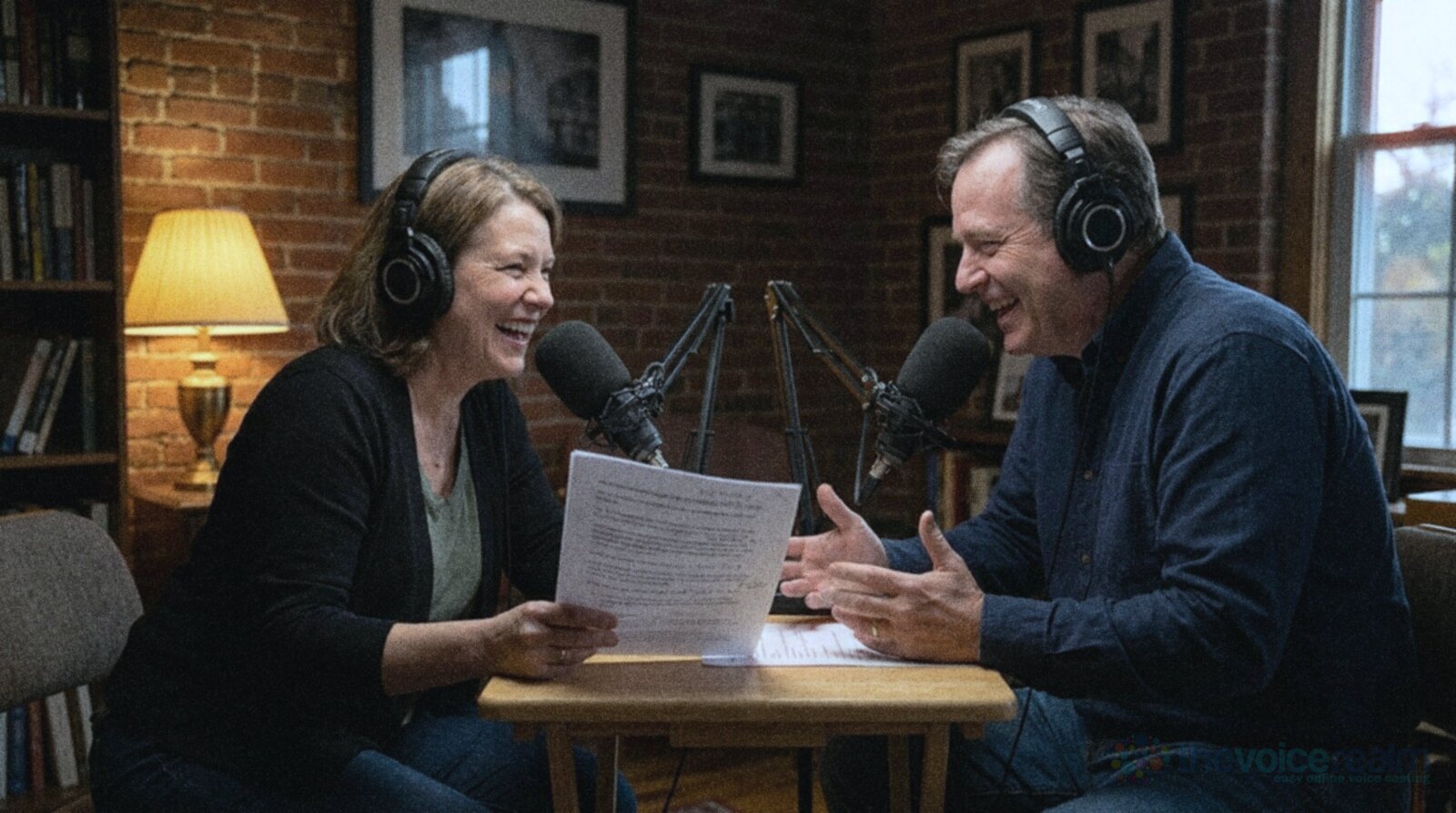
Spotify’s guide is blunt about the tone. Podcast reads should be less dramatic than other styles, and “as a general rule, less is more.” Then the line every podcast ad brief is really asking for: “The goal is to be natural, like a friend sharing a tip or an exciting discovery.”
Think about how you actually tell a friend about something you like. You don’t announce the brand name in a big, round voice. You don’t punch every benefit. You lean in a little, you’re slightly amused by your own enthusiasm, and you get to the point. Picture one specific person who listens to the show, sitting where they’d really be sitting, and talk to them.
A few things that help:
- Drop the pitch for the brand name. Commercial reads often lift on the product name. In a podcast read, say it like a noun, not a trophy.
- Keep your real speaking rhythm. Little hesitations and a natural “so” or “honestly” can live in a podcast read where they’d be cut from a TV spot. Ask first if the copy is locked.
- Smile where you’d smile anyway. On the funny line, not the whole script. We’ve written about how a smile carries in your voice, and in a podcast ad it’s the difference between warm and cheesy.
- Close to the mic, quiet in the voice. Most podcast listening happens in earbuds. You’re inches from their ear, so you don’t need to project to the back of a room.
If you’ve struggled with copy that sounds read rather than said, our guide on sounding natural on a voice over script has exercises that work well here too.
© The Voice Realm
Talking points aren’t a script
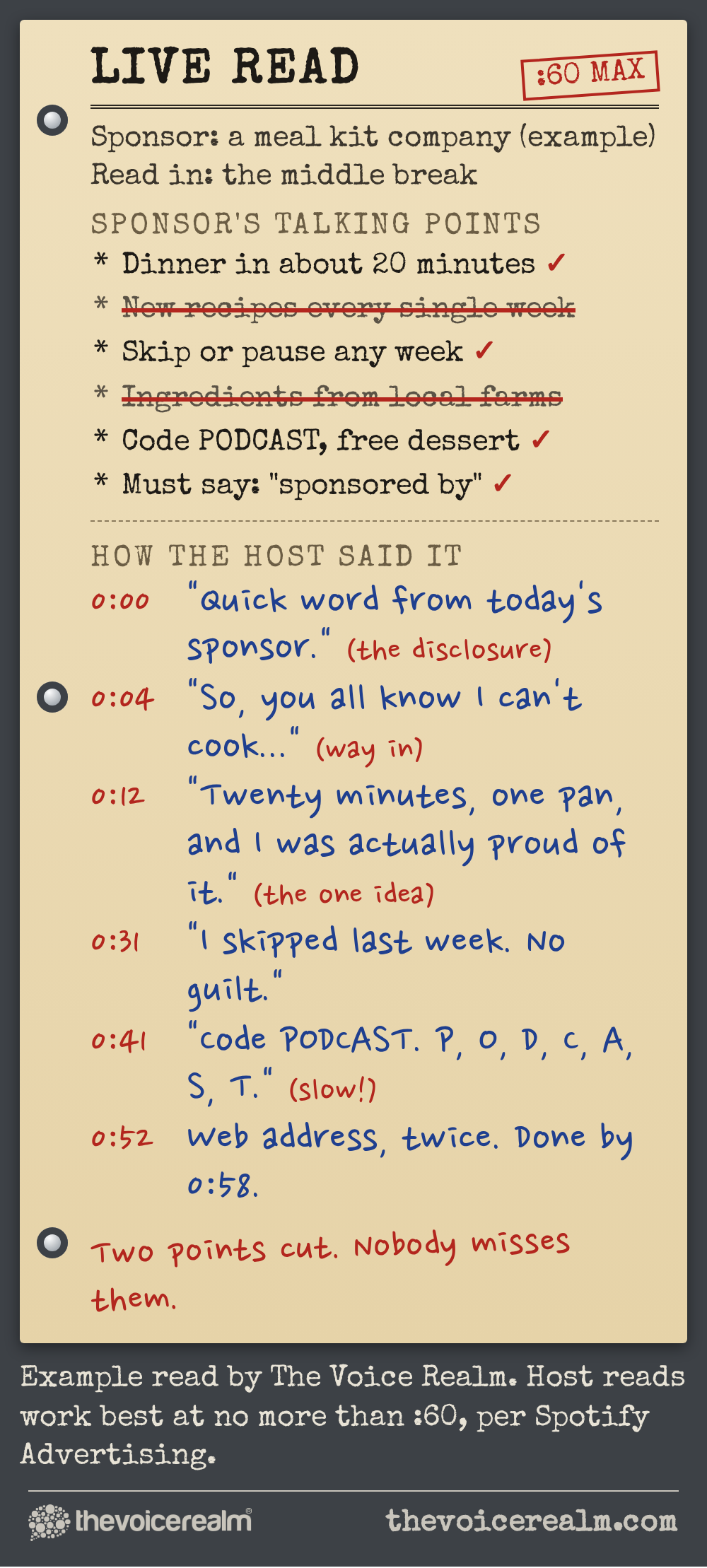
For host reads, many sponsors don’t send a script at all. They send talking points: the brand, the one thing they want the listener to remember, a promo code, a web address and a list of things you must and mustn’t say. The rest is up to you.
That freedom scares a lot of voice actors, because we’re trained to serve the page. Here’s a simple way in. Read the talking points once, then put them face down and tell the room what the product is and why someone might want it, in your own words, out loud. Record that. It’ll be rambling, but somewhere in it is a sentence that sounds like you. Keep that sentence.
Then build the read in three parts. A way in that connects to the show or to your day. The one idea the sponsor cares about, said once and clearly. And the call to action, said slowly enough that someone driving can remember it. Everything else on the talking points is optional, and a good read usually leaves half of it out.
 VOICEMASTERACADEMYTwenty modules, one at a time.Breath controlHome studioCommercial techniqueAuditionsStart module oneNo experience needed.
Time it. If the sponsor’s brief says sixty seconds, a host read that runs ninety is a host read that annoys the producer. Mark the promo code and the web address, because those are the two things the sponsor will listen for when they check the episode.
© The Voice Realm
Announcer reads: thirty seconds in someone else’s show
When you’re voicing an announcer read, the copy usually arrives written. It still needs the podcast touch, and Spotify’s guide gives a structure worth knowing, because a good script follows it and a weak one will need help in the session.
It starts with an announcement. “Always start by announcing your ad to avoid confusing the listener,” the guide says. A listener deep in a story needs a beat to realise the voice has changed and this is a sponsor. Your first line should sound like a friendly hand on the shoulder, not a siren.
Then comes the message, which the guide puts at “4-5 sentences delivering your core message,” and finally the call to action, which it says should be “delivered clearly and hits with a punch.” In a podcast read, punch means the last line is the clearest, slowest and most certain thing you say.
There’s a tip in there for writers that helps the reader too: “Try to anticipate when the voice actor will take breaths.” If the copy is a single long sentence with no place to breathe, flag it politely in the session, offer a version with a natural break, and record both.
Because an announcer read may sit in a comedy show at 7am and a horror podcast at midnight, ask the client where it’s running. If it’s going everywhere, aim for the middle: relaxed, warm, unhurried. If they want alternates, record a brighter take and a softer one.
Say it out loud, then make it true
Podcast ads have one wrinkle that radio spots mostly don’t. Host reads are full of the first person. “I’ve been using this for a month.” “My partner and I love it.” When those words come out of your mouth, they’re an endorsement, and in the US the Federal Trade Commission has rules about that.
The FTC’s guidance on its Endorsement Guides says “An endorsement must reflect the honest opinion of the endorser.” It’s equally clear that a paid relationship has to be disclosed in the same way the claim is made: “If the representation is made audibly, the disclosure should be made at least audibly.” In practice that’s why reads start with “this episode is sponsored by” or “a word from our sponsor.”
So if you’re hosting and you haven’t tried the product, ask the sponsor to send it, or rewrite the line to something true, like “they sent me the details and here’s what caught my eye.” If you’re the hired voice on a scripted announcer read, the first person is usually avoided for exactly this reason. If a script has you claiming a personal experience you’ve never had, ask the client about it before you record. A good producer will thank you. These are US rules; other countries have their own advertising codes, so if the ad runs elsewhere, the client should know what applies there.

© The Voice Realm
Recording a podcast ad at home
The technical side is simpler than a broadcast spot, but a few habits will save you a second session.
- Ask for the show’s sound. A link to one episode tells you more about the tone than any brief. Listen to the host’s energy, then sit just under it.
- Record dry. The producer will match your read to the show. Clean, unprocessed audio in the format they ask for is the safe delivery.
- Give them choices. Two or three takes of the opening line and the call to action cost you a minute and often save a pickup session.
- Read the code and address like a phone number. Clear, separate, a touch slower. Spell anything a listener could get wrong.
- Check the usage. Ask how long the ad will run, and across how many shows. A read that lives in one episode isn’t the same job as one inserted into every show on a network for a year.
“The listener has a very good ear for the moment a person turns into a salesperson. Your job is to never let them hear that moment.”
The Voice RealmPost this quote
On that last point, podcast ads are advertising, and usage matters as much as it does on radio. If you’re pricing one, our guide to quoting a voice over job walks through the questions to ask.
Where podcast ad work comes from
Podcast reads come through the same doors as other commercial work: production companies that make the ads, the networks and shows themselves, and brands with their own branded podcasts who want a voice they can use across episodes. They also show up on our voice over jobs board, often described as a “conversational sponsor read” or “host style” ad.
If you want to be hired for them, put a podcast style read on your commercial demo. Keep it short, keep it real, and make it sound like it was recorded for a show rather than for a TV break. A producer who hears ten seconds of you sounding like a trusted friend will picture you in their show straight away.
Then the next time a host says “this episode is brought to you by,” listen to how they do it. The best ones make you forget you’re hearing an ad at all. That’s the bar, and it’s a lovely one to aim for.
Sources: Spotify Advertising, “Hitting the sweet spot with podcast ads”; IAB, “Nearly Two-Thirds of Podcast Listeners Are More Inclined to Consider Purchasing Products and Services They Learn About During Podcasts”; Radio Ink, “Nielsen: Host Read Ads in Podcasts Work”; Barrett Media, “Digital Audio Ad Spending Hits $8.4 Billion in 2025, New IAB Data Shows”; Federal Trade Commission, “FTC’s Endorsement Guides: What People Are Asking”.
Ready to get booked?
See the jobs open right nowAbout Sarah Robbins
Sarah Robbins writes for The Voice Realm about finding voice over work, home studios, casting and the business side of voice acting.