Blog
Blog

The email is short. “Hi, love your voice, how much would you charge for this?” There’s a script attached, or sometimes not even that. You want the job, you don’t want to scare them off, and you also don’t want to find out next month that your voice is running on national radio for the price of a training video.
This guide is for freelance voice actors who get asked for prices directly, whether you’re quoting your first private client or tidying up a habit of guessing. It walks through the questions to ask before you name a number, how to pick the right way to charge for each kind of job, what a written quote should say, and how to handle the reply when the client says it’s more than they expected.
There’s no single price for a voice over
The first thing new voice actors want is a number they can send to everyone. It doesn’t exist, because the same thirty seconds of your voice can be worth wildly different amounts depending on where it ends up.
The Global Voice Acting Academy, which publishes a free rate guide for voice actors, puts it this way: “Voiceover is not a flat per hour or per allotment service model.” Its example is easy to picture. A national TV commercial for a big sports brand, it says, “is going to be different than a 3-minute internal corporate narration for that same brand.” Same voice, same studio, same morning. Completely different job.
So a quote isn’t a price list. It’s a short piece of detective work, followed by a sentence or two of maths, followed by a clear written offer.

© The Voice Realm
Ask before you answer
Before you send a number, you need to know what you’re pricing. Reply quickly and warmly, and ask what you don’t yet know. Most clients are happy to answer, and asking makes you look like someone who’s done this before.
You want to know what the piece is and who it’s for, so you know the genre. You need the script, or at least the word count, because length drives the work. Ask where it will be heard, in which countries or regions, and for how long, because that’s usage, and usage is usually where the real difference in price lives. Ask when they need it and in what file format. And ask whether anyone will direct you live or whether you’ll record on your own and send files.
If there will be a live directed session, ask roughly how long they expect it to run and who’ll be on the call. An hour with a producer, a client and a writer listening in is a different morning from recording alone and sending files at lunchtime, and your quote should reflect that.
If the script isn’t final, say you’ll quote on the current draft and that a much longer final version would need a fresh quote. That one sentence saves a lot of awkward emails later.

© The Voice Realm
Usage is the part that changes everything
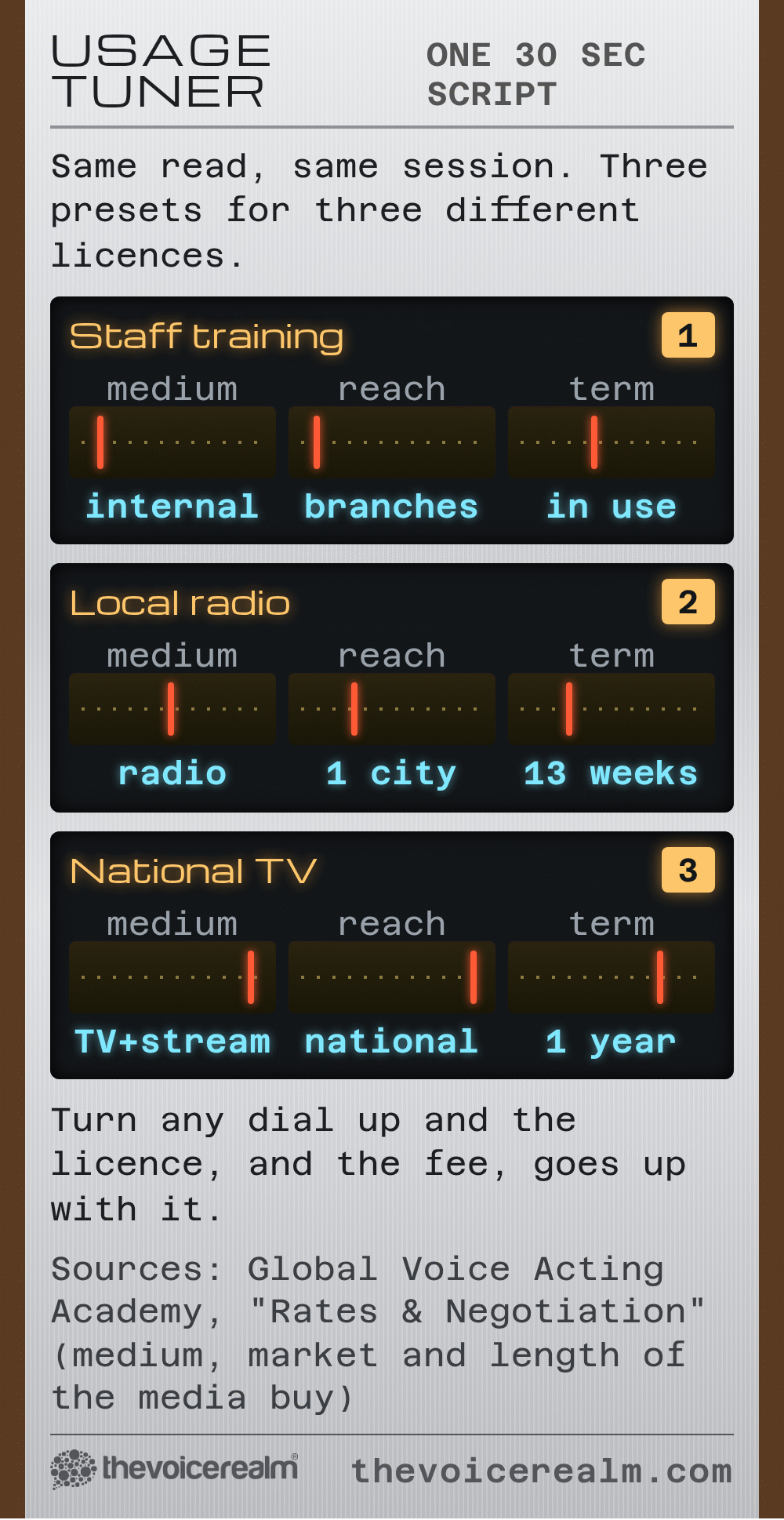
Usage is the licence the client is buying to use your recording. GVAA describes it as “the term a voice actor’s work is licensed for a particular project,” and it lists three things that decide it: the types of broadcast medium in the media buy, the market or reach (“National, Regional, or Local”), and the length of the buy (“1 year, 6 months, 13 weeks”).
Think of it as three dials. Move any one of them up and the value of the job goes up with it, even though the recording itself takes you the same twenty minutes.
Our longer guide to who owns your voice after the session goes deeper into licences and buyouts. For quoting, the key habit is simple: never send a number until you know where the recording will run and for how long. If the client honestly doesn’t know yet, quote for the use you’ve discussed and say plainly that anything wider is priced separately.
© The Voice Realm
Same thirty seconds, three very different jobs
The tuner above shows how far apart three versions of one script can sit. Your recording session is almost identical for all of them. What changes is how many people will hear you, where, and for how long, and with it the client’s budget and your price. GVAA also warns about deals that never end, telling voice actors to learn “why ‘in-perpetuity’ or unlimited use can be dangerous for your career.” Once your voice is tied to a brand forever, you may not be able to voice that brand’s competitor later, and you’ve been paid once for a lifetime of use.
Pick the way of charging that fits the genre
Different kinds of voice work are priced in different units, and using the wrong unit is the fastest way to undercharge. GVAA lists the common ones: a session fee plus a usage buyout, “Most commonly used in the Commercial genre”; time in session per hour, common with video games, toys and character work; a time basis for corporate, internal and medical narration and explainers; per finished minute, “based on the finished (edited) run time of the project”; and per word, “based on the total number of words in the project.” Audiobooks, it notes, are paid per finished hour.
 VOICEMASTERACADEMYLearn the craft in order.Module one is freeStart module oneTwenty modules, start to finish.
The unit matters because it tells the client what they’re paying for. A per word quote on a long e-learning course keeps the maths honest as the script grows. A session plus usage quote on an advert keeps the licence visible, so nobody quietly turns a local spot into a national one. If you’re estimating finished minutes from a word count, our guide to timing a script by its words gives you a reliable starting point.
Finding your number
Published rate guides are a useful sense check, especially early on. GVAA is careful to say its guide “reflects ranges observed in the market and is not an attempt to set, fix, or standardize industry pricing,” and adds a line worth remembering: “You alone decide what you charge.”
“Negotiating should never be a battle or a tug of war, but rather a spirited dialogue of ideas, expectations, and goals.”
Global Voice Acting Academy, Rates & NegotiationPost this quote
Start with the guides, then make the number yours. Think about how long the job will really take you, including prep, recording, editing, pickups and admin, not just the minutes on the timeline. Work out the lowest fee you’d be glad to accept for that time, and treat it as a floor you don’t go under. Then add the usage on top, because the licence is a separate thing from your hours.
If you’d like a second opinion before you hit send, the free Rate Calculator in Voice Edit Suite walks through the job type and usage and gives you a range to compare with what you were about to quote.
What goes in the written quote
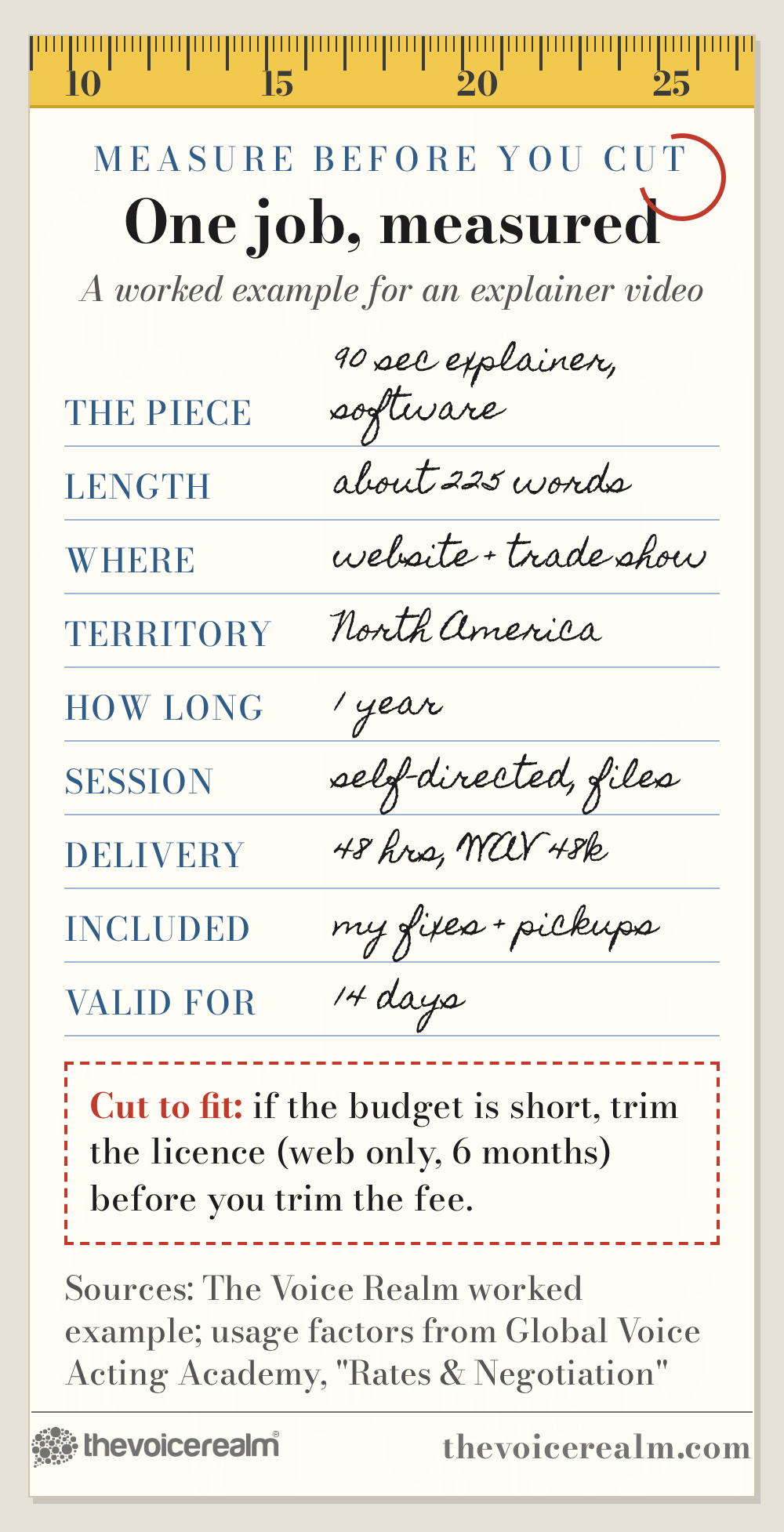
A good quote is short, specific and impossible to misread. It repeats back what you understood about the job, so any mistake shows up before you’ve recorded a word. It should say what the piece is, the word count or length you quoted on, the usage (media, territory and term), what’s included, when you’ll deliver, the file format, your fee, and how long the quote stays open.
Include your revision policy in plain words. A common approach is to include a round of fixes for their own mistakes and pickups at no charge, and charge for changes to the script or a new direction after the session. Say which is which. If you’re unsure where to draw that line, the free Revision Checker helps you sort a client’s change requests into fixes and new work.
Finish with your payment terms and how you’ll invoice. When the job’s done, our guide to what belongs on a voice over invoice picks up where the quote leaves off, and if the quote was clear, the invoice almost writes itself.
© The Voice Realm
When they say it’s more than they expected
It happens, and it’s not a disaster. Often the client has no idea what voice over costs and is genuinely surprised. Sometimes they’ve got a fixed budget they can’t move. Either way, the worst response is to drop your price straight away. It tells them your first number wasn’t real.
Change the job, not your value. If the budget’s smaller, offer a smaller licence: one region instead of national, six months instead of a year, web only instead of broadcast. Offer fewer versions, or a shorter edit. GVAA makes the point that taking less than you’re worth sets a precedent, warning that “you’ll be setting an unsustainable precedent for future work and limiting your earning potential.” A client who paid a fair fee once will expect the same next time, and so will the people they recommend you to.
And sometimes the right answer is a friendly no. Thank them, leave the door open, and spend that time on auditions from the voice over jobs board instead.

© The Voice Realm
Speed and tone win more jobs than a low price
Clients asking for quotes are often asking several people at once. The one who replies the same day, asks two sharp questions and sends a clear, friendly quote looks easier to work with than the cheapest name on the list. That’s usually who gets the job.
Keep a quote template ready with your usual wording, your revision policy and your payment terms, so a reply takes ten minutes rather than an evening. Save every quote you send, with the result. After a few months you’ll see which kinds of jobs say yes, which say no, and where your numbers sit. That record is worth more than any rate chart, because it’s built from your own clients.
Sources: Global Voice Acting Academy, “Rates & Negotiation”; Global Voice Acting Academy, “GVAA Rate Guide”.
Ready to get booked?
See the jobs open right nowAbout Sarah Robbins
Sarah Robbins writes for The Voice Realm about finding voice over work, home studios, casting and the business side of voice acting.