Blog

If you clear your throat before every take, after every long sentence and again when the session’s over, this one’s for you. It’s a habit most voice actors don’t notice until someone points it out, and it costs more than the half second it takes. Here’s what all that throat clearing does to your vocal folds, what the research really says about the alternatives, and how to break the habit without spending a session distracted by it.
Why one little ahem adds up
When you clear your throat, your vocal folds come together hard and fast, with a burst of air pushed through them. Once in a while, that’s nothing. Dozens of times a day, every day, it’s a lot of hard contact for two small bands of tissue that already do a full shift when you record.
A patient handout on throat clearing from the University of Calgary’s Cumming School of Medicine puts it bluntly: “It’s rather like smacking them together with too much force.” It goes on to say that doing it often, over a long stretch, “can injure the vocal folds and this will in all likelihood impair the quality of the voice,” with a hoarse or breathy sound as a likely result.
That matters more to you than to most people. Your voice is the product. A slightly rough edge that a teacher or a call centre worker would shrug off is the thing a client hears on your audition, and it’s the thing you’ll be trying to EQ out of an audiobook chapter at midnight.
There’s a sound problem too. A throat clear right before a take sets up a hard, slightly pressed onset on your first word. You’ve just slammed the folds together, so the next thing you say tends to start with a little click or a push. Listen back to a few of your own takes and you may hear it.
The loop that keeps you clearing
The frustrating part is that clearing feels like it works. You clear, the tickle goes, your voice sounds fine for a moment. Then it’s back.
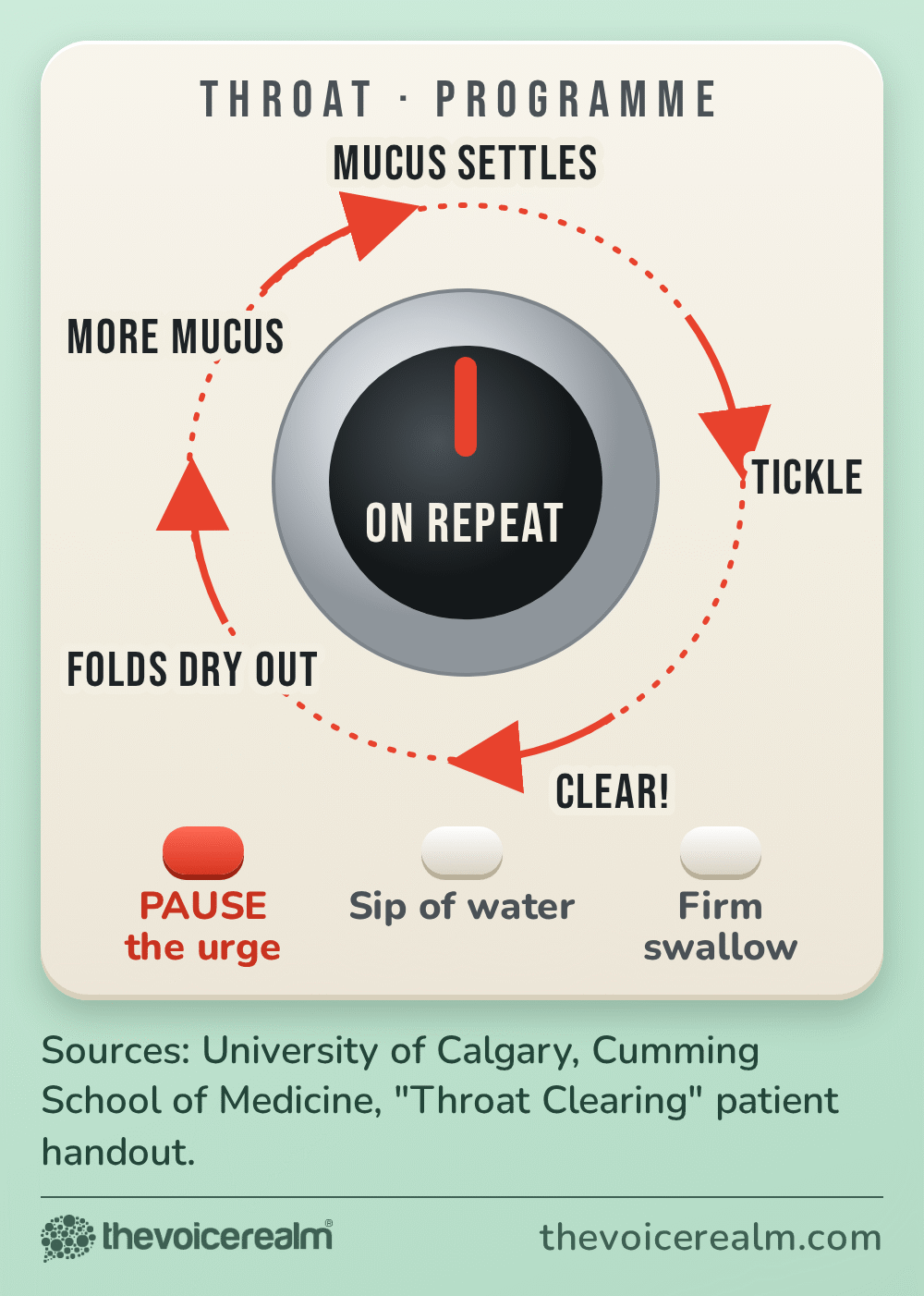
The Calgary handout explains why: “Frequent throat clearing is a self-destructive, repetitive cycle.” The relief is real but short, and the clear itself helps set up the next urge. That’s why people who clear a lot tend to clear more over time, not less. The dial below shows how the loop turns, and the three places you can step in and stop it.
Knowing it’s a loop is useful in itself. It means the goal isn’t to win every single urge. It’s to break the cycle often enough that the urges come less often, and that takes a few weeks, not a few hours.
© The Voice Realm
What the research actually found
Here’s where it gets more honest than most vocal health advice. Voice clinics have taught “kinder” alternatives to throat clearing for years: a sip of water, a firm swallow, a silent cough, a soft clear. But until fairly recently, nobody had properly tested whether those alternatives did what they were supposed to do.
Heather Bonilha and her colleagues, then at the Medical University of South Carolina, looked at it in two studies published in the Journal of Voice. They filmed the vocal folds of people with and without voice problems before and after six different clearing behaviours.
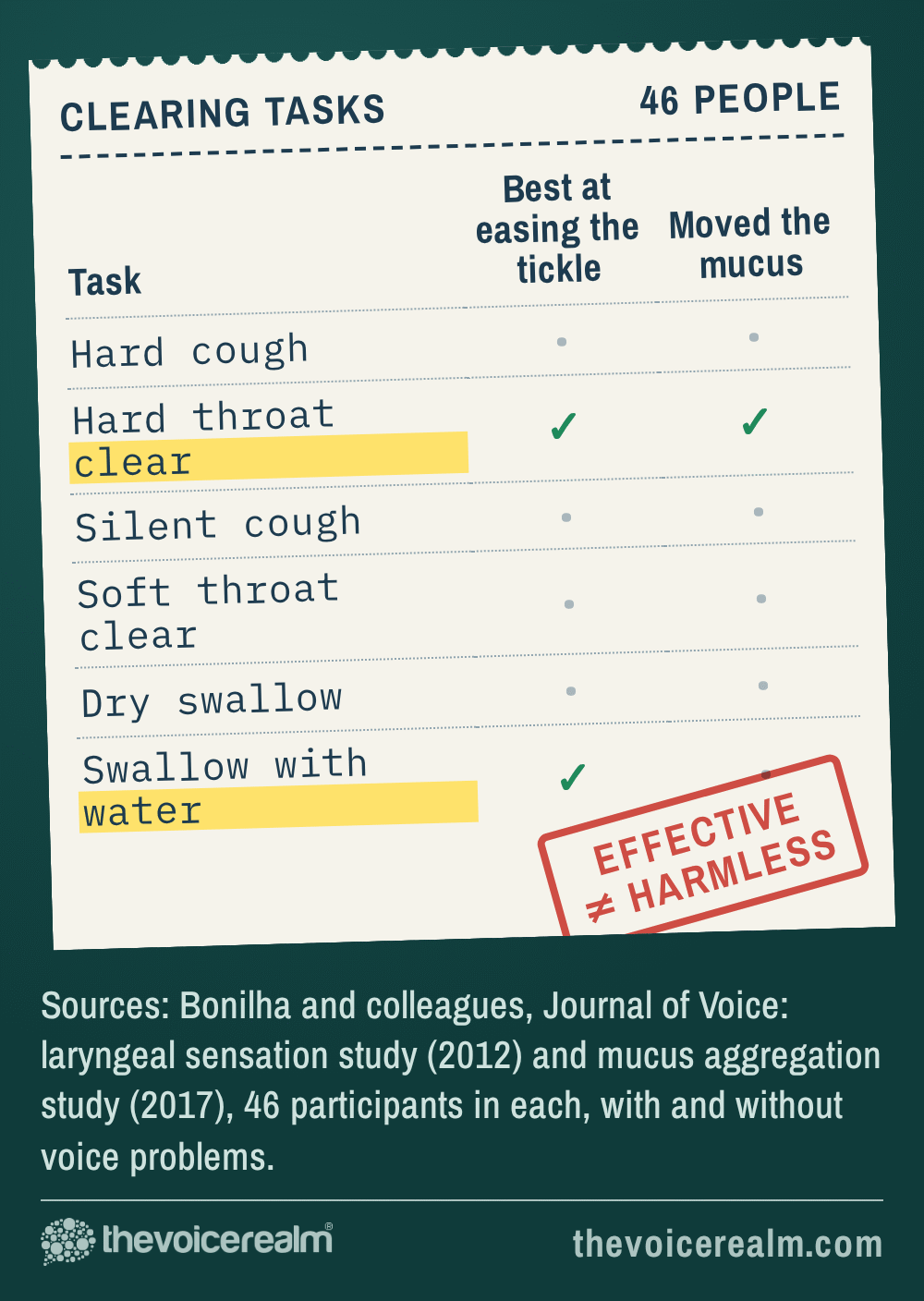
The first study, from 2012, asked people how their throat felt. “Hard throat clear and swallow with water were the most effective techniques in removing laryngeal sensation,” the authors wrote. In other words, a sip and a swallow got rid of that “something’s there” feeling about as well as a full clear did. The team called it “initial evidence” for the common clinic advice of swallowing a sip of water in place of clearing.
The second study, from 2017, looked at what was actually sitting on the folds. This time the result went the other way: “only hard throat clearing changed vocal fold mucus aggregation.” The gentler options eased the feeling but didn’t shift the mucus on camera. The authors were careful to say the finding needs a larger study before anyone rewrites the rulebook.
So what do you do with that? Put simply, a hard clear works, it just isn’t free. Most of the time, the urge you feel is the tickle, not a real blob of mucus blocking your sound, and the tickle responds to a sip and a swallow. Save the occasional deliberate clear for when there genuinely is something there that’s changing your voice, and stop doing it on autopilot.
© The Voice Realm
Count it before you change it
You can’t cut back on something you don’t notice. Most habitual clearers are amazed by how often they do it once they start counting.
The University of Mississippi Medical Center’s vocal hygiene handout suggests you “make someone the ‘Throat Clearing Police’ to increase your AWARENESS of the behavior.” A partner, a housemate or a director you trust works well. So does your own recording software: scroll through a raw session file and count the clears between takes. You’ll see them as little spikes in the waveform.
For a few days, keep a tally. A cheap hand clicker, a note on your phone or a pencil mark on your script will do. Note when it happens: first thing in the morning, after meals, when you’re nervous before an audition, during long reads. Patterns tell you a lot about the cause, which we’ll come to.

© The Voice Realm
Swap the reflex for something kinder
Once you’re catching yourself, you need something to do instead, because “just don’t” doesn’t work against an itch. The Calgary handout lays out three steps to try in order, each time the urge arrives.
First, simply take a normal sip of water, and don’t clear afterwards. If the urge is still there, move to a firm swallow: the handout’s version is to hold a small sip of water in your mouth, lower your chin slightly and “imagine that you are trying to swallow a pea or a small candy all in one go.” The Mississippi handout gives the same idea in fewer words: “Take a sip of water with your chin down to chest and swallow hard.”
 VOICEMASTERACADEMYFirst read to first booking.Twenty modules. The first one is free.Start free
If that still doesn’t settle it, the third step is a breathy “dry cough”: take a decent breath and blow it out firmly on an “h” sound, like the start of “how,” keeping the throat open and relaxed rather than clamping down. Then take a small sip of water straight after, because it’s drying.
Ahem, on autopilot
Folds slam together, the tickle goes for a minute, the dryness brings it back, and your next line starts with a push.
Sip, then swallow
Eases the feeling almost as well in the research, with far less hard contact. Keep the real clear for when something’s truly there.
One practical note from the Calgary handout: you can’t do more than a few dry swallows in a row, so do these with a little water in your mouth rather than swallowing on nothing. That’s one more reason the water bottle lives within arm’s reach.
Between takes in the booth
Voice actors have a specific problem: we clear most when we’re about to record, because we want the first word to be clean. Here’s how to get the clean first word without the clear.
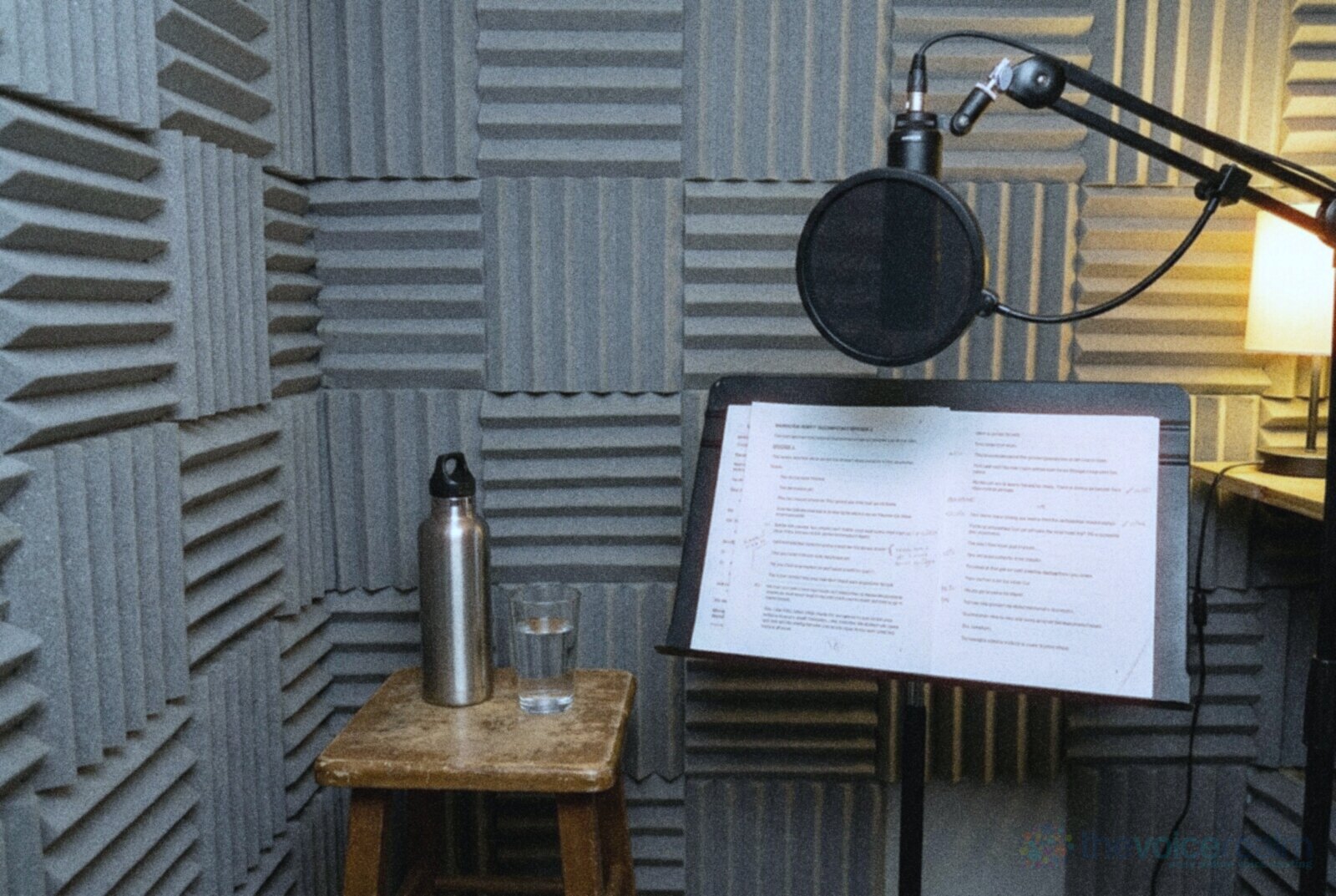
Keep room temperature water on a stool or shelf right beside you, where you can reach it without moving the mic. Take a small sip before a take, swallow, breathe, then speak. If you feel a catch mid-paragraph, stop, sip, swallow, and pick up from the start of the sentence. Your editor, or you wearing your editor’s hat, would far rather cut out a swallow and a pause than a throat clear with the whole room in it.
A gentle hum before you start also helps. A soft “mm” at a comfortable pitch tells you whether the voice is clear without banging the folds together. If the hum sounds clean, so will the take.
And if a clear slips out during a take, don’t fight it on the recording. Stop, have your sip, and go again. One retake is cheaper than a session full of nervous clears.
© The Voice Realm
Find out what’s making the mucus
Throat clearing is often a symptom of something else. If you only work on the habit, you’re fighting the urge without touching what’s causing it.
Silent reflux is a common culprit, especially if your clearing is worst in the morning or after meals. Stomach contents irritate the throat without the classic heartburn, and the body answers with mucus. If that sounds familiar, our piece on reflux that never feels like heartburn covers what to watch for and when to ask a doctor.
Allergies and post-nasal drip are the other big one. If the clearing comes in seasons, or gets worse after a dusty day in the spare room, read up on allergy season and your voice.
Then there’s plain dryness. Thick, sticky mucus is often just under-hydrated mucus, and the Calgary handout notes that drinking plenty of water “can help to thin the mucus.” It also suggests some people try cutting back on dairy to see if it makes a difference. We’ve gone into what water can and can’t do in our guide to hydration and the dry mouth.
Look back at your tally. Morning clearing points one way, clearing after the dog’s been on the couch points another, and clearing only before auditions points to nerves. That last one is pure habit, and the swaps above are exactly the fix.
When to get your throat looked at
Most habitual clearing is just that, a habit. But some of it isn’t, and you shouldn’t try to swap your way past something that needs a doctor.
Book an appointment if you’ve cut back on clearing, sorted the obvious causes, and still feel a constant lump or catch, or if your voice stays hoarse or changed and doesn’t come back. Our piece on the callus a voice actor can’t see sets out how long health services say to wait before booking. Ask about being referred to an ear, nose and throat specialist, ideally one who works with voice, or a speech and language therapist who specialises in voice. They can look at your vocal folds directly, which is the only way to know what’s really going on.
Tell them what you do for a living. A voice clinic will treat a professional voice user differently, and they’ll understand why a small change matters so much to you.

© The Voice Realm
Quiet habits, clean takes
The fix for throat clearing isn’t dramatic. Notice it, swap it for a sip and a swallow, keep the real clear for real problems, and go after whatever’s making the mucus in the first place. Give it a few weeks. Most people find the urge fades faster than they expected once the loop is broken.
Your recordings will thank you, too. Fewer clears means fewer pressed first words and fewer clicks to edit out. That’s less time at the editing desk and more time in front of the mic.
Sources: University of Calgary, Cumming School of Medicine, “Throat Clearing” (patient handout); University of Mississippi Medical Center, “Vocal Hygiene”; Bonilha HS and colleagues, “Laryngeal sensation before and after clearing behaviors”, Journal of Voice, 2012; Bonilha HS and colleagues, “Efficacy of Six Tasks to Clear Laryngeal Mucus Aggregation”, Journal of Voice, 2017.
Ready to get booked?
See the jobs open right nowAbout Sarah Robbins
Sarah Robbins writes for The Voice Realm about finding voice over work, home studios, casting and the business side of voice acting.