Blog
Somewhere tonight a Hancock repeat is playing to someone who can’t sleep. A 1980s thriller is keeping a lorry driver company on the M6. A cast of actors, many of them long retired, are earning a little money from work they did decades ago. From spring 2027, a lot of that stops.
On 20 October the BBC confirmed that Radio 4 Extra will close as a broadcast service, along with the linear channels of BBC Three and BBC Scotland. Listeners are furious, comedians are signing petitions, and the actors’ union Equity has put its finger on the part most coverage skipped: repeats are how audio performers get paid twice. Here’s what was announced, why it matters to anyone who earns a living from their voice, and what British voiceover artists can take from it.
What the BBC announced
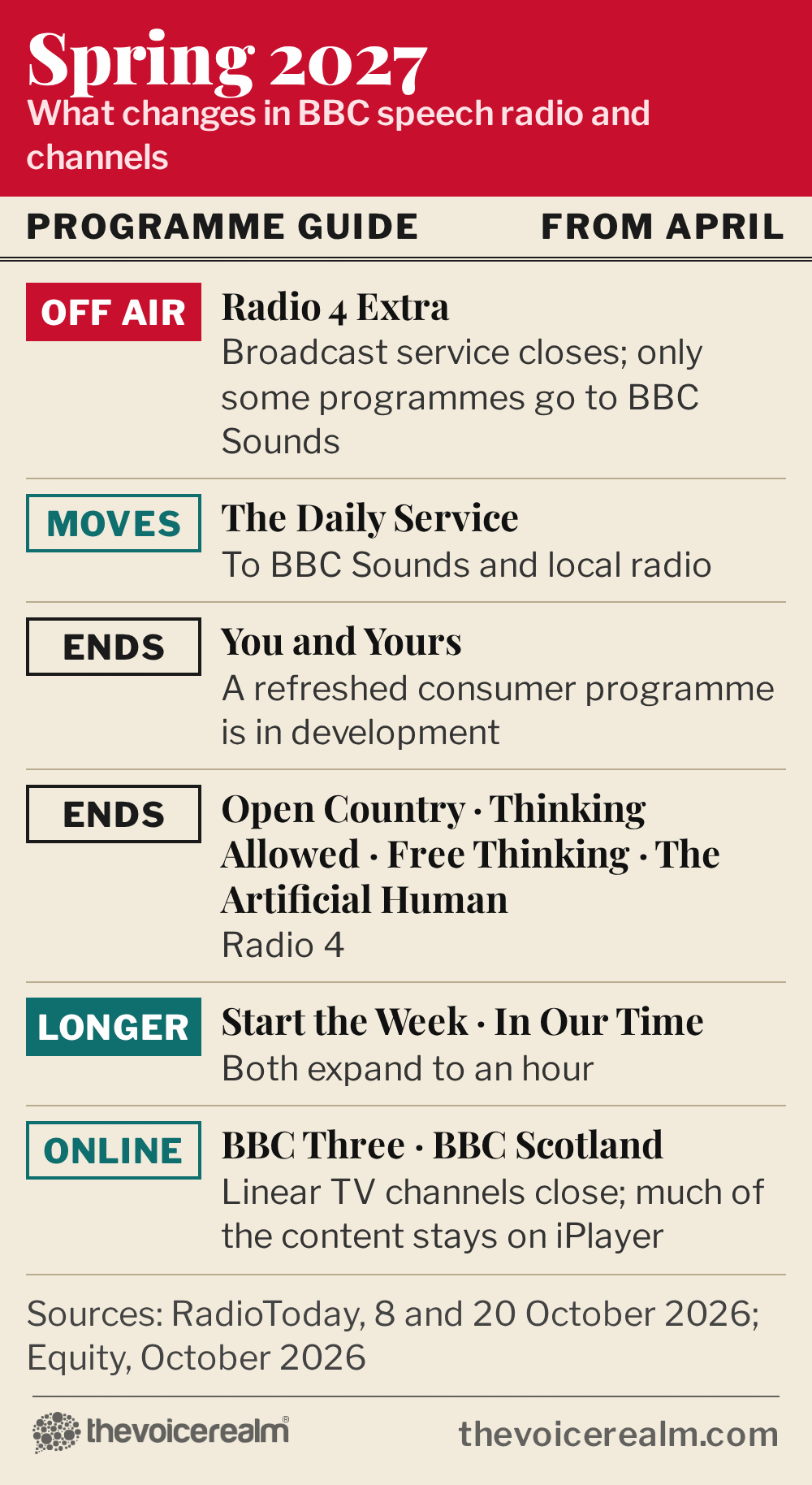
The closures are part of a savings drive running to 2028. According to RadioToday, programmes currently broadcast on Radio 4 Extra “will continue to be available through BBC Sounds”, while The Daily Service moves to Sounds and local radio. In a note to staff, Director-General Matt Brittin was frank about the reason: “We all know that means tough choices.”
He added that much of the content “will still be found where audiences already enjoy it on iPlayer and Sounds”, and that “I recognise the confirmation of this news will be hard for audiences and colleagues.”
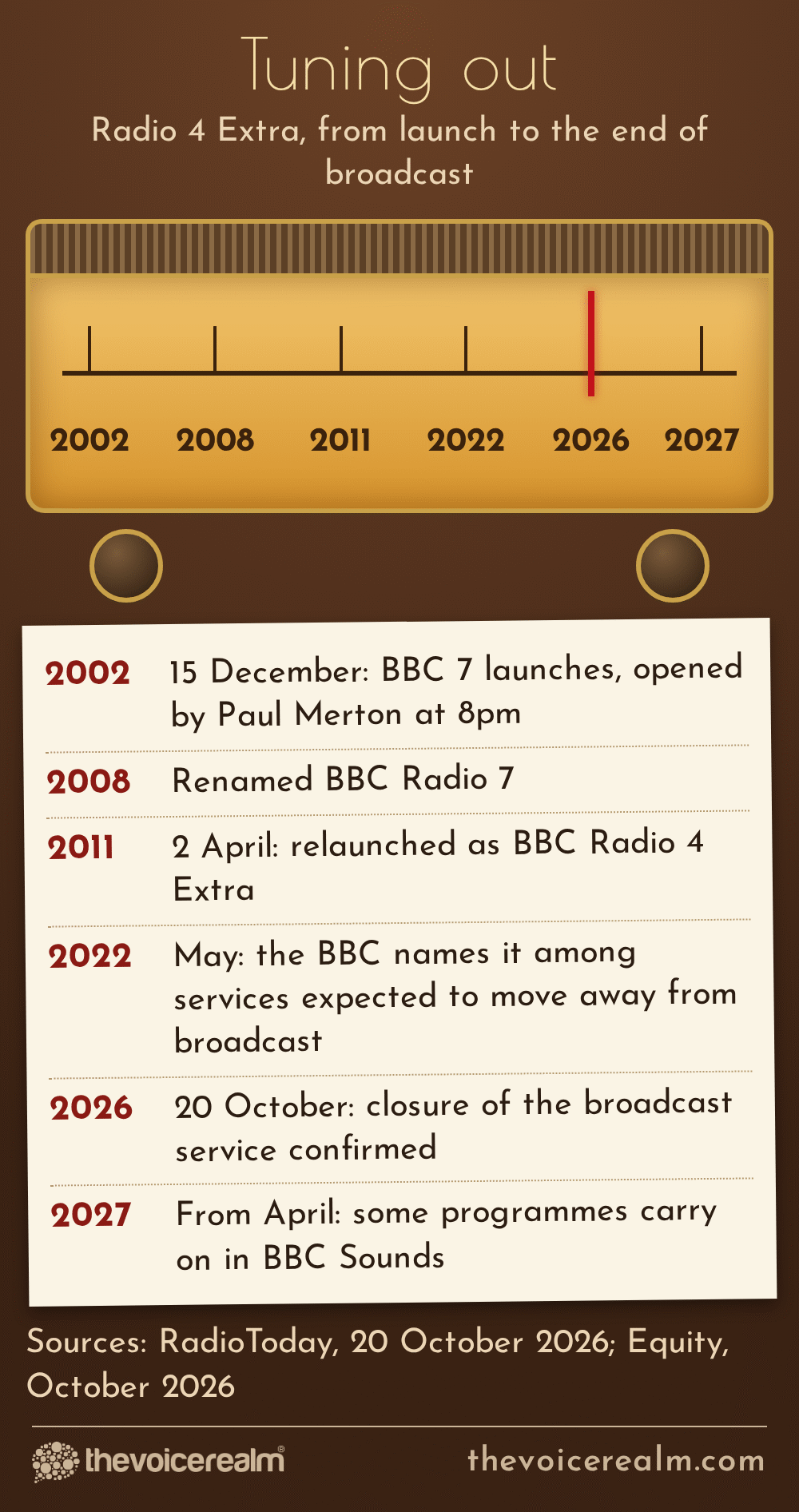
The station’s story is a long one, from its start as BBC 7 to its relaunch under the Radio 4 Extra name, and the BBC first flagged a move away from broadcast back in 2022. So the news isn’t a total surprise. What’s new is the date, and the detail that only part of the archive is promised a home online.
© The Voice Realm
Why a repeat is a pay day
If you’ve only ever done commercial voiceover, you might think of a job as a single fee and a usage period. Broadcast drama and comedy work differently. Under union agreements, performers are paid when the programme is first made and again when it’s repeated. A comedy series recorded in 1995 can earn its cast a small payment every time it goes out again. For older actors, those cheques are a genuine part of their income. For their estates, they’re a living link to the work.
That’s the point Equity made the day the closure was announced. “The loss of Radio 4 Extra in its current format will be a significant blow to the income of audio artists,” a union spokesperson said. “The channel currently airs archival programmes and our members are paid for these repeats. But from April 2027, only some of Radio 4 Extra’s content will be available on BBC Sounds.”
The union’s conclusion follows from that: less of the archive on air means less income for audio artists, and less scripted audio from the BBC overall.
A schedule that keeps the archive working
A curated channel plays archive comedy and drama round the clock, and Equity says members are paid for those repeats. Programmes find listeners who never went looking for them.
A shelf you have to know about
Only some of the content is promised a place on BBC Sounds. A programme that isn’t there can’t be repeated, and one that is there waits for someone to search for it.
Equity was calmer about the television side, saying it has agreements covering usage rights and fees across both online and linear channels for BBC Three and BBC Scotland. It did raise one new worry: some BBC Three content is to be made specifically for YouTube. In the union’s words, “it is currently unclear how secondary payments will function for work that airs initially on linear broadcast or iPlayer, then is repeated on YouTube.”
That sentence matters well beyond the BBC. Every time a piece of voice work moves to a new kind of platform, the question of who gets paid when it’s played again has to be answered all over again. It’s the same argument we’ve had for years about buyouts and residuals in commercial work, just with older programmes and bigger stakes.
© The Voice Realm
A channel, not a catalogue
The BBC’s case is that the programmes aren’t vanishing, they’re moving to an app. The people who make and present them don’t think that’s the same thing.
Toby Hadoke, who presents the station’s science fiction and horror block The 7th Dimension, told Chortle: “I’m just very sad. 4 Extra is not just a rerun channel, it is a lovingly curated repository of broadcasting gems.” He argued that an on demand app “strips away the unique bit that a public service broadcaster can provide”, namely “the listener not knowing what’s coming on next, but being prepared to be surprised by it.”
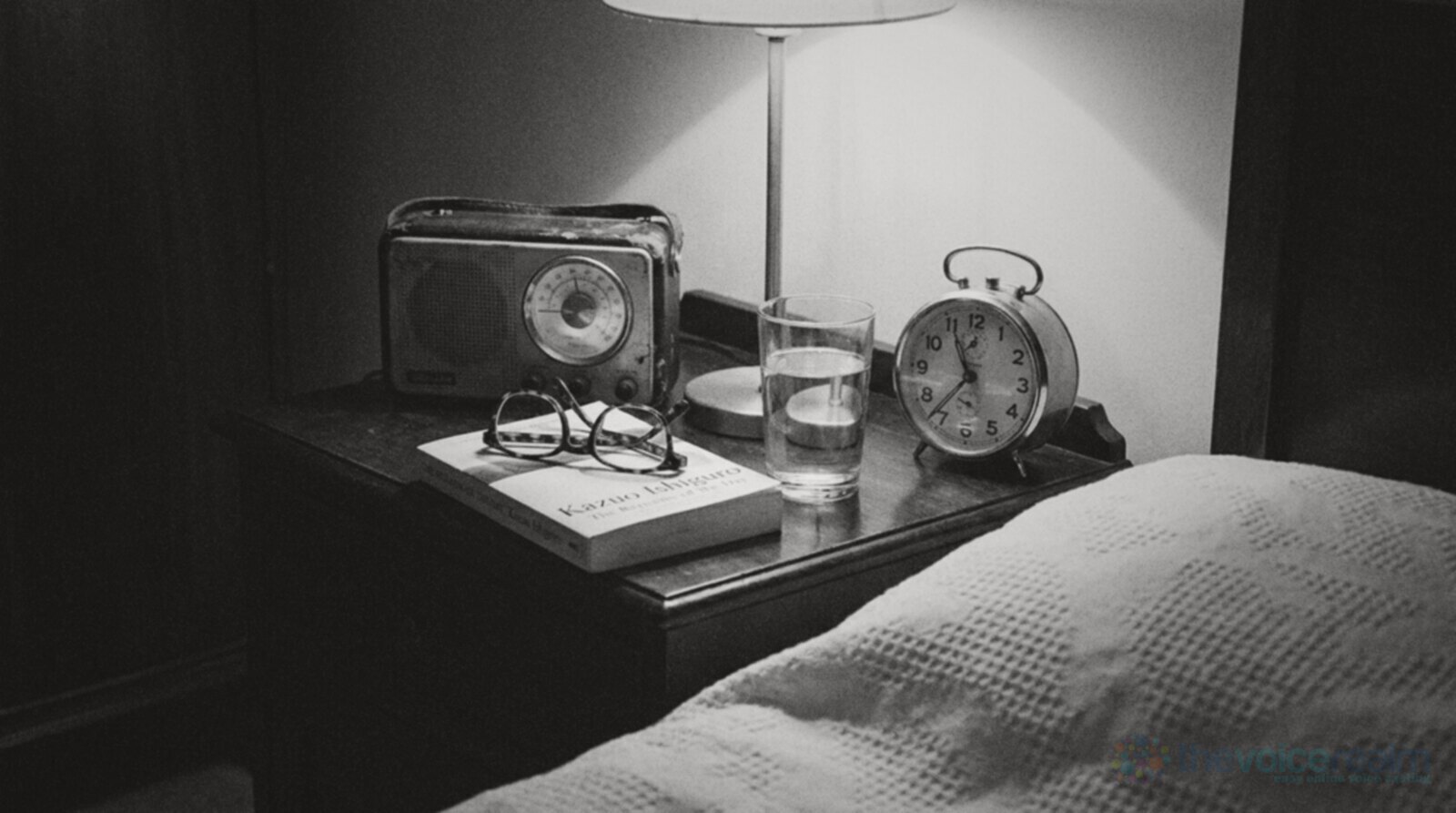
Director Bert Coules, whose radio credits include Cadfael and Rebus, said the BBC’s argument “completely ignores the section of the public which for a variety of reasons doesn’t have access to online services.” He also put it more simply: “For many, Radio 4 Extra is a continuous day and sometimes night-time companion, a true friend.”
We’d add one thing from a performer’s point of view. Discovery is income. A listener who stumbles on an old Rebus adaptation at midnight might go looking for the books, the audiobooks, or the actors’ other work. Crime fiction set in Scotland’s capital is a natural fit for Edinburgh voiceover artists, and a radio adaptation is often where a listener first hears a story in the accent it was written for. Take away the channel that hands people things they didn’t know they wanted, and fewer of those journeys begin.
 VOICEMASTERACADEMYFirst read to first booking.Twenty modules. The first one is free.Start free
There’s a voice job inside the station too, and it’s easy to miss. Wes Butters, the former Radio 1 DJ who works as a continuity announcer on the station, said: “If Radio 4 Extra with its carefully curated archive isn’t the epitome of public service broadcasting, well, I don’t know what is.” Continuity is a real craft: setting up a 1950s comedy for a 2026 listener in twenty seconds, with warmth and without a script that sounds like a script. An app doesn’t need a continuity announcer.
© The Voice Realm
The bigger squeeze on BBC speech radio
Radio 4 Extra isn’t happening in isolation. Earlier in October, BBC Speech and Sounds said it would cut its budget by at least 10 percent and close several long-running Radio 4 programmes from April 2027, with production roles affected. Jonathan Wall, the Director of BBC Sounds, said: “These are difficult decisions, and they are not based on cost alone.”
Put the two announcements together and spring 2027 looks like a real turning point for spoken word on the BBC. Some programmes end, some get longer, some move online, and the overall slate of podcasts on Sounds gets smaller to make room for new formats. For the people who write, produce, present and act in British audio, that adds up to fewer slots and fewer second chances for the work they’ve already made.
It also follows the row over the Archers studio in Birmingham, where the BBC dropped plans for a purpose built drama studio. Same budget, same pressure, and the same pattern: the cuts land on the work that’s hardest to see from the outside.
A campaign is fighting back. The team behind the comedy site Chortle has launched a petition to save the station, and writers and performers have lined up behind it. Richard Herring summed up the mood with a line that’s hard to argue with, describing the station as “surely the least expensive radio channel the BBC has, run by a tiny number of people, broadcasting the work of mainly dead people”.
© The Voice Realm
What it means if you work in voice
Most voiceover artists will never have a programme on Radio 4 Extra. The lessons still apply to everyone.
Read the repeat clause. Before you sign, know what happens when the work is played again. Is there a repeat fee, a secondary payment, a buyout, or nothing? Does it change if the work moves from broadcast to an app or to YouTube? If the contract doesn’t say, ask.
Keep a record of your broadcast credits. Title, broadcaster, date, contract. Repeat money is easy to miss if nobody knows a programme went out again, and the paperwork is much easier to chase when you kept it from day one.
Build income that doesn’t depend on one schedule. Long-form narration is the obvious partner to drama work. British publishers keep commissioning, and audiobook narrators with drama training tend to handle a full cast of characters with real confidence. Commercial reads, e-learning and corporate narration spread the risk further.
Join the union, or at least read what it says. Equity’s response landed on the day and spelt out exactly where members lose money. That’s the value of having someone reading the small print for the whole industry.
If you care, say so. The petition is open, and the BBC’s Charter is being renewed. Broadcasters do listen when the people who make the programmes and the people who hear them say the same thing at the same time.
© The Voice Realm
Our take
Here’s our read. The BBC has a real money problem, and nobody expects it to keep every channel forever. But Radio 4 Extra is one of the cheapest things the corporation does, built almost entirely on work it has already paid for, and it keeps that work earning for the people who made it. Closing it saves a little and costs audio performers more than the headlines suggest.
We’d love to see the BBC answer two plain questions before April. Which programmes are moving to Sounds, and which are going back on the shelf? And how will performers be paid when their work is played on demand, on YouTube or anywhere else the BBC decides to put it? Clear answers would take a lot of the sting out of this.
For brands and producers, there’s a lesson too. A great performance keeps its value for decades, and the voice that people love hearing again is worth paying again. Treat the artists on your projects that way and you’ll find they come back when you need them.
Sources: Equity, “BBC closures ‘a significant blow’ for audio artists”, October 2026; RadioToday, “BBC Radio 4 Extra to close as a broadcast service”, 20 October 2026; RadioToday, “Cuts announced for several BBC Radio 4 programmes”, 8 October 2026; John Freeman, downthetubes.net, “Campaign launched to save BBC Radio 4 Extra gathers momentum”, 22 October 2026.
Ready to get booked?
See the jobs open right nowAbout Sarah Robbins
Sarah Robbins writes for The Voice Realm about finding voice over work, home studios, casting and the business side of voice acting.