Blog

The alarm goes, you say “morning” to the cat, and what comes out sounds like a gravel truck reversing. Then a client books you for an 8 a.m. live session, or a time zone on the other side of the world wants pickups before your breakfast. This guide is for voice actors who need to sound like themselves early in the day. It covers what morning voice actually is, what the research does and doesn’t say about it, what to change the night before, and a first hour that gets you to the mic sounding awake.
What happens to your throat while you sleep
Your voice spends the night in poor conditions. Anthony Jahn, a New York ear, nose and throat doctor who has looked after opera singers for decades, sets it out in a column for Classical Singer magazine. While you sleep, the tiny hairs that move mucus along your airway slow down, you mostly stop swallowing, and mucus collects at the back of your throat instead of being cleared away.
That matters because your vocal folds don’t make their own lubrication. They rely on mucus from just above them, which normally gets squeezed down onto them every time you swallow. Fewer swallows, less moisture. As Jahn puts it: “It’s easy to see that as mucus production and swallowing slow down at night, the folds may get dry.”
Then there’s the air itself. You breathe all night, and if the bedroom is heated and dry, or your nose is blocked and you breathe through your mouth, the folds sit in that dry airflow for hours. Jahn notes that people who wake with a dry, uncomfortable throat are often mouth breathers who don’t know it.
Add anything from the night before, a loud bar, a late curry, a glass or two of wine, and you’ve got the recipe. In another column on the same subject, Jahn describes what he sees when he looks: “When I examine a singer’s larynx in the morning, even after a normal and uneventful concert, I commonly see some redness and mild swelling of the vocal folds.”
Is your voice really deeper in the morning?
This is the part most articles get wrong. The popular explanation is that your vocal folds soak up fluid overnight, get heavier, and so vibrate more slowly, which would make your voice lower. It’s a reasonable idea, and researchers have taken it seriously.
A team at the University of Iowa and the National Center for Voice and Speech tested it in 1999. Their paper starts from the same theory, that “the vocal folds may tend to be more fluid-laden upon awakening in the morning, as compared with later in the day.” Then they recorded the same group of young women at about seven in the morning and again in the evening. The result surprised them: the tests “failed to reveal any clear evidence of time-of-day effects” on the range of pitch and loudness the women could produce.
- Rougher, yes. Voices measure worse first thing, and doctors see mild swelling and dryness.
- Deeper, not proven. The heavier folds idea is popular, but a careful test didn’t find a clear difference.
- It wears off with use. Talking through the morning is linked to a better voice later.
- Some of it is the night before. Late food, alcohol and loud talking all show up at breakfast.
A larger study from the University of Utah, published in 2021 in the Journal of Speech, Language, and Hearing Research, followed healthy women three times a day for a week. It did find a pattern: the acoustic measures of their voices tended to be at their worst in the morning, and more voice use through the day went with a better voice.
So the gravel you hear is real, but it’s mostly roughness, dryness and a sluggish start, not a magic extra octave. That’s useful to know, because it changes what you do about it. You’re not trying to keep a deeper voice, and you’re not fighting a fault. You’re waking up a cold instrument.
If you love your morning rumble for a trailer read, enjoy it, but don’t build a booking around it. It won’t be there at 2 p.m. when the client asks for pickups, and the version of your voice that matches across sessions is the warmed-up one.

© The Voice Realm
The night before decides your morning
A lot of morning voice is made the evening before. The biggest culprit Jahn names is reflux, which many people have without any heartburn at all. When you lie flat, “Acid and pepsin (an enzyme found in the stomach) can travel up the esophagus when you are in a horizontal position and can pool in the back of the throat.” The lining of your stomach can cope with acid. The lining of your throat and larynx can’t.
His suggestion if you suspect it is simple: make the evening meal a light one, “eaten at least two hours before going to bed.” If your voice is always worst after late dinners, that’s your clue. We’ve written more about reflux that never feels like heartburn if this sounds familiar.
Alcohol is the second one. It dries you out, it loosens your technique, and it usually comes with a noisy room where you shout without noticing. Jahn’s advice for the evening is short: “my first suggestion is that you hydrate well during the evening.” Water through the evening does more for tomorrow’s session than a big glass at 7 a.m.
Third, watch your voice at night. A long dinner in a loud restaurant is a session of its own. If you’ve got an early booking, keep the evening quiet, or at least keep yourself quiet in it.

© The Voice Realm
Your bedroom is part of your studio
You spend more hours breathing in your bedroom than anywhere else, so it’s worth setting up for your voice. Jahn suggests keeping the heat down and trying “a humidifier or cool-mist vaporizer to decrease drying of the vocal tract.” Clean it often, and if your room is already damp, skip it.
If reflux is part of the picture, the head of the bed matters. UT Health San Antonio’s voice clinic recommends raising it by four to six inches, and is clear about who it’s for: “This step is important if your symptoms are worse in the morning.” Blocks under the legs at the head end work better than piling up pillows, which just bends you at the waist and can make things worse.
And if you wake with a dry mouth most days, a blocked nose may be making you breathe through your mouth all night. That’s a question for your doctor, and fixing it can do more for your morning voice than any warm-up.
© The Voice Realm
The first hour: wake your voice up gently
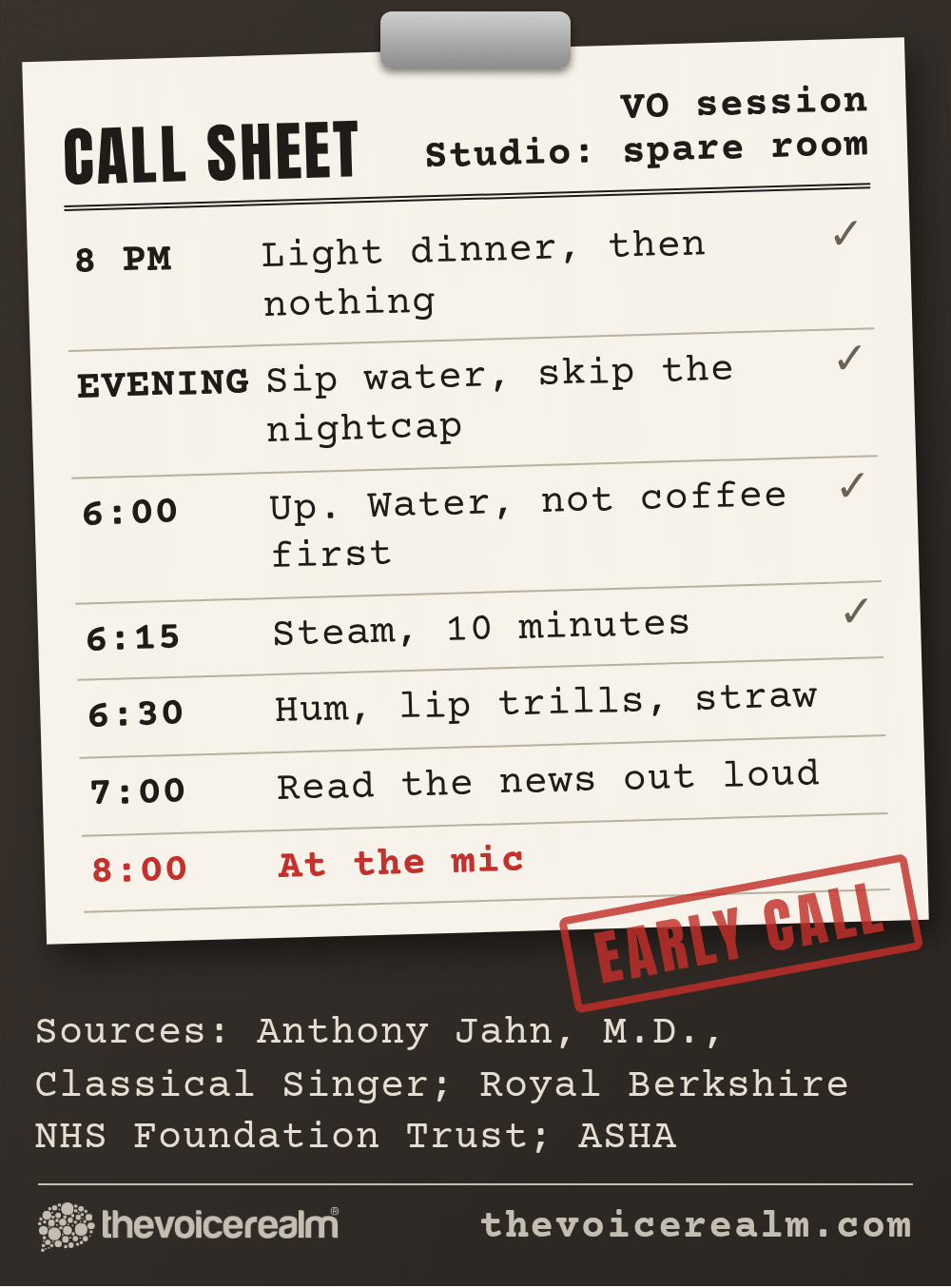
Start with water. Sip it rather than gulping, and keep sipping. The Royal Berkshire NHS Foundation Trust’s voice care leaflet says caffeine and alcohol are dehydrating and suggests cutting back on both. You don’t have to give up coffee, but have water first and don’t count the coffee as your fluids.
 VOICEMASTERACADEMYLearn the craft in order.Module one is freeStart module oneTwenty modules, start to finish.
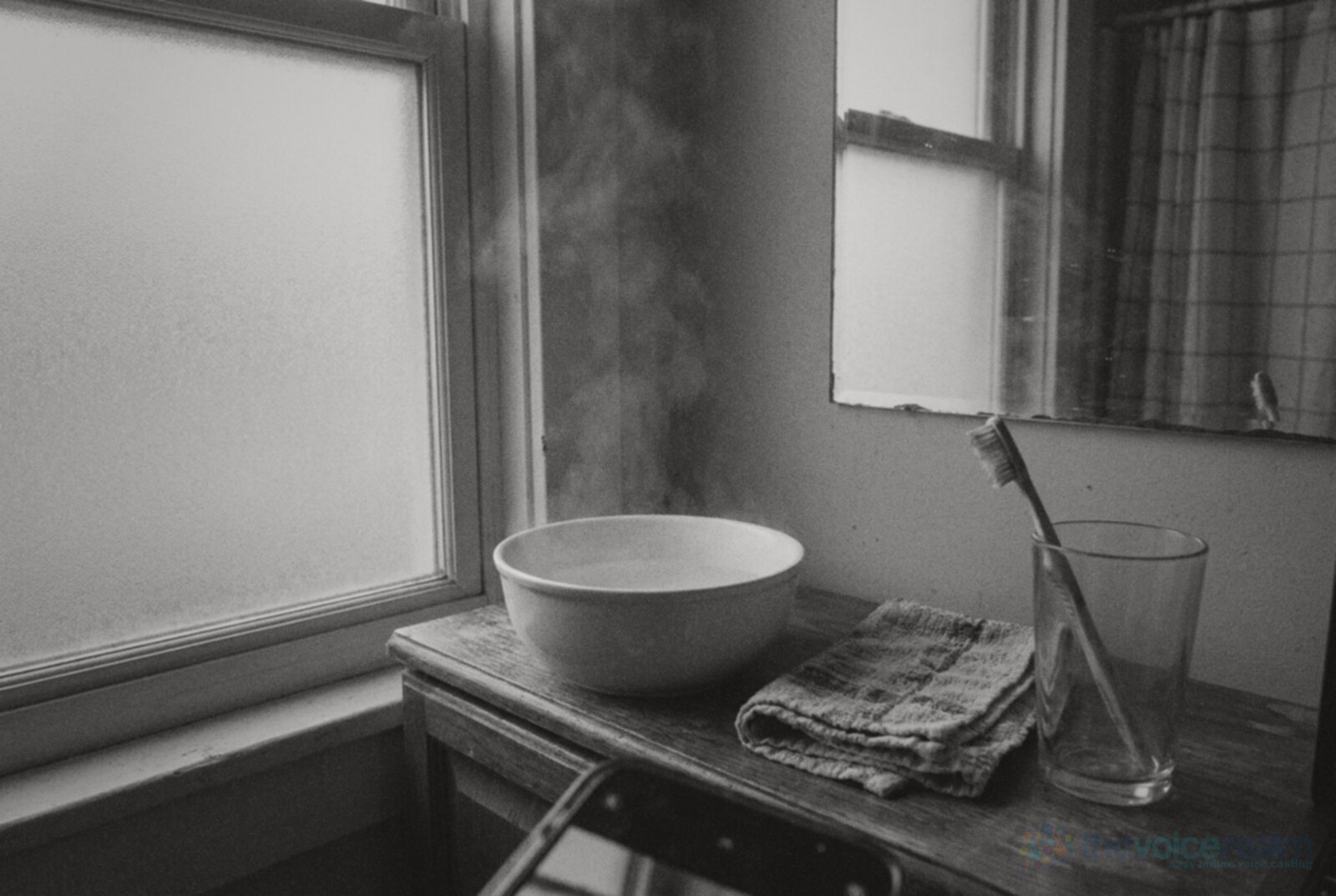
Next, steam. The same NHS leaflet says: “Try steam inhalation to soothe a dry throat.” It adds that you don’t need to put anything in the water. A bowl of hot water and a towel, or simply a long hot shower, gets moisture onto tissues that have been drying out all night.
Then the hard one: don’t clear your throat. It’s the instinct when it feels gunky, but it slams the folds together. The NHS leaflet says “Avoid coughing or clearing your throat. Instead, take a sip of water and swallow hard.” The American Speech-Language-Hearing Association agrees: “Throat clearing can irritate your throat further.” To be fair, not every specialist is that strict. Jahn, writing for singers, allows it before they start vocalising: “Hawking and spitting is permitted and encouraged before you start vocalizing.” The middle path is a sip of water, a hard swallow, or a gentle huff of air rather than a harsh bark. There’s more on breaking the throat-clearing habit if you can’t stop.
Now make sound, quietly. ASHA recommends easing in before a busy day, saying that warming up with gentle humming “can loosen up the muscles and prevent injury.” Hum through your speaking range, do some lip trills, or spend five minutes on a straw and a glass of water. Keep it soft and easy. A cold voice needs a slow start, not a hard push.
Finally, talk. Read the news out loud, read yesterday’s script, chat to whoever’s around. The research says the voice improves with use, so give it use before the red light goes on. If you can, leave an hour between waking and your first take.

© The Voice Realm
Don’t chase the gravel
It’s tempting to push for the low, husky sound you had at 6 a.m., or to press down on a voice that feels thin. Don’t. Pushing a voice that hasn’t warmed up is how a rough morning turns into a sore afternoon, and it won’t match the rest of the job anyway.
Book your mornings with this in mind. If a client wants a 7 a.m. live session from your time zone, set the alarm early enough for an hour of waking up, and ask whether a slightly later slot works. Most clients are glad you asked. For self-directed work, record the demanding stuff, big character voices, shouting, long narration, later in the morning, and do admin, editing and email first.
Keep your sessions consistent too. If you start a project in the afternoon, try not to record its pickups at dawn, because your morning voice may not match. It’s a small thing that saves a re-record.
© The Voice Realm
When it’s more than morning voice
Normal morning voice fades as you get going. If yours doesn’t, or it’s getting worse, pay attention. UT Health’s list of reflux signs includes throat clearing and a “Prolonged vocal warm-up for singers”, and morning hoarseness that hangs around is one of the classic ones.
ASHA advises seeing an ear, nose and throat doctor if hoarseness or other signs of strain last longer than two weeks. Pain when you speak, a voice that keeps cutting out, or a range that has suddenly shrunk are reasons to go sooner. A voice clinic can look at your folds and tell you what’s really going on, which beats guessing every morning.
For everyone else, morning voice is just your instrument coming out of storage. Water, steam, a quiet hum, and an hour of talking will get you there. And if a client ever asks why you’d rather start at nine, you can tell them it’s for the good of their recording.
Sources: Anthony Jahn, M.D., “The Doctor Is In”, Classical Singer, November 2014. Anthony Jahn, M.D., “That Morning Voice”, Classical Singer, September 2010. van Mersbergen, Verdolini and Titze, “Time-of-Day Effects on Voice Range Profile Performance in Young, Vocally Untrained Adult Females”, Journal of Voice, 1999. Pierce, Tanner, Merrill, Shnowske and Roy, “Acoustic Variability in the Healthy Female Voice Within and Across Days”, Journal of Speech, Language, and Hearing Research, 2021. Royal Berkshire NHS Foundation Trust, “Voice care tips for a healthy voice”. American Speech-Language-Hearing Association, “Protect Your Voice This Back-to-School Season”. UT Health San Antonio, “Laryngopharyngeal Reflux Disease (LPR)”.
Ready to get booked?
See the jobs open right nowAbout Sarah Robbins
Sarah Robbins writes for The Voice Realm about finding voice over work, home studios, casting and the business side of voice acting.