Blog

You know the words, you hit every one cleanly, and the playback still sounds like a train announcement. Same note, same speed, same weight on every word. If a director has ever told you your read is “a bit flat”, or you’ve caught yourself drifting off while listening to your own audition, this guide is for you. It’s for new voice actors and for working ones who’ve noticed their reads settling into a groove they can’t get out of.
The good news first. Monotone is almost never about the voice you were born with. It’s a habit, and habits can be retrained.
Monotone is more than one note
When people say a read is monotone they usually mean the pitch doesn’t move. That’s part of it. But listeners hear flatness in lots of places at once: a pace that never changes, a volume that never dips, pauses that land at the same spot in every sentence, and a tone colour that stays the same whether the line is a joke or a warning.
Resonance plays a part too, which surprises people. A team from the University of Toronto, São Paulo State University and Montclair State University had one male and one female voice actor record the same material at three levels of intonation and four levels of nasality, then asked thirty listeners to rate how much the pitch moved. Their finding was blunt: “The presence of hypernasality in speech can lead listeners to perceive speech as more monotonous.” In other words, a voice that’s stuck in the nose can sound flatter than it really is, even when the pitch is moving.
So the fix isn’t to start swooping up and down. It’s to get every part of the read moving with the meaning: pitch, pace, volume, pause and colour, each doing a little.

© The Voice Realm
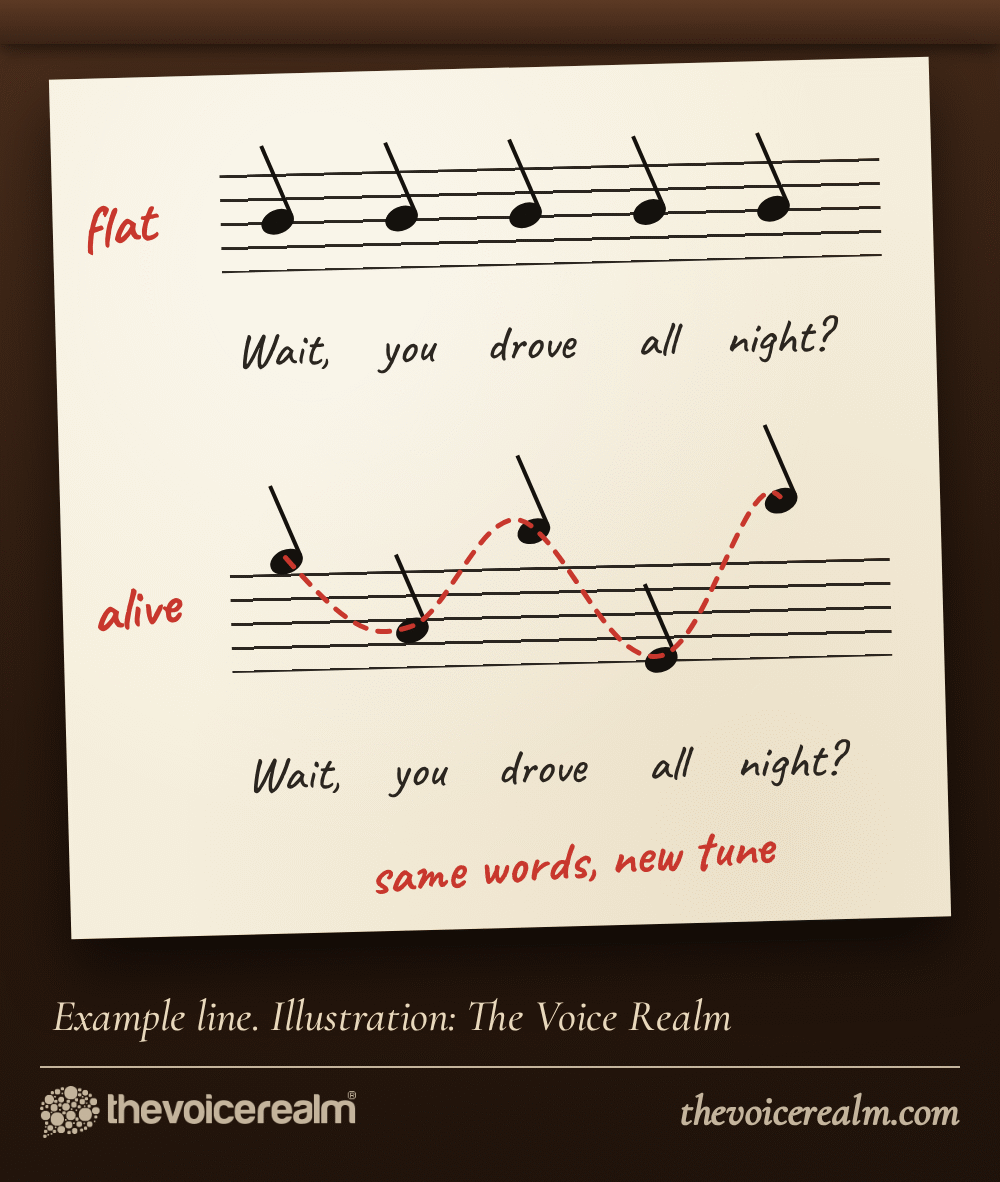
The shape of the line beats the height of it
A lot of voice actors trying to fix a flat read push their pitch higher, or drop it lower to sound more serious. That changes where the voice sits, but it doesn’t change how alive it sounds.
Research on intonation backs this up. Emma Rodero, a communication researcher at Pompeu Fabra University in Barcelona, played different pitch patterns to a listening panel of 100 people and asked which emotions they heard. Both pitch level and the shape of the melody mattered, but her conclusion, published in the Journal of Voice, was that “contour type is more decisive.” The rise, the fall, the little lift before a turn: that’s where listeners find the feeling.
Think of it like a tune. You can sing “Happy Birthday” in a high key or a low key and everyone still knows the song. Sing every syllable on one note and nobody does.
© The Voice Realm
Why good readers go flat
Here’s the odd part. People who read well are often the ones who go flattest in the booth. A few reasons come up again and again.
You’re reading, not talking. Your eyes are on the page, your brain is busy decoding, and the part of you that normally shapes speech goes quiet. If that sounds familiar, there’s a longer piece here on why so many reads sound read, and what to do about it.
You’re playing it safe. Nerves make us careful, and careful sounds even. It feels professional from the inside. From the outside it sounds like someone reading terms and conditions.
You don’t know who you’re talking to. In real life your voice moves because you’re reacting to a person. Take the person away and there’s nothing to react to.
You’re tired. Late in a long session, or at the end of a working day, the voice settles into the easiest path. Variety takes energy.
The script has no obvious emotion. Corporate, e-learning and medical copy can look neutral on the page. It isn’t. Somebody wrote it because they wanted a listener to understand or do something, and that wish is your way in.
Find the word the line is about
Every sentence has one word that carries the news. Actors call it the operative word. Hit it and the rest of the line arranges itself around it, with pitch, volume and timing all bending toward that point. Miss it, or give every word equal weight, and the line goes flat.
Take a typical piece of commercial copy: “Our new app saves you an hour every morning.” Is the news that it’s new? That it’s an app rather than a gadget? That it saves an hour, not ten minutes? That it’s every morning? Each choice is a different ad. A director will often have an opinion, so find yours first and be ready to change it.
Once you’ve found the word, the line will want to rise toward it and settle after it. You’ll also find a tiny pause before it helps, the way a comedian waits a beat before the punchline. Pencil the word in before you record. If you’ve never done it, our guide to marking up a voice over script shows the whole system, page by page.
The old acting exercise on the sign below does the same thing with a single sentence. Seven words, and each one you stress tells a different story about who took the money.

© The Voice Realm
Five drills that bring a read back to life
These don’t need a studio. A phone and ten minutes a day will do. The point of each one is to make movement feel normal again, so it shows up without you thinking about it when the red light’s on.
Do them in a different order each day, and record the “after” take every time. You’ll want those recordings later.
If you’re starting out and want a structured way to build this kind of range, Voice Master Academy runs voice acting courses for beginners that work on exactly these habits with a coach listening.
- Talk it, then read it. Explain the script out loud in your own words to an imaginary friend, then read the real copy straight after. Keep the melody of the first take.
- Over the top, then back. Read a paragraph like a children’s storyteller, wildly expressive, then read it again at a third of that. The second take will still have more shape than your usual one.
- Hum the tune. Hum a line without the words, just the pitch pattern you’d use if you meant it. Then put the words back on that tune.
- Change the listener. Read the same line to a nervous first-time customer, to your best friend and to a busy boss. Notice what changes without you forcing it.
- Move your hands. Gesture as if the listener were in front of you. Movement in the body tends to bring movement into the voice.
Pace, pauses and volume do half the work
Pitch gets all the attention, but timing is often the quicker fix. A flat read nearly always has a steady, even pace from the first word to the last, like a metronome ticking under it.
Real speech speeds up through the parts we think the listener already knows and slows down for the parts that matter. Try it: race a little through “As you probably know,” then lean into the new information. Pauses work the same way. A pause before a key word builds a little anticipation. A pause after it gives the listener time to take it in.

 VoiceEditSuiteNewYour breath. Your pace. Your edit.Learns from numbers, never your audio. Never used to train AI.See how it works
Volume is the quiet one. Pulling back for a moment, almost confiding, can be more striking than getting louder. Just keep the mic distance steady so the change comes from you, not from you drifting off axis.
And don’t forget your face. A smile, a frown or a raised eyebrow all change the shape of your mouth and throat, which changes the sound. There’s a whole article on how a smile changes what listeners hear, and the same goes for every other expression.

© The Voice Realm
Hear yourself the way a client will
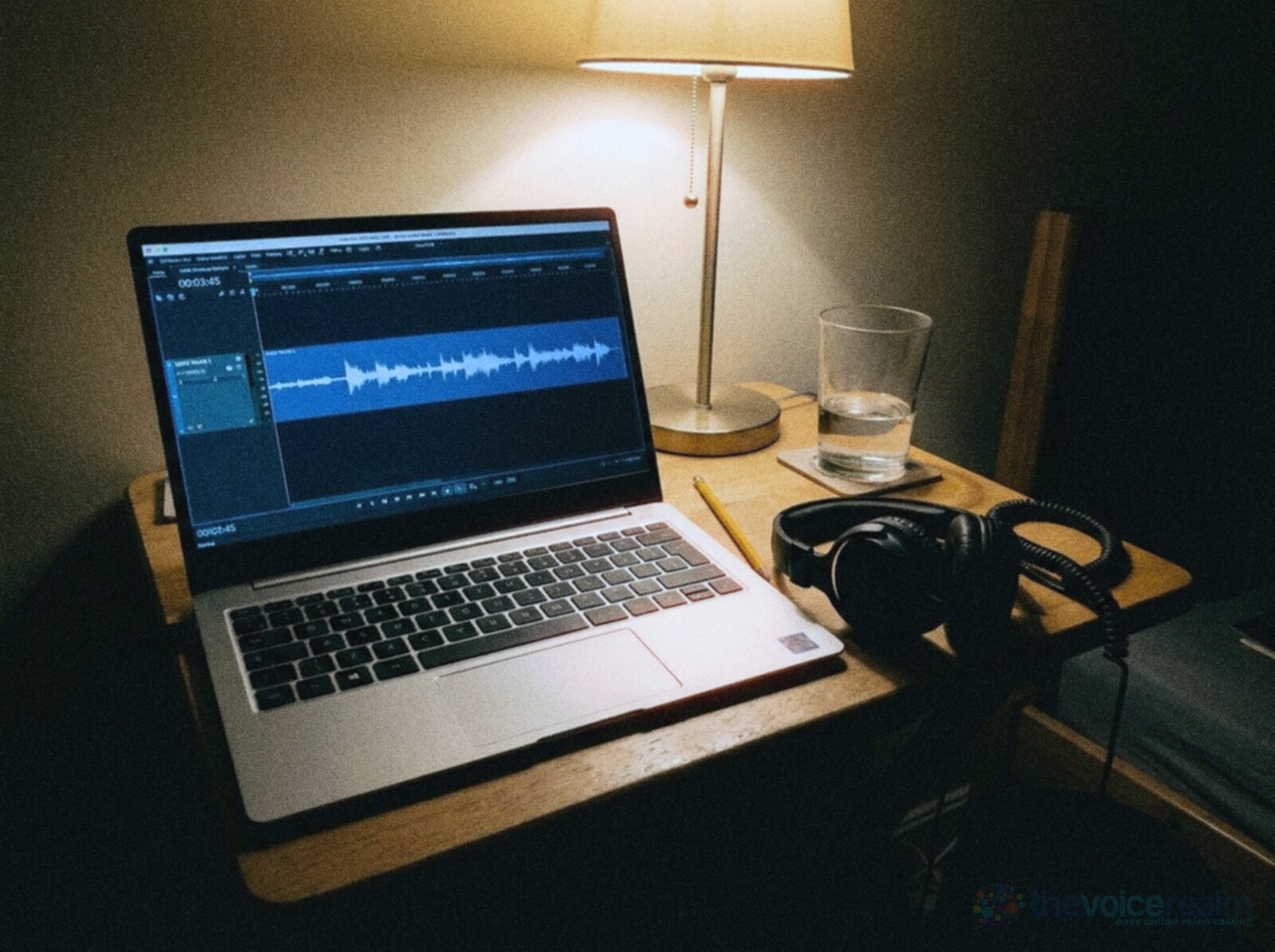
You can’t judge your own variety while you’re speaking. Your head is full of the meaning, so you hear the movement you intended, not the movement you made. You need the recording.
Record a short script, then leave it overnight. The next day, play it back once without the script in front of you and ask one question: would I keep listening if this came on in a waiting room? Listen for stretches where every sentence ends on the same falling note. That repeated pattern, sometimes called a sing-song cadence or a reading lilt, is one of the most common forms of flatness. The pitch moves, but it moves the same way every time, so it still sounds monotone.
If you like seeing things, a free speech analysis program called Praat, made at the University of Amsterdam, will draw a pitch line under any recording. A flat read looks like a flat line. A lively read looks like hills. Don’t try to make the picture pretty, though. Use it to spot long flat stretches, then fix them by changing the thought behind the words, not by drawing extra bumps with your voice.
© The Voice Realm
Don’t swing into sing-song
Once people discover they’re flat, some go too far the other way. Every line climbs and dips, every other word gets punched, and the read starts to sound like a kids’ TV presenter on a sugar high. Listeners trust that even less.
The fix is the same one that cures flatness: tie every change to a reason. If you can’t say why a word went up, it probably shouldn’t have. Variety should follow thought. When the thought changes, the voice changes. When it doesn’t, it doesn’t.
It’s also worth matching the variety to the job. A guided meditation wants gentle, slow movement. A retail radio spot wants more. A documentary sits somewhere between. Listen to what’s already working in the genre you’re auditioning for and notice how much the voices actually move. It’s often less than you’d expect, but it’s never zero.
When flat isn’t a habit
Most monotone reads are habit, nerves or tiredness. Occasionally, though, a voice loses its range for other reasons: hoarseness that won’t clear, pain when you speak, a pitch that’s dropped and stayed down, or a voice that tires much faster than it used to. Those aren’t things to drill your way through. If a change like that lasts more than a couple of weeks, see a doctor, and ideally an ear, nose and throat specialist or a speech and language therapist who works with professional voices.
For everyone else, the outlook’s good. Range is trainable. In a study of journalism students published in the Journal of Voice, Rodero and colleagues compared a group that took a voice training course with a group that didn’t, measuring things like pitch, speech rate, pauses and stress before and after. They reported that “The participants were able to enhance their main vocal and prosodic elements”. In plain English, training measurably changed how they sounded.
So give it a month. Pick one drill a day, record yourself once a week, and keep the old recordings to compare against. Then send that livelier read out into the world. There are fresh voice over jobs to audition for most days, and a read with a pulse stands out in any list.
Sources: Tardif M, Berti LC, Marino VCC, Pardo J, Bressmann T, “Hypernasal Speech Is Perceived as More Monotonous than Typical Speech”, Folia Phoniatrica et Logopaedica, 2018. Rodero E, “Intonation and emotion: influence of pitch levels and contour type on creating emotions”, Journal of Voice, 2011. Rodero E, Diaz-Rodriguez C, Larrea O, “A Training Model for Improving Journalists’ Voice”, Journal of Voice, 2018.
Ready to get booked?
See the jobs open right nowAbout Sarah Robbins
Sarah Robbins writes for The Voice Realm about finding voice over work, home studios, casting and the business side of voice acting.