Blog

This one’s for voice actors heading into party season with a session booked for the morning after. The work party, the family dinner, the friend’s birthday that somehow lands on a Tuesday. You don’t have to sit in the corner with a glass of water, but you should know what a few drinks do to the instrument you’re bringing to the mic at nine.
Below is what alcohol actually does to a voice, according to voice clinicians and a teaching manual written for singers, why the damage often shows up the next morning rather than the night itself, what a study of actors found about sounding drunk, and a plain plan for enjoying the evening without paying for it on the recording.
Why a drink feels like it helps
Plenty of performers reach for a drink to settle their nerves. It loosens you up, your shoulders drop, and for an hour you feel warmer and chattier than usual. On a stage that can even sound like a good thing.
The ear, nose and throat practice CEENTA, which runs a voice and swallowing team in the Carolinas, warns against exactly that habit. “You might be tempted to use alcohol to soothe your anxiety before a performance, but it can actually impact your singing ability,” its clinicians write. What’s true for singing is true for a read. The relaxed feeling is in your head. Your throat is having a very different night.
It also helps to know that the lift doesn’t last. The same CEENTA article notes that alcohol is a depressant and that “At the end of the first buzz, it can lead to mumbling or less enthusiastic speaking.” That’s the opposite of the bright, present read most scripts ask for.
So treat a drink before a session the way you’d treat any other shortcut for nerves: it trades a calmer five minutes for a worse take. If audition nerves are the real problem, breathing and preparation do far more, and they don’t wear off halfway through the script.
The dry part: what it does to your vocal folds
Your vocal folds are two small bands of tissue that vibrate hundreds of times a second while you talk. They do that best with a thin, slippery layer of moisture on top. Take the moisture away and they have to work harder for the same sound.
Alcohol takes it away. CEENTA puts it bluntly: “Despite being a beverage, alcohol can cause dehydration and take away moisture from your throat.” The result, in their words, is that your folds aren’t properly lubricated, which can “create a more raspy tone.”
On mic, dry folds sound like a slightly grainy edge on every line, more mouth clicks, and a voice that cracks on soft, low phrases where it never used to. You’ll also hear yourself clearing your throat more, which is its own small problem.
The US National Institute on Deafness and Other Communication Disorders, part of the National Institutes of Health, lists hydration first among its habits for a healthy voice, and its advice on drinks is short: “If you drink caffeinated beverages or alcohol, balance your intake with plenty of water.” It also suggests a humidifier at home, especially in winter, which is exactly when party season lands. The short version holds here: the water you drink tonight is the moisture your folds have tomorrow.
© The Voice Realm
The numb part: you push harder and don’t notice
This is the effect most people never think about, and it’s the one that hurts voices.
The musician health manual St. Olaf College publishes for its singers describes alcohol’s harm as “two-fold.” First, “It dehydrates your body, making your voice less resilient to recover from traumatic vocal use.” Second, “it also has an anesthetic effect that causes one to press their vocal cords together harder in order to achieve a normal sensation while talking or singing.”
Read that second part again. A drink dulls the feedback that tells you you’re straining, so you squeeze harder to feel normal. You don’t notice you’re doing it, because the thing that would tell you has been switched down.
Now put that throat in a room with music on. The same manual warns that “when you drink you lose good judgment about how much and how loudly you use your voice.” Parties are loud, everyone leans in, and three hours of talking over a speaker is a long session with no producer telling you to ease off. The NIDCD’s guidance is to “Avoid talking in noisy places,” because “Trying to talk above noise causes strain on the voice.”
Put those together and the risky part of the night isn’t the glass in your hand. It’s the shouting you do while holding it.
The burn that shows up later: reflux
Some of the damage arrives after you’ve gone to bed. CEENTA explains that “Certain types of alcoholic beverages can make GERD symptoms worse by relaxing the sphincter muscle and allowing stomach acid to come back to the esophagus.” Lie down after a big night, and that acid has an easier trip up.
Bubbles don’t help either. “Beer in particular is pretty rough on GERD and your voice due to its carbonation,” the same article adds. Sparkling wine and fizzy mixers raise the same question.
Reflux that reaches the throat often doesn’t feel like heartburn at all. It shows up as a lump in the throat, a need to clear it, and a husky first hour in the morning. If that sounds familiar after nights out, it’s worth reading our guide to the quiet kind of reflux that hits voices, because the habits that help are the same ones that help here: finish eating and drinking well before bed, and don’t lie flat on a full stomach.
CEENTA also links steady, regular drinking with chronic laryngitis, noting that “Constant drinking irritates the larynx.” One party won’t do that. A month of them in a row is a different story.
© The Voice Realm
Then there’s the night’s sleep
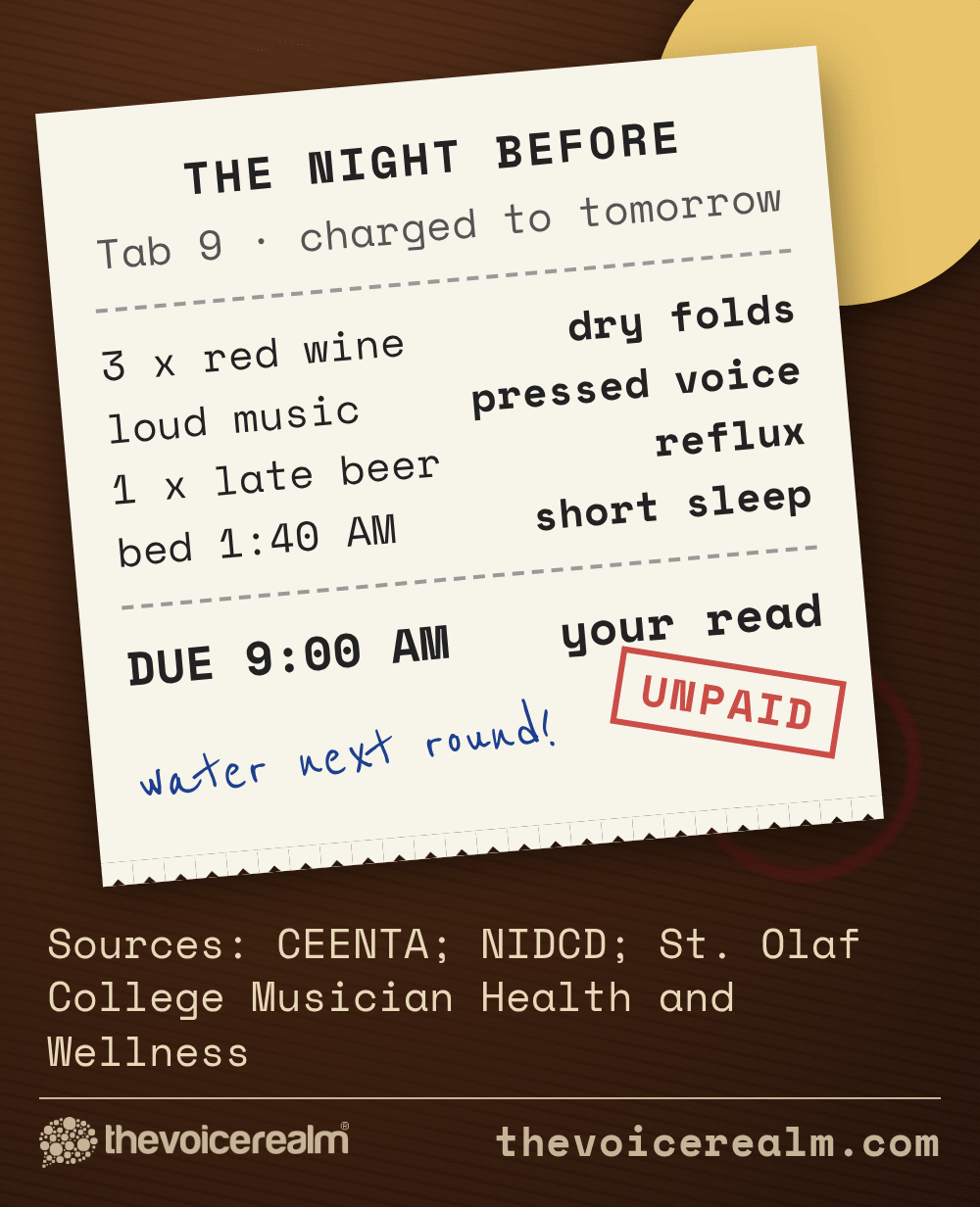
A drink can make you sleepy, which is why people think it helps them rest. It doesn’t, or not in the way your voice needs. The St. Olaf manual says plainly that “Alcohol can also interfere with getting restorative sleep.”
For a voice actor, that’s a second hit on top of the first. You wake up with dry folds, maybe a bit of reflux, and less rest than the hours in bed suggest. Your read comes out flatter, your energy dips by the third paragraph, and your timing gets a little sloppy. We covered what a short night does on its own in our piece on tired voices and flat reads. A late, boozy night stacks those same effects on a throat that’s already dry.
This is also why so many people say “I felt fine last night.” You probably did. Most of what the evening costs your voice is billed the next morning.
© The Voice Realm
Can listeners hear it? Actors tried to find out
Here’s a study that’s oddly useful for voice actors. Researchers at the University of Florida’s Institute for Advanced Study of the Communication Processes, led by Harry Hollien, recorded actors who were sober, then genuinely and severely intoxicated, and asked them to play it both ways: to fake being drunk while sober, and to sound sober while drunk.
 VOICEMASTERACADEMYFirst read to first booking.Twenty modules. The first one is free.Start free
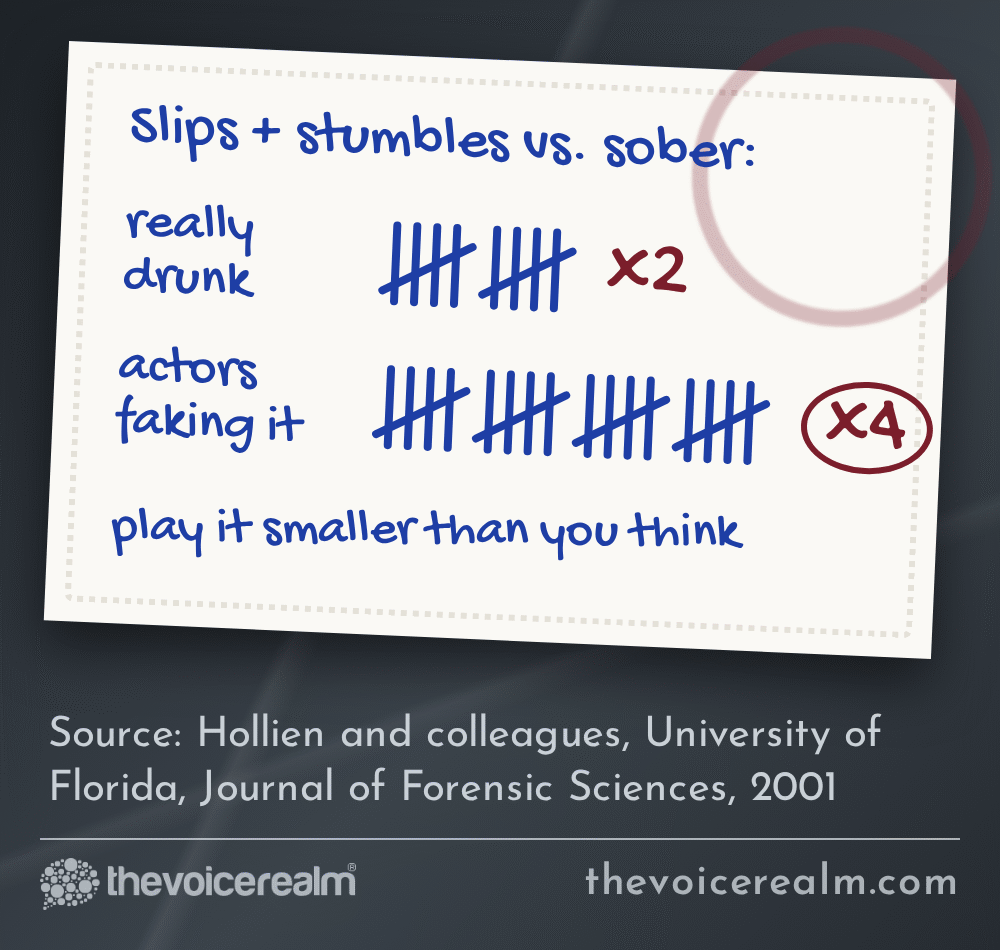
The result surprised them. The paper reports that “even when sober, nearly all of them were judged drunker (when pretending) than when they actually were severely intoxicated.” When they were really drunk and tried to sound sober, most were judged less drunk than they were. Listeners can hear something, but actors are very good at steering it, in both directions.
There are two lessons in that. The first is for performance: when a script asks you to play a character who’s had a few, you’ll almost certainly overdo it. Real intoxication is quieter than the version in our heads. Slow the pace a touch, let a word slip now and then, and leave it there.
The second is for the morning after. “They couldn’t tell” isn’t a plan. The study was about whether listeners could spot intoxication, not about whether the voice was healthy, and an engineer listening on good headphones hears a dry, pressed voice long before anyone hears a drunk one.
© The Voice Realm
A plan for party season with a session in the morning
None of this means skipping the party. It means planning the night around the booking, the same way you’d plan around an early flight.
- Pick your stop time before you go. Decide when your last drink is while you’re still sober. Two or three hours before bed gives your stomach a head start on the reflux problem.
- Water between every drink. That’s the NIDCD advice in practice. A glass of water each round keeps you hydrated and slows the pace without anyone noticing.
- Choose the quiet corner. Talk in the kitchen, step outside, sit away from the speaker. If someone has to lean in to hear you, move rather than raise your voice.
- Skip the shouting games. Singing along at full volume, cheering the football, yelling across the room. That’s the strain the numb throat won’t warn you about.
- Go easy on the fizz. If you’re prone to reflux, beer and bubbles are the ones CEENTA calls out.
- Book smart when you can. If you know the party’s coming, ask for an afternoon slot rather than an early one. Most clients don’t mind, and you’ll get a better take.
- Don’t gargle it away. The NIDCD also says to “Avoid mouthwash or gargles that contain alcohol or irritating chemicals.” Swap the alcohol mouthwash for plain water in the morning.
“The risky part of the night isn’t the glass in your hand. It’s the shouting you do while holding it.”
The Voice RealmPost this quote
A sparkling water with lime in your hand at a party looks exactly like a drink, and nobody asks. It’s an easy trick for the last hour of the night.
If your voice is rough the next morning
You went anyway, you stayed late, and you’ve got a session at ten. Here’s how to give yourself the best chance.
Start with water as soon as you’re up, and keep sipping. Breathe some steam from a mug or a hot shower. Eat something plain. Then warm up gently rather than hard, because a dry, tired voice is easy to push into strain. Our straw and water routine is a good fit for exactly this kind of morning: it gets the folds working with very little effort.

© The Voice Realm
Listen back to your first few lines before you commit to the whole script. Check for a grainy edge, extra mouth noise, a pitch that’s sitting lower than usual, and lines that run out of energy at the end. If you hear them, slow down, drink more water, and take short breaks. Small adjustments often get you through.
If the voice simply won’t come, be honest with the client early. Moving a session by a few hours is a small thing. Sending a hoarse file and needing to redo it is not. The NIDCD’s advice is to avoid speaking or singing when your voice is hoarse or tired, and that’s sound guidance for a working voice too.
And if a rough voice hangs around for more than a few days after the night out, it’s not a hangover anymore. That’s the time to see a doctor, ideally an ear, nose and throat specialist or a voice clinic, rather than pushing through another week of sessions.
The short version
You can enjoy the season and still turn up sounding like yourself. Alcohol dries your folds, numbs the feedback that stops you straining, nudges reflux along overnight and takes the good out of your sleep. Water, a quiet corner, an early last drink and a sensible booking time handle most of it.
Then, when your voice is rested and ready, there’s plenty of work waiting on the voice over jobs board, with new castings most days.
Sources: CEENTA, “How does alcohol change your voice?”; National Institute on Deafness and Other Communication Disorders, “Taking Care of Your Voice”; St. Olaf College Musician Health and Wellness, “Drug and Alcohol Use”; Hollien H, Liljegren K, Martin CA, DeJong G, “Production of intoxication states by actors: acoustic and temporal characteristics”, Journal of Forensic Sciences, 2001.
Ready to get booked?
See the jobs open right nowAbout Sarah Robbins
Sarah Robbins writes for The Voice Realm about finding voice over work, home studios, casting and the business side of voice acting.