Blog

This one’s for anyone who stutters and wants to work behind a microphone, and for anyone who’s been told, or has quietly told themselves, that a stutter rules voice work out. It doesn’t. The job asks for a voice people believe. A stutter changes how you get there, not whether you can.
Below you’ll find what tends to change when you read from a script, where the work genuinely gets harder, how to set up your recording so it works in your favour, and what speech therapy focuses on these days. We’ll finish with a different question: what to do when a script asks you to play a character who stutters.
A stutter interrupts the flow, not the voice
It helps to be precise about what a stutter is. The US National Institute on Deafness and Other Communication Disorders (NIDCD) describes it as “a speech disorder characterized by repetition of sounds, syllables, or words; prolongation of sounds; and interruptions in speech known as blocks.” It adds that a person who stutters “exactly knows what he or she would like to say but has trouble producing a normal flow of speech.”
Look at what isn’t on that list. Tone, pitch, warmth, texture, the thing a casting director decides on in the first few seconds of an audition: none of it is touched. A stutter interrupts the flow of words. It doesn’t make a voice less trustworthy, less warm or less right for a part.
And voice work is recorded. Unlike a stage, a meeting or a phone call, almost all of it happens with a stop button, an undo key and time to try again. That changes the maths more than most people expect.
It’s also common. NIDCD estimates that “Roughly 3 million Americans stutter,” and for about a quarter of children who start stuttering, it carries on into adult life. You’d be in large company.
Why a script can feel different from conversation
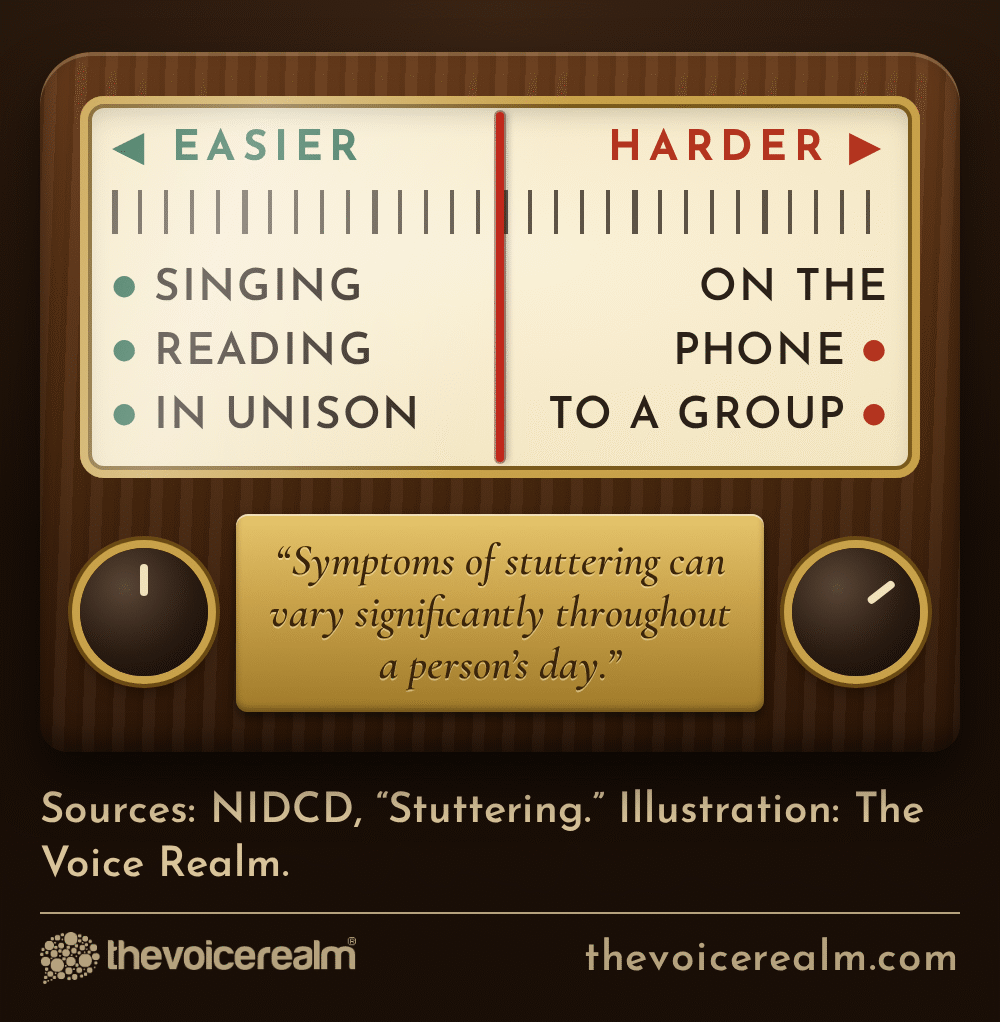
Ask a few people who stutter and you’ll hear the same thing: it isn’t the same every day, or in every room. The research agrees. In NIDCD’s words, “Symptoms of stuttering can vary significantly throughout a person’s day.” Some situations tend to tighten things up and others tend to loosen them, and reading aloud sits on the easier side of the institute’s list, at least for a while.
The best known example is James Earl Jones. Northeastern University’s news service wrote that his stutter was “so severe as a child that he barely spoke,” and that things turned when “a teacher had him read poetry in front of class, which helped him get a handle on the condition.” He went on to own one of the most recognised voices in film. Caren McDonough, who runs Northeastern’s Speech-Language and Hearing Center, told the university that poetry and music use a different part of the brain than everyday speech, which can help people who stutter.
Don’t read too much into one famous story, though. A script isn’t a cure, and plenty of people find a cold read brings its own blocks. In conversation you can swap a hard word for an easier one without anyone noticing. On a script the words are fixed, and the client paid for every one of them. That’s the honest trade: a script hands you rhythm, preparation and a chance to rehearse, and takes away the escape hatch of choosing your own words.
© The Voice Realm
Where the work gets harder
The two situations at the far end of that dial turn up in a voice actor’s week more often than you’d think. A directed session is a group, even when it’s only three faces on a video call, and a phone patch is exactly what it sounds like.
In a live session a director, and sometimes the client, listens to every take as you record it. Nobody expects perfection on the first pass; every actor fluffs lines, and directors ask for retakes all day long. What changes for you is the feeling of being heard in real time, which is often what tightens things. A few habits help:
- Ask to roll. Most engineers are happy to keep recording while you go again from the top of the sentence. Nobody needs to stop and start the session for every block.
- Prepare the script the night before. Find the words you know are hard for you and read them aloud until they feel familiar. Familiar is not the same as easy, but it helps.
- Agree on a signal. A raised hand or a quick “again” tells the engineer to keep rolling and lets you reset without a conversation.
- Take notes the way you’d take any direction. Our guide to taking direction in a live voice over session covers the rest of the session etiquette.
Auditions are kinder. You record them alone, you can do twenty takes, and the casting team only hears the one you send. If your own name is one of your hard words, and for some people who stutter it is, you can record the slate as many times as you like. Nobody hears the attempts.
© The Voice Realm
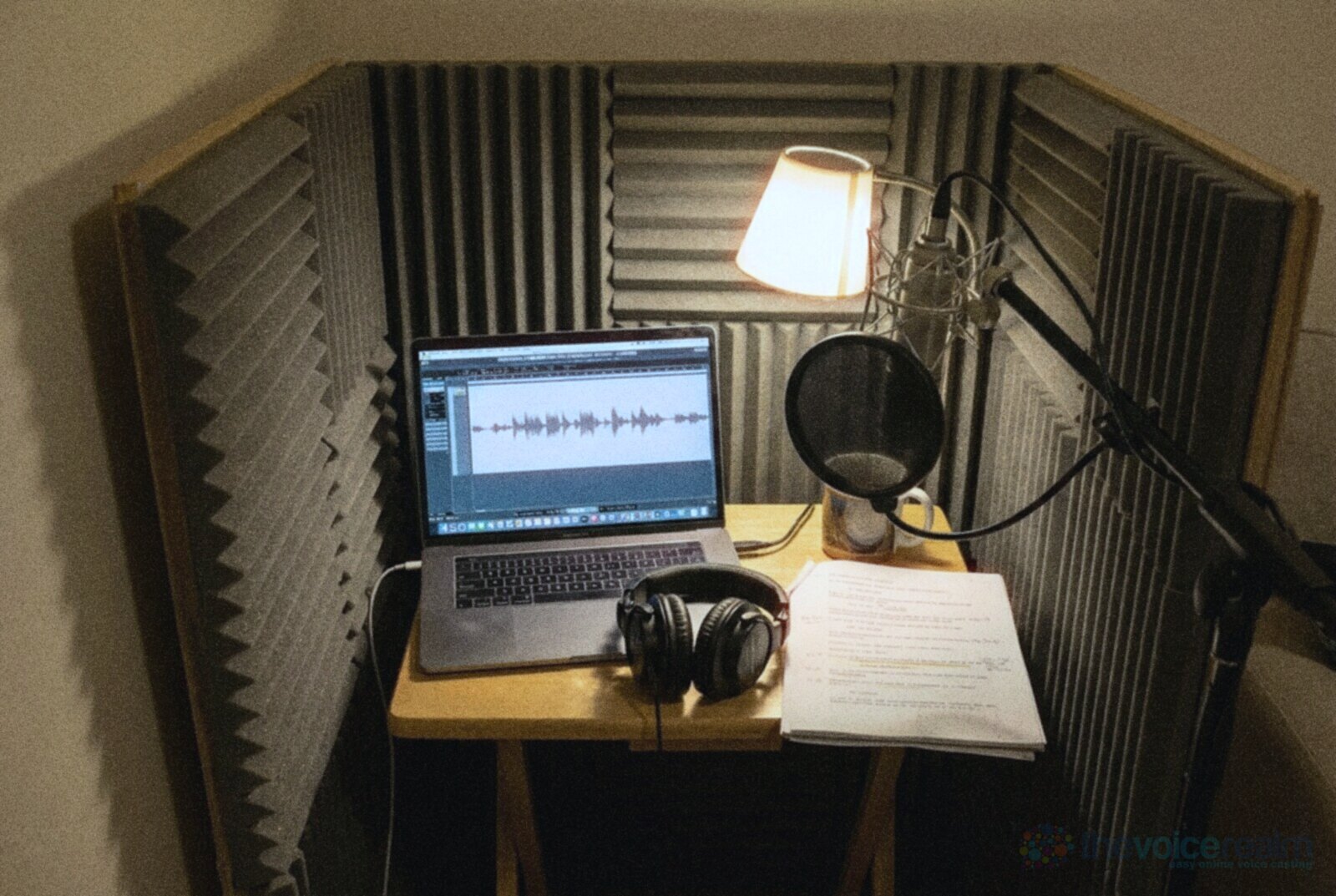
Your booth is the friendliest room you’ll ever work in
Most voice work today is self-recorded: e-learning, explainers, corporate narration, commercials, phone systems. You get a script, you record at home, you send a finished file. The client never hears the takes you threw away.
That makes editing your best friend. Record a sentence, and if it blocks, pause, breathe and go again from the start of the phrase. Later you cut the stumble and keep the clean take. Many narrators work this way whether they stutter or not; the technique is called punch and roll recording, and it lets you fix a line without losing the flow of the read around it.
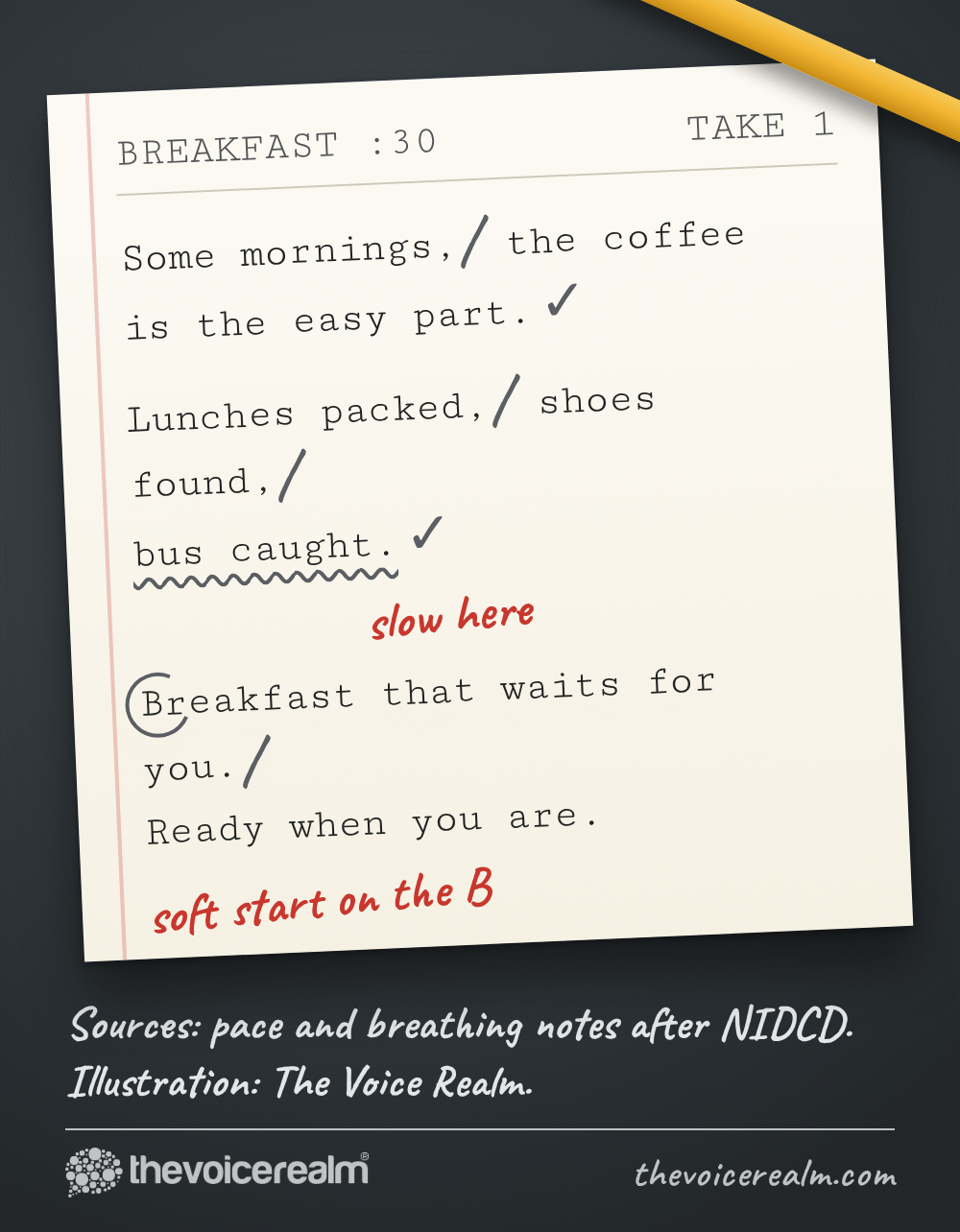
Mark up your script before you start. Slashes where you’ll pause, a small tick where you’ll breathe, a note above any word you know is a hard start. Shorter phrases are easier to land and easier to edit, and the pauses usually make the read sound more natural, not less.
Be realistic about time, too. If you need three takes of some sentences, a ten minute script takes longer to record and edit than it would for someone else. Price your work on the finished minutes, not on how long the session took you, and choose formats that suit your pace. Short commercial and e-learning scripts are friendlier to start with than a twelve hour audiobook.
© The Voice Realm
What speech therapy works on now
NIDCD is clear that “there is currently no cure for stuttering,” and just as clear that treatment helps. For teens and adults, it says, therapy focuses on “helping them learn ways to minimize stuttering when they speak, such as by speaking more slowly, regulating their breathing, or gradually progressing from single-syllable responses to longer words and more complex sentences.” It also notes that “Most of these therapies also help address the anxiety a person who stutters may feel in certain speaking situations.”

 VoiceEditSuiteAuto Clean Up now learns you.Your breath, your pace and every fix you make, so each file comes back sounding like you edited it yourself.See how it worksLearns from numbers, never your audio. Never used to train AI.
The thinking has shifted a lot. Hannah Rowe, who teaches a graduate course on stuttering at Northeastern, put it this way: “It really used to be focused on not stuttering, whatever we can do to not stutter. Now we’re all realizing that the act of avoiding the stutter can make the experience of stuttering harder.”
That matters for voice work in a practical way. Avoidance on a script looks like rushing at hard words, swapping in a filler sound, or bracing your throat before a sentence starts. All three show up on a recording. Working with a speech-language pathologist on easier starts and steady breathing tends to improve the read at the same time.
There’s a happy overlap here. Slowing down, placing your breaths and starting a phrase gently are exactly what voice coaches teach everyone. Our guide to breathing for voice over covers the basics, and none of it fights what a therapist will ask of you.

© The Voice Realm
To tell or not to tell
Whether you mention your stutter to clients is entirely your call. Caren McDonough describes the range she sees: “There are some people who are comfortable stuttering openly, and then there are people who do get very quiet, especially in certain situations.”
For self-recorded jobs there’s usually nothing to tell; the client gets a clean file. For live sessions, some actors find that a single line at the start (“I stutter, so if I stop, just let me roll on”) takes the pressure off completely, because they’re no longer hiding anything. Others would rather not, and that’s fine too. You never owe anyone a disclosure to do a job well.
Frankie Oldham, an actor in training who stammers, wrote for the UK charity STAMMA about the advice his acting tutor gave him, which he now uses everywhere: “Run towards the thing that scares you”. If live sessions are the thing that scares you, that might mean booking a practice session with a coach or a friend before a paid one. Small steps count.

© The Voice Realm
When the script asks you to stutter
Sooner or later a script arrives with a character who stutters. Oldham noticed a pattern in how drama uses it: “The role of a stammer in theatre and film is most widely used to show someone who is of lower status to their hero counterpart.” Comedy has leaned on it for decades, which is part of why it still gets laughs from audiences who should know better.
If you’re cast in a part like this, play a person, not a sound effect. Ask why the writer gave the character a stutter and when it shows up for them: under pressure, with certain people, on certain words. NIDCD’s description gives you the real range of repetitions, stretched sounds and silent blocks, which is far more varied than the comic “b-b-b” most scripts expect. And if you stutter yourself, you bring knowledge nobody else in the audition can fake. Mention it if you’re comfortable; it’s an asset.
Oldham’s own view is worth keeping: “The stage and screen deserve the sound of the stammer”. So do headphones.
Getting started
The route into voice work is the same for everyone, with a few extra notes for you. Learn to read copy naturally, set up a quiet place to record, practise auditions until they feel routine, and build a short demo of the kind of work you want. If you’re starting from scratch, the beginner lessons at Voice Master Academy walk you through reading, mic basics and auditions at your own pace.
- Record a practice script in phrases. Stop at every block, breathe, and start the phrase again. Then edit and listen to the finished version.
- Mark your hard words. Read them aloud the day before until they feel familiar.
- Slate your name ten times. Keep the one you like. Nobody hears the other nine.
- Book one practice live session. A friend on a video call playing director is enough to start.
Find your people, too. Support groups exist in most countries, from STAMMA in the UK to the National Stuttering Association in the US, and NIDCD notes that self-help groups “provide a way for people who stutter to find resources and support.” When you’re ready, our piece on the nerves that come with auditions is a good next read, because the nerves are the same for everyone, and so is the fix: more reps.
Then go and audition. The microphone doesn’t care how long a word took to arrive. It only hears the take you keep.
Sources: “Stuttering,” National Institute on Deafness and Other Communication Disorders; “Can James Earl Jones’ triumph over stuttering inspire others?” Northeastern Global News; “Run towards the thing that scares you,” Frankie Oldham, STAMMA.
Ready to get booked?
See the jobs open right nowAbout Sarah Robbins
Sarah Robbins writes for The Voice Realm about finding voice over work, home studios, casting and the business side of voice acting.