Blog
Australians found an extra hour a week for listening this year. That’s the headline number in Deloitte’s 15th annual Media & Entertainment Consumer Insights report, released this week, and if you make your living with your voice it’s the most cheerful thing to land in your inbox since a producer said “that’s the one” on take one. This piece is for Australian voice over artists who want to know where that hour went, what the same report says about AI voices, and what to do with it before the summer rush.
The report surveyed more than 2,000 Australians across five generations, from Gen Z to the people Deloitte calls Matures. It covers everything from streaming subscriptions to sport, but two pages matter more to our industry than the rest: the one on audio and the one on trust in AI. Read together, they say something useful.
Thirteen and a half hours a week, and climbing
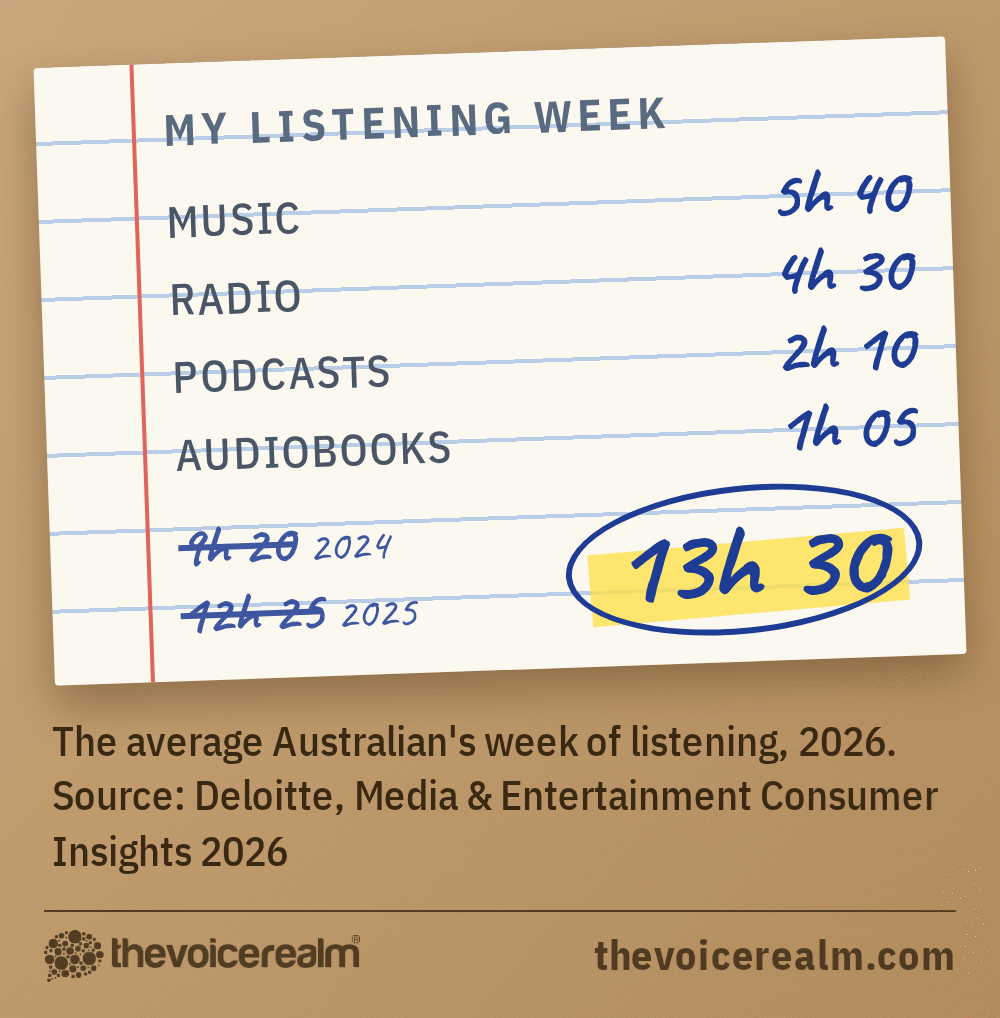
On Deloitte’s figures, Australians now spend 13 hours and 30 minutes a week listening to music, radio, podcasts and audiobooks. Last year it was 12 hours and 25 minutes. In 2024 it was 9 hours and 20 minutes. That’s a big climb in two years, and it happened while total media time stayed flat at a little over 45 hours a week. People aren’t consuming more overall. They’re moving time from screens to ears.
Peter Corbett, who leads Deloitte Australia’s technology, media and telecommunications practice, put it plainly in the release: “Audio is taking a larger share of Australians’ media time, even as their total consumption holds steady.”
The split matters, because not every format pays a voice the same way. Music still takes the biggest slice at 5 hours and 40 minutes. Radio sits at 4 hours and 30 minutes. Podcasts climbed from 1 hour 45 to 2 hours 10, and audiobooks went from 55 minutes to just over an hour. Music doesn’t hire many of us, but every one of the other three does, and the ads that pay for most of them are read by somebody.
A fair warning before we get carried away: these are survey answers. People are telling Deloitte what they think they do, and nobody keeps a perfect diary of their week. But the same question has been asked the same way for years, so the direction is worth trusting even if the minutes are a little rubbery.
© The Voice Realm
Radio changed hands
The overall radio number dipped by ten minutes, which sounds like bad news until you look at who’s listening. Boomers added 45 minutes of radio a week, the biggest jump of any format in their age group. Gen Z, the generation every station has been told it’s losing, added 20 minutes of radio too. The people tuning out a little are Gen X, Millennials and the oldest listeners, and the first two are drifting toward podcasts instead.
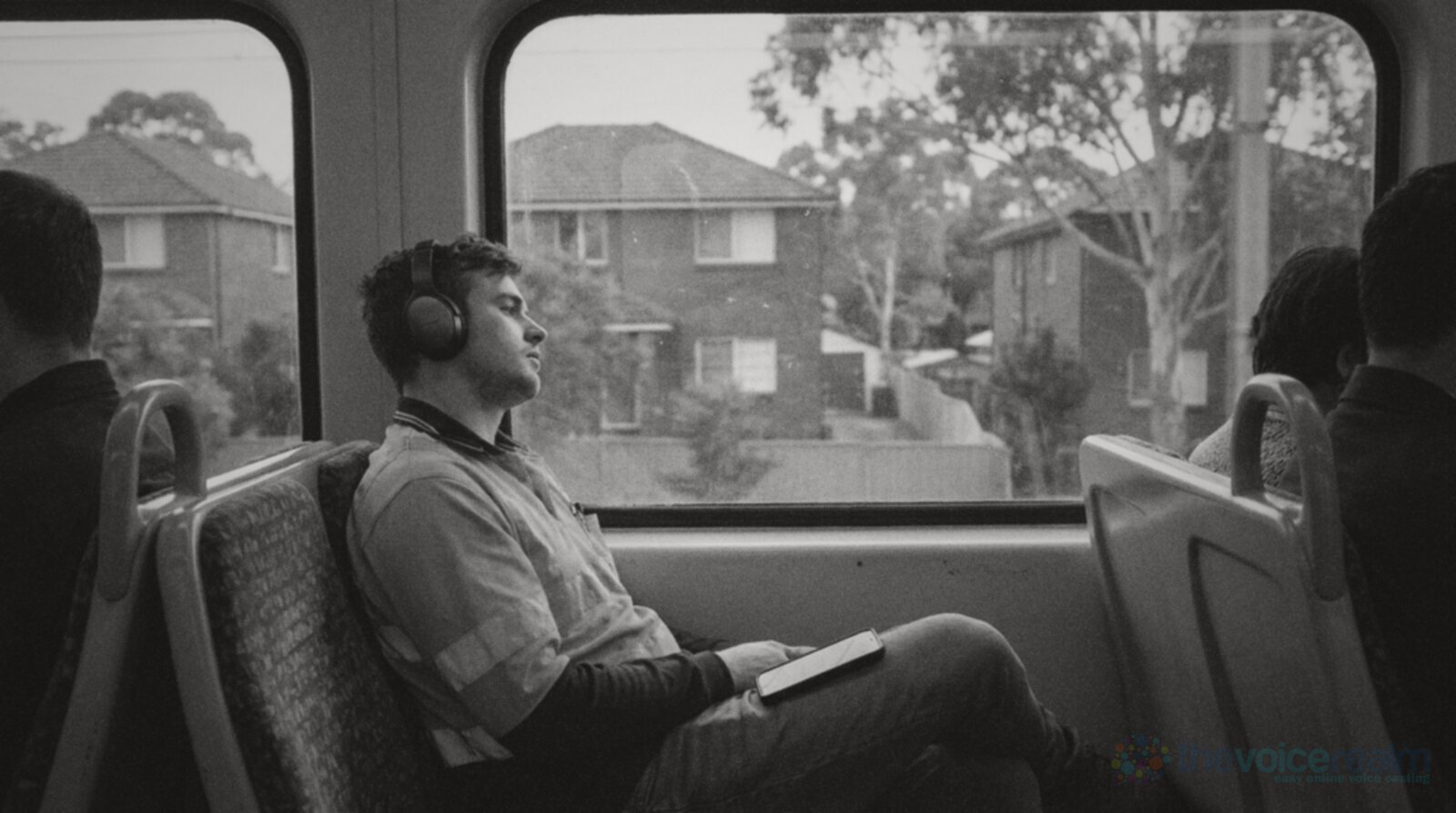
That’s a useful map for anyone voicing commercials. The audience at the end of a radio spot is getting older and younger at the same time, and the read that works for one doesn’t always work for the other. A warm, unhurried voice that a retired couple in a Queenslander trusts over breakfast is a different job from the dry, quick, slightly self-aware read that lands with a 22 year old on the train. Being able to do both, and knowing which one the script wants, is worth more this year than it was last year.
Radio also did well on a question advertisers care about. When Deloitte asked which kinds of ads people feel most comfortable with, free-to-air TV came first and radio came second, ahead of social media, search and streaming. Comfort isn’t the same as sales, but a medium people don’t resent is a medium brands keep paying for.
© The Voice Realm
Audiobooks are the quiet winner
The audiobook page is the one we’d pin to the fridge. Nearly one Australian in four now says they listen to an hour or more of audiobooks every week, up from 20 per cent last year. Among Millennials it’s 37 per cent, and among Gen Z it’s 29 per cent. That’s not a niche hobby any more. That’s a habit.
More listeners means more titles, and more titles means more work for Australian audiobook narrators who can hold a listener for ten hours without wearing them out. Local publishers are calling out for local voices for local books, and Australian listeners have strong views on who they want in their ears. We looked at that last month when we covered what Australian listeners want from a narrator’s accent, and the short version still holds: they want to hear the place the book is set.
Long form narration is its own craft. Stamina, consistent mic position across days, a clean noise floor and the patience to edit honestly all count for as much as the voice. If you’ve only ever done thirty second spots, a book is a different sport.
© The Voice Realm
Gamers found forty more minutes
Audio wasn’t the only thing that grew. Time spent gaming rose for every age group, from 3 hours and 5 minutes a week last year to 3 hours and 45 minutes this year. Australia has a busy games scene, from small indie studios in Melbourne and Brisbane to bigger outfits making mobile titles for the world, and every one of those games needs voices for characters, tutorials and the barks that play a thousand times an hour.
 VoiceEditSuiteA director's notes on every take.Upload a take and Performance Coach scores delivery, energy, pacing, character and authenticity, with timestamped notes on what to fix next.See how it worksYour recordings are never used to train AI.
Game work rewards range and stamina more than polish. A studio might want twenty versions of the same pain grunt, a cheeky shopkeeper, a narrator for the tutorial and an announcer for the menu, all from one session. If you’ve got character voices for games sitting in your back pocket, put them on a demo that shows them off in under a minute.
© The Voice Realm
Three in ten trust an AI voice
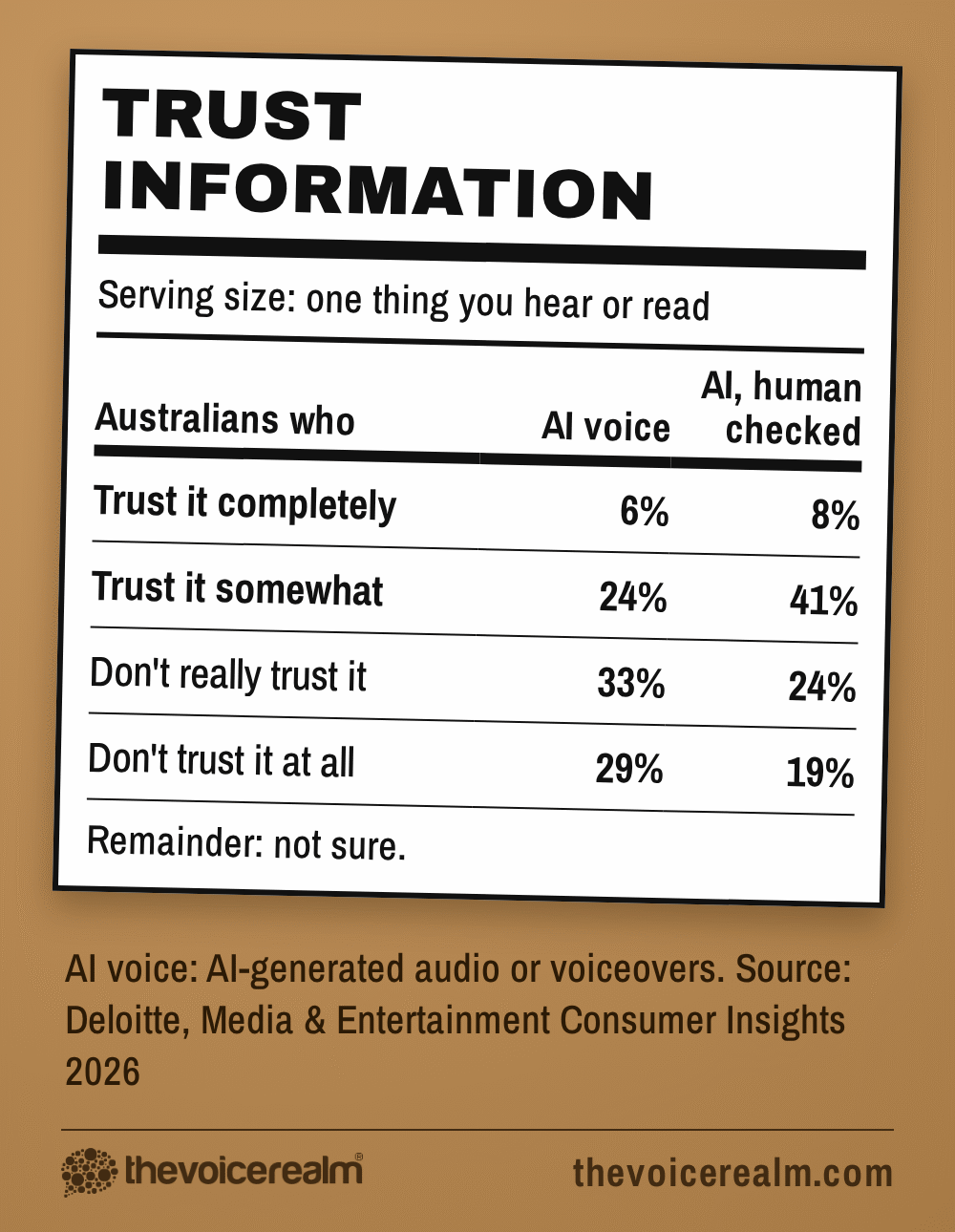
Now the page that should calm a few nerves. Deloitte asked Australians how much they trust different kinds of AI content. For “AI-generated audio or voiceovers (e.g., in podcasts or news bulletins)”, 6 per cent said they trust it completely and 24 per cent trust it somewhat. That’s three in ten. Another 33 per cent said they don’t really trust it and 29 per cent said they don’t trust it at all.
Compare that with content where a human has reviewed and edited AI output, which almost half of Australians trust to some degree. The gap is the whole point, and the man who led the report said so directly.
“Australians are more willing to trust AI content when a human has reviewed and edited it, and they want to know when AI has been used.”
Peter Corbett, Deloitte AustraliaPost this quote
People also want it on the label. Of those surveyed, 84 per cent said platforms and publishers should be legally required to label AI-generated content, and 71 per cent said they’d stop using a platform that didn’t clearly disclose it. Among Boomers, the generation adding the most radio time, 90 per cent want a legal label.
And plenty of people say they’ve already heard something fake. About a quarter of respondents, 26 per cent, recall coming across an AI-generated voice or deepfake audio clip of a real person. For Gen Z it’s 41 per cent. Listeners are getting suspicious, and suspicion is the enemy of every ad.
Our take
Here’s our read. The audio market in Australia is growing, and it’s growing in exactly the places that hire human voices: radio ads for an older and a younger crowd, podcasts with host reads and produced spots, and audiobooks that people now plan their commute around. That’s the good news, and it’s real.
The trust numbers are the more interesting part. For two years the story in our industry has been that cheap synthetic voices will eat the bottom of the market. Some of that has happened. But a brand that spends money on a radio campaign is buying attention and trust, and Deloitte’s figures say most Australians start out sceptical of a voice they think is synthetic. If a listener thinks your spot sounds fake, the money is gone. A real person reading the script isn’t a nostalgic choice in that world. It’s the safe one.
We’d also say this to anyone feeling gloomy: the label is coming. If 84 per cent of people want AI content labelled and regulators keep moving the way they have, the ads that don’t need a label will have an advantage. Human voices don’t need one.
What we wouldn’t do is get smug. The same survey shows trust rises when a human checks the work, which means AI tools aren’t going away from production. The artists who’ll do best are the ones who sound unmistakably like a person, deliver clean files fast, and can explain to a client in one sentence why that matters.
© The Voice Realm
What to do with the extra hour
Some practical steps for the next few months, while budgets for the new year are being set:
Split your commercial demo by audience. One short reel for the warm, trusted, breakfast radio read and one for the quick, dry, younger read. Label them so a producer can find the right one in five seconds.
Learn the host read. Podcast time is up by 25 minutes a week, and podcast ads are mostly read in a voice that sounds like a mate’s recommendation, not an announcement. We broke down the podcast ad nobody skips last month, and it’s worth a second look before you pitch any podcast network.
Record a long form sample. If you want audiobook work, a five minute chapter excerpt with dialogue between two characters tells a publisher far more than a one minute montage.
Build a game reel. Ninety seconds, five or six characters, efforts and barks included. Keep it local where you can: Australian games often want Australian voices.
Say you’re human, simply. A line on your website and your profile that says every file is recorded by you, in your own studio, is no longer a throwaway. It answers the question three in ten listeners aren’t even asking yet.
And for the clients who book voices: if your brand lives on trust, and most do, the cheapest insurance in your next campaign is a voice your listeners know is real. You can hear real Australian voice over artists and get free auditions on your own script before you decide. Australians just told Deloitte they’re listening more than ever. Give them something worth hearing.
Sources: Deloitte Australia, “Media & Entertainment Consumer Insights 2026”; Content+Technology, “Australians Trust Traditional News over AI, Mandatory AI Labelling”, 12 November 2026.
Ready to get booked?
See the jobs open right nowAbout Sarah Robbins
Sarah Robbins writes for The Voice Realm about finding voice over work, home studios, casting and the business side of voice acting.