Blog
This one’s for voice actors who vape, or who quit smoking by switching to a vape and wonder whether they’ve done their voice a favour. Maybe you’ve noticed a drier throat on long sessions, more clearing between takes, or a voice that takes longer to warm up than it used to. Maybe you’ve noticed nothing at all and just want to know.
Here’s the honest answer up front: the research on vaping and the voice is young, and some of it is done on cells in a dish rather than people. But it isn’t empty, and nearly everything that has been published points the same way. Below is what the studies actually say, where they stop, and what a working voice actor can do with that today.
The vapour goes straight past the part you earn your living with
Every puff takes the same route. The aerosol leaves the mouthpiece, crosses the back of your mouth and throat, and passes through the larynx on its way to the lungs. Your vocal folds sit right in that doorway.
A team in the otolaryngology department at Stanford University School of Medicine put it plainly in a 2023 paper in The Laryngoscope: “The vocal folds are among the first tissues exposed to this insult. However, the impact of e-cigs on vocal fold health is almost entirely unknown.”
That second sentence matters as much as the first. Nobody is hiding a giant study that settles it. What we have is a handful of careful pieces of work, each looking through a narrow window. Put them side by side and a picture forms.
It also helps to remember what the folds need to do their job. They vibrate hundreds of times a second, and the soft outer layer has to stay moist and supple to do that cleanly. Anything that irritates, swells or dries that layer shows up in the sound, often before it shows up as discomfort. If you’ve ever read our guide to looking after the instrument you work with, this is the same principle applied to one habit.
© The Voice Realm
What the lab studies found
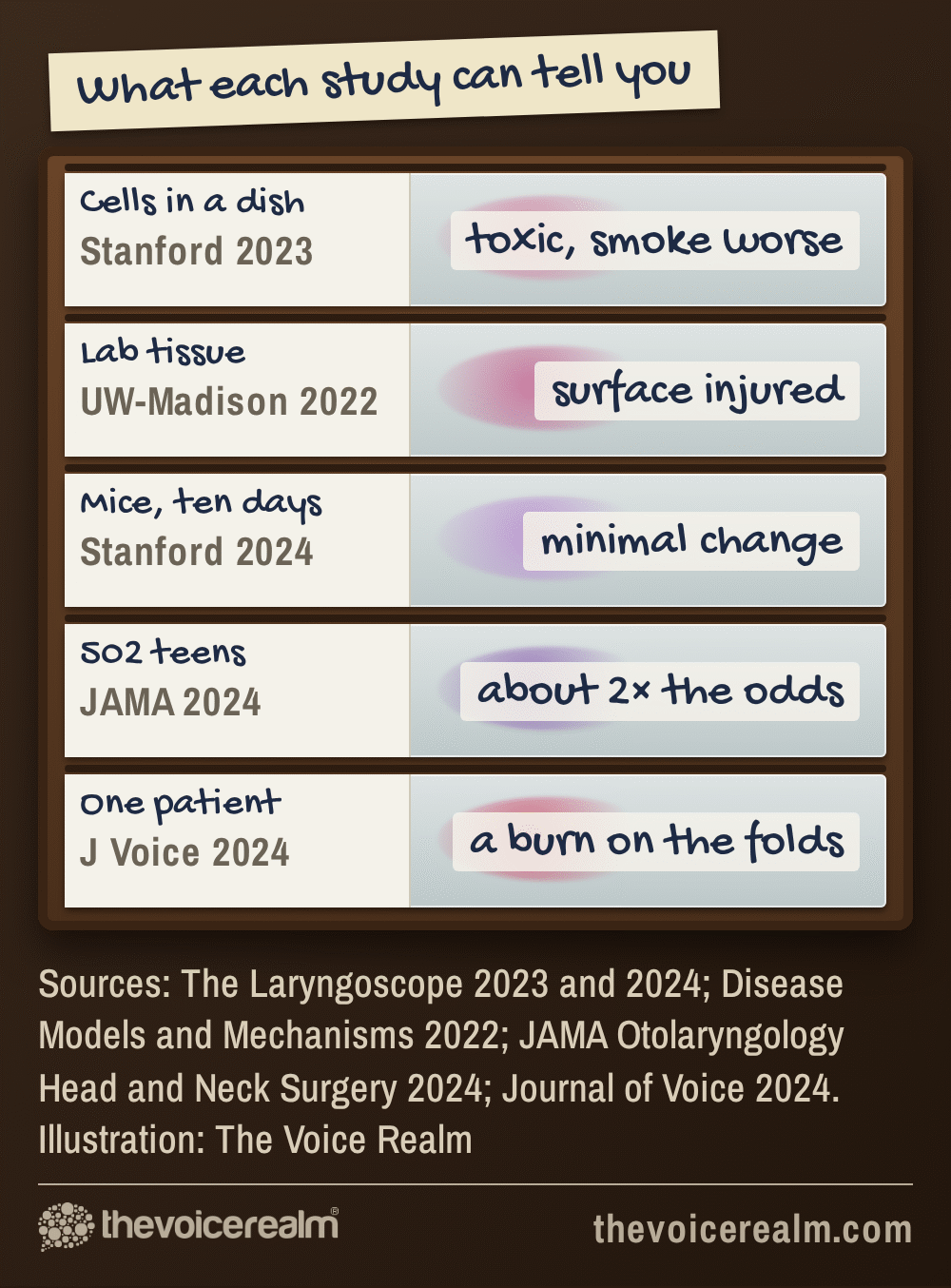
Start with the closest thing to real vocal fold tissue a lab can grow. Researchers in the Department of Surgery at the University of Wisconsin-Madison built engineered human vocal fold mucosa and exposed it to e-cigarette vapour extract for a week. The surface cells were damaged and the tissue went into heavy repair mode afterwards. Their summary, published in Disease Models and Mechanisms in 2022: “vaping presents a threat to VF mucosal health and airway protection, thereby raising further concerns over the safety of e-cigarette use.”
The Stanford group tested the cells underneath that surface layer, the fibroblasts that build the tissue’s structure. Undiluted vapour extract, with or without nicotine, killed enough of them to count as toxic. Cigarette smoke did more damage still. Their conclusion was careful: “cigarette smoke may induce more harm, at least in the short term.”
The same department then exposed mice to pod vapes for up to ten days, two hours a day. This time the changes were small. In their words, “Short-term e-cigarette exposures cause minimal flavor- and region-specific cellular and inflammatory changes in the mouse larynx.” That’s worth saying out loud, because it’s the result people who sell vapes like to quote. Ten days in a mouse is not ten years in a narrator, and the authors themselves describe it as a foundation for longer studies.
Notice the pattern. Nicotine wasn’t needed for the damage in the cell work. The liquid itself was enough.

© The Voice Realm
A survey of teenagers points the same way
Cells and mice can’t tell you whether a real person’s voice gets worse. For that you need people, and the best recent data comes from an unexpected group: American teenagers.
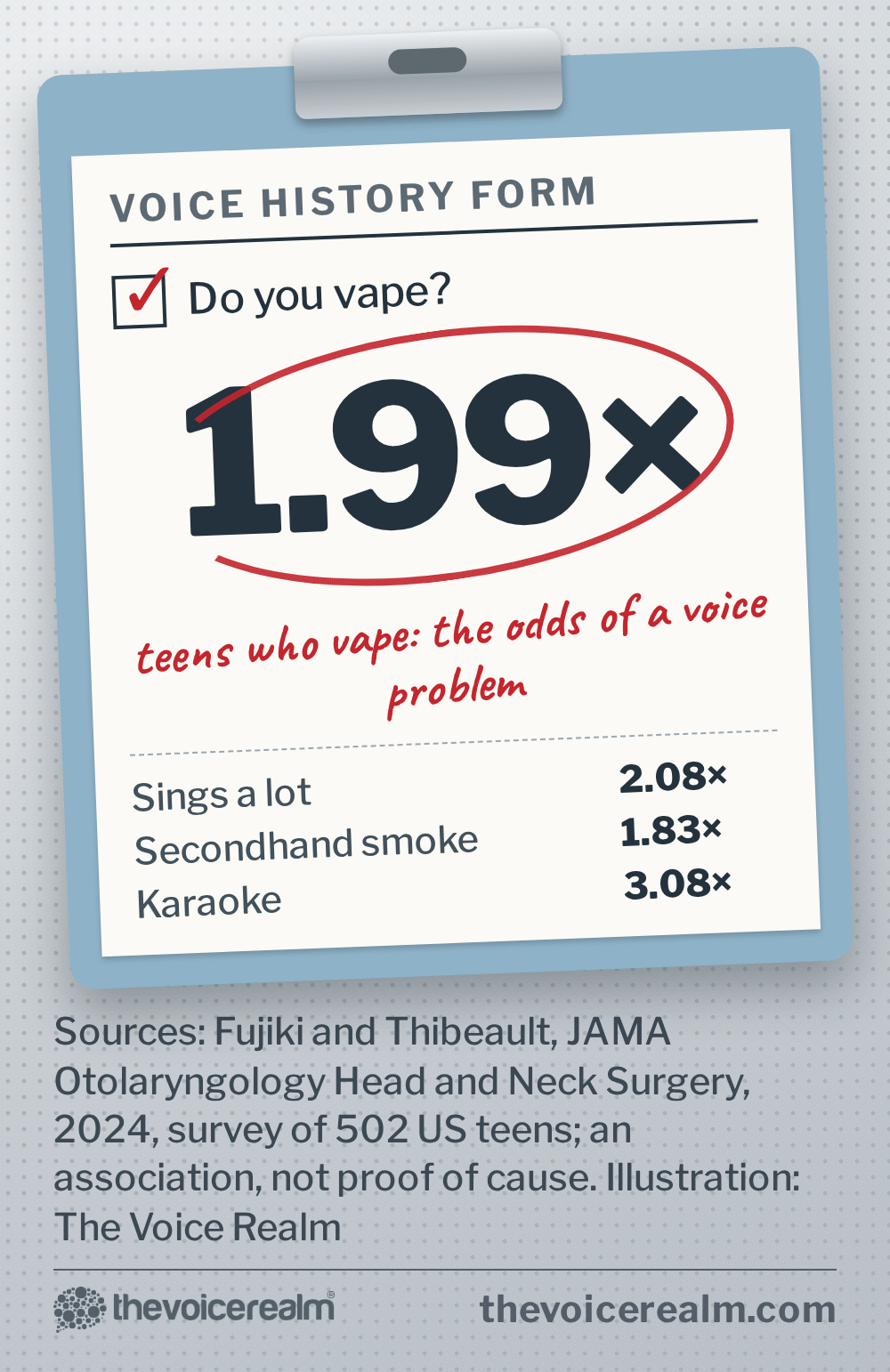
In 2024, two researchers at the University of Wisconsin-Madison published a national survey of 502 adolescents in JAMA Otolaryngology Head and Neck Surgery. They asked about voice problems, how the teens used their voices and what they put into their bodies. Teens who vaped had roughly double the odds of reporting voice problems (an odds ratio of 1.99). So did teens who sang a lot, which tells you the survey was picking up real voice users, not just a quirk of the data.
The authors are clear that this kind of study shows an association, not proof that vaping caused the problems. Their stated next step is to “determine whether observed relationships are causal or associative.” Still, it’s the first solid human signal, and it lines up with what the lab saw.
Is vaping better for your voice than smoking?
Probably less bad, which isn’t the same thing as good. A team at the University of North Carolina at Chapel Hill reviewed 53 studies on what e-cigarettes do to the upper airway, from the nose and mouth down to the larynx. Their conclusion, in Otolaryngology Head and Neck Surgery in 2024, was that “while e-cigarettes are generally less harmful than traditional cigarettes, they possess a distinct toxicological profile that is enhanced upon the addition of flavoring(s) and/or nicotine.”
The known damage
Decades of evidence on swelling, long term changes to the folds and throat cancer risk. In the lab, smoke hurt vocal fold cells more than vapour did.
The newer risk
Less harmful than smoke in most lab comparisons, but the liquid alone damaged vocal fold tissue, and flavours and nicotine added to it.
Two details in that review are useful for a voice actor. First, the base liquids on their own caused harm in several studies. Second, flavours and nicotine made it worse. So the sweet, heavily flavoured, high nicotine pod is the worst version of a habit that’s already not great for the throat.
If you’ve switched from cigarettes, that’s a real step in the right direction for your lungs and your folds. If you never smoked and picked up a vape, you’ve added a risk that wasn’t there before.
© The Voice Realm
Dry folds make for sticky takes
The base of most e-liquids is propylene glycol and vegetable glycerin. They’re humectants, which means they hold on to water, and that’s why the vapour cloud is so thick. The worry for a voice user is what happens when that cloud passes over tissue that needs to stay wet.
 VOICEMASTERACADEMYLearn the craft in order.Module one is freeStart module oneTwenty modules, start to finish.
A 2025 review in the Journal of Voice, from speech and hearing scientists at the Federal University of São Paulo, pulled together twenty studies on e-cigarettes and voice production. Their conclusion reads like a list of things that ruin a session: “E-cigarette use can cause inflammation of the epithelium and mucosa of the vocal folds, and their components can cause dryness, compromising vocal homeostasis, increasing the risk of coughing and breathing difficulties, deteriorating the vocal folds, and worsening voice quality.”
In the booth, dryness shows up as clicks, a slightly rough edge on held vowels, the urge to clear your throat between lines, and a voice that tires an hour earlier than it should. You’ll hear it in the edit before you feel it. Our piece on how water actually reaches your vocal folds explains why sipping helps less than you’d think and why the hours before a session count more.

© The Voice Realm
The one case report every vaper should know
Most vaping harm to the voice, if it happens, will be slow. One kind isn’t. In its January 2024 issue the Journal of Voice published a short case report from ear, nose and throat surgeons at Foch Hospital near Paris. Their patient had a burn on the lining of the vocal folds after vaping, and the paper’s one line summary is blunt: “This paper demonstrates that vaping can cause vocal fold injury such as the mucosal burn seen in the case presented.”
It’s one patient, so it tells you what can happen rather than how often. But the device heats liquid to make an aerosol, and anything that goes wrong with that heat lands on the same tissue you need for tomorrow’s booking. A harsh, hot or burnt tasting hit is a reason to stop, not to push through.
© The Voice Realm
If you vape and voice for a living
You don’t need to wait for a perfect study to make sensible choices. Here’s a plan that works whether you’re cutting down, quitting or simply not ready yet.
Keep the booth a no vape zone. Don’t vape in the hour or two before you record, and never between takes. Even if the folds cope, the dryness and the throat clearing that follows will cost you clean takes and editing time.
Go lower and plainer. The North Carolina review found flavours and nicotine both made things worse. If you’re not ready to stop, a lower nicotine strength with fewer added flavours is the less harmful version of the habit.
Hydrate like you mean it. Water through the day, a humid room at night if your home runs dry. Keep a glass in the booth, but don’t rely on it to rescue a dry throat mid session.
Listen back for changes, not just mistakes. Compare a read from this month with one from six months ago at the same level and distance. More roughness, a lower ceiling on your range, or less power on a held note are all worth noting down with dates. If it keeps happening, our guide to breaking the throat clearing loop is a good place to start.
Know when to get looked at. The American Academy of Otolaryngology Head and Neck Surgery’s patient site, ENT Health, lists “Hoarseness that lasts more than four weeks, especially if you smoke” as a reason to see a doctor, and adds that “Smokers who develop hoarseness should see an ENT specialist right away.” A voice professional with a vaping habit should hold themselves to the same standard. Ask for a laryngologist if you can, and tell them what you vape and how often.
Thinking about stopping?
If you’re ready to quit, talk to your doctor or a local quit service about nicotine replacement or other support. Plan it around your calendar like any other job. A big audiobook or a week of long e-learning sessions is the wrong time to go cold turkey, because cravings and poor sleep both show up in the voice. A quieter fortnight is the right time.
Tell yourself what you’re getting back, too. Clearer mornings, less clearing, and a few more minutes of good voice at the end of a long session add up over a career. For a voice actor, those minutes are billable.
And if you never started, keep it that way. The research may still be catching up, but your vocal folds don’t need to wait for it.
Sources: “Effects of Electronic (E)-cigarette Vapor and Cigarette Smoke in Cultured Vocal Fold Fibroblasts”, Martinez, Easwaran, Ramirez and Erickson-DiRenzo, Stanford University, The Laryngoscope, 2023; “Exposure to e-cigarette vapor extract induces vocal fold epithelial injury and triggers intense mucosal remodeling”, Lungova, Wendt and Thibeault, University of Wisconsin-Madison, Disease Models and Mechanisms, 2022; “Effects of Short-term Electronic(e)-Cigarette Aerosol Exposure in the Mouse Larynx”, Easwaran and colleagues, Stanford University, The Laryngoscope, 2024; “Voice Disorder Prevalence and Vocal Health Characteristics in Adolescents”, Fujiki and Thibeault, JAMA Otolaryngology Head and Neck Surgery, 2024; “The Toxicological Effects of e-Cigarette Use in the Upper Airway: A Scoping Review”, Worden and colleagues, University of North Carolina at Chapel Hill, Otolaryngology Head and Neck Surgery, 2024; “Effects of E-Cigarette Use on Voice: An Integrative Literature Review”, Monteiro, Haddad and Azevedo, Journal of Voice, 2025; “E-Cigarette Vaping-Related Vocal Fold Injury: A Case Report”, Lechien, Papon, Pouliquen and Hans, Journal of Voice, 2024; “Hoarseness”, ENT Health, American Academy of Otolaryngology Head and Neck Surgery Foundation.
Ready to get booked?
See the jobs open right nowAbout Sarah Robbins
Sarah Robbins writes for The Voice Realm about finding voice over work, home studios, casting and the business side of voice acting.