Blog

You probably warm up before you record. Most voice actors do, at least before a big session. But what happens when you take the headphones off after three hours of character voices or a long narration chapter? For most of us, nothing. We walk out of the booth, pick up the phone and start talking. This guide is for anyone who records for a living, or wants to, and has never thought about the other end of the session. Here’s what a vocal cool-down is, what the research says it does, and a short routine you can do before you leave the booth.
A long session leaves your voice in a different place
After a heavy session your voice isn’t just tired in some vague way. Several things are going on at once. Kari Ragan, a voice teacher and researcher at the University of Washington, sums up what’s known about voice fatigue in a 2018 paper for the Journal of Singing: tired muscles in the larynx and in the breathing system, strained ligaments and joints, inflammation of the vocal folds, and changes in blood flow.
Those don’t all bounce back at the same speed. As Ragan puts it, “It is hypothesized that there is some recovery in seconds, but other aspects of recovery may take hours or even days.”
That’s the case for a cool-down in one line. The session ends when you stop recording. Your vocal folds are still dealing with it long after that, and what you do in the next few minutes can help or get in the way.
Voice actors have a particular version of this problem. A day of cartoon voices, promos at full energy or a children’s character pitched well above your own voice leaves the muscles that hold that pitch working overtime. Then you go straight into a phone call with a client in your normal voice, or worse, an evening in a loud restaurant. If you’ve ever noticed your speaking voice feeling “stuck” a bit high, or slightly fuzzy, after a long character session, that’s what a cool-down is for.
Almost everyone warms up, and hardly anyone cools down
Warming up is part of the culture. Singing teachers teach it from the first lesson, and plenty of voice actors run through something like our five minute warm-up routine before they record. Cooling down is a different story.
Ragan’s paper gathers the surveys, and they keep finding the same gap among trained singers: the big majority warm up, and only a small minority ever cool down. The whiteboard below has the numbers. If trained singers, who are taught to think of themselves as vocal athletes, skip it, it’s a fair bet most voice actors do too.
Part of the reason is that a warm-up has a clear payoff you can hear in the first take. A cool-down pays off later, in the evening and the next morning, so it’s easy to feel it isn’t doing anything. The research suggests it is, even if the evidence is still young.
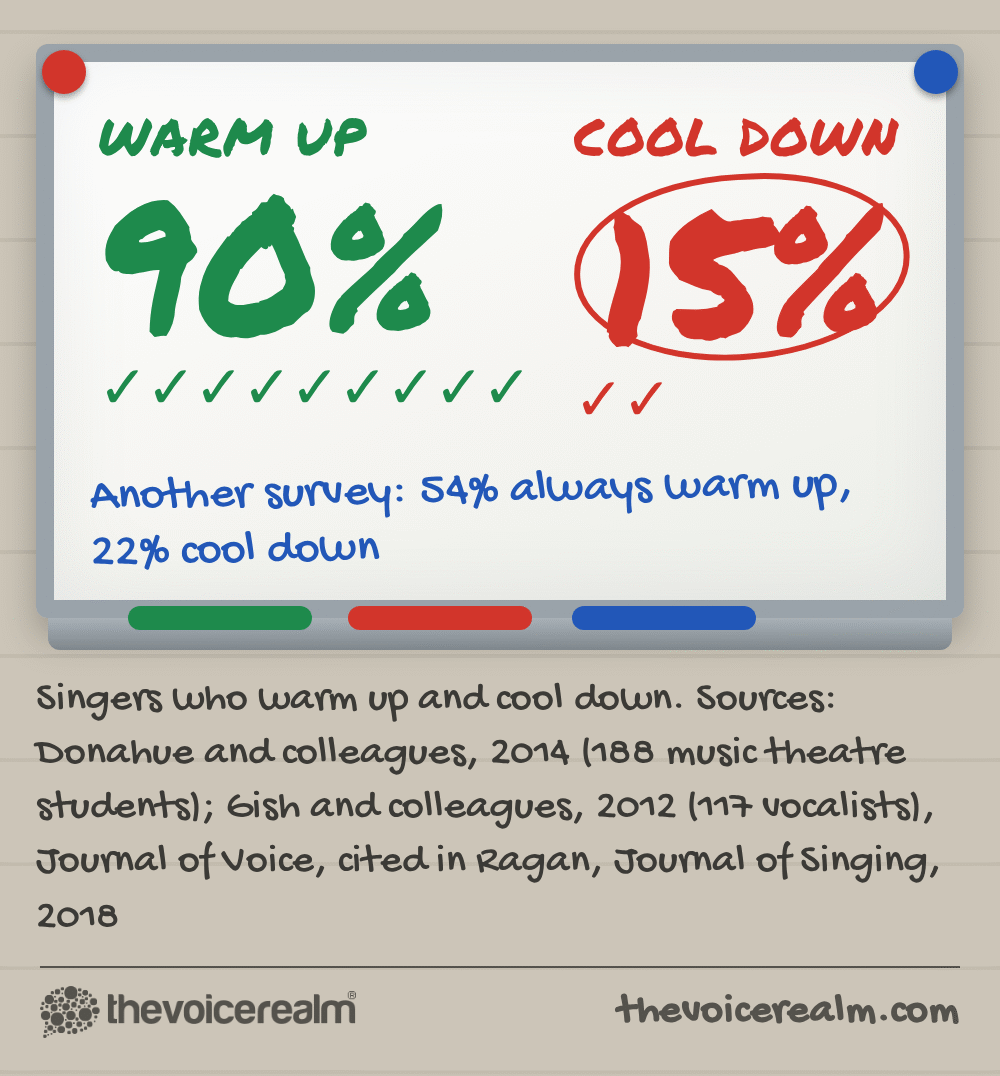
© The Voice Realm
What the research found, and what it hasn’t yet
It’s worth being honest here, because a lot of vocal advice online overstates what’s known. Cool-down research is early and small. Ragan says so herself: “Studies exploring the method of cool-down exercises and their effectiveness are in early stages; there is still much to be learned.”
Her own study, first published in the Journal of Voice, asked twenty classically trained female singers to keep questionnaires over two weeks: one week with a cool-down after an hour of singing, one week without. The machine measurements didn’t show a significant change. The singers felt one. In Ragan’s words, “Even though the objective data were statistically insignificant, the singers’ subjective data clearly indicate a perceived sense of vocal well-being in both their singing and speaking voices after utilizing the vocal cool-down protocol.”
The singers reported faster recovery, an easier warm-up the next day and a speaking voice that came back to normal sooner. Two exercises stood out. “Straw phonation and humming were perceived as the most successful at reducing vocal fatigue,” Ragan writes.
The most interesting physical evidence comes from a 2012 study led by Katherine Verdolini Abbott at the University of Pittsburgh. Nine healthy adults spent an hour loading their voices, then were split into three groups for the rest of the day: talk as normal, rest the voice completely, or do gentle “resonant voice” exercises, the humming and buzzy forward sounds you’ll find in most cool-down routines. The team then measured markers of inflammation in the secretions on the vocal folds the next morning.
The study was tiny, with complete results for just one person in each group, so treat it as a pointer, not proof. But the pattern is striking, and it’s shown on the podium below. The authors’ conclusion is carefully worded: “Some forms of tissue mobilization may be useful to attenuate acute vocal fold inflammation.”
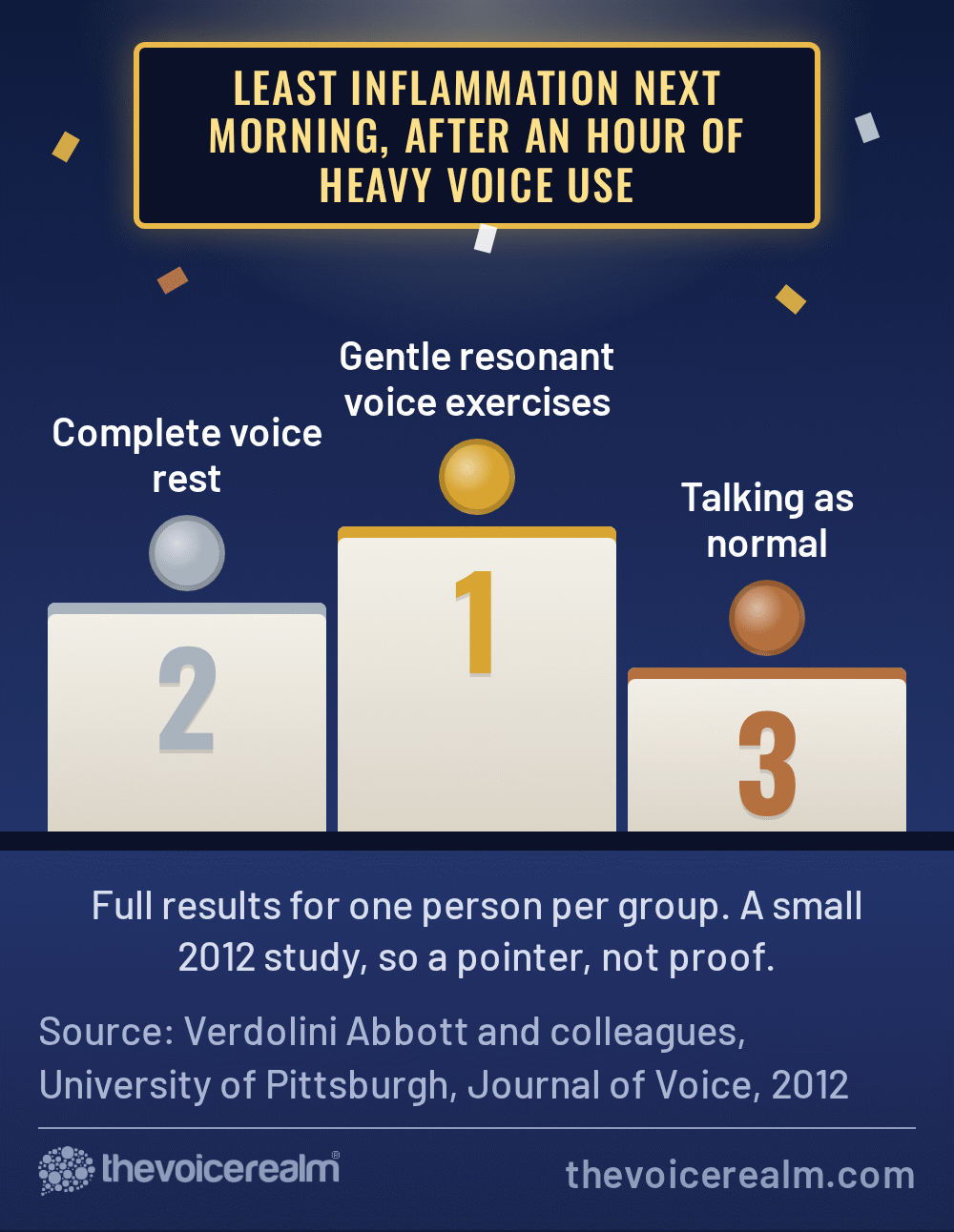
© The Voice Realm
The surprise for most people is that gentle exercise came out ahead of total silence. Resting isn’t wrong. It just may not be the only tool, and a few minutes of easy humming after a long session could be doing more than you’d think.
A five minute cool-down for the booth
This routine borrows from two places: the cool-down protocol Ragan designed for her study, and the “warm down” handout given to patients by the speech and language therapy team at the Royal Berkshire Hospital in the UK. Everything in it should feel easy. The NHS handout is clear on that point: “None of these exercises should feel painful or uncomfortable, so should this occur, stop the exercises until you have discussed this with your speech and language therapist.”
Do it before you leave the booth, while you’re still in the habit of paying attention to your voice. Set a timer for five minutes if that helps you actually do it.
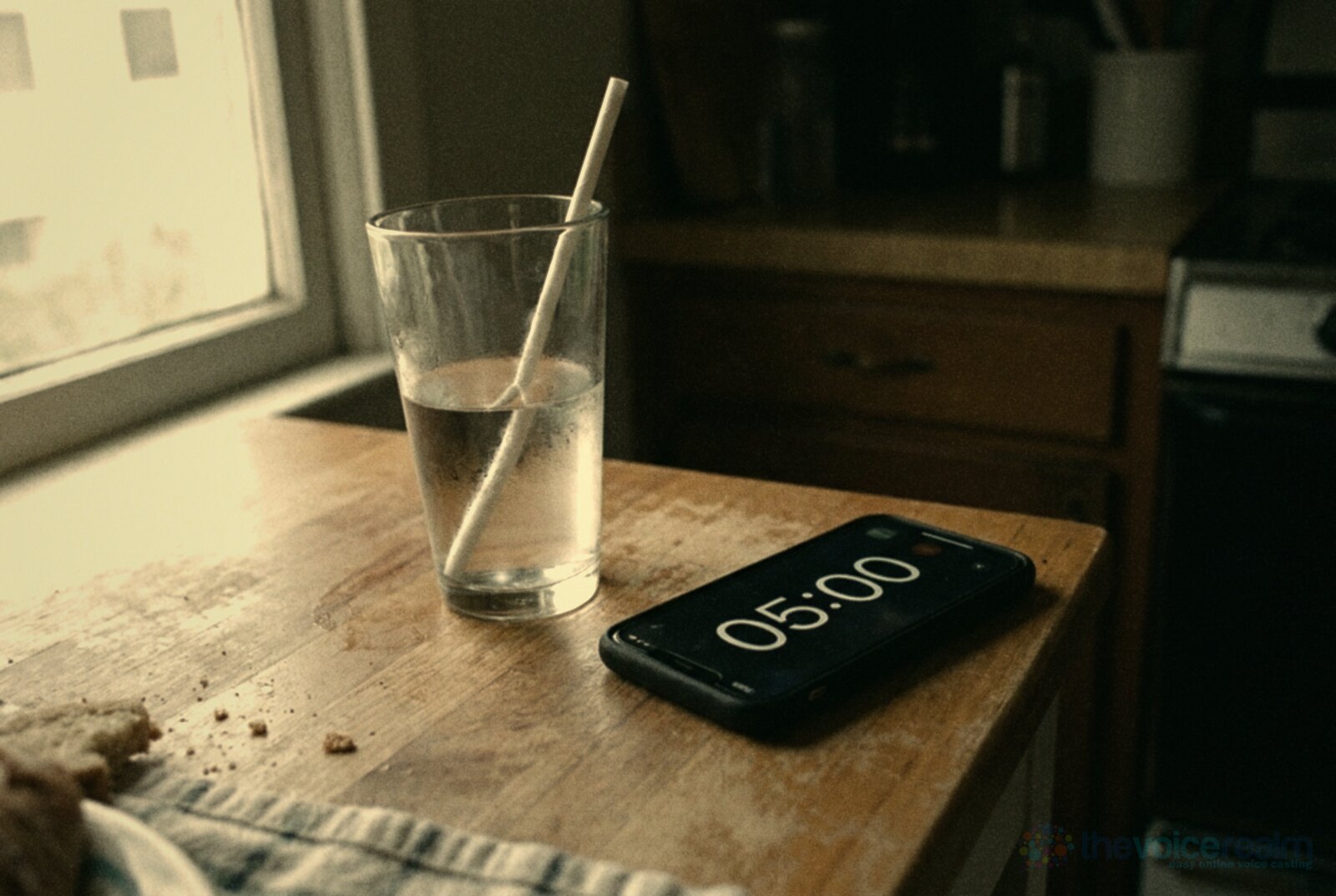
A straw and a five minute timer are all the kit a cool-down needs. © The Voice Realm
Start with silent breathing. The Royal Berkshire handout begins its warm down this way: “Breathe gently in through your nose and out via your mouth, without sound.” Notice your neck and shoulders and let them drop. After a long read, most of us are holding tension we didn’t know about.
Then the straw. Put a normal drinking straw between your lips and hum through it, sliding slowly from the bottom of a comfortable range to the top and back, three times. Ragan’s protocol opens with exactly this. Straw work is one of a family of exercises called semi-occluded vocal tract exercises, which partly close off the mouth so the pressure helps your vocal folds come together easily. If you’ve done our warm-up, you already know the feeling, and that’s the point: the same easy sounds that get you going also settle you down.
 VOICEMASTERACADEMYLearn the craft in order.Module one is freeStart module oneTwenty modules, start to finish.
Lip trills, gliding down. Let your breath out on a “brrrr” lip trill, then glide it up and down in pitch. If your lips won’t buzz, press a fingertip gently into each cheek. Keep the volume low.
Downward glides on buzzy sounds. The handout suggests gliding gently downwards on “zzzzz”, “vvvvvvv” and a soft “whooo”. Downward is the important word. You’re walking the voice back down from wherever the session left it.
A quiet hum. Finish with the handout’s simplest step: “Hum gently and quietly “mmmmmm” whilst feeling the sound resonate on your lips.” Keep your jaw loose and your teeth apart. If you feel a light buzz on your lips, you’re doing it right.
- Quiet. Nothing in the routine needs more than a soft, easy volume.
- Low and middle. Glides end lower than they start, back toward your everyday speaking pitch.
- Short. Five minutes is plenty. Longer isn’t better after a heavy day.
- Comfortable. Anything that hurts or scratches gets dropped, not pushed through.
Bring your speaking voice home after character work
The Royal Berkshire handout explains the point of a warm down in terms that will sound familiar to anyone who’s spent a day as a squeaky sidekick: “The warm down helps restore muscles to their resting tone. This particularly applies to singers who have had to sustain high pitch during singing. These singers sometimes find their speaking voices remain in a high pitch after singing.”
Replace “singers” with “voice actors” and it reads like a description of animation, video game and toy work. A high, bright character voice, a child voice or a manic promo read keeps the voice in a position it doesn’t normally live in. The downward glides and the hum are what bring it back.
Ragan noticed the same thing with her singers, who often described a “fuzzy” speaking voice after a long rehearsal and said the humming helped to “refocus” it. A good check before you leave the booth: say a few ordinary sentences out loud, something like your own name and what you’re having for dinner. If it sounds like you, you’re done. If it still sounds pitched up or tight, do another round of hums and downward glides.
If you’ve been screaming, growling or doing creature sounds, the cool-down matters even more. Our guide to keeping your voice in one piece through screams and death cries covers how to plan those sessions in the first place.
Lights off, but don't walk straight out and start talking. © The Voice Realm
The cool-down carries on after you leave the booth
The exercises take five minutes. The next couple of hours matter just as much, and that’s where most voice actors undo the good work without noticing.
The Pittsburgh study’s worst result came from the group that simply went back to normal talking after their hour of voice use. It’s a small study, but it lines up with common sense. A tired voice that goes straight into a long phone call, a noisy bar or a car ride shouting over the radio is getting another session, not a rest.
A few habits help:
- Keep the first hour quiet. You don’t need to go silent. Just avoid loud places and long calls straight after a heavy session.
- Turn the radio down in the car. Talking or singing along over road noise is one of the easiest ways to strain a tired voice without noticing.
- Keep sipping water. The handout ends its warm down with “Take sips of water and ensure you remain well hydrated across the day.”
- Book your sessions with gaps. If you’re stacking long reads back to back, our piece on how many hours a day you can safely record is worth a read.

Talking over road noise on the drive home is another session for a tired voice. © The Voice Realm
The next-morning check
Ragan ends her protocol with a soft, floaty “oo” sung high in the voice, and the reason is worth knowing. Drawing on the voice scientist Ingo Titze, she writes that if soft and high voice is difficult, “especially on the day after a strenuous workout, the singer probably has not fully recovered.” The delicate tissue near the surface of the vocal folds is what lets you sing quietly up high, so it’s the first thing to go when that tissue is still recovering.
You can turn that into a quick daily check. The morning after a big session, gently sing a soft, high “oo” on a few notes. If it comes out clean and easy, your voice has recovered. If it’s breathy, cracks or won’t start without pushing, take it as a sign to go easy that day: shorter sessions, more breaks, and certainly no screaming.
One morning of that is normal after a heavy day. If it keeps happening, or your voice stays hoarse for weeks, see a doctor and ask about a voice clinic. Our guide on vocal nodules sets out when to book that appointment.
Five minutes you’ll notice tomorrow
Nobody is going to hear your cool-down. It won’t make today’s takes any better. What it does, if the early research and a lot of singers are right, is help you recover faster, get back to your own speaking voice sooner and start tomorrow’s session from a better place.
So add it to the end of your session the same way you add the warm-up to the start. Silent breaths, a straw, a few lip trills, some downward glides and a quiet hum. Then go home and talk softly for a while. Your voice is the one piece of gear you can’t replace, and for once looking after it costs nothing but five minutes.
Sources: Kari Ragan, “The Efficacy of Vocal Cool-down Exercises”, Journal of Singing, May/June 2018 (a version of her Journal of Voice study; the survey figures it cites are from Donahue and colleagues, Journal of Voice, 2014, and Gish and colleagues, Journal of Voice, 2012); Katherine Verdolini Abbott and colleagues, “Vocal exercise may attenuate acute vocal fold inflammation”, Journal of Voice, 2012; Royal Berkshire NHS Foundation Trust, Speech and Language Therapy, “Voice warm up and warm down”, April 2024.
Ready to get booked?
See the jobs open right nowAbout Sarah Robbins
Sarah Robbins writes for The Voice Realm about finding voice over work, home studios, casting and the business side of voice acting.