Blog

This one’s for the voice actor who’s just been handed a car ad, a bank spot or a prescription drug commercial and has noticed the paragraph at the bottom. The offer end date. The APR. The “see dealer for details.” The list of side effects that runs longer than the ad itself. That’s the legal line, the tag, the disclaimer, and it’s a skill all of its own.
Most people read it badly in one of two ways. They gabble it as if it’s embarrassing, or they slow right down and turn it into a funeral. Neither is what the client wants, and one of them can get the ad pulled. Here’s how to read it fast, clear and in one piece.
Why the legal line is there in the first place
The disclaimer is there because a regulator says the listener has to be able to take it in, and the rules are surprisingly specific about how it should sound.
In the United States, the Federal Trade Commission’s Endorsement Guides define what “clear and conspicuous” means for a disclosure, and they don’t leave audio out. “An audible disclosure should be delivered in a volume, speed, and cadence sufficient for ordinary consumers to easily hear and understand it,” the rule reads. Note the word speed. Nobody wrote that line about video.
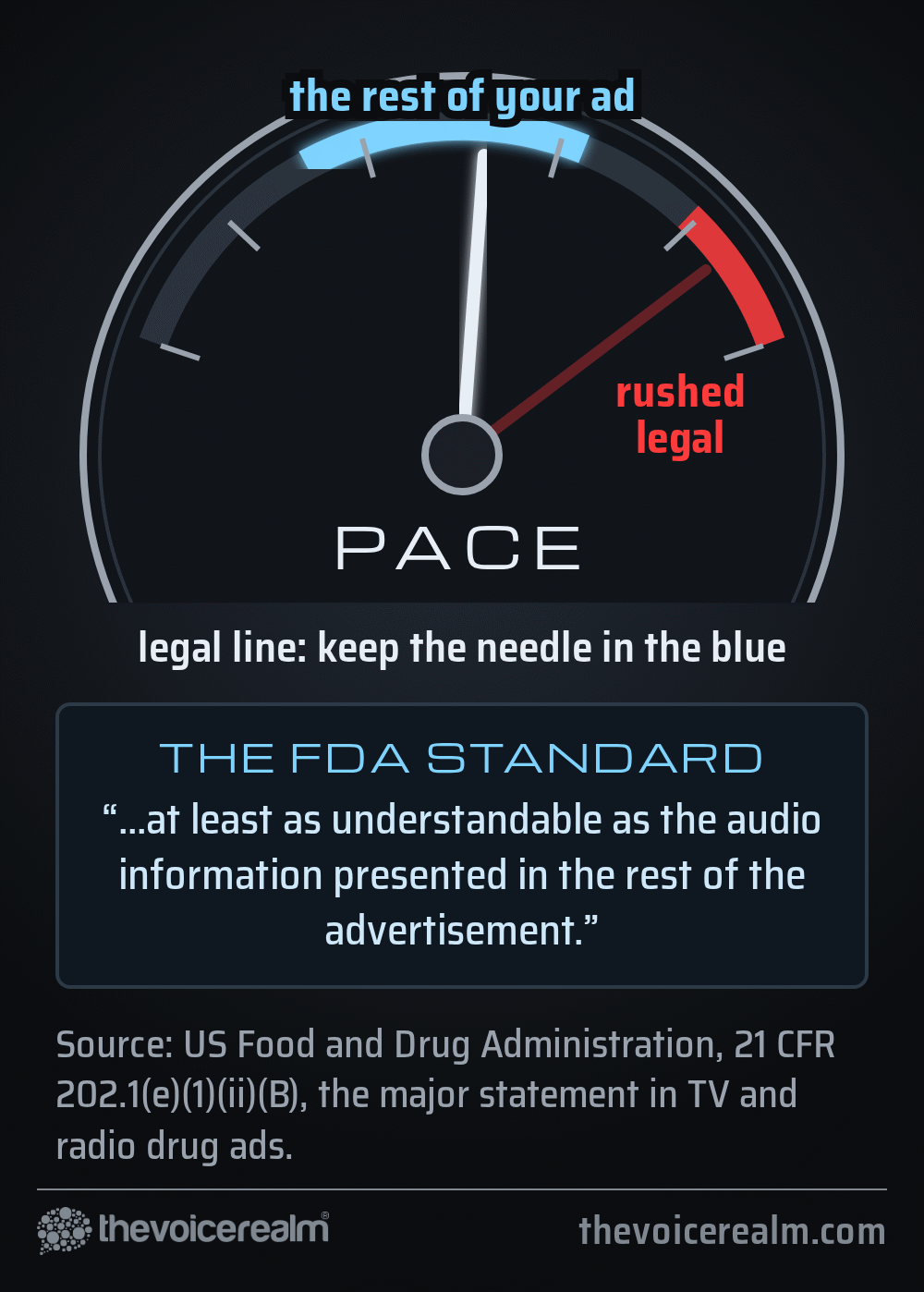
Drug advertising goes further. Since the US Food and Drug Administration’s final rule on direct-to-consumer ads took effect, the “major statement” of side effects in a TV or radio ad has to be presented in a clear, conspicuous and neutral manner. One of the standards is that “it is presented in consumer-friendly language and terminology that is readily understandable.” Another is that the ad mustn’t carry “audio or visual elements, alone or in combination, that are likely to interfere with comprehension of the major statement.” That second one is about music beds and busy pictures, which is the producer’s problem. The first is about the words in your mouth, which is yours.
The word that matters to you in that rule is neutral. A drug ad’s risk section isn’t supposed to sound like a cheerful afterthought or a whispered secret. It’s supposed to sound like the same trustworthy person who told you about the benefits, still talking to you.

© The Voice Realm
What happens when it’s rushed
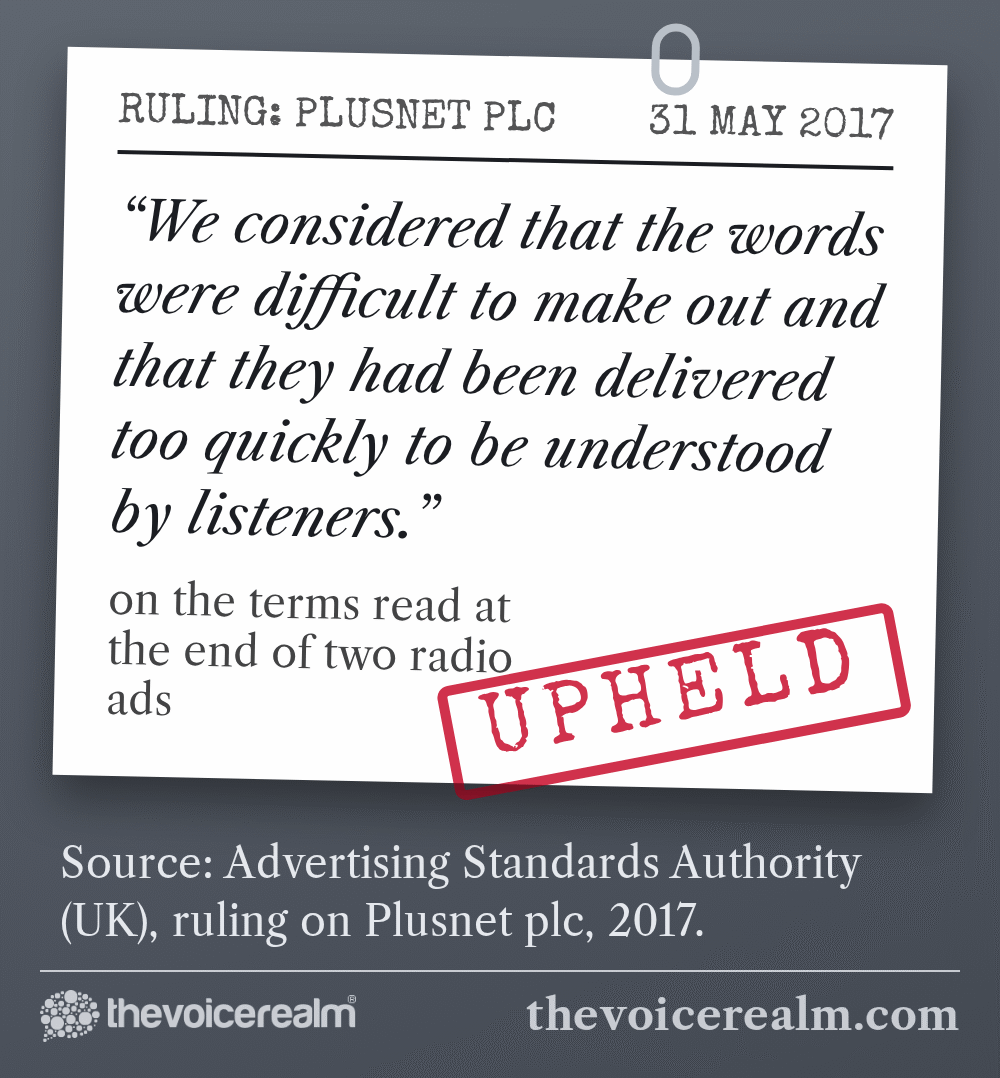
In the UK, the Advertising Standards Authority has ruled against radio ads for exactly this. In 2017 it upheld a complaint about two Plusnet radio ads, after a listener said the terms and conditions were too fast to follow. The ASA found the terms “were spoken at a much faster pace compared to the rest of the ad” and concluded that the ad was misleading. The ads weren’t allowed to run again in that form.
Read that finding again, because it’s the most useful sentence in this whole guide. The ASA didn’t measure the legal line against a stopwatch. It measured it against the rest of the ad. The problem was the change of gear.
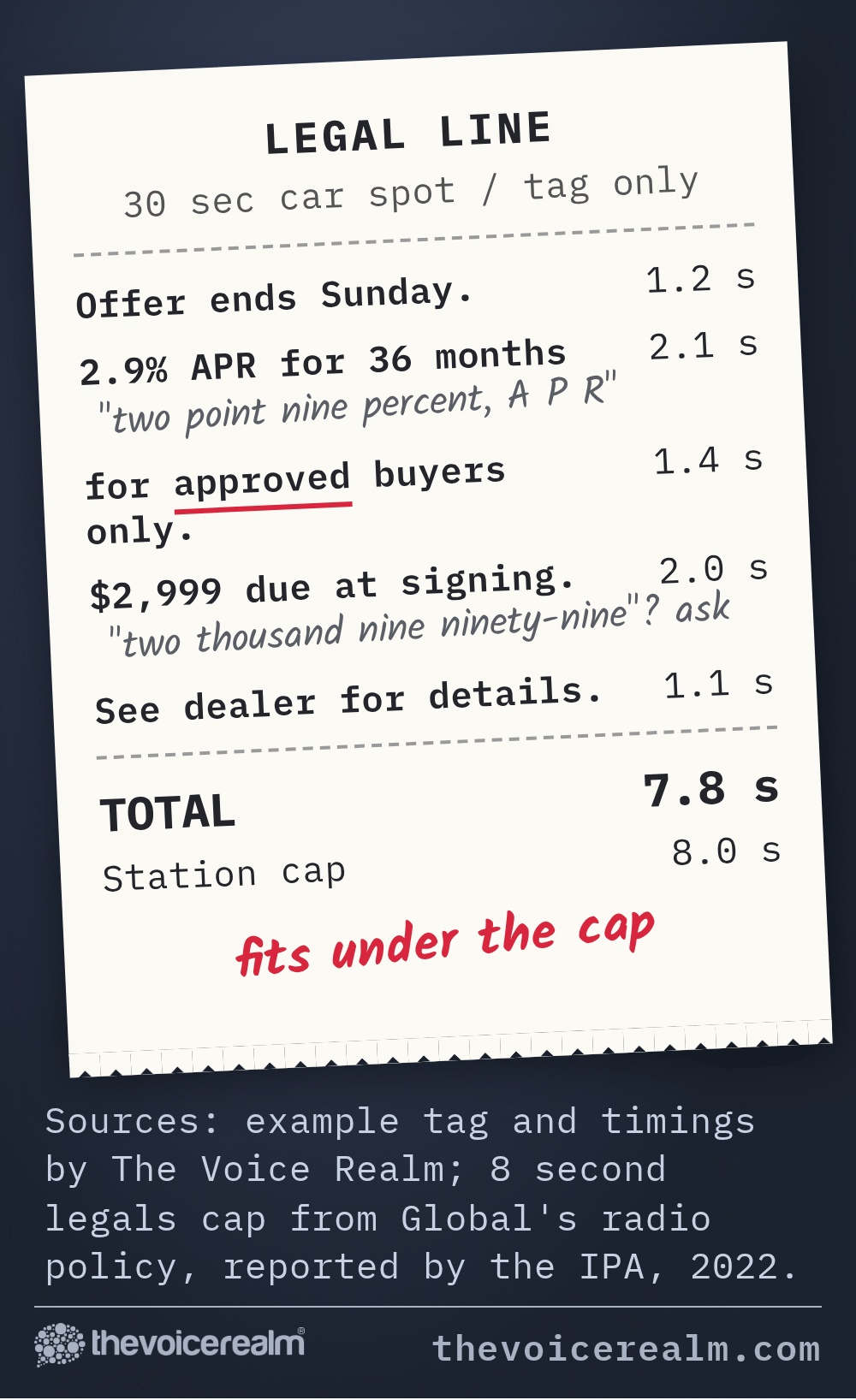
The radio industry has been pushing for shorter legals for years, partly because long ones don’t work anyway. Radiocentre, the trade body for UK commercial radio, published guidance in 2020 to help advertisers write tighter terms, citing research in which “only 4% of listeners say they can recall any salient facts” from the terms in radio ads. Global, the radio group behind Capital and Heart, went further and capped legals at eight seconds; its policy note says “the 8-second legals cap will now be rolled out to all Radio ads from 1 December 2022.”
So the copy is getting shorter in some markets. It isn’t getting easier to read, though, because a shorter legal is usually a denser one, and in plenty of markets you’ll still meet the full paragraph.
© The Voice Realm
Fast is a feeling, not a speed
Here’s the thing nobody tells you: a good legal read isn’t actually much faster than the rest of the spot. It sounds brisk because it’s flat, even and certain. A listener hears confidence as pace.
What makes a read sound fast and clear at the same time:
- Level pitch. In the body of the ad you’re shaping lines, lifting and landing. In the legal, keep the pitch on a gentle, steady line. That alone saves time, because you’re not spending syllables on melody.
- Full consonants. When people rush, the ends of words go first. “Approved credit” becomes “approve’ cred’.” Land every final t, d and s, even at speed, and the words survive.
- No dying fall. The classic legal mistake is starting strong and trailing off, as if you’re leaving the room. Keep the last word of the tag as present as the first.
- Short pauses, not none. A tiny gap between ideas lets the ear file each one. Take them out and it all smears together. Leave them in and the whole thing actually sounds quicker.
Think of an air traffic controller or a good train announcer. They say a lot in a short time, and you understand every word, because the delivery is even and the diction is crisp. That’s the register you’re after, warmed up to match the voice of the spot.

© The Voice Realm
Mark it up in chunks before you read it
Legal copy is written by lawyers for lawyers, and it doesn’t fall naturally out of the mouth. Five minutes with a pencil saves you twenty takes. If you’ve never marked a script before, our guide to pencil marks that make a script easier to read covers the basics; for legals, three habits matter most.
Split it into thoughts. Draw a slash between every separate idea: the offer, the condition, the exclusion, the instruction. Each chunk gets one even breath of delivery, and you’ll find most legals are four to six chunks long.
 VOICEMASTERACADEMYTwenty modules, one at a time.Breath controlHome studioCommercial techniqueAuditionsStart module oneNo experience needed.
Write out every number the way you’ll say it. Is 2.9% “two point nine percent” or “two point nine per cent”? Is $2,999 “two thousand nine hundred ninety-nine dollars” or “twenty-nine ninety-nine”? Is APR said as letters, or as “annual percentage rate”? Ask, then pencil it in above the figure. Numbers are where legal reads go wrong, and our piece on saying numbers and web addresses out loud goes deeper on the choices.
Find the one word that can’t be misheard. In most tags there’s a word the whole thing hangs on: “not,” “excludes,” “only,” “approved.” Underline it. It doesn’t get extra punch, but it must never get swallowed.
Drug names and medical terms get the same care. If a pharmaceutical spot lists conditions you’ve never said aloud, check them before the session, the same way you would for any medical narration job.
© The Voice Realm
Keep it in the same voice
The single most common note a producer gives on a legal is some version of “don’t change gears.” The read should sound like the same person, in the same room, who has simply moved on to the small print.
So keep your placement, your energy and your distance from the mic the same as the body of the spot. Don’t drop into a lower, quieter “legal voice.” Don’t brighten up into an announcer either. If the spot is a warm, smiling conversational read, the legal is a warm, efficient one. If the spot is a hard sell, the legal is crisp and businesslike, never mumbled.
“A listener hears confidence as pace. The legal line sounds fast because it’s even, not because you sped up.”
The Voice RealmPost this quote
There’s a practical reason too. Editors often cut the tag on to different versions of a spot: a thirty and a fifteen, a radio mix and a streaming mix, a new offer end date next month. If your legal sounds like a different session, every edit shows. If it sounds like the same breath as the line before, nobody can hear the join.
Give the editor what they’ll ask for
The legal is the part of a commercial most likely to change after you’ve gone home, so record it in a way that’s easy to use.
- Read it in the full spot and on its own. Record the whole ad through, then give the legal as a separate pass, two or three takes, with a beat of silence either side.
- Give two speeds. One at your natural, comfortable legal pace and one a touch tighter. Slate them clearly so the editor knows which is which. A producer will often prefer your tighter take to digitally speeding up a slower one, because time compression starts to sound processed if it’s pushed.
- Know the budget. If the producer tells you the tag has to fit in a set time, time a take and tell them where it lands. If it doesn’t fit cleanly at a clear pace, say so. Suggesting that a line could be cut is a lot better than delivering a read nobody can understand, and as the ASA case shows, an unclear legal isn’t a safe legal.
- Keep the room the same. Pickups on legals are common, often weeks later. Note your mic position and settings so the new date or price slots in without a change of sound.
Timing is its own craft, and our guide to how many words fit in a thirty explains why the legal eats into the read before you’ve said a word.
© The Voice Realm
A ten-minute drill to get good at it
You don’t need a booking to practise. Legal copy is everywhere, and most of it is public.
- Collect real tags. Copy the small print from a few car, bank and phone ads, or from the bottom of an offer email. Print them so you can mark them up.
- Mark each one. Chunks, numbers written out, the one word that can’t be lost.
- Read the line before it. Always rehearse the legal with the last line of the ad in front of it, so you practise staying in the same gear.
- Record three takes and time them. Comfortable, tighter, tightest you can do while staying clear.
- Play them to someone who hasn’t seen the copy. Ask them to tell you the offer end date and the main condition. If they can’t, the take failed, however good it sounded to you.
That last step is the whole test. The rules in the US and the UK both come back to the same idea: an ordinary listener has to be able to take it in. Your ears are the wrong judge, because you already know what it says.
Do the drill a few times a week and you’ll find legals stop being the part of the session you dread. They become the part where you quietly show a producer you’re a pro: quick, clean, the same voice to the very last word, and done in one take more often than not.
Sources: Federal Trade Commission, “16 CFR 255.0, Purpose and definitions” (Guides Concerning the Use of Endorsements and Testimonials in Advertising); US Food and Drug Administration, “21 CFR 202.1, Prescription drug advertisements”; Advertising Standards Authority, “ASA Ruling on Plusnet plc” (31 May 2017); Radiocentre, “Radio industry tackles over-lengthy advertising terms & conditions” (5 February 2020); IPA, “Global Radio extends 8-second T&C policy to all sectors” (15 August 2022).
Ready to get booked?
See the jobs open right nowAbout Sarah Robbins
Sarah Robbins writes for The Voice Realm about finding voice over work, home studios, casting and the business side of voice acting.