Blog

Next Monday the Lord Mayor of Sheffield will hand a blue plaque to a radio programme. Not to a building or a famous former resident, but to a Saturday afternoon football phone-in where supporters ring up to cheer or moan about the match they’ve just watched.
BBC Radio Sheffield’s Praise or Grumble turns 40, and RadioToday reports it’s the UK’s longest running football phone-in. For voiceover artists, it’s a better lesson in the value of a real regional voice than most workshops, and it arrives just as more British clients are asking for exactly that sound.
Here’s our read on what a plaque for a phone-in tells voiceover artists about accent, warmth and the sound of a place, with a few practical steps and a word for the brands and producers who book them.
A blue plaque for a phone-in
The programme was founded in 1986 by Robert Jackson, who was also its first presenter. RadioToday says his family will join former hosts and the current presenters, Adam Oxley, Rob Staton and Andy Giddings, for the presentation, and a special live programme will go out from the event, with supporters invited along.
The show brings together fans of Barnsley, Chesterfield, Doncaster, Rotherham, Sheffield United and Sheffield Wednesday. Over four decades the callers have included the actor Sean Bean and the former Sheffield United and Rotherham manager Neil Warnock. This year listeners are also being invited to record their own praises and grumbles, some of which may make it on air.
Katrina Bunker, BBC Senior Head of Content Production for Yorkshire, called it “one of local radio’s great institutions, giving supporters a platform to celebrate victories, vent frustrations and share their passion for the game.” Presenter Rob Staton put it more simply: “It’s at the heart of our community”.

© The Voice Realm
Why a phone-in is a masterclass in real voices
Listen to any football phone-in and you’ll hear something most scripts try to recreate and most reads miss: people talking because they care. Nobody ringing Praise or Grumble is performing. They’re telling you the back four were a disgrace, or that the lad on the wing is the best thing they’ve seen in years, and they’re telling you in their own accent, at their own speed, with all the rise and fall of somebody who means every word.
That’s the read so many advertisers now ask for: conversational, relatable, “not too polished”. It’s hard to do from a script, because a script is tidy and real speech isn’t. A caller doubles back, leans on an odd word, laughs halfway through a sentence, drops the volume for the bit that really hurts. Voiceover artists who study real talk, rather than other voiceovers, get far closer to it.
There’s a timing lesson in there as well. Callers on a Saturday phone-in have a minute or two before the presenter moves on, so the good ones get to the point fast and save their best line for the end. That’s the shape of a thirty second radio spot: hook, reason, payoff. Next time you’re handed a conversational script, try reading it the way a caller would make their point, and notice how much of the ad-voice falls away.
We looked at the opposite end of sports broadcasting recently with Australia’s racing commentators, whose craft is pure pace and precision. Our piece on what a Melbourne Cup caller can teach a voice covers that side. The phone-in is the other half of the picture. It isn’t technique, it’s truth, and the accent is a big part of the truth.
Britain still ranks its accents
If regional voices sound so good on air, why do so many people still try to iron theirs out? Because research says they’ve been given good reason to.
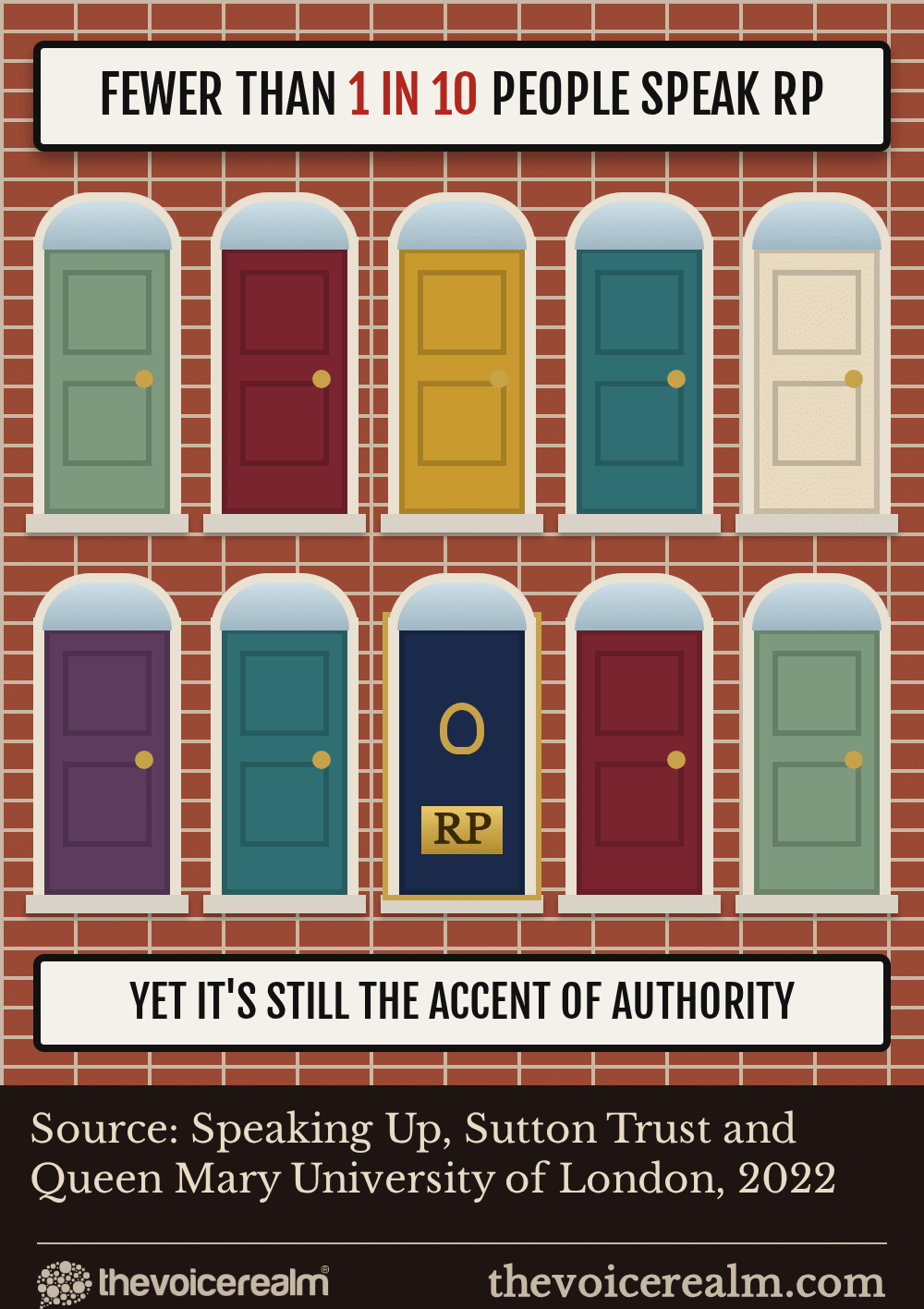
The Sutton Trust’s 2022 report Speaking Up, led by Professor Devyani Sharma of Queen Mary University of London, asked how different accents are perceived. Queen Mary’s summary says Received Pronunciation ranks highly, while the lowest rankings go to ethnic minority accents and “those associated with ‘working class’ industrial English cities (Manchester, Liverpool, Birmingham)”. It also found that “29% of university applicants from the North were concerned that their accent could affect their ability to succeed, compared to 10% of those in the South (excluding London)”.
Professor Sharma put it plainly: “Our work shows that a long-standing hierarchy of accent prestige in Britain is still in place.” There’s a hopeful line in the same release too. She said “recruiters can disregard accent when alerted to the problem in training, as well as when candidates speak confidently and knowledgeably, regardless of their accent.”
Voiceover is one of the places that old hierarchy has loosened fastest. Sit through an evening of British adverts now and you’ll hear Geordie, Scouse, Brummie, Glaswegian and broad Yorkshire selling everything from broadband to biscuits. Clients looking for regional British voices are usually after the same thing a phone-in has in bucketloads: trust. A Yorkshire voice telling you a building society is straightforward sounds like a neighbour, not a call centre.
© The Voice Realm
What clients mean by a real voice
“Real” has become one of the most common words in a voiceover brief, and it rarely means the same thing twice. Most of the time it means the client has heard too many ads that sound like ads, and wants one that sounds like a person.
Neutral, polished, from nowhere
A smooth delivery with no regional colour, the same read whether the ad runs in Truro or Thurso. Safe, and very easy to forget.
Local, warm, from somewhere
A voice the audience hears as one of their own, a conversational pace and a smile you can hear. Harder to fake, and much harder to ignore.
Brands with a regional footprint, a building society, a supermarket’s northern stores, a club’s season ticket campaign, often want the local voice above everything else. That’s work where the right accent can win the job before the audition’s half over. Commercial radio is where it shows most clearly, and the voiceover artists behind radio adverts who do best are often the ones who sound most like the station’s own listeners.
None of this means polish is dead. A regional read still has to be clean, consistent and in control. The trick is keeping the warmth of real speech while hitting the time, the brand name and the call to action in every take.

© The Voice Realm
Football is a voice business too
Football has always been an audio business, long before anyone filmed a pundit. Every club now needs a steady stream of voiced content: matchday videos, kit launches, season ticket campaigns, stadium tour audio, community projects. Most of it sounds best in the club’s own accent, read by someone who’d be at home on that phone-in.
 VOICEMASTERACADEMYTwenty modules, one at a time.Breath controlHome studioCommercial techniqueAuditionsStart module oneNo experience needed.
Then there are the books. Every autumn brings a fresh crop of football memoirs, and when the player isn’t reading their own, the narrator has to carry a club’s accent across ten hours without sliding into caricature. If long-form work appeals, it’s worth hearing how the best audiobook narrators pace a story, because a memoir in a South Yorkshire voice needs a narrator who sounds at home in it.
And there’s the oldest football voice job of all, the stadium announcer. Nobody needs them to sound posh. Everybody needs them to sound like they belong.

© The Voice Realm
Our take
Here’s our read. A blue plaque for a phone-in is a lovely bit of local pride, and it’s also a quiet argument about what makes a voice worth listening to. Forty years of callers haven’t been trained, coached or smoothed out. They’ve just been themselves, and people have tuned in every Saturday to hear it.
For voiceover artists, the lesson isn’t to throw away technique. It’s that your accent isn’t a flaw to work around. It’s part of your range, and for a lot of British clients it’s the reason they press play on your demo in the first place. Research says people still carry real worry about how they sound. We’d rather they carried a demo that shows it off.
We also like that the anniversary week hands the microphone back to listeners, inviting them to record their own praises and grumbles. That’s the whole spirit of the thing. The programme has never pretended its callers need to sound like presenters, and the best moments in four decades of Saturday afternoons have almost certainly come from people who’d never been near a studio. There’s a humility in that which every voiceover artist could use: the audience already knows what a real voice sounds like, because they hear one every time they open their mouths.
The flip side is responsibility. A caller can ramble. You can’t. The skill that gets you booked is being completely yourself while landing every word the client paid for.
© The Voice Realm
What to do with your own accent this week
Record a praise or grumble of your own. Talk for sixty seconds about something you care about, unscripted. Transcribe it, then read the transcript back as a script. The gap between the two takes is exactly what you’re training to close.
Put your natural voice on your demo. If your own accent isn’t on your demo, add a short spot in it. Clients who want a Sheffield, Glasgow or Bristol sound need to hear it in the first ten seconds.
Name it the way clients search. In your profile, describe your accent precisely, “South Yorkshire” rather than “northern”. If you also do a neutral read, say so as well.
Learn the neighbours. Good regional artists can usually move a few miles either way convincingly. Our guide to learning an accent properly covers the listening work, and it applies to dialects close to home as much as faraway ones.
Listen to local radio. Phone-ins, community stations, regional breakfast shows. It’s free training in how real people sound right now, and it changes faster than you’d think.
For brands and producers. If your audience lives somewhere, think about hiring a voice who does too. Put the accent in the brief, ask for a natural read alongside the polished one, and let the auditions show you which your listeners would trust.
Sources: “Praise or Grumble to receive 40th anniversary plaque”, RadioToday, 9 November 2026; “New Queen Mary research reveals impact of accent on social mobility”, Queen Mary University of London, on the Sutton Trust report Speaking Up.
Ready to get booked?
See the jobs open right nowAbout Sarah Robbins
Sarah Robbins writes for The Voice Realm about finding voice over work, home studios, casting and the business side of voice acting.