Blog
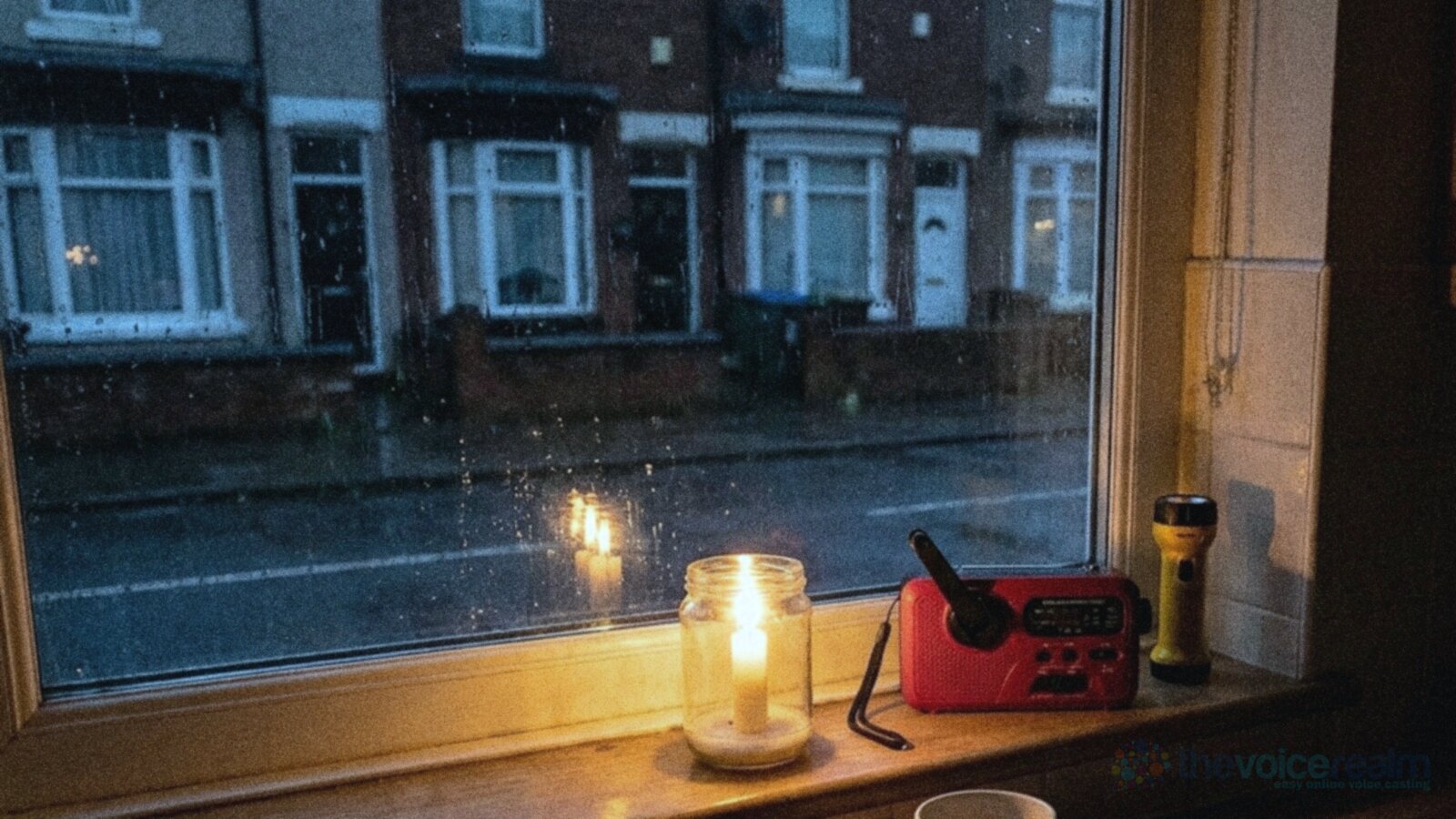
Last Thursday the government asked every household in Britain to keep a radio in the cupboard. Not a smart speaker, not an app, but a battery or wind-up FM set that still works when the power, the broadband and the phone signal don’t. Within days, high street shops were reporting a run on them. This piece is for British voiceover artists, and for the councils, utilities and agencies who will be writing the messages those radios carry. When the lights go out, the voice on the other end is the whole service, and a lot of that voice work is about to be commissioned.
What Be Ready actually asks
The Cabinet Office launched Be Ready on 22 October as the first stage of a three-year campaign. Its message is simple: have enough at home to manage for three days if a storm, a long power cut or a cyber attack takes out the services you rely on. The campaign website puts it in two plain sentences: “From severe weather to cyber attacks, emergencies can disrupt the services you rely on. Being ready for 3 days helps you manage while support reaches those in need.”
The downloadable checklist covers water, food that needs no cooking, a torch, blankets, cash, copies of documents, medication, and, under communication, a battery or wind-up FM radio with a charged power bank. As the UK Defence Journal reported, more than five hundred organisations have signed up to share the materials, Scotland and Northern Ireland have their own versions, and social media and radio advertising over the coming weeks and months will target families with young children and older people.
That last detail matters to anyone reading this with a microphone in the spare room. A national campaign aimed at older listeners and young families, running for three years, will be heard as much as it’s read.
© The Voice Realm
The run on radios
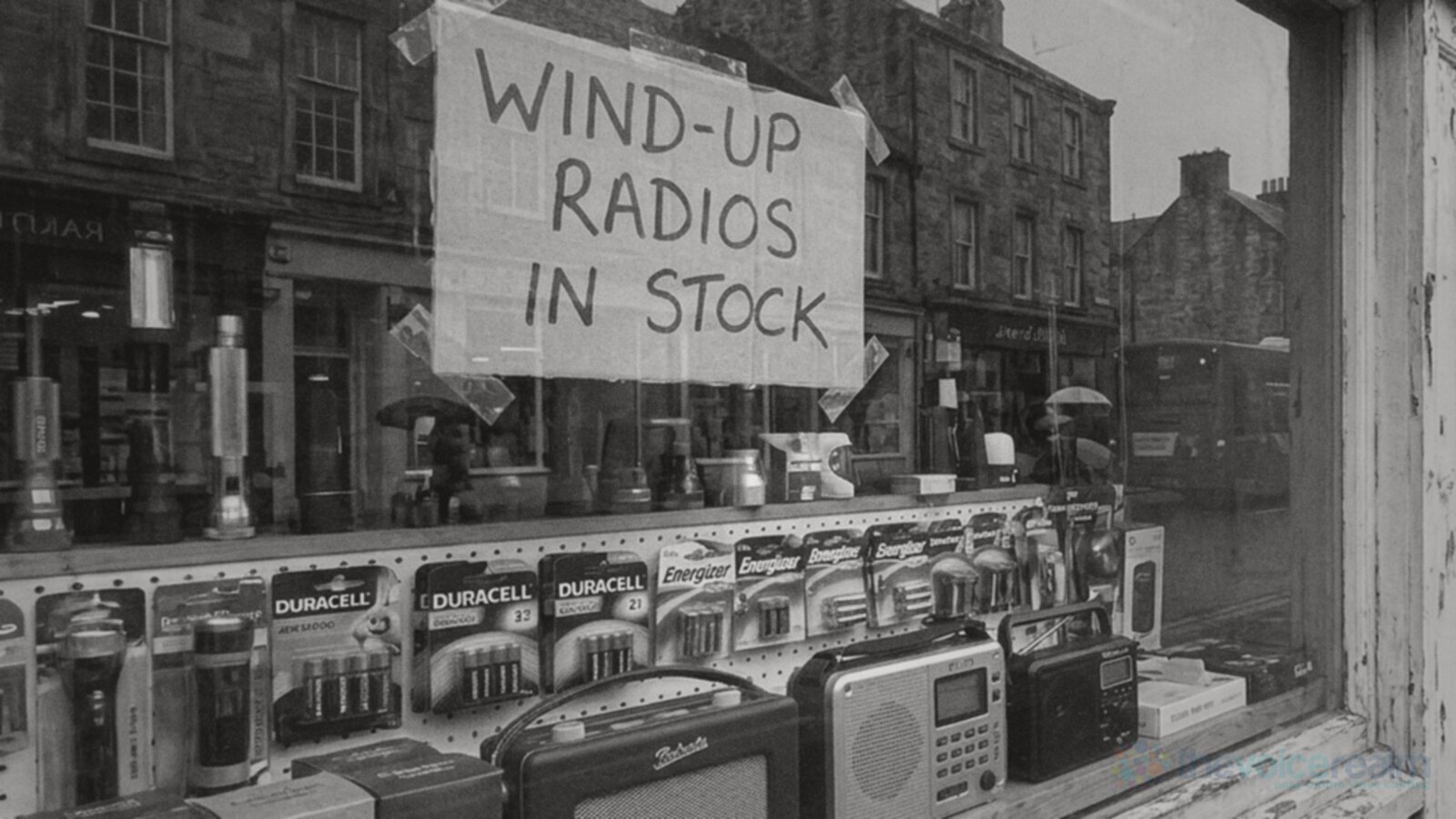
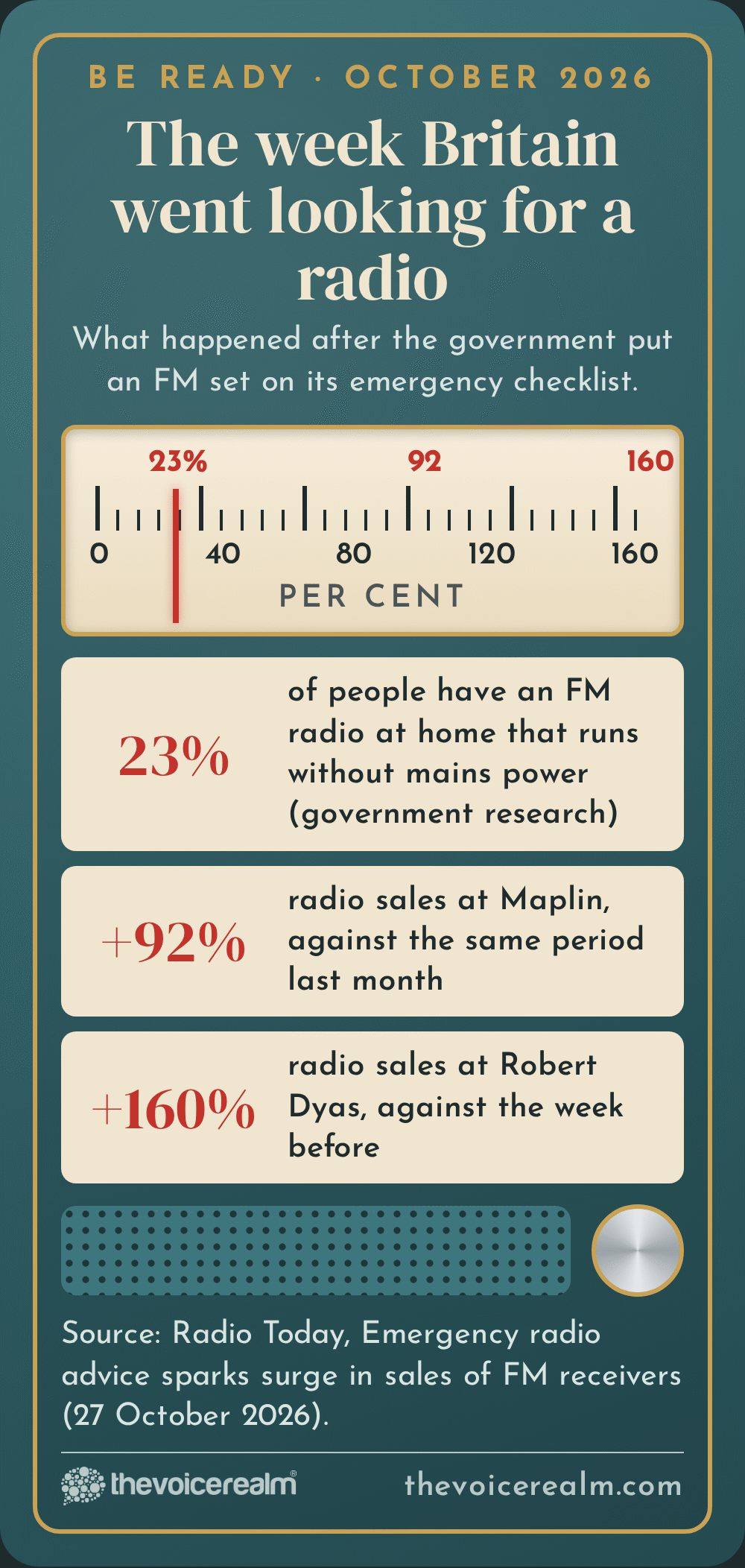
The response on the high street was quick. Radio Today reported that Robert Dyas saw radio sales rise by 160% on the previous week, and Maplin by 92% on the same period the month before. Government research quoted in the same report suggests only 23% of people have an independently powered FM radio at home, not counting the car or a phone.
There’s an awkward wrinkle. The guidance specifically recommends FM, even though more and more stations broadcast only on digital, and it doesn’t name a single national emergency frequency. Households are told to write down the frequencies of the local and national stations they use for news. Radio Today also noted that in June the BBC’s Rhodri Talfan Davies told a House of Lords committee the corporation would concentrate emergency information on two major radio frequencies during a national power outage, while keeping the ability to broadcast locally on FM and DAB. Which two, nobody has said yet.
For a medium that spends a lot of time being told it’s old fashioned, it was a striking week. The government’s own preparedness advice puts a radio next to the torch and the bottled water.
Here’s our read: an emergency is a voice job
Think about what you’d actually hear in a three-day outage. The newsreader and the local station presenter, of course. But also the pre-recorded public information slots that stations play between bulletins. The recorded message on a power cut line when you ring to find out how long it’ll be. The council’s flood line. The water company’s hold queue. The explainer video a housing association sends round before winter, and the version of it that gets read out on community radio for people who never saw the video.
Almost all of that is written and recorded in advance by someone. Some of it will be voiced by broadcasters, but much of it goes to voiceover artists through agencies, production houses and in-house comms teams who need a clear, warm, trustworthy read by Thursday. Be Ready gives every one of those organisations a reason to look again at what their messages sound like. Expect a winter of refreshed phone prompts, new public information spots and updated explainers.
The phone line work is easy to overlook. When the power goes, the first thing many people do is ring someone, and the first voice they hear is a recording. If you’ve never done it, it’s worth learning the craft of recording phone prompts properly: short phrases, consistent level, and the kind of evenness that still sounds right when the system stitches your words together in a different order.
© The Voice Realm
What a trusted voice sounds like
There’s a particular register for this work and it isn’t the one most of us use for ads. A commercial read sells. An emergency read informs, and the listener may be frightened, cold, half asleep or hard of hearing. Laura Scott, the British Red Cross Director for UK Resilience, summed up the spirit of the campaign at its launch: “We can’t control when emergencies happen, but we can all take some simple steps to be prepared.” That tone, calm and practical with no drama, is exactly the read.
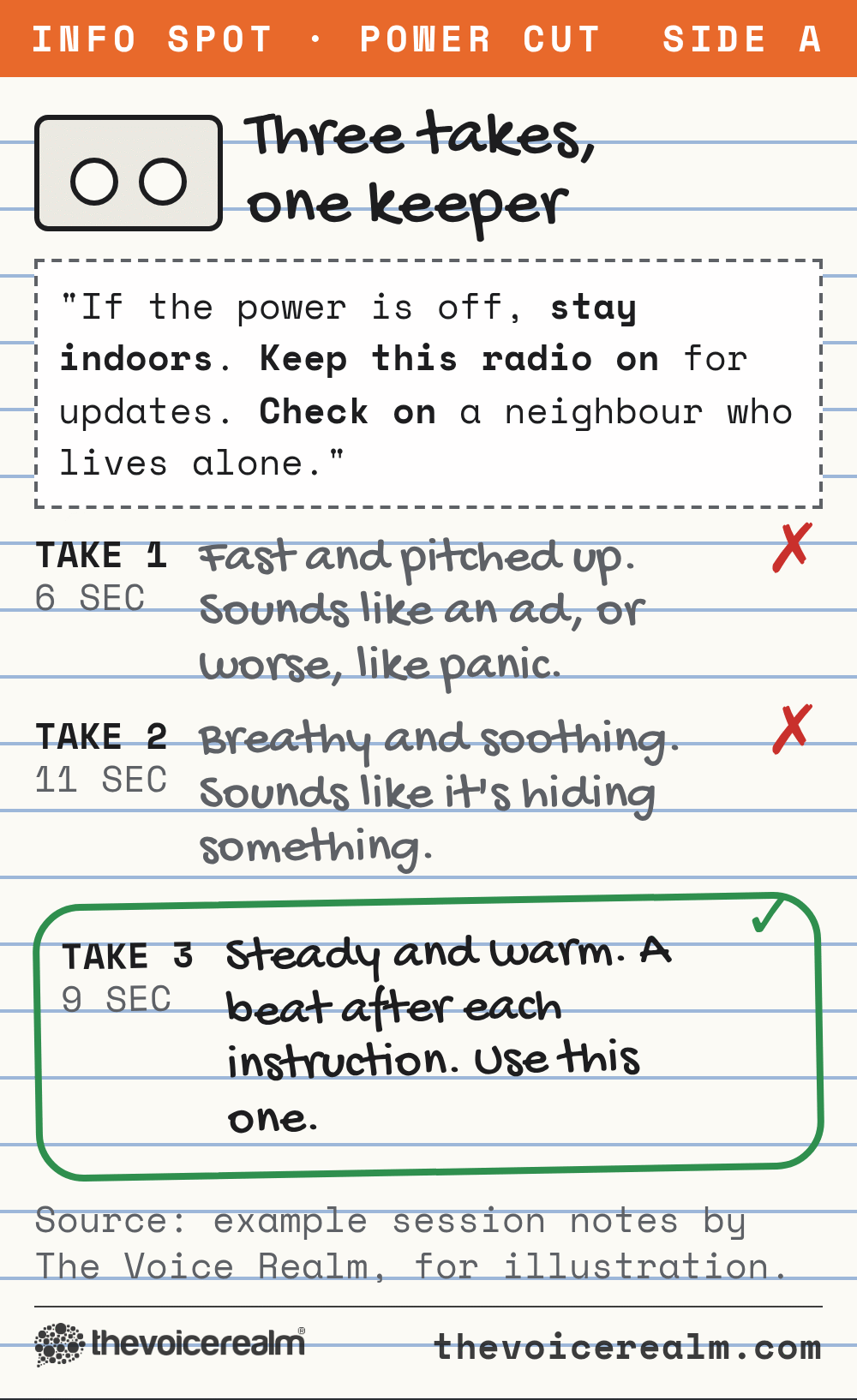
Calm doesn’t mean soothing. A breathy, comforting voice can sound as if it’s hiding something. The voice people trust in an emergency sounds like a capable neighbour: steady pace, low pitch movement, warmth without performance, and every key word landed cleanly. Slow down a touch from your normal conversational pace, because the listener is doing something else with their hands. Pause after instructions. Say important numbers twice, grouped the way people write them down, which is where the craft of reading numbers aloud earns its keep. And never sound as if you’re reading. In a crisis, people tune out anything that sounds like an announcement and lean in to anything that sounds like a person.
© The Voice Realm
Why the accent matters
A campaign that reaches older listeners in Cornwall, Belfast, Swansea and Inverness won’t land with one voice. Scotland and Northern Ireland already run their own versions of the advice, and local councils will produce their own messages for their own areas. People trust a voice that sounds as if it comes from where they live, especially when the message is about their street flooding or their substation failing. That’s an opening for voices from across Britain, not only the neutral southern read that still dominates national campaigns.
 VOICEMASTERACADEMYLearn the craft in order.Module one is freeStart module oneTwenty modules, start to finish.
Language matters too. In Wales, public bodies routinely put information out in Welsh and English, so a voiceover artist who can give both versions the same steady, unhurried read is worth a great deal to a council comms team. The same goes for anyone who can voice a message in one of the community languages spoken in British cities, where an outage notice in English alone will miss people who most need it.
If your natural accent is regional, this is work where it’s an asset. Put a short public information read in your own voice on your reel, and make sure the people producing local messages can find you.
Announcer mode
Fast, bright and pitched up. Numbers said once and run together. Instructions buried mid-sentence. Sounds like an advert, so listeners stop believing it.
Capable neighbour
Steady, warm and a little slower than normal. One instruction per sentence, a pause after each. Numbers twice, in groups. Sounds like a person who knows what to do.
Practical steps for voiceover artists
First, record a sixty second public information read in your own words: a power cut message, a flood warning or a “what to keep at home” spot. Keep it plain. Listen back through a cheap radio speaker or your phone, because that’s how it’ll be heard, and make sure every word survives the small speaker.
Second, build a short set of phone prompts in the same voice. Utilities and councils often buy the hold message, the out-of-hours message and the outage update as a set, and they like the same voice across all three.
Third, practise the slow read. Most of us are trained to fit too many words into thirty seconds. Time yourself reading the same script at your ad pace and at an information pace, and learn to feel the difference without a clock.
Fourth, look after your own resilience. A home studio with no power isn’t a studio. A charged power bank for your laptop and interface, a backup of your session files somewhere off the machine, and a way to tell a client you’re offline will save a job one day.

© The Voice Realm
For the people writing the messages
If you’re commissioning outage messages, information spots or preparedness explainers this winter, write for someone listening on a wind-up radio in a cold kitchen. Short sentences. One instruction at a time. Numbers spelled out exactly as they should be said. Then cast for trust, not polish. Ask for a custom audition on your actual script, play the auditions back through a small speaker, and pick the voice you’d believe if you were the one sitting in the dark.
And keep the voice consistent. If the same organisation’s phone line, video and radio spot all use the same voiceover artist, people recognise it, and recognition is half of trust.
© The Voice Realm
Our take
We like Be Ready. It’s sensible, unglamorous advice, and it quietly admits something the audio industry has known for a long time: when everything else fails, people turn to a voice on the radio. The run on wind-up sets shows the public agrees.
For voiceover artists, the campaign is a nudge to take a kind of work seriously that rarely wins awards. Public information reads, outage lines and local explainers need skill, restraint and a voice people believe. Do them well and you’re part of how your town gets through a bad night. Not a bad thing to have on the reel.
Sources: “Be Ready”, Cabinet Office (October 2026); George Allison, UK Defence Journal, “Households asked to prepare for three days of disruption” (22 October 2026); Radio Today, “Emergency radio advice sparks surge in sales of FM receivers” (27 October 2026).
Ready to get booked?
See the jobs open right nowAbout Sarah Robbins
Sarah Robbins writes for The Voice Realm about finding voice over work, home studios, casting and the business side of voice acting.