Blog

This guide is for voice actors who open a script and find a name they’ve never heard said out loud. A surgeon’s surname in a medical module. A Welsh village in a tourism spot. A brand that was invented last Tuesday. A character in book three of a fantasy series. You can read beautifully for thirty minutes and still lose the client on one word, because a wrong name is the mistake everybody hears.
Below is how the people who do this for a living find the right answer, where to look when nobody hands it to you, how to write it down so you can read it at speed, and what to do when you simply can’t confirm it.
Why one wrong name undoes a good read
Listeners forgive a lot. A tiny breath, a slightly rushed line, a read that’s a touch warmer than they pictured. What they don’t forgive is hearing their own name, their town or their product said wrong. It tells them nobody checked, and it makes them wonder what else nobody checked.
Broadcasters worked this out a long time ago. Voice of America, which covers news from all over the world, has kept a public pronunciation guide since around 2000. Its own account of the project quotes VOA broadcaster Jim Tedder, and puts his reason simply: using the correct pronunciation of a name “shows that the speaker cares about his listener.”
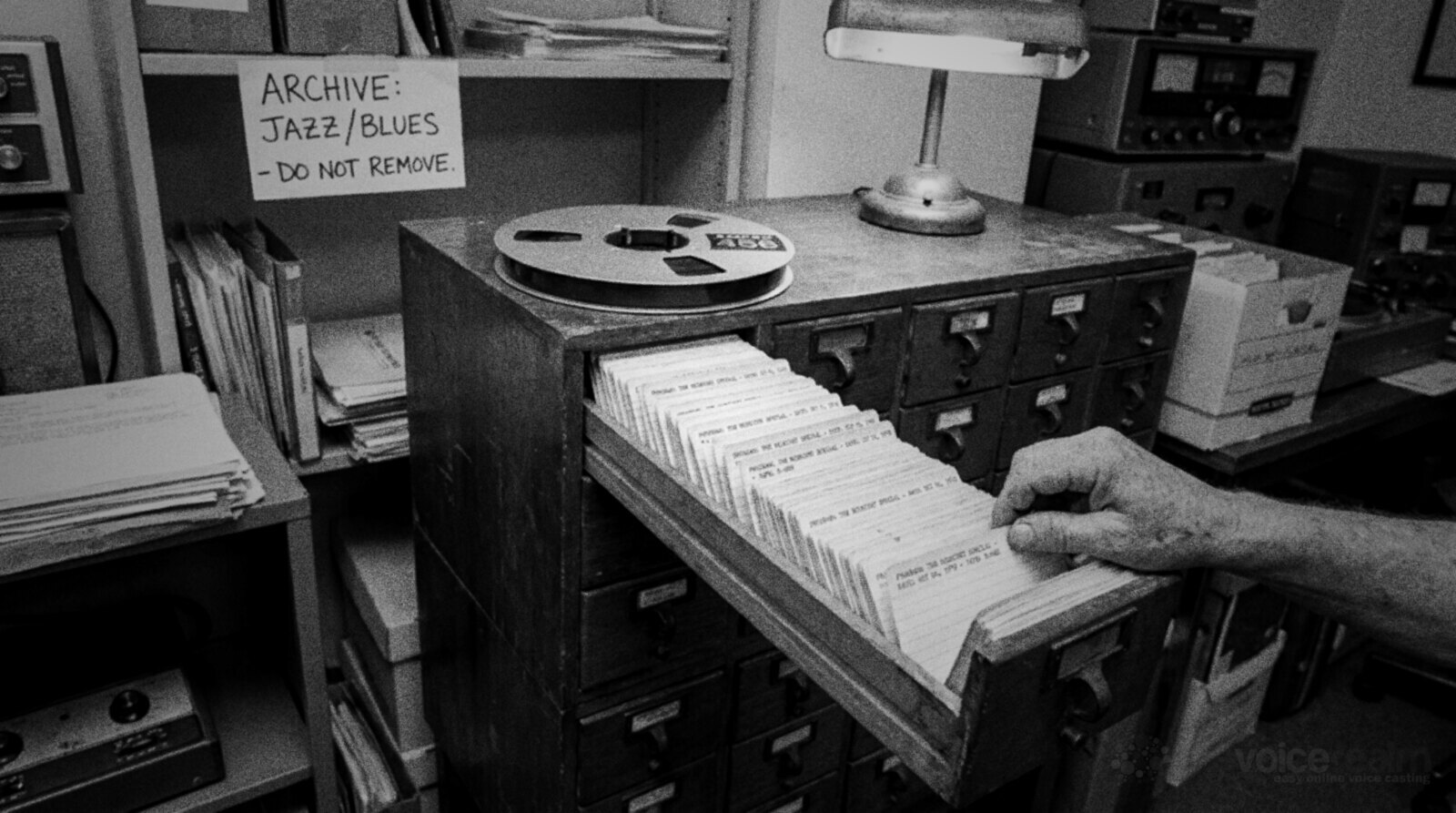
Before that guide went online, VOA’s announcers worked from a drawer of cards. The same page describes how “VOA broadcasters used index cards with phonetic pronunciations written on them, a system that had been in place since the 1950’s.” The format has changed. The habit hasn’t. Professionals look it up, write it down and keep it.
For a freelance voice actor the stakes are personal. A client who has to send the file back for a name fix pays for your time twice, in their head if not on the invoice. A client who never has to think about it books you again.
© The Voice Realm
Ask the person who owns the word
The single best source for a name is the person or place it belongs to. That sounds obvious, but it’s the step people skip, because guessing is quicker than asking.
Graham Pointon, who edited the second edition of the BBC Pronouncing Dictionary of British Names, described the BBC’s rule on his blog. For British names, he wrote, the job is to “establish who “owns” a name (the bearer if a person, or the inhabitants if a place), and follow them.” VOA works the same way. Its guide says “The most direct way is to get in contact with the actual person for each name.”
On a voice over job, the person who owns the word is usually one email away. Before you record:
- Ask the client. One short message listing every name, place, brand and acronym you’re unsure of. Ask for a voice note if they can send one. Most clients are glad you asked.
- Ask about the people in the script. If the narration names the company’s founder or a doctor in a case study, the client can ask them directly. People love being asked how to say their name.
- Ask on the audition, too. If you can’t ask before an audition, pick the most likely version and say in your note which one you used. That reads as careful, not unsure.
© The Voice Realm
Keep the answer in writing. A voice note or an email reply covers you if someone later decides they preferred the other version.
Where to look when the client doesn’t know
Sometimes the client is an agency three steps away from the people named, and they genuinely don’t know either. Then you research, in roughly this order.
- The owner. The person, the brand, or the people who live there.
- The client. They can usually reach the owner faster than you can.
- Their own recordings. Interviews, ads, voicemail, local news.
- Published guides. Broadcaster lists and audio dictionaries, checked against each other.
- Your best guess, flagged. Only when everything above runs dry, and always named in your note.
The person’s own voice. Search for an interview, a conference talk, a podcast guest spot or the outgoing voicemail on a company line. Ten seconds of someone saying their own name settles it.
Local voices for local places. For a town, listen to local radio, local TV news or the council’s own videos. Newsreaders in the area will say it the way residents do.
Broadcaster guides. The VOA guide covers people and places in international news, with audio. Library services for blind readers keep lists too. The Library of Congress talking book program says its narrators regularly update two lists, Say How? for names of public figures and The ABC Book for acronyms, brand names and corporations. It calls them “living documents” that “help guide narrators in correctly pronouncing names of people and organizations that are too obscure or recent in prominence to appear in dictionaries and other standard reference works.”
Dictionaries with audio. Good online dictionaries play recordings for ordinary words, and many cover place names and famous people. Check two, because they sometimes disagree, and listen for whether a recording is the American or the British form.
Video search by word. Some sites let you type a word and jump straight to moments in public videos where people say it. Useful for technical terms and brand names that nobody has written a guide for yet.
Stop when two good sources agree, or when you’ve heard the owner say it. Don’t keep searching until you find the version you like.
© The Voice Realm
Places argue with themselves
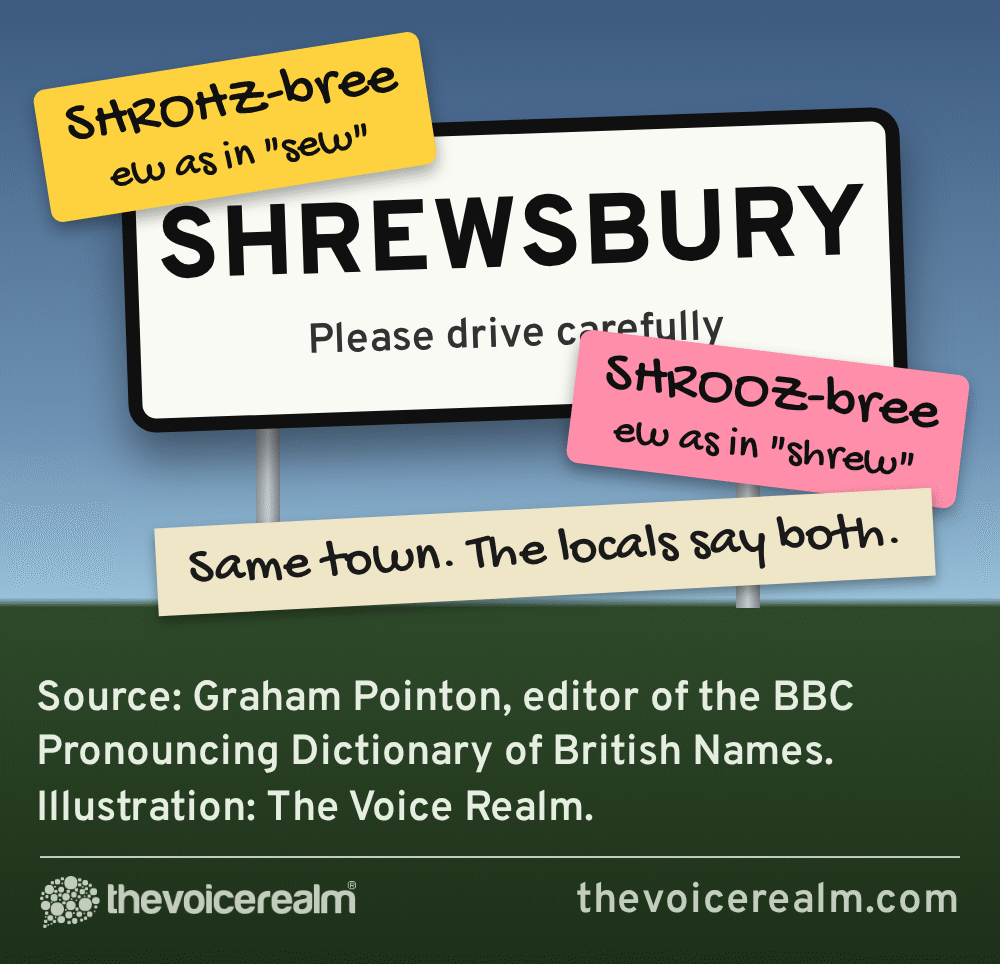
You’d think a town would agree on its own name. Many don’t. Pointon gives a couple of English examples. On Bath, the question is whether the vowel is “long (as in the south) or short (as in the north)”. And on Shrewsbury, he notes that “the inhabitants of a place disagree among themselves”. He adds that “There are even families some of whose members pronounce the family name in one way, others in a different one.”
So when a place has two local versions, the right answer depends on who’s listening. A tourism ad paid for by the town council should use whichever version the council uses. A national news style piece might follow the broadcaster’s list. When in doubt, ask the client which audience they’re speaking to, and record the alternate as a spare take.

 VoiceEditSuiteNewIt edits like you would, and it gets better every file.Learns from numbers, never your audio. Never used to train AI.See how it works
Foreign place names add another layer. Some have a settled English form that listeners expect, and saying the local form can sound showy in an English script. Others are newer to English speakers, and the local form is the polite one. Pointon describes the balancing act as finding a version “that trips fairly easily off the tongue of a native English speaker while sounding suitably impressive, but at the same time does not annoy speakers of the language”. Your client’s audience decides where on that line you land.
© The Voice Realm
Names that look like they belong to another language
Spelling is a trap. A surname can look Spanish, Italian or French and still be said in a completely English way by the family that carries it.
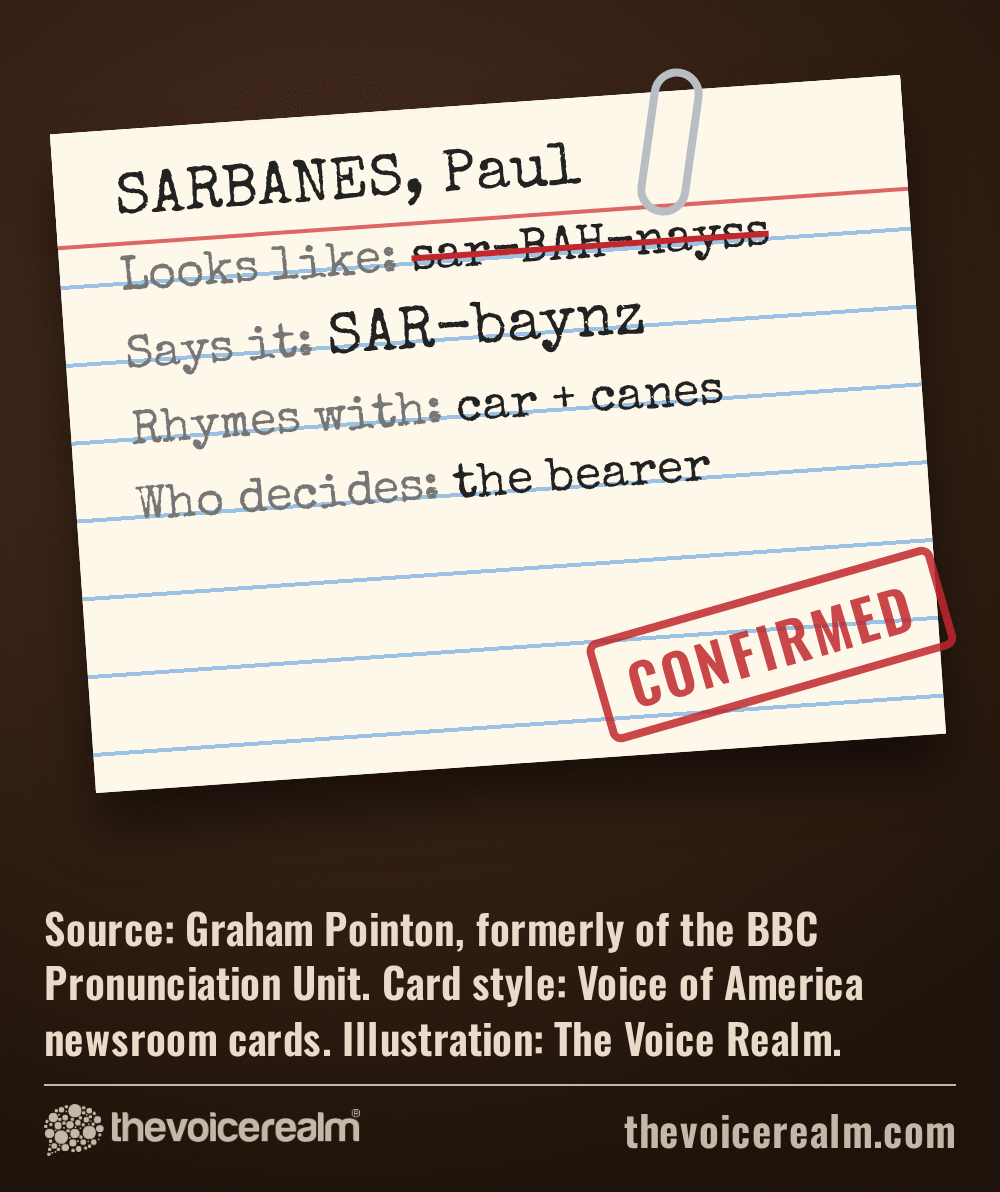
One of Pointon’s examples is a US senator. Reviewing a BBC pronunciation guide, he wrote that the name Sarbanes looks as if it would be “sar-bah-nayss”, “but his first name is Paul”. The family actually says it SAR-baynz, and Pointon adds a careful aside: “in this case at least”. That aside is the important part. The same spelling can be said two ways by two families. You’re never researching a word. You’re researching a person.
The same goes for first names. Two people called Andrea, Jean or Siobhan in the same script may say their names differently. Check each one, even if it feels fussy.
Brand names, acronyms and invented words
Brands are the easiest of all to get right, because the brand has almost certainly said its own name in an ad. Find the brand’s own video or radio spot and copy it exactly, stress included. If it’s a new brand with no ads yet, ask. Brand names are often invented, and the person who invented it has an opinion.
Acronyms need one specific question: is it said as letters or as a word? Some are always letters, some are always words, and a few change depending on the company. Write the answer above the acronym in the script, every time it appears, because your eye will try to switch halfway through a long module.
Medical and scientific terms have their own references and their own traps. We’ve covered drug names in detail in our guide to voicing medical narration without tripping, and the same goes for the numbers, dates and web addresses that sit beside those names in a script, which you’ll find in our piece on reading numbers and URLs.
Write it so you can read it at full speed
Once you know the answer, write it in a form your eye can take in without stopping. Most working voice actors don’t use the phonetic alphabet. They use a simple respelling: plain English sounds, hyphens between syllables, and the stressed syllable in capitals. MED-ih-chee. HAYZ-buh-ruh, which is how the Norfolk village of Happisburgh is said. A rhyme helps too. A quick “rhymes with” note is faster to read mid sentence than any symbol.
Put the respelling directly above the word on your script, not in a separate list you have to look across to. If you mark up scripts already, add a colour for pronunciation so it stands out from your breath marks and emphasis. Our walkthrough on marking up a script before you speak shows a full system you can slot this into.
Then say the name ten times out loud before you record, in the sentence it sits in. A name you’ve only read is a name you’ll stumble on. A name you’ve said in context comes out sounding like you’ve known it for years.
© The Voice Realm
When you can’t confirm it
Sometimes you run out of road. The client doesn’t know, the person has never been recorded, and the sources disagree. Here’s how to handle it without looking careless.
- Record your best version as the main take. Pick the one with the best evidence behind it.
- Record the alternate as a labelled pickup. Say the line again with the other version and name the file clearly so the editor can swap it in seconds.
- Say so in your delivery note. One line: which names you couldn’t confirm, which version is in the main take, where the alternate is.
- Never bury it. A flagged guess is professional. A hidden guess becomes a revision when the client’s chief executive hears their own name wrong.
For audiobooks, settle every name before the first chapter, and keep it the same all the way through. Listeners will notice if the hero’s sister is said one way in chapter two and another in chapter nineteen. Make a list at prep time and keep it open while you record. If you’re new to long-form work, our working guide to becoming an audiobook narrator covers prep in more depth.
Keep a pronunciation file for years
Every name you research is research you never have to do again. Keep a simple file: the word, your respelling, where you confirmed it, the date, and the client or project. A spreadsheet works. So does a notes app. Some narrators record a short audio clip of themselves saying each name next to the written version, which is the modern version of VOA’s card drawer.
Clients come back. Series run for years. The pharmaceutical company you voiced in March will have the same product names in its September module, and the fantasy author’s book four will bring back characters from book one. When that file is already open on your desk, you’ll start recording while everyone else is still searching.
If you’re still building the basic skills that sit underneath all this, from reading ahead to breath control, Voice Master Academy is a good place to work on them with feedback. And when you’re ready to put a careful read in front of real clients, the voice over jobs board has new castings most days.
Sources: Voice of America, “About the VOA Pronunciation Guide”; Library of Congress, National Library Service for the Blind and Print Disabled, “Guidelines and Specifications”; Graham Pointon, Linguism, “The BBC and its Pronunciation Unit” and review of the Oxford BBC Guide to Pronunciation.
Ready to get booked?
See the jobs open right nowAbout Sarah Robbins
Sarah Robbins writes for The Voice Realm about finding voice over work, home studios, casting and the business side of voice acting.