Blog
You record your first audition, press play, and want to crawl under the desk. The voice coming back is thinner, higher and somehow more nasal than the one you’ve been using your whole life. If you’re new to voice acting, or you’ve been at it a while and still wince at playback, this guide explains why it happens, why it matters less than you think, and how to train your ear so playback becomes a tool instead of a torment.
Almost everyone goes through this. Plenty of working voice actors still don’t love their own voice on a recording. They’ve just learned to listen to it differently.
The voice in your head has extra bass
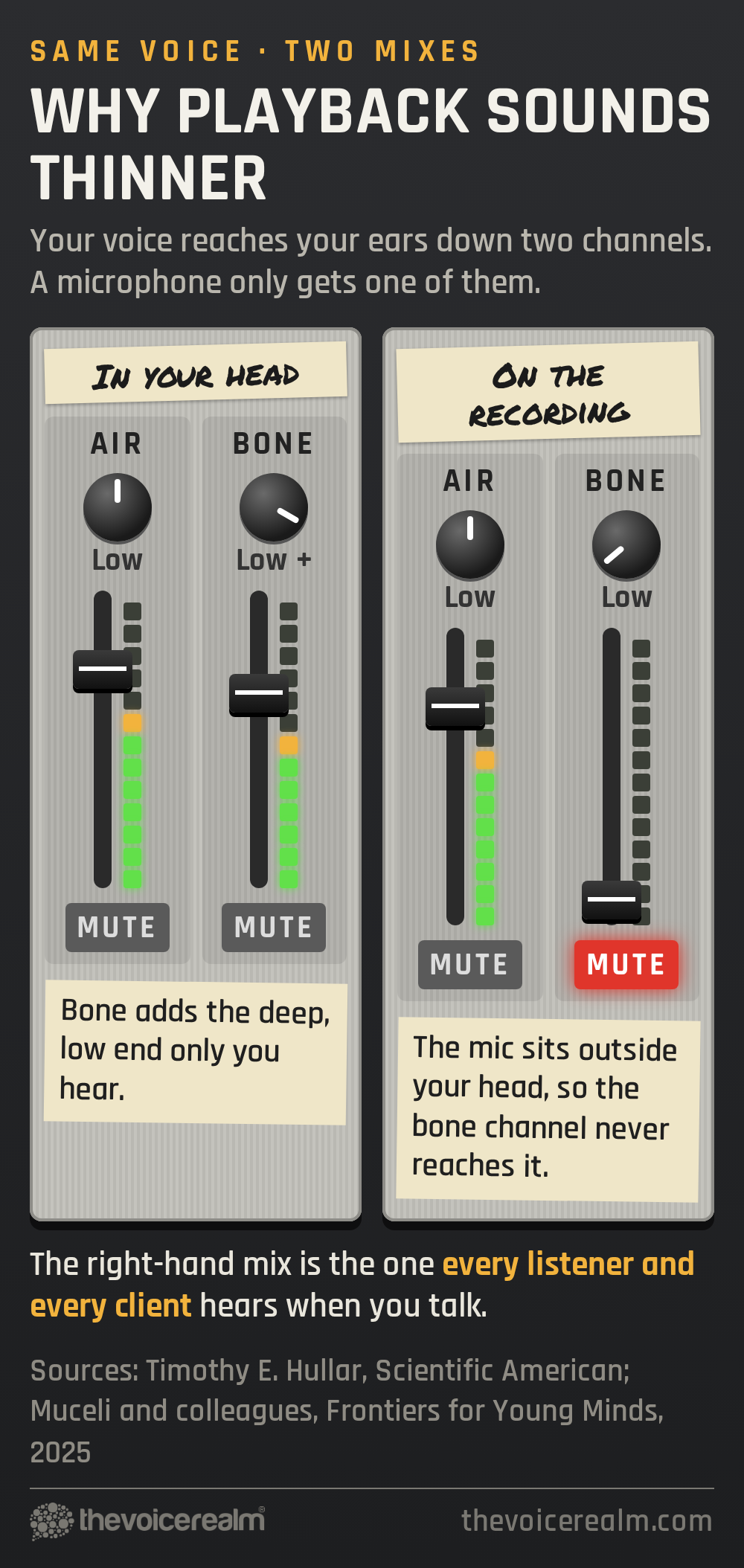
When you speak, the sound reaches your ears by two routes. One goes out of your mouth, through the air and into your ear canals, the same way anyone else’s voice does. The other never leaves your body. The vibration of your vocal folds travels through the bones and tissue of your head straight to your inner ear.
Timothy E. Hullar, an otolaryngologist who answered this question for Scientific American while at Washington University School of Medicine in St. Louis, explained that the second route changes the sound, because “the mechanical properties of your head enhance its deeper, lower-frequency vibrations.” So the voice you hear while talking has a warmth and depth that nobody else gets.
A recording strips that away. In Hullar’s words, “When you listen to a recording of yourself speaking, the bone-conducted pathway that you consider part of your ‘normal’ voice is eliminated.” A team of hearing researchers writing for young readers in Frontiers for Young Minds put it even more simply: “only the air conduction part is recorded, because the microphone is outside your head.”
That’s the whole mystery. The microphone isn’t lying about you. It’s just missing the part only you could ever hear.
The recording is the version everyone else hears
This is the bit that stings for a moment and then helps a lot. The voice on the playback is much closer to the one your friends, your family and every client hear when you speak. They’ve never heard the bass-heavy version in your head. To them, the recording just sounds like you.
That changes what playback is for. You aren’t comparing the recording with your “real” voice, because the recording is the real one as far as the listener is concerned. You’re getting your first honest look at the instrument people are actually hiring.
It also explains why the shock is so specific. The missing part is mostly the low, rich end, so the recording seems thinner and higher. Nothing has gone wrong with your voice. You’ve simply heard it without the extra helping of bass your own head adds every time you talk.
© The Voice Realm
You probably like your voice more than you think
Here’s a twist that might cheer you up. When people don’t know it’s their own voice, they tend to rather like it.
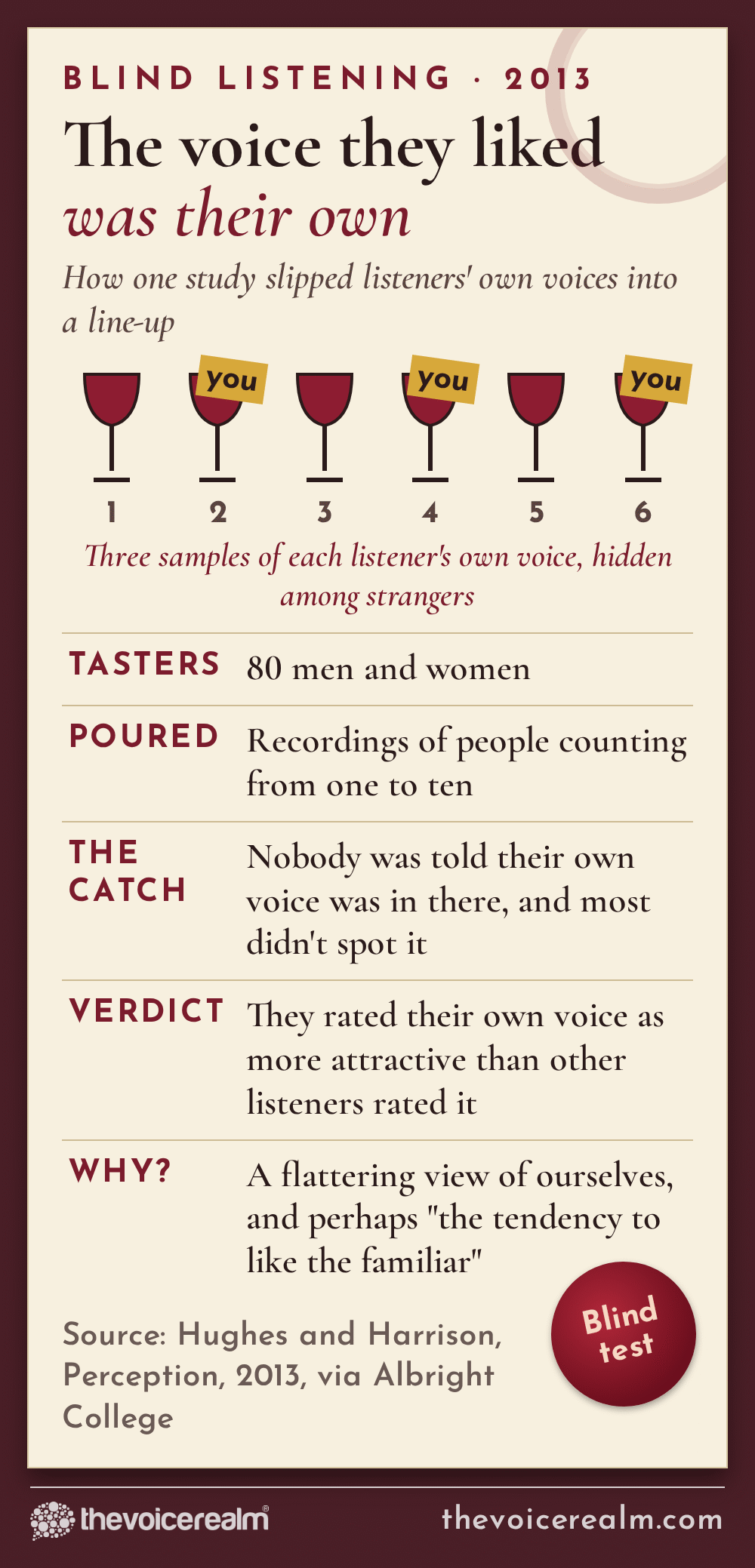
In a 2013 study published in the journal Perception, psychologists Susan Hughes of Albright College and Marissa Harrison of Penn State Harrisburg played voice recordings of people counting from one to ten to a group of listeners. According to Albright College’s summary of the work, “80 men and women assessed the voice attractiveness of an array of different voice recordings,” and, without telling anyone, the researchers slipped three samples of each listener’s own voice into the line-up.
Most people didn’t recognise themselves. And they “rated their own voices as sounding more attractive than how other raters judged their voices.” Hughes’s take was gentle: “People generally tend to have an enhanced sense about themselves.” The researchers also suggested a second reason, that people may have preferred their own voice through “a mere exposure effect and the tendency to like the familiar.”
Put those findings together and the cringe looks less like a verdict and more like surprise. When you know it’s you, you’re hearing the difference from the voice in your head. When you don’t know, the same voice can sound perfectly pleasant.

© The Voice Realm
Why the cringe hits voice actors harder
Most people hear themselves on a recording now and then, shrug and move on. Voice actors listen back every day, closely, on good headphones, and usually while hunting for mistakes. That’s a recipe for a harsher reaction.
Good headphones are part of it. Studio headphones show every breath, every lip noise and every slightly flat vowel. Our guide to closed-back headphones for voice work explains why they’re built to do exactly that. It’s a gift when you’re editing and brutal when you’re feeling fragile.
Habit is the rest. If the only time you ever hear yourself is when you’re checking for problems, your brain learns that your recorded voice means “something’s wrong”. Listening a little more often, in a calmer frame of mind, starts to break that link.
© The Voice Realm
Train your ear with a listening routine
The good news hiding in that study is the familiarity effect. People tend to warm to sounds they hear often, so the cure for hating your recorded voice is, quite literally, more of it. A small, regular routine does the job far better than one long, painful session.
Record a short, easy read every day. A paragraph from a book, a product description, the back of a cereal box. Two minutes is plenty, and it doesn’t need to be good.
 VoiceEditSuiteStudio RescueSave the take. Lose the noise.Hiss, hum and room noise out. Your voice untouched.See how it works
Listen back once, all the way through, without stopping or fixing anything. Just let it play. The aim for the first week is simply to get used to the sound.
Leave it a day, then listen again. A recording heard the next morning sounds different from one heard straight after the read, when you can still remember what you meant to do. Distance turns you into an audience.
Listen on more than one thing. Headphones, a laptop speaker and your phone held at arm’s length. Clients will hear you on all three, and a voice that seemed harsh on headphones often sounds just right on a phone.
Write one note per playback, and make it a specific, useful one. “Rushed the second sentence” helps. “I sound awful” doesn’t. If you’d like a structured place to begin, Voice Master Academy has voice acting training you can start for free, and our guide to practising voice acting at home has plenty more ideas for daily reads.
© The Voice Realm
Listen like a client, not a critic
When you listen back as yourself, you hear your voice. When a client listens, they hear a message. Shifting into their chair is the most useful skill you can learn at playback.
A client is asking a handful of plain questions. Do I believe this person? Can I understand every word? Does it fit the brand, the character or the mood? Does it sound like a real person talking to me? None of those questions is “is this the most beautiful voice I’ve ever heard?”
“The bone-conducted pathway that you consider part of your ‘normal’ voice is eliminated.”
Timothy E. Hullar, otolaryngologist, in Scientific AmericanPost this quote
Try it on your next playback. Pretend you’ve just been sent the file by someone you’ve never met, and you’re deciding whether to book them. Would you understand the product? Would you keep listening? That frame of mind turns vague dislike into choices you can actually make, like a warmer tone on the opening line or a slower pace through the price.
It helps to have something to compare with. Find a commercial, an explainer or an audiobook in the style you want to do, and listen to a minute of it right before your own take. You’ll often find that the pro’s voice is just as particular as yours. What makes it work is the read, not the tone of the voice.
© The Voice Realm
When the sound really is a problem
Sometimes the recording sounds odd for reasons that have nothing to do with bone conduction, and those are worth fixing. A few common ones:
If your voice sounds boomy and muddy, you may be too close to the mic, which exaggerates the bass. If it sounds hollow and distant, it’s usually the room, and a few heavy blankets go a long way. If every P and B lands with a thump, that’s a plosive problem, and our guide to stopping popping Ps covers the fixes. If the ends of your lines crackle and fade away, that’s often vocal fry from running out of air.
These are technical and habit problems, and they all have fixes. Unlike the shock of the missing bass, they’ll still be there for the client, so they deserve your attention first.
And if your voice itself has changed, say it’s stayed hoarse for weeks or it hurts to speak, that isn’t a playback problem at all. See a doctor, ideally one who works with voices.
Your first week of listening back
If you want a simple plan, here it is. On day one, record two minutes of easy reading and listen once without judging. On days two to five, do the same, but listen the next morning on a different device each time and write one specific note. On the last two days, record the same paragraph you read on day one and play the two versions side by side.
Most people find two things by the end of the week. The sound of their voice has stopped being shocking, and the notes have moved from “I hate it” to things like pace, energy and clarity. That’s the shift that matters. You’ll probably never hear your recorded voice the way you hear it in your head, and nobody else will either. What you can do is get used to the one they hear and make it work for you.
Sources: Timothy E. Hullar, Scientific American, “Why does my voice sound so different when it is recorded and played back?”; Silvia Muceli, Tiffany Hamstreet, Karl-Johan Fredén Jansson and Sabine Reinfeldt, Frontiers for Young Minds, “How Air and Bones Can Help You to Hear”, 2025; ScienceDaily, from Albright College, “Hate the sound of your voice? Not really”, September 2013, on Hughes and Harrison, “I Like My Voice Better: Self-Enhancement Bias in Perceptions of Voice Attractiveness,” Perception, 2013.
Ready to get booked?
See the jobs open right nowAbout Sarah Robbins
Sarah Robbins writes for The Voice Realm about finding voice over work, home studios, casting and the business side of voice acting.