Blog
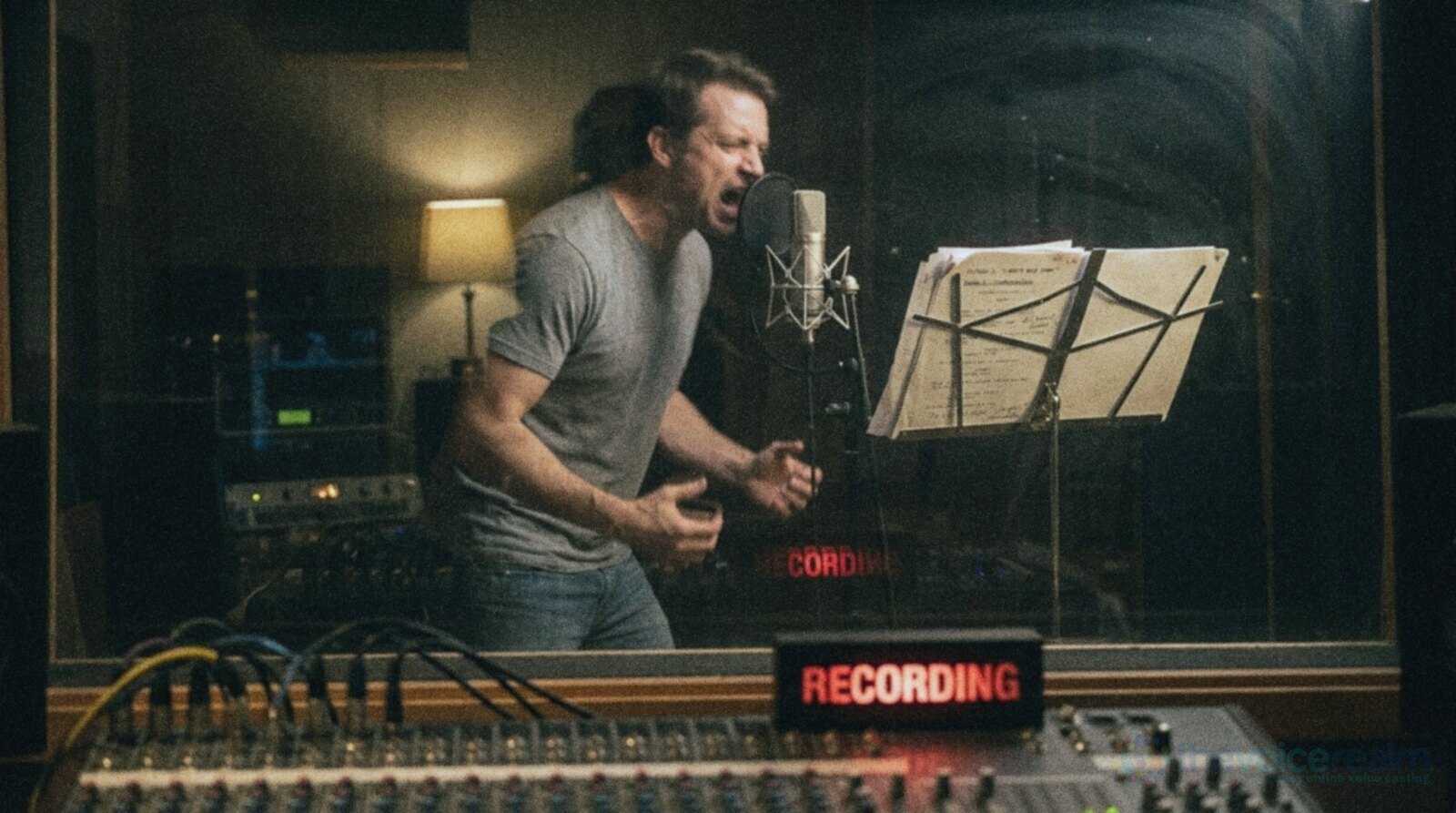
Somewhere in every video game script there’s a page that just says “efforts.” Then a list: light hit, heavy hit, jump, fall, burn, death, long death. Animation has them too, and so do trailers, horror audio dramas and the odd energy drink commercial. Screaming, shouting and grunting are part of the job, and nobody sends a doctor along to the session.
This guide is for voice actors who are starting to book that kind of work, or who’ve just come out of a battle session with a voice that feels like sandpaper. It covers what the union actually counts as vocally stressful work, why a scream can do lasting harm, how working actors get the sound without paying for it, and the signs that mean it’s time to stop and see a specialist.
What counts as vocally stressful work
SAG-AFTRA has a definition, and it’s a useful checklist even if you never work under a union contract. Its 2024 Independent Interactive Localization Agreement says “vocally stressful sessions are any work that risks damage or undue strain to the Performer’s voice which may be due to prolonged requests for the Performer to enact: yelling/shouting/screaming, fighting sounds, death sounds, battle cries, complicated creature sounds, unnatural vocal textures, extensive whispering, high pitched vocal sounds, or any other voice/sound that is difficult/challenging for the performer to deliver.”
Notice what’s on that list besides screaming. Extensive whispering. High pitched sounds. Creature voices. A soft, breathy villain who never raises his voice can tire you just as fast as a barbarian king, because whispering asks the voice to work without its normal support.
The same agreement sets a hard limit: “Sessions that contain vocally stressful work will be no longer than 2 hours and paid at full 4-hour Off-Camera Day Performer rate.” Producers are also meant to warn you in advance, and the agreement says those who don’t “shall pay liquidated damages of $100 for each failure to provide a notice of vocally stressful work.” Union or not, those two ideas are worth borrowing: short sessions for loud work, and a heads up before you walk in.
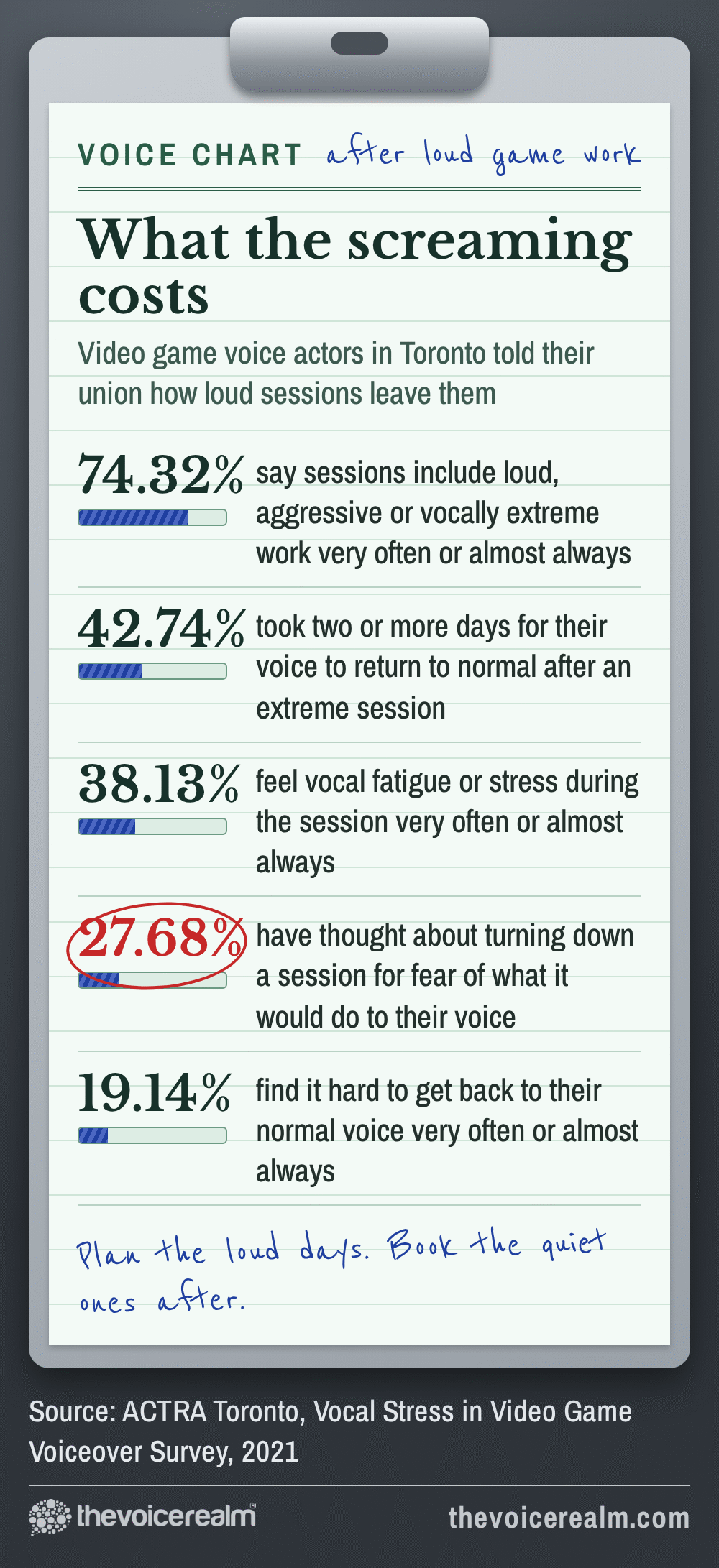
Canada’s performers have put numbers on how common this is. When ACTRA Toronto surveyed its members about video game voice work, 74.32% said loud or extreme vocal work came up very often or almost always. So if you’re heading into games, plan for it rather than hoping it won’t come up.
© The Voice Realm
Why a scream can do real damage
Your vocal folds are two small bands of tissue that slap together hundreds of times a second when you make sound. Shouting makes them hit harder. Do that for a few hours, day after day, and the tissue starts to protect itself the way skin does, by thickening.
The Cleveland Clinic is blunt about where that leads: “Vocal cord nodules, sometimes called singer’s or screamer’s nodes, can form if you’re repeatedly misusing or overusing your voice.” Polyps are the other common lesion, and the same page notes they “can also form after a single episode of vocal abuse (like yelling at a sports event).” One afternoon can be enough.
The National Institute on Deafness and Other Communication Disorders, part of the US National Institutes of Health, puts screaming on its list of habits to avoid: “Avoid using the extremes of your vocal range, such as screaming or whispering.” It also explains why technique matters so much: “Talking from the throat, without supporting breath, puts a great strain on the voice.”
That second line is the whole game. You can’t avoid screaming if the script calls for it, but you can change where the effort comes from.

© The Voice Realm
The scream is acted, not just loud
The microphone does a lot of the work for you. A scream that sounds enormous in the final mix often wasn’t that loud in the booth, because the engineer can add level, and the listener hears the shape of the sound far more than its volume. What sells a scream is the attack, the breath before it, the face you pull and the way it breaks off.
- Breath first. Take a low, full breath and let the push come from your middle, not your neck. If your jaw and throat tighten before you’ve made a sound, reset.
- Sell it with your body. Clench your fists, bend at the waist, screw up your face. The physical tension reads in the sound, so your throat doesn’t have to carry it alone.
- Use space, not volume. Back away from the mic and turn a little off to the side for the biggest moments. Distance makes a big sound feel bigger and saves the engineer from a clipped take.
- Fake the rasp carefully. Rough, gravelly textures can be made higher in the throat without grinding the vocal folds, but they need proper teaching. Don’t copy them from a video and push through pain.
- Make every take count. Know exactly what the moment is before you open your mouth. Ten unfocused screams cost more than three that mean something.
On that fourth point, there’s encouraging research. A study led by ear, nose and throat doctors at Nottingham University Hospitals, working with the Complete Vocal Institute, followed 20 professional singers who use distortion, growls and grunts for 14 years. Their conclusion was that these effects, made higher in the throat, “can be performed sustainable and in a healthy manner if performed with correct vocal technique.” Two caveats: one of the authors works for the institute that teaches the method, and the key words are “correct vocal technique.” It’s a reason to find a teacher, not a licence to wing it.
If you’re still finding your character’s sound, our guide to building a character voice from the person outward helps you choose a placement you can actually keep up for a full session.
Plan the session like a fight scene
Stunt performers rehearse and plan. Treat a loud session the same way. Ask when you’re booked whether the script includes efforts, screams or creature sounds, and roughly how many. If nobody says, ask again. You’re not being difficult, you’re protecting the client’s recording as well as your voice.
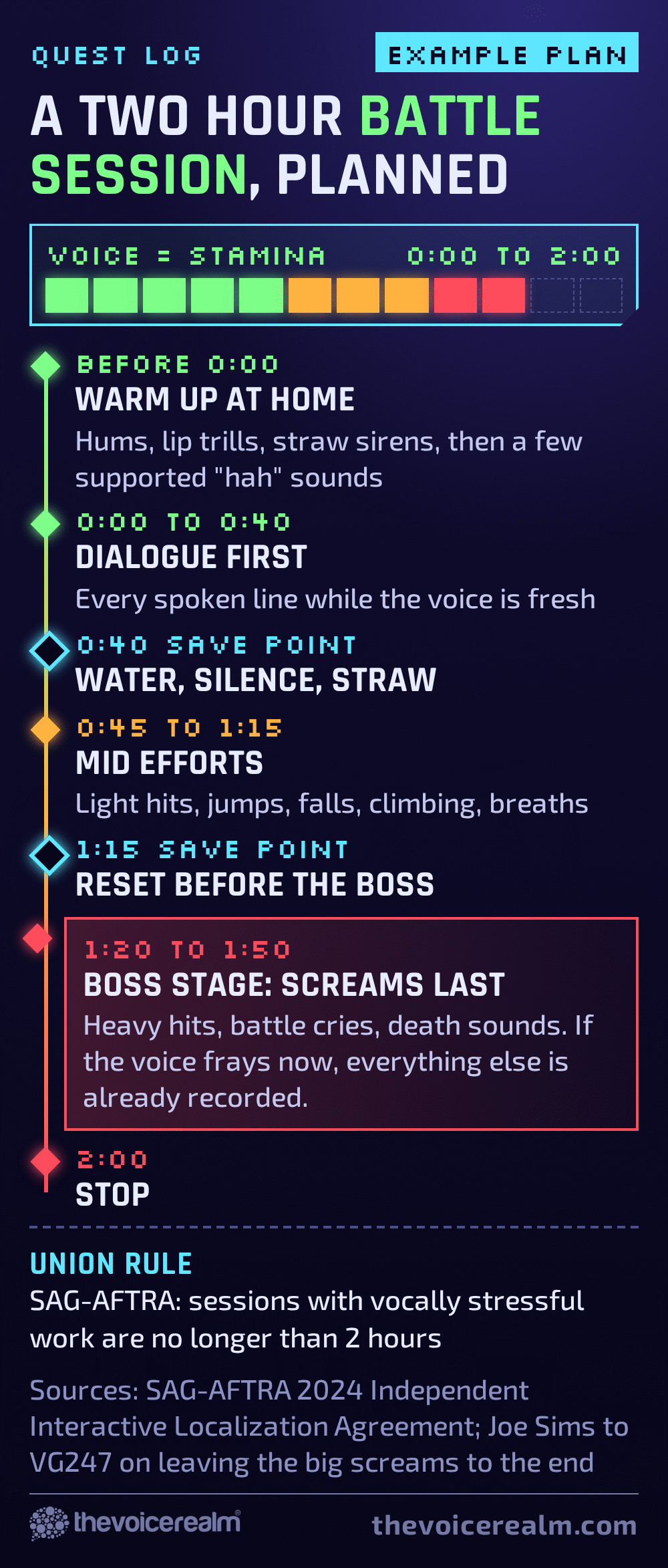
Order matters most. Dialogue goes first while your voice is fresh. Mid level efforts come next. The biggest screams and death cries go last, so that if your voice starts to fray, you’ve already delivered everything else. Joe Sims, who voiced Laurence in Bloodborne, told VG247 that he pushes for the big screams to be left to the end of a session, for exactly this reason.
 VOICEMASTERACADEMYTwenty modules, one at a time.Breath controlHome studioCommercial techniqueAuditionsStart module oneNo experience needed.
Cissy Jones, the voice of Delilah in Firewatch, put the timing problem in plain words when she spoke to VG247: “An hour of talking really loudly is fine, but when it starts going on hour two, hour three, hour four, it’ll wreck you.” That matches the union’s two hour cap. If a client books you for four hours of battle sounds, it’s fair to ask whether it can be split across two days.
© The Voice Realm
Warm up first, then work up to it
Walking into a scream session cold is like sprinting without stretching. Spend ten minutes beforehand on gentle humming, lip trills and sirens, then gradually bring in more volume and more character. Our five minute warm up is a good base. Add a few low, open “hah” sounds on a supported breath before the first loud take.
Straw phonation is a favourite with voice teachers because it’s so kind to the folds. Hum or sing a siren through a straw, either into the air or into a glass of water so you can see the bubbles. The resistance from the straw lets the folds vibrate with less effort, and it’s a good reset between loud takes too.
Julie Nathanson, who voiced characters in Far Cry 5, told VG247 how she manages it: “I have a pretty good personal system of warming up, staying hydrated, avoiding certain foods and activities, taking breaks, and minding intensity and vocal placement when I first find the character’s voice.” Notice the last part. She sets the placement before the hard work starts, so she isn’t fixing it under pressure.
Hydration helps the folds move freely, and the NIDCD’s advice is simple: “Stay hydrated: Drink plenty of water, especially when exercising.” A heavy effort session counts as exercise. Start drinking the day before, not in the booth. There’s more on why in our piece on what water really does for your voice.

© The Voice Realm
Between takes, and the morning after
Between takes, stop talking. That’s harder than it sounds in a friendly session, but chatting with the engineer between screams uses up voice you need. Sip water, breathe through your nose, and save the jokes for lunch.
Afterwards, give your voice a quiet evening. No shouting over music at a bar, no long phone calls, no throat clearing (swallow or sip instead). Gentle humming and straw work the next morning tell you how things stand. A little tiredness that’s gone by lunchtime is normal. A voice that’s still rough two days later is telling you something.
ACTRA’s survey found that “more than 4 in 10 actors (42.74%) said that it took 2 or more days for their vocal quality to return to “normal” after a vocally extreme voice-over session.” If you’re one of them, don’t book another loud job for the next morning.

© The Voice Realm
Recording effort sounds in your own booth
More and more of this work is recorded at home, with the director on a call or no director at all. That puts the technical side on you, and a clipped scream is a wasted scream.
Record efforts as their own pass, with your gain turned well down from your normal dialogue setting. Do a quick test at full volume before the real takes and check your meters peak comfortably below zero. Step back from the mic for the biggest sounds rather than turning yourself down, because a held back scream sounds held back.
Slate each effort clearly with its name and take number in your speaking voice, and leave a second of silence between them. Clients often ask for three or four variations of each sound. Deliver them in the order of the list, label the files the way the brief asks, and you’ll rarely be asked to redo them, which is the best protection your voice can get.
If you’re new to game work in general, our guide to becoming a video game voice actor covers the rest of what a session asks of you.
When to say no, and when to see a doctor
Pain is the line. Hoarseness, tickle and tiredness are signals to rest. Sharp pain, a sudden loss of voice or a voice that cracks on notes you normally hit easily mean stop the session, even if it’s awkward. A good director would rather reschedule than lose you for a month.
Ashly Burch, the voice of Aloy in Horizon Zero Dawn, told VG247 that “an otolaryngologist once referred to what we do as ‘vocal stunt work,’ which sounds metal, but ultimately means that the work is high risk and potentially dangerous.” Stunt performers have safety rules and so should you.
For when to get checked, the Cleveland Clinic advice is clear: “If you’re hoarse or have other symptoms of a vocal cord lesion for more than two to three weeks, see an otolaryngologist (ear, nose and throat doctor).” Ask for one who works with singers or professional voice users if you can, since they’ll look at your vocal folds on camera and understand what your work asks of them. The same clinic lists losing your voice, pain when you speak or swallow, and coughing up blood as reasons to contact a doctor straight away.
Saying no to some jobs is part of a long career too. If a booking means a full day of death screams with no breaks, it’s fine to ask for a shorter session, more breaks or a split day, and it’s fine to pass if the answer is no. For everyday care between loud jobs, our guide to looking after your voice covers the habits that keep you working.
Sources: SAG-AFTRA, “2024 Independent Interactive Localization Agreement”; ACTRA Toronto, “Vocal Stress in Video Game Voiceover Survey”; Cleveland Clinic, “Vocal Cord Lesions: Nodules, Polyps and Cysts” and “Hoarseness”; NIDCD, “Taking Care of Your Voice”; Aaen, Sadolin, White, Nouraei and McGlashan, Journal of Voice, “Extreme Vocals: A Retrospective Longitudinal Study of Vocal Health in 20 Professional Singers Performing and Teaching Rough Vocal Effects”; VG247, Kirk McKeand, “My throat was bleeding”.
Ready to get booked?
See the jobs open right nowAbout Sarah Robbins
Sarah Robbins writes for The Voice Realm about finding voice over work, home studios, casting and the business side of voice acting.