Blog
Blog

It always lands the same way. You wake up on the morning of a booking with a head full of cotton wool, you say “hello” to the kettle to test it, and a stranger answers. This guide is for voice actors who work from a home studio and have to decide, quickly and sensibly, whether today is a recording day. It covers how to tell a nuisance cold from a voice problem, what to say to the client, how to keep your voice working without making things worse, and how to sound like yourself again when you come back.
None of this replaces a doctor. It’s the working side of being ill: the calls you make at 7am with a box of tissues in your lap.
First, work out where the cold actually lives
A cold is a lot of different problems wearing the same coat. For a voice actor, the only question that matters on the day is where it’s sitting, because that decides what the mic will hear and what the recording will cost you.
If it’s in your nose and sinuses, the problem is mostly about sound. Your vowels go dull, your “m” and “n” turn into “b” and “d”, and you sound like you’re reading from inside a cupboard. Annoying, sometimes unusable, but your vocal folds themselves are fine.
If it’s in your throat, and especially if your voice has gone husky, breathy or crackly, the problem is the instrument. Hoarseness means the vocal folds are swollen and aren’t vibrating cleanly. That’s laryngitis territory, and it’s the one where pushing on can turn a week off into a month off.
If it’s in your chest, you’ve got a cough to manage. Coughing is rough on the folds, and a session full of stops and restarts is rough on everyone else.
So before you touch the mic, do a quick check. Say a few lines of any script at your normal level. Hum a slide from low to high and back. Try a soft, sustained “ahh”. If the slide is smooth and the voice is clear, you’ve probably got a nose problem. If notes drop out, the voice cracks, or talking at normal volume hurts, you’ve got a throat problem.
A blocked nose is a sound problem. A sore throat is a voice problem
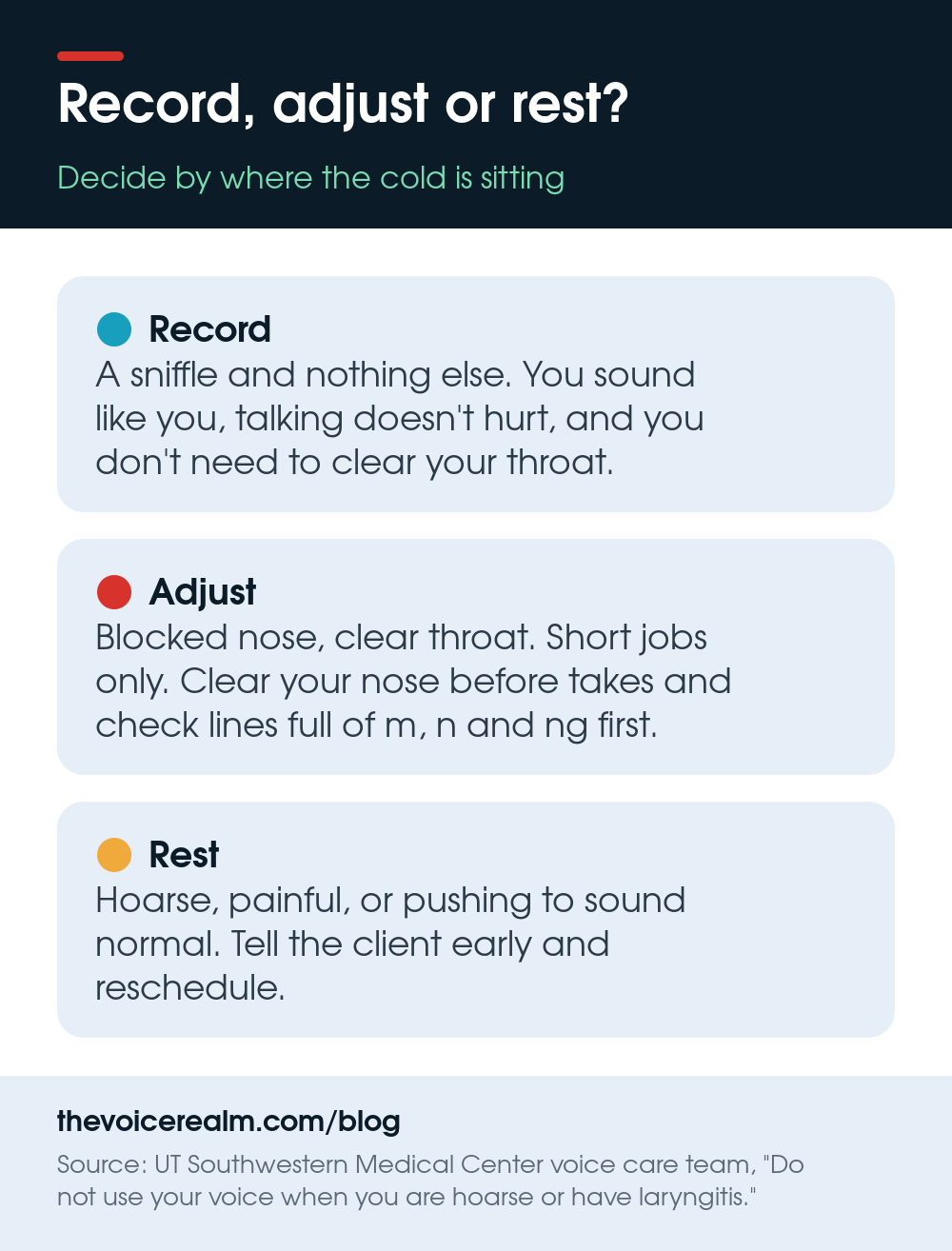
Once you know which one you’ve got, the decision gets a lot simpler. Think of it as three possible answers: record, record with adjustments, or rest.
Record when it’s a sniffle and nothing else. Your voice sounds like you, your throat feels normal, and you can get through a paragraph without clearing it. Plenty of short commercial and corporate jobs get done on days like this, and nobody ever knows.
Record with adjustments when your nose is blocked but your throat is fine. Do short jobs, not long ones. Clear your nose properly before each take, sip water between takes, and listen back more carefully than usual. A blocked nose is most obvious on words full of “m”, “n” and “ng”, so play those lines back first. If the client has heard your voice before, ask yourself honestly whether they’d notice. For a one-off tag line they probably won’t. For chapter nine of a book they definitely will.
Rest when you’re hoarse, when it hurts to speak, or when you’d need to push to get your normal sound. This one isn’t a judgement call. The voice clinic at UT Southwestern Medical Center puts it bluntly: “Do not use your voice when you are hoarse or have laryngitis.” Recording through it doesn’t just give the client a scratchy take. It can hurt the folds and add days to the recovery, which is a much bigger booking problem than one rescheduled session.
© The Voice Realm
When the answer is rest, tell the client early
Clients don’t mind that you’re ill. They mind finding out at 4pm on the deadline day. The earlier you tell them, the more options everyone has, and the more professional you look.

Tell the client early, in a short, practical message. © The Voice Realm
Keep the message short and practical. Say what’s happened, what it means for their job, and what you’re offering. Something like this works:
“Hi Sam, I’ve come down with a throat infection and my voice isn’t at a standard I’d send you today. I don’t want to give you a take you’d need to redo. I can have the finished files to you by Thursday afternoon, or if the date can’t move, I’m happy for you to recast this one. Sorry for the hassle, and thanks for understanding.”
Three things make that message work. It doesn’t over-explain your symptoms. It puts the quality of their project first, which is the truth. And it gives them a real choice, including the one that costs you the job. Clients remember the actor who made a bad day easy for them, and they come back to that actor.
If you’ve got a whole diary of bookings, sort them by deadline and by how much of your voice they need. A 20-second phone greeting due next week can wait for you. A long-form narration with a publisher’s date might need a new plan, so call that one first.
Keep the voice wet, not numb
Whatever you decide about recording, the first few days of a cold are about keeping your throat hydrated and giving the folds as little work as possible. The advice here is consistent across the voice clinics, and some of it runs against what people reach for first.
Talk less, and don’t whisper. The NHS advice on laryngitis is to “try to speak as little as possible”, and it warns against whispering as firmly as it warns against talking loudly, because both strain the voice. That surprises people, but whispering is not a rest. The UT Southwestern team explains that “most people do not whisper in a way that is good for the voice.” If you have to talk, use a soft, easy, breathy voice at a low volume, the way you’d speak to someone next to you in a library.
 VOICEMASTERACADEMYTwenty modules, one at a time.Breath controlHome studioCommercial techniqueAuditionsStart module oneNo experience needed.
Drink, and keep drinking. The NHS page says to “drink plenty of fluids”, and the Lions Voice Clinic at the University of Minnesota puts it as a habit rather than a dose: “Sip on liquids all day long.” Water is the main event. Warm drinks feel good and count. Caffeine and alcohol don’t help, because they dry you out.

Run the humidifier where you sleep, not in the booth. © The Voice Realm
Put moisture in the air. The same clinic says: “A humidifier, especially in the bedroom, can be very helpful.” And you don’t need special gear for steam: “you can get the same effect from standing over a pot of simmering water or holding a hot, wet washcloth over your mouth and nose for a few minutes.” If you’ve got a humidifier, run it where you sleep, not in the booth while you’re recording, where its hiss will end up on your takes.

Steam from a bowl of hot water does the same job as a steamer. © The Voice Realm
Be careful with the medicine cabinet. A lot of cold remedies work by drying things up, and they don’t stop at your nose. The Minnesota clinic warns voice users to “be wary of OTC (over the counter) antihistamines, which can be very dehydrating”, and notes that antihistamine nasal sprays have a reputation for rebound congestion. Decongestants and combined “cold and flu” tablets can leave the throat just as dry. Tell the pharmacist that you use your voice for work, and ask what they’d suggest. They get this question from singers and teachers all the time.
- Quiet, not silent. Speak softly and rarely. Skip the whisper, it works the voice harder than you’d think.
- Sip all day. Small amounts of water, often. Keep a glass by the bed and one at the desk.
- Wet air. A humidifier where you sleep, steam over a bowl or a hot shower in the morning.
- Check the label. Some cold and allergy tablets dry the throat. Ask a pharmacist for something that won’t.
Go easy on lozenges. Menthol sweets feel like they’re doing something, mostly because they numb and cool the throat. UT Southwestern’s advice: “If you do use cough drops, we recommend using glycerin-based products and to avoid menthol.” A numb throat is the last thing you want before a session, because it hides the discomfort that tells you to stop. If you’ve read our piece on protecting your voice for the long haul, you’ll recognise the pattern: comfort and safety aren’t always the same thing.
Cough once instead of clearing twenty times. Constant throat clearing slams the folds together. The UT Southwestern team says “it’s actually more vocally healthy to cough once than clear your throat multiple times.” A sip of water and a hard swallow often does the job too.
Matching the voice you had last week
This is the part of being ill that catches narrators and anyone else on a long project. Even when you’re well enough to record, you might not sound quite the same. A little extra weight at the bottom, a little less shine at the top, a slightly different nasal colour. On a single ad it doesn’t matter. Halfway through an audiobook or an e-learning course with forty modules, it’s the thing a proofer or a listener hears straight away.
A few habits save a lot of pain here:
- Keep a reference clip. On any long project, save a minute of clean narration from your first good session. Before each new session, play it and read the same lines back. If you can’t match it, you’re not ready for that project yet, even if you’re ready for other work.
- Record easy material first. Save the shouting scenes, the big character voices and the high-energy reads for when you’re fully back. Start with plain narration at a comfortable pitch.
- Log what you recorded while ill. Note the chapters or files you did with a cold. If anything sounds off later, you know exactly where to look for pickups instead of re-listening to the whole project.
- Don’t try to fix it in the edit. EQ can hide a bit of stuffiness, but it can’t put clarity back into a hoarse voice. If you find yourself reaching for heavy processing to make a take usable, that take should be redone.
Our guide to editing your own voice over has more on pickups and matching levels, which is where most of the ill-day repair work ends up.
The first session back
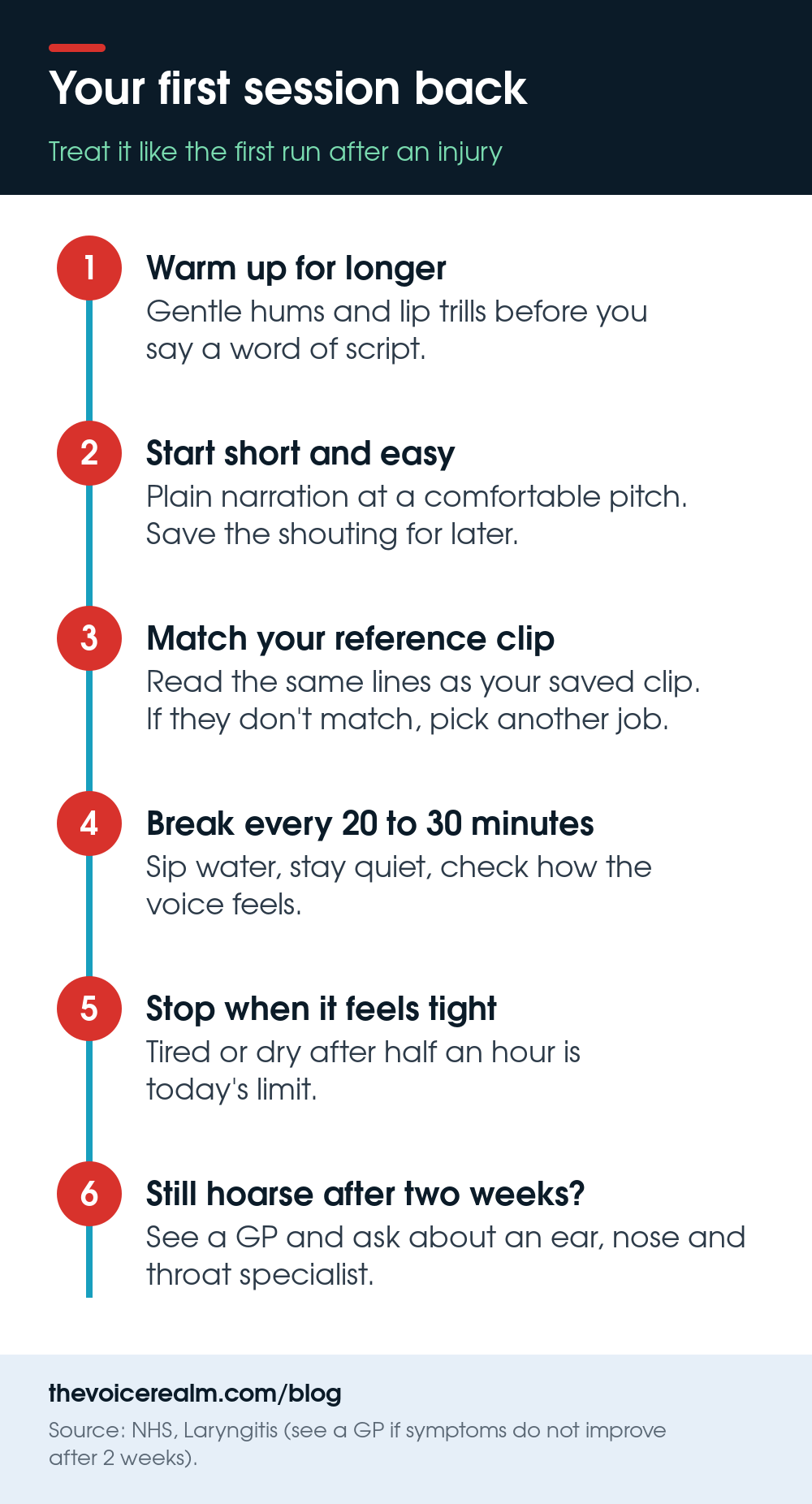
When your voice sounds normal again, it might not be fully recovered underneath. The NHS notes that laryngitis “usually goes away by itself within 1 to 2 weeks”, and voice users often find the last few days of that are when they feel fine but tire quickly. Treat the first session back like the first run after an injury.
Warm up gently and for longer than usual. Hums and lip trills are ideal because they get the folds moving without any strain. Then start with the shortest, easiest job on your list. Take a break every twenty or thirty minutes, and pay attention to how your voice feels at the end of the session, not just how it sounds during it. If it’s tight, dry or tired after half an hour, that’s your limit for today, and tomorrow can be longer.
If breathing has been part of the problem, because a chest cold has left you short of air, our piece on where the air goes before the words has some easy exercises for getting your support back.
© The Voice Realm
When it’s more than a cold
Most colds clear up and take the husky voice with them. Some don’t, and a voice actor is the kind of person who’s tempted to keep working through it. Don’t. The NHS says to see a GP if “your symptoms do not improve after 2 weeks” or “you keep getting laryngitis or voice problems”, and to get urgent help if it’s very painful or difficult to swallow. Difficulty breathing is an emergency.
If hoarseness hangs around after everything else has gone, ask for a referral to an ear, nose and throat specialist, ideally one who works with voice users. They can look at the folds directly and tell you whether it’s simple irritation or something that needs proper treatment. Most voice problems are very treatable when they’re caught early, and far harder when they’ve been recorded through for a month.
The short version is this. A blocked nose is an inconvenience you can often work around. A hoarse voice is a stop sign. Tell the client early, keep your throat wet rather than numb, and come back gently. Your voice has to last a whole career, so one lost day is a bargain.
Sources: “Laryngitis”, NHS; “Voice care: Sorting fact from fiction”, UT Southwestern Medical Center; “Maintain the Vitality of the Vocal Fold Mucosa”, Lions Voice Clinic, University of Minnesota Medical School.
Ready to get booked?
See the jobs open right nowAbout Sarah Robbins
Sarah Robbins writes for The Voice Realm about finding voice over work, home studios, casting and the business side of voice acting.