Blog

Should you use your own name as a voice actor, or invent a new one? It’s one of the first questions people ask when they start building a voice over business, and one of the hardest to undo later. This guide is for anyone setting up a website, a demo or a union membership and wondering what name to put on it. We’ll go through when your own name works fine, when a stage name makes sense, the union rules that can make the decision for you, and how the paperwork works once you’ve got two names.
Your own name is the default, and that’s fine
Most voice actors work under the name on their passport, and there’s a lot to be said for it. It’s the name you already answer to, the one on your bank account, the one your old colleagues and classmates will search for when they need a voice. There’s nothing to register, nothing to keep straight, and no awkward moment when a client calls you by a name you forgot you’d invented.
Your own name also makes the business side simple. Invoices, contracts, payments and tax forms all match. Nobody in a client’s accounts department has to work out who “Marlowe Finch” is when the payment goes to someone else entirely.
If your name is easy to say, easy to spell, and isn’t already famous, you probably don’t need to change it. Plenty of very busy voice actors never did.
Good reasons to pick something else
There are some situations where a stage name is the better choice, and they come up more often in voice work than you’d think.
Your name is hard to say or spell. You’ll say your name out loud in every audition slate. If people regularly mispronounce it, or if a casting producer would struggle to type it into a search box after hearing it once, that’s a real cost. A name that gets lost between the ear and the keyboard is a name nobody can rebook.
Someone else got there first. If you share a name with a well known actor, presenter or musician, searching for you means scrolling past them. If you share it with another voice actor, it’s worse: their demos and your demos end up muddled together, and so can their reputation and yours.
You want some privacy. Voice work is public by nature. Your name ends up on websites, credits and social media. Some people would rather keep their legal name, their home town and their family a step removed from that.
You do very different kinds of work. Some narrators keep one name for children’s books and another for adult fiction, so a parent searching for a bedtime story doesn’t land on something else entirely. The same logic can apply if you voice horror games and also record hospital training modules.
What isn’t a good reason: wanting to sound more “voice-y.” A made-up name that sounds like a radio jingle can feel fun on day one and slightly embarrassing on day five hundred. Pick something that sounds like a person.

© The Voice Realm
Union rules can make the choice for you
If you live in the US and there’s any chance you’ll join SAG-AFTRA, check this early. The union doesn’t let two members work under the same professional name, and it says so on the form it sends new members.
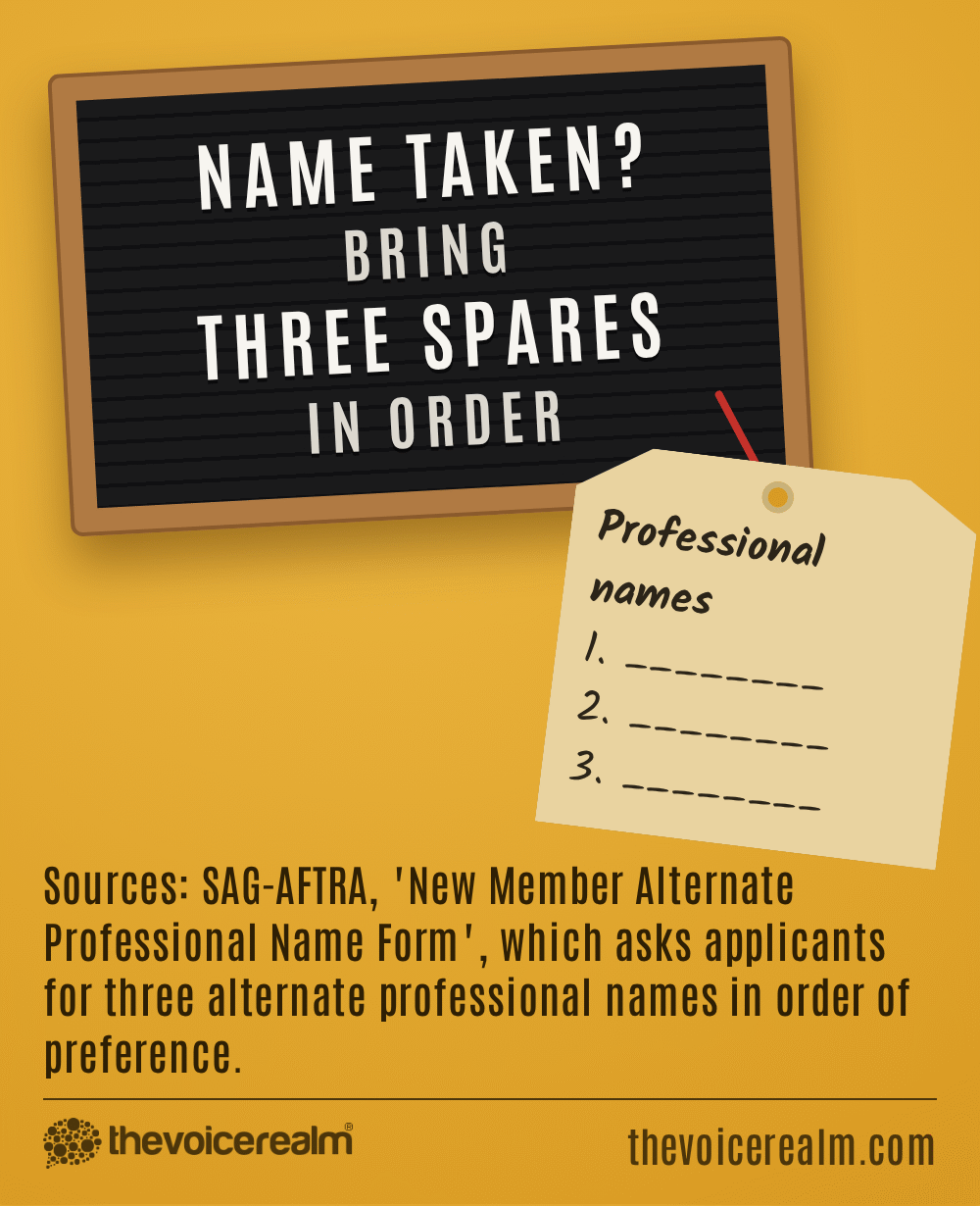
That form quotes the policy directly: “It is SAG-AFTRA’s objective that no member uses a professional name which is the same as, or resembles so closely as to tend to be confused with, the name of any other member.” It also warns applicants that “the possibility exists that we may not be able to enroll you with the professional name you wish to use,” and asks them to list three alternate professional names in order of preference.
The catch is timing. The same form notes that “Name availability can only be determined at the time of joining.” So you can’t reserve a name years in advance and be sure it’ll still be free. If your name is common, it’s worth thinking about your options before you’ve spent three years building a brand around one that might get taken.
Other performers’ unions run similar rules. Irish Equity, for instance, tells members: “Once you pick your Professional Name we reserve this and will not allow a situation where two members have the same name.” It gives the reason too: it’s “crucial for the distribution of royalties and other payments as well as for credits and casting clarity.” If you’re a member of a union somewhere else, ask them how it works before you print anything.
This is also why so many well known actors use a middle initial. Adding an initial, a middle name or a shortened first name is often the smallest change that turns a taken name into a free one, and it keeps you recognisable to the people who already know you.
Say it, spell it, search it
Before you commit to a name, put it through a few quick tests.
Say it in a slate. Record “Hi, I’m [name], and this is my read for…” ten times. Does it roll off the tongue, or do you trip on it? Does it sound like you? Our guide to those two seconds at the top of an audition explains why the way your name sounds there matters more than you’d think.
Spell it over the phone. Call a friend, say the name once, and ask them to text it back to you. If it comes back wrong, a casting producer will get it wrong too.
Search it. Look it up on the web, on the big video and social platforms, and in any directories for your country’s performers. You’re looking for anyone else in entertainment using it, especially other voice actors. Check whether you can get a matching website address and social handles, or something close.
“A name that gets lost between the ear and the keyboard is a name nobody can rebook.”
The Voice RealmPost this quote
If you’re planning to run your voice work as a proper brand, it’s worth a look at trademarks too. The US Small Business Administration’s guide to business names points out that registering a DBA name “doesn’t provide legal protection by itself,” and that “trademark infringement laws will still apply,” so check the official trademark database before you fall in love with something.
If you’re just starting out and still working out what kind of voice actor you are, there’s no rush. Plenty of people only settle on a name once they know which genres they’ll focus on. A course like Voice Master Academy can help you get the craft sorted first, and the name can follow.

© The Voice Realm
The tax forms still want the real you
A stage name is a public face, not a new legal identity. Money still has to land with the real person, and the paperwork reflects that.
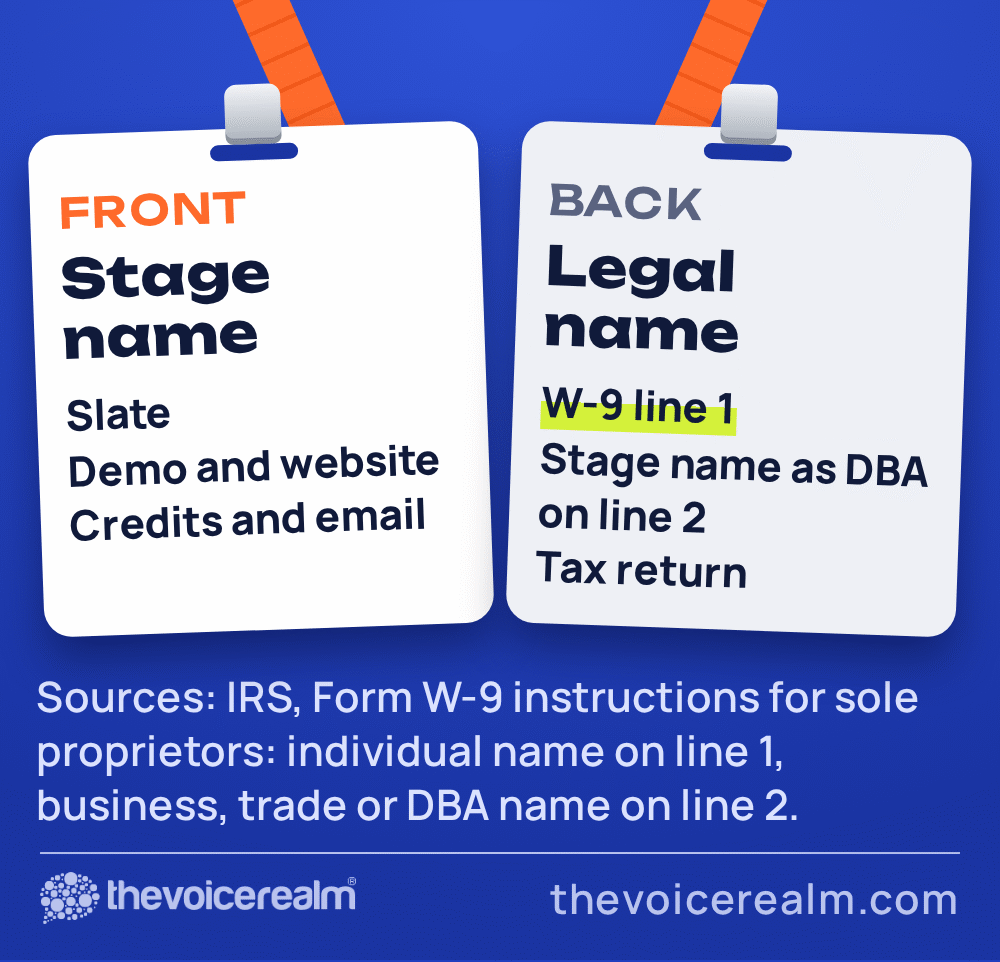
In the US, clients who pay you as a freelancer will usually ask for a Form W-9. The IRS instructions are clear about which name goes where. For a sole proprietor, “Enter your individual name as shown on your Form 1040 on line 1. Enter your business, trade, or ‘doing business as’ (DBA) name on line 2.” Your stage name can live on that second line, but the first line is always you.

 VoiceEditSuiteAuto Clean Up now learns how you breathe.A 30-second setup teaches it your breath, and you can teach it any breath it misses.See how it worksLearns from numbers, never your audio. Never used to train AI.
Depending on where you live, you may also need to register your stage name as a DBA (doing business as) name. The SBA explains that a DBA is also known as “a trade name, fictitious name, or assumed name,” and that “most states require you to register your DBA if you use one.” Rules vary by state, county and city, so check with your local registrar. It also mentions that a DBA plus an employer identification number lets you open a business bank account, which makes it much easier for clients to pay “Marlowe Finch” without confusion.
Outside the US the details change, but the principle doesn’t: your legal name stays on tax and banking records, and the trading name sits alongside it. If in doubt, ask an accountant, and see our guide to quarterly payments, deductions and records for the bigger picture.

© The Voice Realm
Two names, one tidy business
Running under a stage name is easy once it’s set up. The trick is to decide which name goes where, write it down once, and stop thinking about it.
Think of it as one name badge with two sides: a public front and a private back. When you sign a contract, sign it with your legal name and add your stage name if the client needs it for credits.
Your invoices should carry both. Put your business or stage name at the top, and make sure the payment details match the account the money is going into. Our checklist of what goes on a voice over invoice has the rest.
Tell your regular clients once, clearly, and you’ll rarely need to explain it again. Most producers have worked with plenty of people who use stage names. It won’t surprise them.
© The Voice Realm
Changing your name later
You can change your professional name later, but it costs more each year you wait. Every demo with a slate, every credit, every review and every link to your website carries the old name. Search engines take time to catch up, and some past clients will only ever remember the old one.
If you do switch, keep the old name pointing to the new one wherever you can: redirect the old website, update your profiles with a short “formerly known as” line for a while, and email past clients with the news. Keep it simple and friendly.
The most common reason people change names late is the union one. They build a career on a name, then find it’s taken when they come to join. That’s exactly why it pays to have your spares lined up before you need them.
© The Voice Realm
Pick it once, then wear it everywhere
The best stage name is the one you don’t have to think about after the first week. Whether you use your own name or invent one, choose it with your slate, your search results and your future union card in mind. Then put it on everything, keep the paperwork in your legal name, and get back to the part that actually books work: the voice.
Sources: SAG-AFTRA, “New Member Alternate Professional Name Form”; Irish Equity, “Membership Benefits”; Internal Revenue Service, “Form W-9 and instructions”; U.S. Small Business Administration, “Choose your business name”.
Ready to get booked?
See the jobs open right nowAbout Sarah Robbins
Sarah Robbins writes for The Voice Realm about finding voice over work, home studios, casting and the business side of voice acting.