Blog
This one’s for voice actors who’ve just opened a script and found a poem in it. Maybe it’s a brand film that ends on a few lines of verse, a rhyming picture book for an audiobook publisher, a tribute video, a museum installation or a holiday ad. You can read copy all day. Then the lines get short, the words start to rhyme, and suddenly you sound like a greeting card.
Reading poetry aloud is its own small craft, and the good news is that the people who teach it for a living agree on most of it. Below is where poems turn up in voice work, why they trip up good readers, and a practical way to prepare, perform and record one so it sounds like a person meaning every word.
Where poems turn up in voice work
More often than you’d think. Advertisers love a poem at Christmas and for big brand moments, because verse makes thirty seconds feel like an occasion. Audiobook publishers need narrators for poetry collections, anthologies and picture books in rhyme. Charities and memorial services ask for readings. Museums and galleries use poems in audio guides and installations. And e-learning writers slip a verse into a module more than you’d expect.
Each of those clients wants the same thing, even if they don’t say it: a read that makes the words land and lets the listener feel something, without the reader getting in the way.
Why poems trip up good readers
The trouble is the rhythm. Poems are built from patterns of stressed and unstressed beats, and many rhyme. Your ear picks the pattern up straight away and your voice starts to follow it, bouncing along the meter and landing hard on every rhyme. That’s the singsong read, and it’s the first thing a director will ask you to lose.
Poetry Out Loud, the national high school recitation contest run by the National Endowment for the Arts with state arts agencies, warns its competitors about exactly this: “Be aware of meter, rhyme, and sound patterns, but avoid letting them create a singsong or overly rhythmic delivery.”
The second trap is the opposite one. Knowing it’s poetry, some readers go grand. Big pauses, a reverent hush, every line treated as profound. That reads as performance, and the listener stops hearing the poem and starts hearing you. If you’ve ever been told a read sounds “announcery”, this is the same problem in a fancier coat. Our guide to sounding natural on any script is a good warm-up for what follows.

© The Voice Realm
Rewrite it the way you’d say it
Here’s the single most useful habit, and it comes from someone who won the whole contest. Anita Norman, the 2014 Poetry Out Loud National Champion, shared her method on the National Endowment for the Arts blog: “take the time to rewrite the piece as you would speak it.”
Copy the poem out by hand or retype it as sentences, ignoring the line breaks. Put each full thought on its own line. You’ll find that a poem that looked like twelve lines is really four sentences, and that some of those sentences run straight across two or three lines without stopping. Norman found the same: “It made it easier to communicate the message of the poem more clearly when it was rewritten to be heard, not read.”
Read your rewritten version aloud a few times as if you’re telling someone something. Once that sounds right, go back to the original layout and keep the same thinking. The line breaks will still shape your read, but they won’t run it.
© The Voice Realm
Line breaks aren’t stop signs
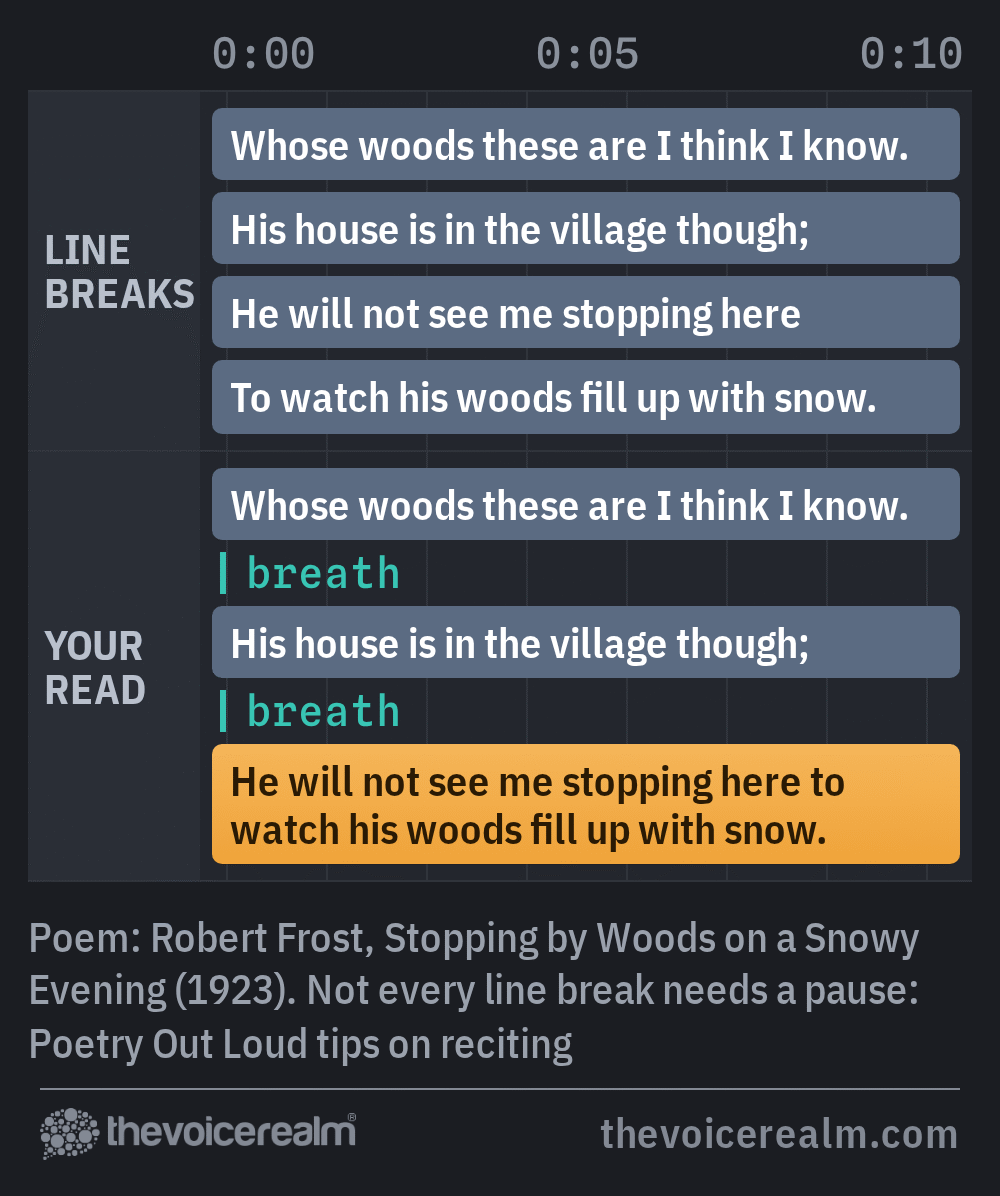
A line break is the poet’s choice about how the words look on the page. It isn’t an instruction to breathe. Poetry Out Loud tells its readers to “Consider line breaks when shaping your delivery, and do not assume every line break requires a pause.”
When a sentence carries on past the end of a line, poets call it enjambment, and it’s where most singsong reads go wrong. Stop at the end of every line and you chop a sentence in half, so the listener loses the thought. Look at the third line of the Frost verse in the editor view above: on the page it ends at “here”, but in the read it flows straight into the fourth line, because it’s one idea.
That doesn’t mean the break means nothing. You can lift the last word of a run-on line very slightly, or hold it for a hair longer, so the listener feels the shape without hearing a full stop. Punctuation is a better guide to where you breathe. A full stop gets a real pause. A semicolon gets a shorter one. A comma might get none at all.
Find the turn
Most poems change direction somewhere. A memory turns into a regret, a description turns into a question, a quiet scene ends on one sharp line. That moment is the heart of the read, and it’s your job to find it before you’re anywhere near a mic.
Norman’s advice is short and worth pinning above your desk: “If the poem has a tone shift, you should have a tone shift. Don’t try to create a feeling that is not there.”
On your printed copy, mark the turn with a line across the page. Read everything before it in one colour of thought and everything after it in another. You don’t need a dramatic change in voice. A slight shift in pace, a lower pitch, a little more air, or simply a beat of silence before the turn is usually enough for the listener to feel the poem change gear.
© The Voice Realm
Say less, mean more
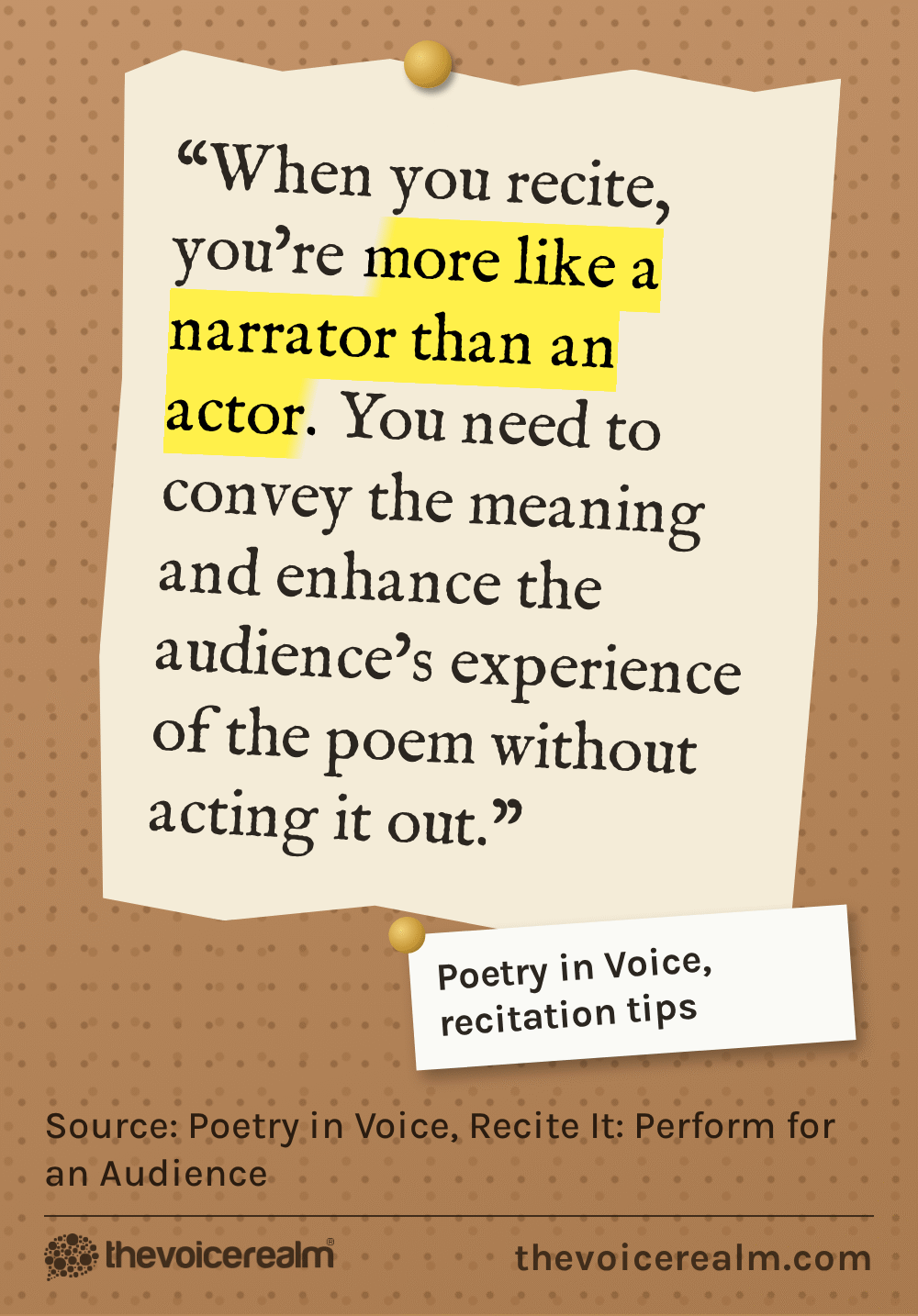
It’s tempting to act a poem out. Poetry Out Loud’s guidance pushes the other way: “Let the poem guide emotional expression rather than adding emotion on top of it.” And: “Remember that a quiet or restrained delivery can be just as powerful as an intense delivery.”
 VOICEMASTERACADEMYTwenty modules, one at a time.Breath controlHome studioCommercial techniqueAuditionsStart module oneNo experience needed.
For voice work, that restraint is doubly true, because the mic picks up every bit of push. A line that sounds moving in a theatre can sound overcooked through headphones. Pick the few words that carry the meaning in each sentence and give them weight. Let the rest sit lightly. Trust the writing to do its job.
A helpful check: record a take where you feel you’re underplaying it. Then play it back next to your “full feeling” take. More often than not, the quieter one is the one a client will pick.
© The Voice Realm
Get every name and word right
Poems are dense, and a single wrong word costs more than it would in a long script. Read the whole thing for meaning first. Look up any word you’re not sure of, any place, any name, and any phrase in another language.
Poetry Out Loud’s list includes a detail plenty of readers forget: “Learn the correct pronunciation of the poet’s name and, if applicable, the translator’s name.” If the client wants the title and poet read at the start, that name is the first thing anyone hears. Our guide to researching tricky names before a session walks through where to look.
Accents are the other trap. Unless the client asks for one, read in your own voice. The contest’s guidance is direct: “Avoid the use of affected or imitated accents.” A borrowed accent pulls attention away from the words, which is the opposite of what you’re there for.
Recording a poem in the booth
Once the thinking is done, the recording is the easy part, as long as you give the poem room.
- Slow down a touch. Poems pack more meaning into fewer words than copy does, so the listener needs a little more time. Not a lot. Just enough that each image lands before the next one arrives.
- Record whole sentences. Don’t stop and pick up mid sentence if you can help it. A poem pieced together line by line loses its flow, and the joins are easy to hear.
- Offer two shapes. Give the client a take that’s plainer and one that’s a little warmer. Directors often don’t know which they want until they hear both.
- Read the title cleanly. If the brief includes the title and poet, read them simply, then leave a short beat before the first line.
Then there’s the ending. Poetry in Voice, a Canadian recitation programme for students, tells students that once they’ve finished, they should “pause to let the poem settle over the audience, then walk away.” In audio, the pause is the walk away. Hold still for a few seconds after the last word so there’s clean silence to work with.
© The Voice Realm
Leave the silence in
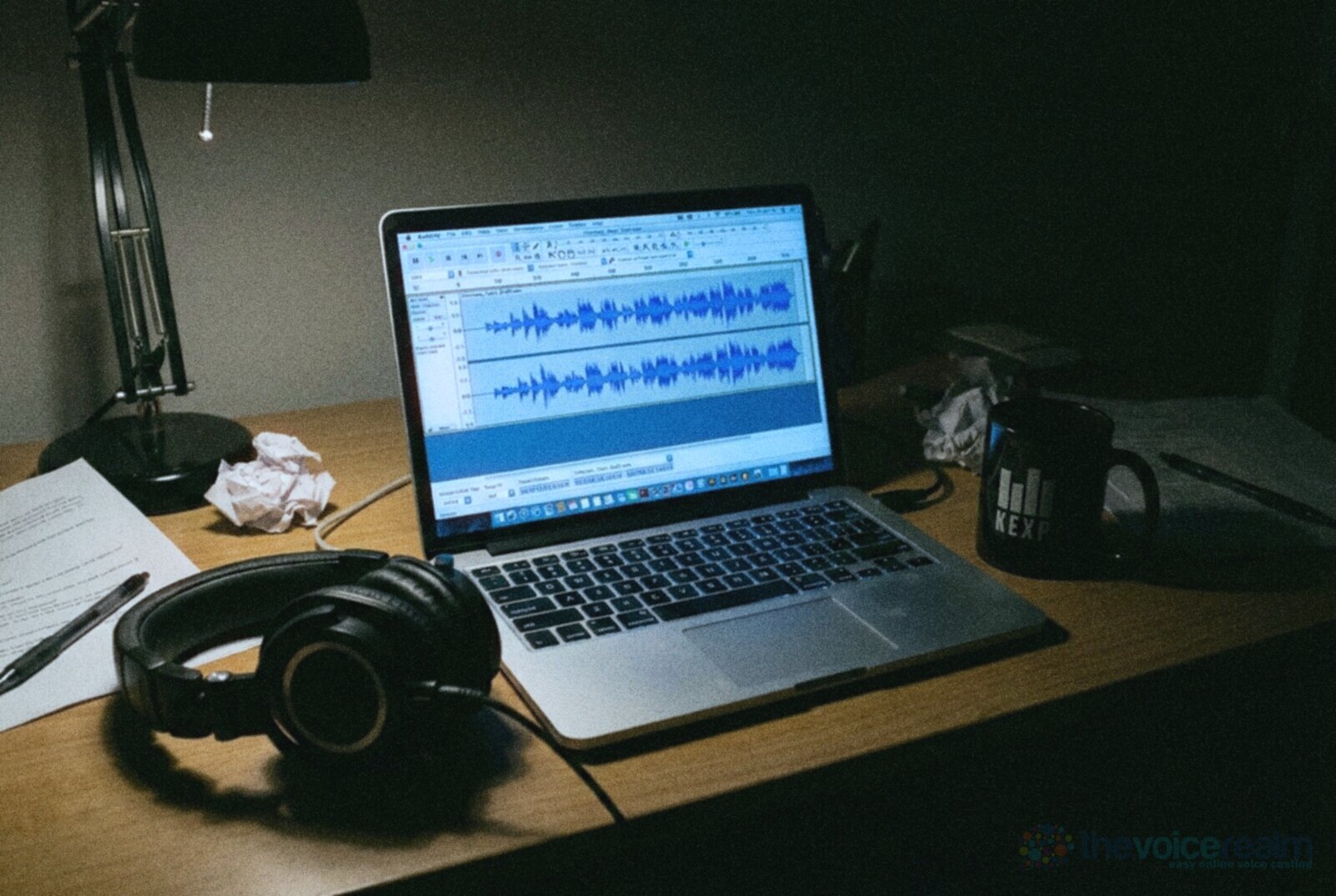
When you edit, resist the urge to tighten every gap. The pauses you chose at the turn, after the big image and before the last line are part of the read. Trim breaths that are loud, fix clicks and fluffs, but leave the timing alone. If a pause has to come out, replace it with room tone rather than cutting to digital silence, which sounds like a hole in the air. Our piece on why every voice over needs room tone explains how to record a clean bed of it.
- Rewrite it as sentences. Find the thoughts hiding under the lines.
- Mark the full stops, not the line ends. Breathe where the sense breaks.
- Draw a line at the turn. Shift your read there, gently.
- Check every name. The poet’s included.
- Play the quiet take back. It’s often the one.
Do the thinking first and the poem will mostly read itself. That’s the quiet secret of good verse reading: the more you understand it, the less you need to do to it.
Sources: “Tips on Reciting”, Poetry Out Loud; “How to Recite a Poem”, Anita Norman, National Endowment for the Arts; “Recite It: Perform for an Audience”, Poetry in Voice; Robert Frost, “Stopping by Woods on a Snowy Evening” (1923).
Ready to get booked?
See the jobs open right nowAbout Sarah Robbins
Sarah Robbins writes for The Voice Realm about finding voice over work, home studios, casting and the business side of voice acting.