 Blog
Blog
This one’s for Australian voice over artists, and for the producers, agencies and small businesses who book them. In the space of three months, Canberra has promised to protect creative work from AI training, a leaked plan has suggested it might not, and commercial radio has started telling listeners when a host isn’t human. None of it has reached the statute books yet. So here’s our read on what changed in 2026, what hasn’t, and what’s worth doing at your desk this week while the politicians make up their minds.
The promise from Canberra
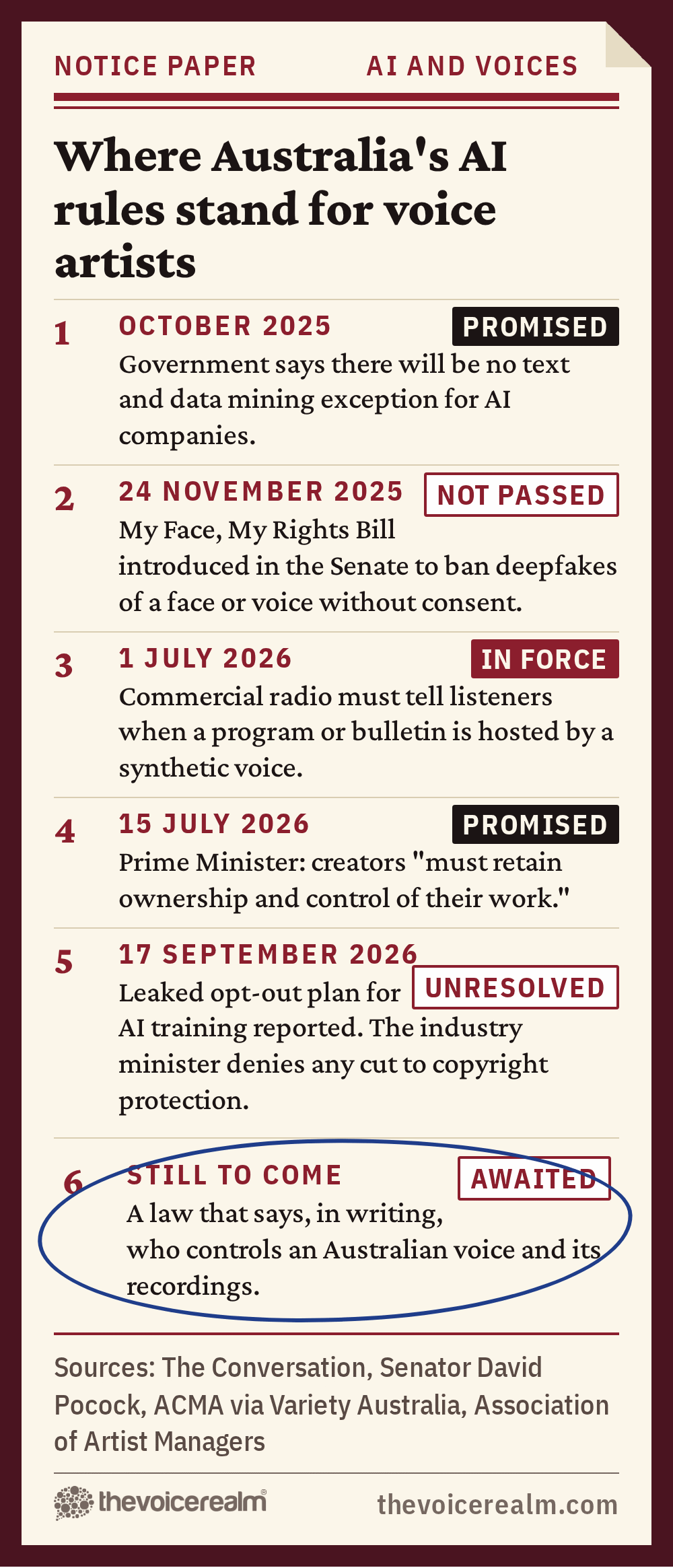
On 15 July, the Prime Minister made the clearest statement any Australian government has made on creative work and AI. “Australian writers, musicians, artists and journalists must retain ownership and control of their work,” Anthony Albanese said, as quoted by the Association of Artist Managers in its response.
Voice actors weren’t named in that line, but the logic covers us. A finished commercial read, an audiobook or an e-learning module is a recording someone owns, and the government had already said in October 2025 that there would be no text and data mining exception letting AI companies help themselves to Australian content. For anyone who has spent years building a library of reads, that’s the line that matters most.
The music side of the industry welcomed it, with a warning. The Association of Artist Managers pointed out that copyright on its own doesn’t solve everything, citing UNSW professor Kathy Bowrey: “Copyright has never been a cultural policy.” That’s worth keeping in mind for voice work too. Copyright protects a recording. It says much less about the voice that made it.

© The Voice Realm
Then the leak
Two months later, the picture got murkier. Writing in The Conversation on 17 September, Dilan Thampapillai described a leaked proposal that would let big AI companies use Australian creators’ work unless the creators opted out, partly because “the government also wants to see big AI companies investing in data center development in Australia.”
Deputy Prime Minister Richard Marles was quoted making the case for closer ties: “The opportunity for Australia economically is enormous in collaborating with frontier companies.” Industry Minister Tim Ayres, for his part, denied that copyright protection was being reduced.
Thampapillai’s objection is the one every voice over artist should understand, because it’s exactly how an opt-out would land on a working voice. “Forcing copyright owners to opt out of a given system, such as their works being included in training materials for AI models, impedes their rights because it forces them to take action to protect those rights,” he wrote. And the bit that should make you sit up: “Once materials are in the model, the AI system can’t ‘unlearn’ them.”
Think about what an opt-out would ask of a freelance voice artist in Perth or Hobart. You’d need to know which of your recordings exist, where they’re hosted, who holds them, and which AI companies to tell. Most of us couldn’t list every corporate video we voiced in 2019, let alone track where the client uploaded it. An opt-out sounds fair in a press release. In a home studio it’s a second job.
© The Voice Realm
Radio already has to tell listeners
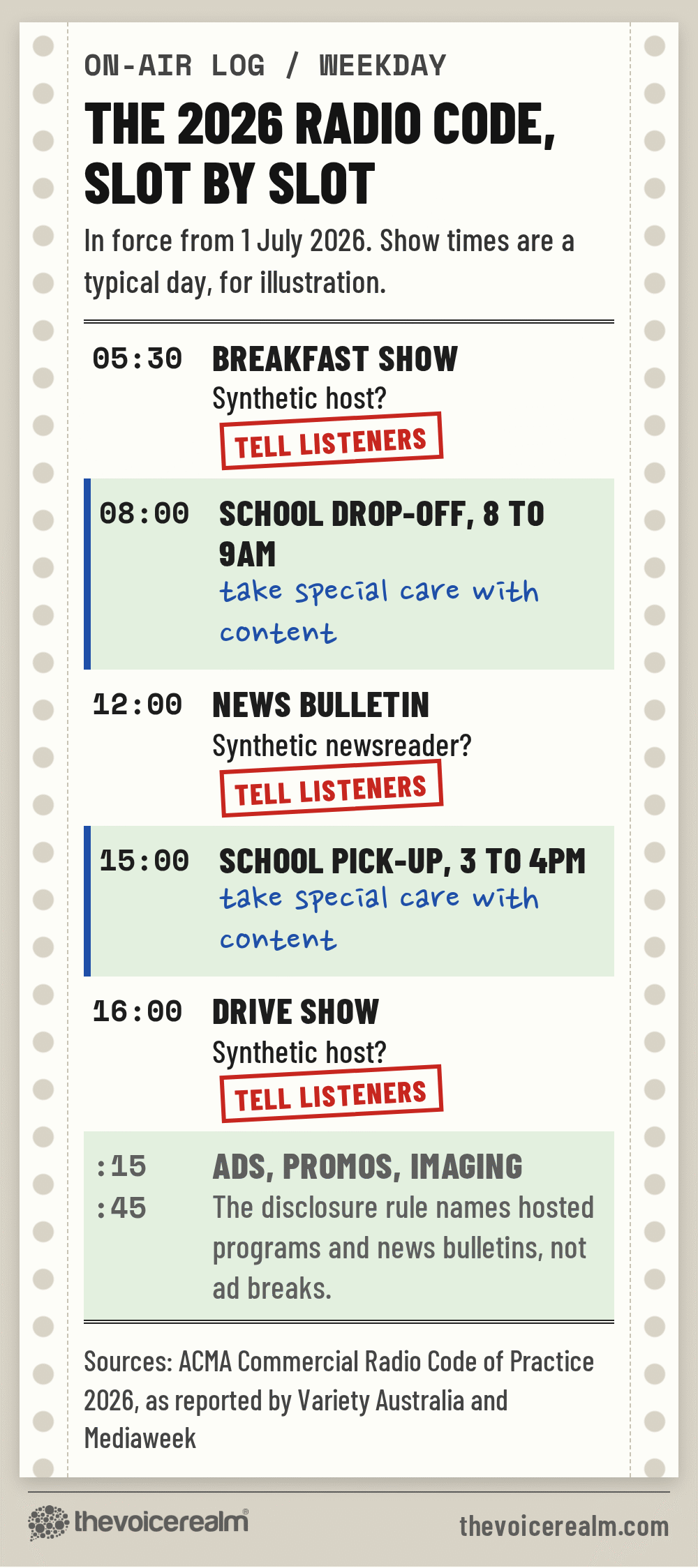
One rule did arrive this year, and it’s a useful one. The updated Commercial Radio Code of Practice, registered by the Australian Communications and Media Authority, took effect on 1 July 2026. Under it, stations must tell listeners when a regularly scheduled program or news bulletin is hosted by a synthetic voice. Variety Australia reported it as the first time AI has been addressed directly in an Australian broadcasting code.
It doesn’t cover ads, promos or station imaging, and it doesn’t stop a station using AI. What it does is put a label on it, and labels change behaviour. A program director who has to announce “this host isn’t a person” every morning has to decide whether that’s the brand they want. Plenty will decide it isn’t.
For voice artists who live in radio, that’s a small but real advantage. If you voice imaging, promos or radio and TV commercials for Australian brands, the human sound is now something a station can say out loud. It’s worth mentioning in your pitch.
© The Voice Realm
Copyright protects the recording, not your voice
Here’s the gap nobody in Canberra has closed yet. Copyright is about recordings and works. If someone trains a model on hours of your reads and produces a new line you never said, it’s far from clear that copyright gives you much to stand on, because the new file isn’t a copy of anything you recorded.
Independent Senator David Pocock tried to fix part of that with the My Face, My Rights Bill, introduced in November 2025. It would ban deepfakes of a person’s face or voice made without consent and give people a complaints process and court remedies. “Artificial intelligence has progressed much faster than our laws have been able to keep pace with,” Pocock said when he introduced it. It’s a private senator’s bill and it hasn’t passed.
 VoiceEditSuiteClean it up, check it, send it.Loudness NormalizerScript AccuracyRate CalculatorSee the suiteThe studio check is free to try.
Until something like it does, the thing protecting your voice is the piece of paper you sign before the session. We went through how licences, terms and territories work in our guide to who owns your voice after the session, and every word of it applies here. The short version: if the paperwork doesn’t say your voice can be used to train or build a synthetic voice, make sure it says it can’t.
© The Voice Realm
What to put in writing now
The industry already has a framework for this. The Callsheet guide to the MEAA voiceover rates puts it plainly: “If the brief involves synthetic voice, voice cloning, AI-assisted manipulation beyond standard post, or a generative voice model trained on the talent, the MEAA Voiceover Standard Contract + AI Rider 2024 applies on top of the rate card.” The same guide describes the rider as a consent and licensing framework that doesn’t replace the base fee.
That’s the right instinct whether you work under MEAA terms or not. AI use is a separate permission, it gets its own fee, and it’s never assumed. Here’s how we’d apply it to everyday freelance work.
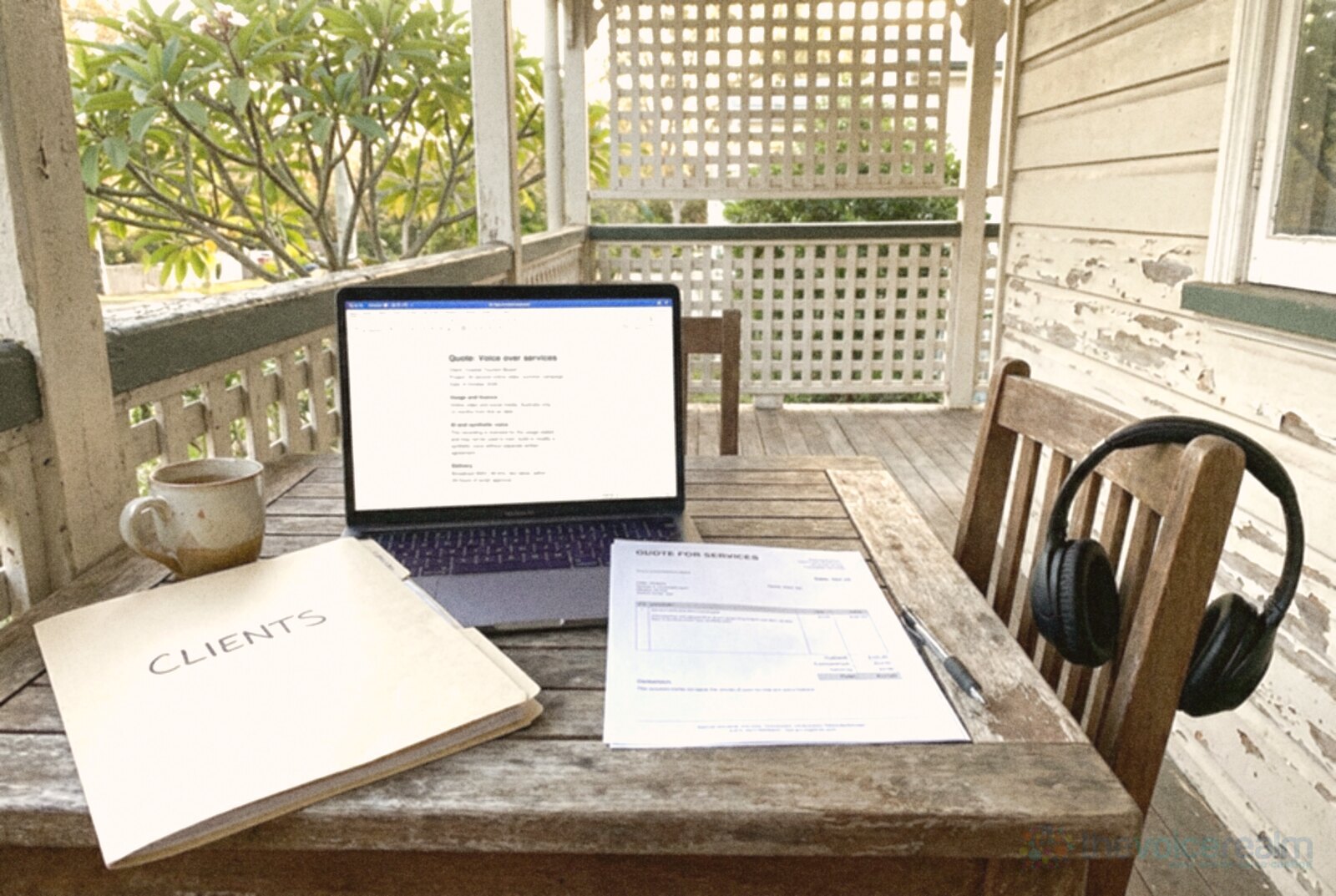
- Add a one-line AI clause to your quote. Something like “This recording is licensed for the usage stated and may not be used to train, build or modify a synthetic voice without separate written agreement.” Clients rarely push back on a sentence that plain.
- Name the usage and the term. Media, territory and time. A 12 month online licence for a Queensland tourism spot is a clear thing to agree to. “All media, in perpetuity” isn’t.
- Keep your own records. Save every quote, licence and final file in one folder per client. If a version of your voice ever turns up where it shouldn’t, that folder is your evidence.
- Read the platform terms before you upload. Practice apps, free TTS tools and some recording services ask for broad rights over anything you feed them. If the terms mention training, don’t upload client work there.
Pricing matters here too. When a client asks for AI rights, they’re asking for something worth far more than a single read, because it replaces future sessions. If you need a starting point for ordinary usage, a public non-union rate card for Australian voice work shows what local clients expect to pay for each kind of job, and you can build any AI permission on top of that rather than inside it.
Where the human voice still wins
It’s easy to read all this as gloom. We don’t. The jobs that pay well in Australia are still the ones where a listener has to believe the person talking: a regional bank’s TV spot, a council safety message, a children’s audiobook, a game character with a real Australian rhythm. Those reads depend on timing, warmth and local ear, and producers know it when they hear it.
“An opt-out sounds fair in a press release. In a home studio it’s a second job.”
The Voice RealmPost this quote
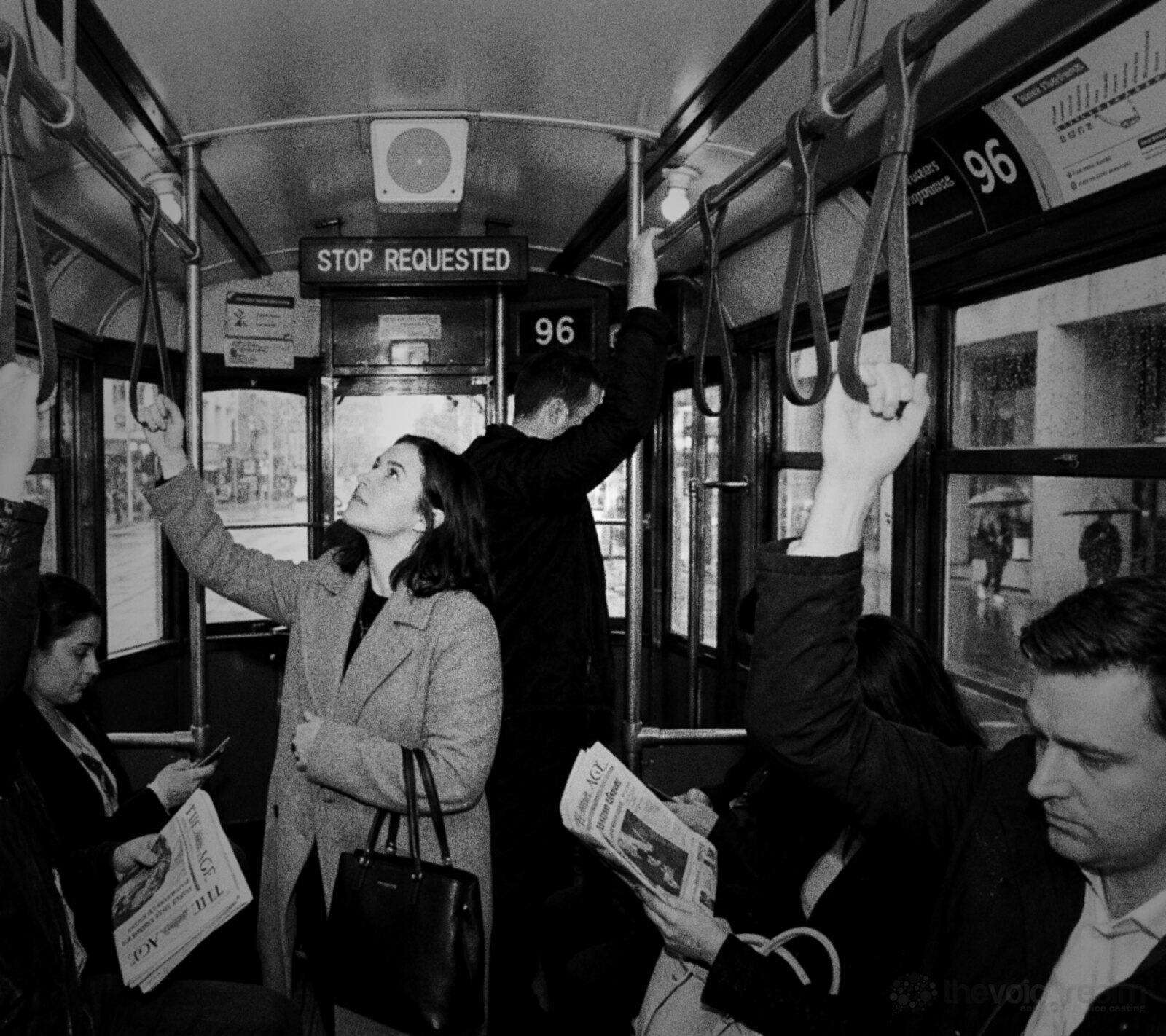
Local sound is a big part of that. A Brisbane brand often wants someone who sounds like Brisbane, not a neutral average of every accent on the internet. Agencies that book Melbourne voice talent for a tram network or voice over artists from Perth for a mining safety induction are paying for exactly the thing a synthetic voice is worst at, which is sounding like it belongs to a place.
The people doing the most to keep that argument loud are voice actors themselves. The Australian Association of Voice Actors describes its mission as being “to tirelessly advocate for human voice acting, while promoting community cohesion through events, education, resources and support for our entire industry.” Its gala on 24 October at Customs House in Sydney will hand out awards for people who’ve built the industry, and that sort of visibility matters when a minister is weighing up data centres against creative jobs.
If you’re newer to all this and wondering whether it’s still worth starting, it is. Read our piece on why a real performance still beats a synthetic one, then look at the kinds of voice over work online that Australian artists are booked for. The work is there. It just needs to be protected on paper.
© The Voice Realm
Our take
The government has said the right thing, and the leak suggests it may be tempted to say something different. Until the law is written, the protection for Australian voices sits in two places: the contracts artists sign, and the choices clients make. Artists can tighten the first one today with a single sentence on every quote.
Clients have a part to play as well. When you book Australian voice over artists, you’re buying a performance, not a dataset. Say so in your brief, agree the usage up front, and keep AI out of the licence unless you’ve both agreed a fee for it. Whether you’re casting a Sydney voice for a harbour ferry announcement or a narrator for a long training course, that’s how this industry stays worth working in. We’ll keep watching Canberra and report back when the rules land.
Sources: “PM doubles down on copyright protection: AAM statement”, Association of Artist Managers, July 2026; “Opt-out AI training plan could weaken Australian copyright protections”, Dilan Thampapillai, The Conversation, republished by Phys.org, 17 September 2026; “ACMA Mandates AI Disclosure in Commercial Radio Under New Code”, Variety Australia, February 2026; “New bill to protect identity in deepfake future”, Senator David Pocock, November 2025; “MEAA Voiceover Rate Card 1 July 2025 explained”, Callsheet; “The Australian Association of Voice Actors”, AAVA.
Ready to get booked?
See the jobs open right nowAbout Sarah Robbins
Sarah Robbins writes for The Voice Realm about finding voice over work, home studios, casting and the business side of voice acting.