Blog
Blog

You’ve booked the job, the read went well and the client loved it. Then the question nobody taught you to ask turns up in your inbox: “Can we also run this on TV?” If that line makes your stomach drop, this guide is for you. It’s for working and new voice actors who quote their own jobs and want to understand usage rights well enough to price them, explain them and spot the clause that quietly gives everything away.
None of this is legal advice, and a contract that matters deserves a lawyer’s eye. But most of usage comes down to a few plain questions, and once you can ask them, quoting stops feeling like guesswork.
Usage is the part of the fee that isn’t about your time
When you record a commercial, you’re paid for two different things. One is the work itself: the hour or so you spent in the booth. The other is permission to use the result. That second part is usage, and it’s where most of the money in commercial voice over actually sits.
The Global Voice Acting Academy, whose rate guide many non-union actors work from, puts it simply: “Usage is the term a voice actor’s work is licensed for a particular project.” It goes on to explain why the word belongs mostly to ads: “the voice actor’s work is tied to the media buy of the commercial, and the client is paying a licensing fee to use the voice over for that period.”
That’s the key idea. A client isn’t buying your voice. They’re renting the right to play one recording, in certain places, for a certain time. Change the places or the time, and you’re talking about a different licence.
Pays for the work
Your time at the mic, the takes, the direction, the edit you deliver. It’s the same whether the spot plays once or for a year.
Pays for the reach
Permission to play that recording. It grows with the medium, the size of the market and the length of time it runs.
Three questions that size every licence
GVAA lists three factors that decide usage, and they make a handy checklist for every quote. Where will it play, how far will it reach, and for how long?
Where it plays. Television, radio, streaming, social media, a website, a screen in a shop. Each is a separate medium, and a spot that runs on radio and TV is two licences, not one. A client who says “it’s just for online” is telling you something useful, so write it down.
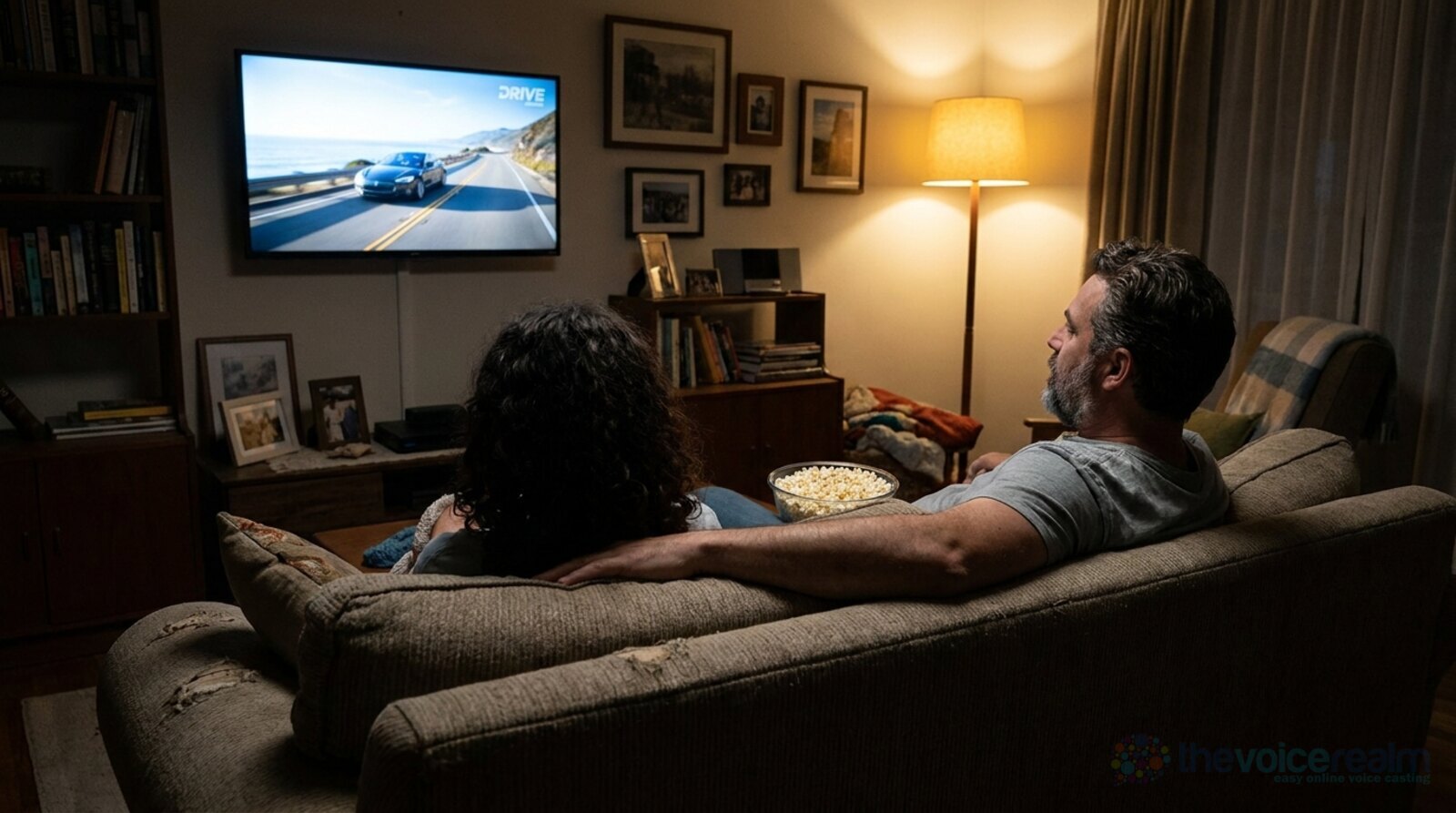
Same recording, different screen, different licence. © The Voice Realm
How far it reaches. A local radio ad in one town is a different thing from a regional campaign across a state, and both are different from a national buy. The bigger the audience, the more the recording is worth to the advertiser, and the more the licence should cost.
How long it runs. The common terms in commercial work are 13 weeks, six months and a year. When that time is up, the client either stops using the spot or pays to renew.
The answers multiply rather than add up. A year of national TV is a very different licence from 13 weeks on one local station, even though the session that produced them might have been identical, right down to the same coffee.
How union commercials count time
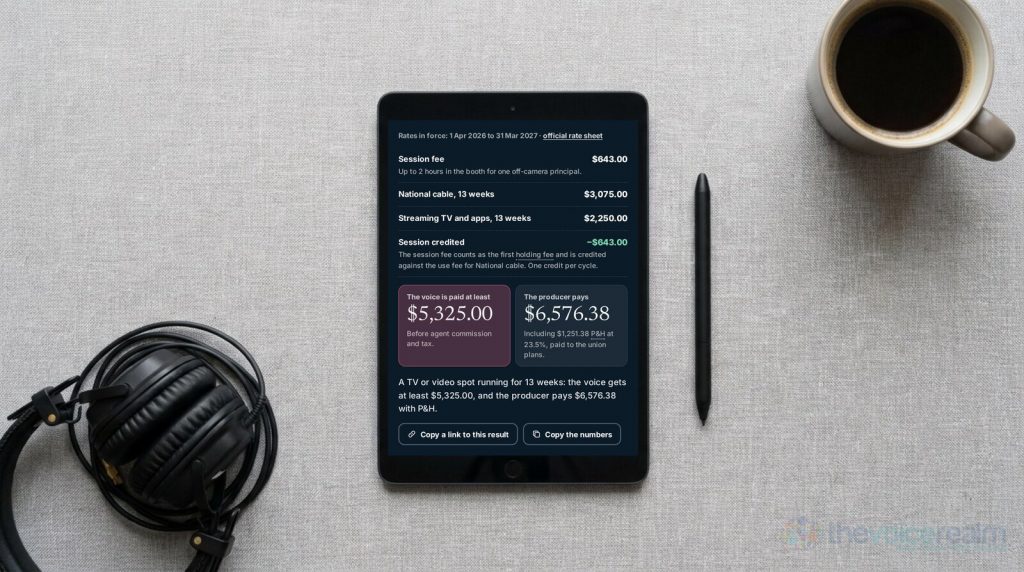
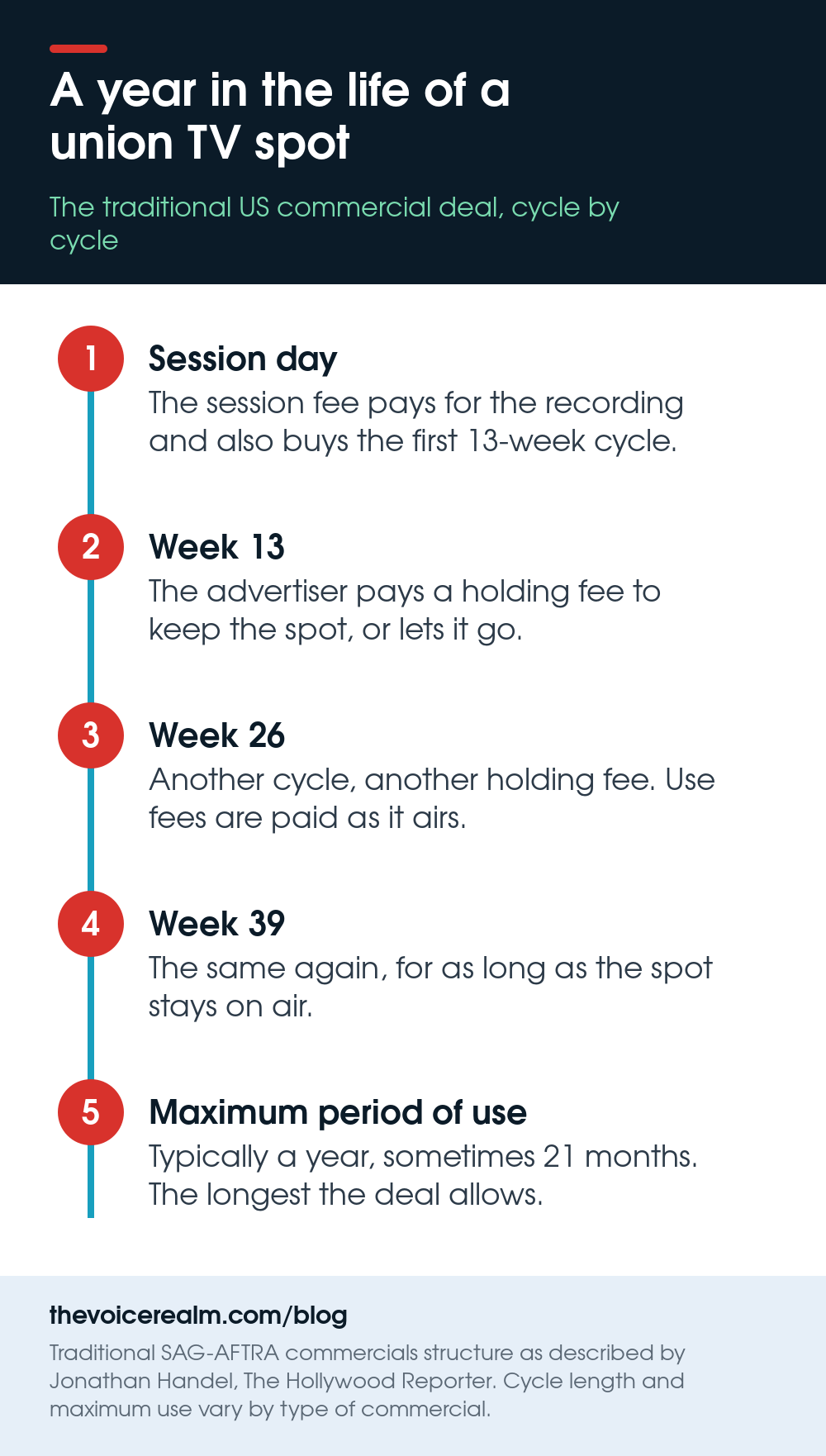
Union commercials in the US are a useful model even if you never join, because they show how seriously advertisers treat time. The Hollywood Reporter’s Jonathan Handel explained the traditional structure like this: “the session fee also serves as the first holding fee, and secures the right to use the commercial for a single ‘cycle,’ typically 13 weeks but sometimes extendable to 17 weeks.”
After that, the advertiser keeps paying to keep the spot. Further holding fees are due “for each cycle” until the spot reaches what the contract calls “the maximum period of use,” which Handel puts at “typically either a year or 21 months.” Use fees, the residuals, sit on top of that, depending on the kind of commercial and how much it airs.
You don’t need to copy that structure to learn from it. The lesson for non-union quoting is that time is never open-ended by accident. Somebody decides how long a recording runs, and the voice gets paid for the length. If you want the actual union numbers, our plain-English guide to the SAG-AFTRA rate card walks through them.
© The Voice Realm
Online is still usage, even when it feels small
A lot of today’s work never touches a TV. It’s a pre-roll before a video, a paid social ad, a looping clip on a product page. It can feel like a smaller job, and sometimes it is. But paid online advertising is still a media buy, and it can reach more people in a weekend than a local radio spot does in a month.

Paid social is a media buy too. © The Voice Realm
The useful split is between audio that sells to the public and audio that doesn’t. A paid ad on social media is advertising. A training module that only staff will ever hear is not. GVAA makes the same point with a neat comparison: the value of “a national tv commercial for a large sports apparel brand is going to be different than a 3-minute internal corporate narration for that same brand.”
Same client, same voice, wildly different licence. So when a corporate client asks for “a short video,” ask whether it’s for the team or for the world. If it’s the second, ask whether money is being spent to push it in front of people. That one question changes the quote more than the word count does.
Buyouts aren’t forever, unless you agree they are
“Buyout” gets used loosely, and that’s where actors get burned. In commercial work, a buyout usually means one fee that covers a defined scope: this medium, this market, this term. It’s a convenience for the client, who pays once instead of in cycles. It isn’t a promise that they can use the recording for anything, anywhere, until the end of time.
 VOICEMASTERACADEMYLearn the craft in order.Module one is freeStart module oneTwenty modules, start to finish.
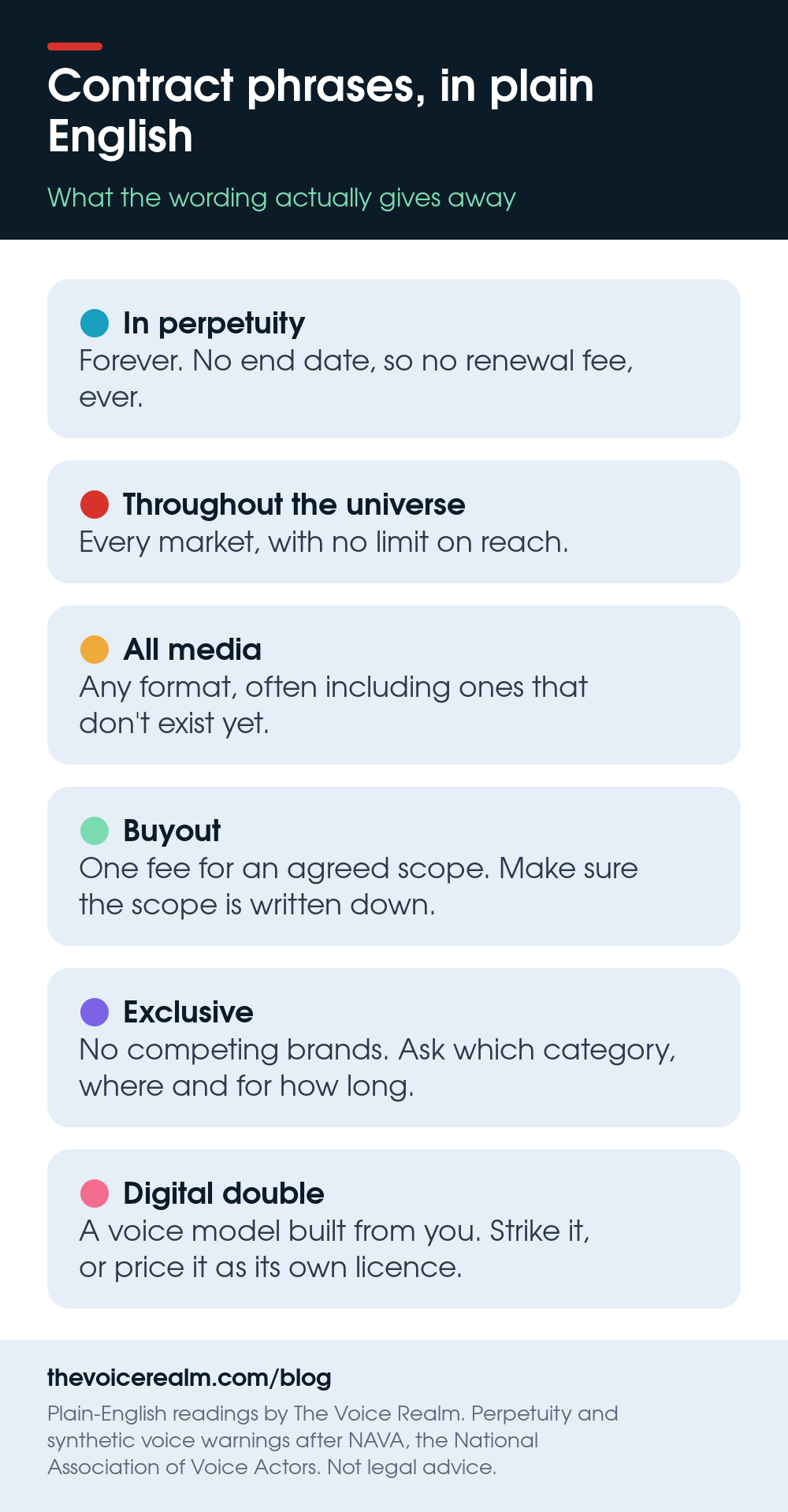
The version to watch for is the unlimited one. The National Association of Voice Actors, NAVA, is blunt about it: “‘In perpetuity throughout the known universe’ robs you of any potential future earnings.” Its advice is to “stipulate a specific start and end date for the usage so you and your agent can renegotiate at the end of the term.”
There are honest reasons a client might want long or broad rights. An explainer video that lives on a website for years, a phone system greeting, a course that’s sold for a decade. That’s fine, as long as you price it knowing what you’re giving. A perpetual licence should cost more than a one-year one, because it’s worth more. We’ve looked at the trade-off between one fee and ongoing payments before, in full buyouts versus residuals, if you want a second angle on it.
Exclusivity is a separate ask
Usage covers where your recording plays. Exclusivity covers where you can play. If a bank wants to be sure its friendly voice isn’t also selling a rival bank’s mortgages next month, that’s a reasonable request, but it costs you work, so it should be paid for.
Union contracts treat it the same way. Handel notes that the holding fee “grants limited exclusivity,” and that blocking an actor from other, non-competing products takes “additional exclusivity fees.” GVAA’s coaching material also flags conflicts and exclusivity as their own subject, alongside the warning that unlimited use “can be dangerous for your career.”
For a non-union job, keep it simple. If the client wants you off competing brands, ask which category, for how long and in which markets, then price it as its own line. “No other banks in Canada for a year” is a clear, quotable promise. “Exclusive” on its own is not.
The newer clause: your voice as data
Usage used to be about where a recording played. Now there’s a second question hiding in some contracts: whether the recording can be used to build something that sounds like you. That might be a synthetic voice, a voice model or training data for one.
NAVA’s guidance is to look carefully at the wording. It tells actors to watch for “ANY verbiage that alludes to ‘simulation’ ‘synthesization’ or ‘digital double’,” and for any rider with suspicious language, and to “work with your agent to get this language struck, or your attorney if you have one.” It also points out that the language often isn’t aimed at you personally: “Many times they may not realize it’s even in there as their attorneys are trying to include this language ‘just in case’.”
So ask. A friendly email saying “I’m happy with the usage we agreed, could we remove clause 7, which would allow synthetic use of my voice?” settles most of these. If a client genuinely wants to build a voice model, that’s a separate, much bigger licence, and NAVA’s checklist of what it should cover (consent, limits, an end date, fair pay) is a sensible place to start. For the wider picture on who owns what in a recording, our older piece on copyright for voice actors is worth a read too.
How to quote when the brief doesn’t say
Plenty of briefs arrive with a script, a deadline and nothing about usage. That’s not a trap, it’s usually just a busy person who hasn’t thought about it. Your job is to make it easy for them.
Start by asking the three questions in one short message: where will it play, roughly how big is the audience, and how long will it run? Most clients answer in a line. If they don’t know yet, quote the version you think is most likely and say your assumption out loud, with the next option priced beside it. Something like: “This covers paid social in the US for 12 months. If it moves to TV, I’ll quote that separately.” Now nobody is surprised later.

Three questions, one short message. © The Voice Realm
Then put the scope in writing, in the quote, the invoice or the email that confirms the booking. It doesn’t need legal language. “Usage: online paid social and website, United States, 12 months from first air” is enough to protect both of you. When the client comes back in a year wanting to renew, you’ll both know exactly what was agreed.
Finally, keep a simple log of what you’ve licensed and when it ends. A spreadsheet with client, spot, medium, market and end date is plenty. Renewals are some of the easiest money in this business, and they only happen if someone remembers to ask.
Read the usage line before you audition
Usage isn’t just a quoting skill. It’s a reading skill. Whenever you’re looking at a casting, whether on our voice over jobs board or in an email from a producer, read where the spot will play and for how long before you hit record. It tells you what kind of read to give (a national TV spot and a staff training video want different energy) and whether the job is right for you at all.
© The Voice Realm
The more often you ask these questions, the more natural they get. Clients notice, too. An actor who asks “where’s this running?” sounds like someone who’s done this before, and that’s exactly who people like to hire.
Sources: Global Voice Acting Academy, “Rates & Negotiation”; Jonathan Handel, The Hollywood Reporter, “SAG-AFTRA’s New Commercials Contract Explained: Who May Benefit”; National Association of Voice Actors, “Synth & AI”.
Ready to get booked?
See the jobs open right nowAbout Sarah Robbins
Sarah Robbins writes for The Voice Realm about finding voice over work, home studios, casting and the business side of voice acting.