Blog
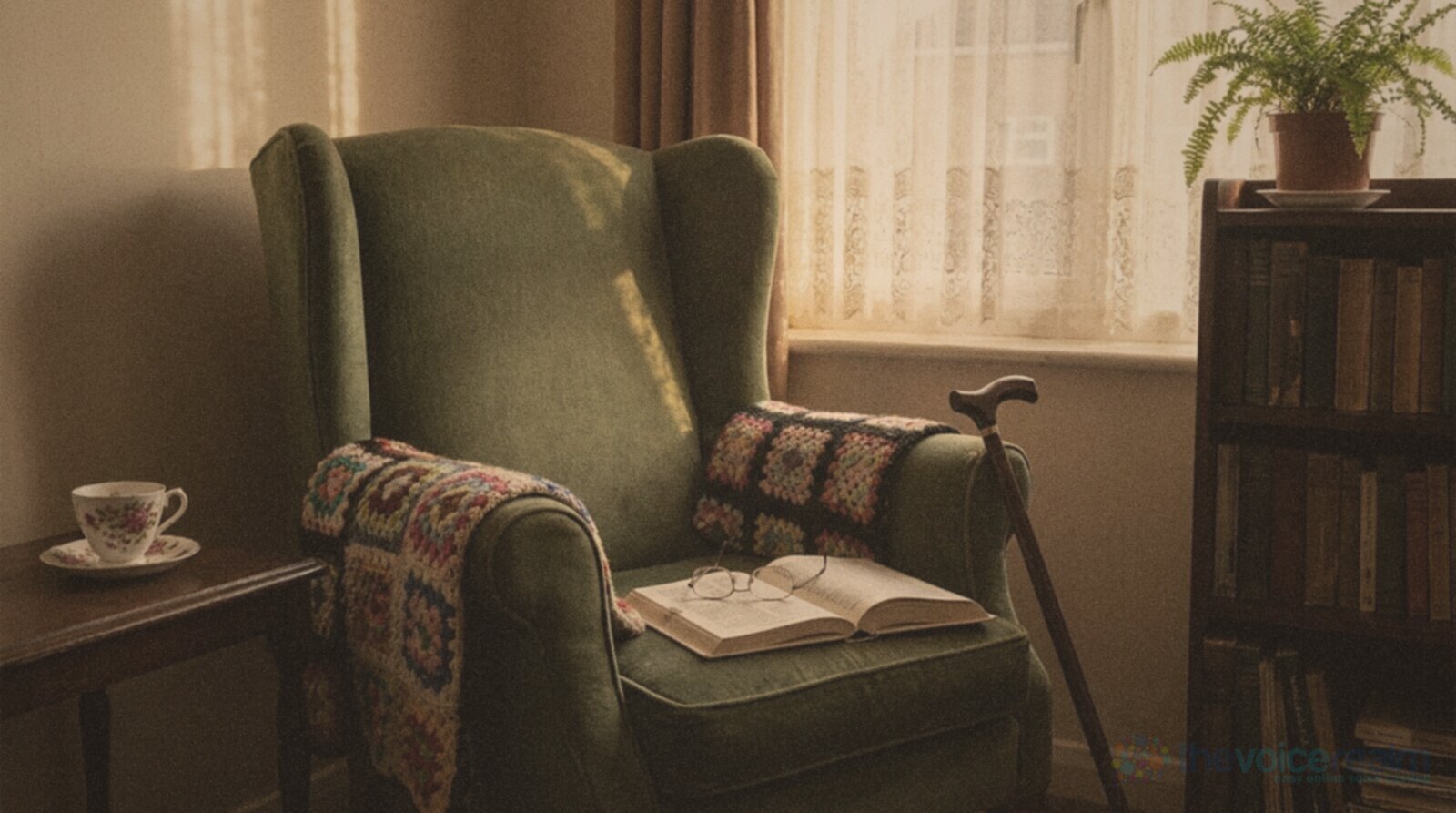
This one’s for voice actors who’ve just been asked to play somebody’s grandad. Maybe it’s an animation audition for a grumpy old wizard, an audiobook with a ninety year old narrator, a radio ad set in a care home or a video game shopkeeper who’s seen it all. You know the voice everyone does: high, creaky, shaking on every word, like a door that needs oiling. Directors know it too, and they’re usually trying to cast anyone but that.
A believable older voice is one of the most useful tools a character actor can have, because older characters turn up everywhere. Here’s what really changes in a voice as people age, how to use that without straining your own, and how to build an older character who sounds like a person rather than a punchline.
Start with who they are, not how old they are
“Old” isn’t a character. A seventy year old retired PE teacher who still runs every morning sounds nothing like a frail ninety five year old who hasn’t left the house in a year. Before you touch your pitch, answer a few questions about the person.
How old are they, exactly? How healthy? Did they spend forty years shouting across a factory floor or whispering in a library? Are they sharp and funny, tired and lonely, proud, nosy, flirty? Where did they grow up, and how did people talk there sixty years ago? What do they want in this scene?
Those answers will do more for the voice than any trick. A proud man straightens up and speaks with care. A tired woman lets the ends of her sentences fall. A cheeky one speeds up when she gets to the good bit. The age sits on top of all that, like a coat.
© The Voice Realm
What really happens to a voice as it ages
It helps to know what you’re copying. Voices do change with age, but not in the way the cartoon version suggests.
Mount Sinai’s voice and swallowing center describes the cause: “As our bodies age, we lose muscle mass, our mucous membranes thin and become more dry, and we lose some of the fine coordination that we had in younger years.” The vocal folds go through the same thing. University Hospitals in Cleveland says that as they change, “the vocal cords don’t vibrate as efficiently as they once did.”
Breath changes too. Weill Cornell Medicine’s Sean Parker Institute for the Voice notes that “reductions in muscle mass and changes in posture can make it harder to produce the same sounds that came easily in the past.” And Mount Sinai adds a detail every character actor will recognize from their own family: these changes “are amplified by the reduced hearing ability that commonly occurs as we age and your need to speak more loudly to your peers.”
Here’s the part that matters most for your performance: plenty of older people sound perfectly clear. Mount Sinai cites a study finding that “approximately one in three adults ages 60 and older in the United States” have one or more of these voice difficulties. Which means most don’t. An older voice can be strong, warm and steady, and often should be. Use the changes as seasoning, chosen for this person, never as a checklist.
Pitch: a nudge, not a leap
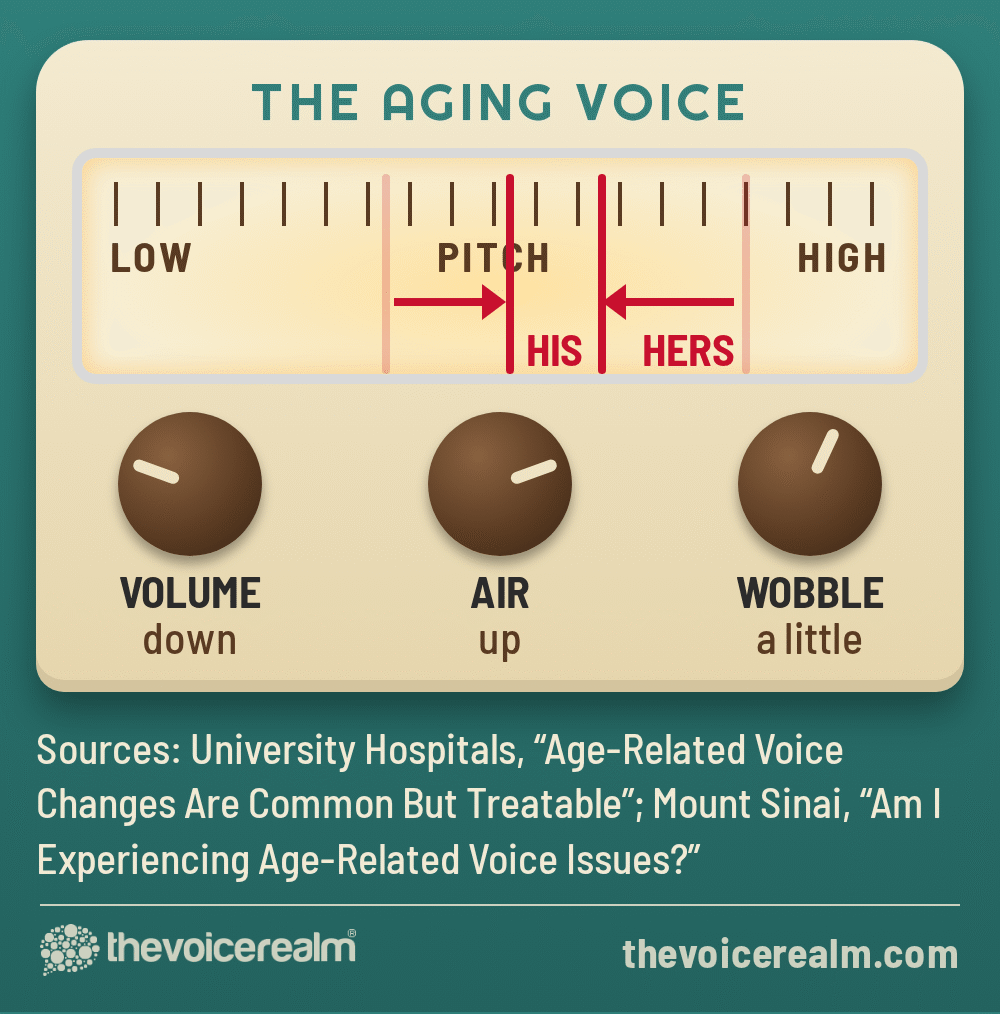
The cartoon old voice goes way up for everyone. Real life is more interesting. University Hospitals puts it like this: “men often experience a slight rise in pitch, while women typically notice a lowering, along with a loss of their upper vocal register.”
Notice the word “slight”, and that men and women move in opposite directions. For an older man, try nudging your speaking pitch up a little and thinning the sound, as if there’s slightly less of you behind it. For an older woman, settle a touch lower and stay away from the bright top of your range. In both cases, start from your own natural pitch and move a short distance. If you jump a long way, the voice stops sounding like a person and starts sounding like a sketch.
A quick test: record a line in your own voice, then in the older character’s voice. If someone who knows you couldn’t tell it was you in the second take, you’ve probably gone too far.
© The Voice Realm
Add air, not gravel
The safest way to age a voice is to let a little more breath into it. Let the sound get slightly softer and airier, as if the voice is working a bit harder to reach the end of the sentence. It reads as age instantly, and it’s easy on your throat.
Gravel is where people hurt themselves. Squeezing the throat to make a rough, crackly sound feels convincing in the moment, but over a long session it’s a fast route to a sore voice. If you want texture, keep it light, find it with an open, relaxed throat, and keep it for a few words in a line rather than every syllable. If anything scratches or aches, drop it. Our guide to protecting your voice as a voice actor has the warning signs worth knowing.
Volume is the other half. Older voices are often a little quieter and have a harder time projecting over noise, so let the character lean in to be heard rather than belting. That small effort of reaching across a room is very human, and a mic picks it up beautifully.
Slow the mouth, not the mind
Older characters often speak a little slower, with more pauses. The trap is playing them as slow thinkers. Most of the older people you know are as quick as anyone, they just don’t rush to fill silence.
So slow the delivery but keep the thought alive. Let them pause because they’re choosing the right word, remembering something, or enjoying making you wait. Let a sentence trail off and then come back with a sharp little kicker. That rhythm, slow then sudden, is where most of the comedy and warmth in older characters lives.
Watch the consonants as well. Slightly softer, less crisp consonants age a voice without any change in pitch at all. Don’t slur, just stop snapping every T and K.
The wobble: use it like salt
Tremor is real. Mount Sinai lists “Tremor or shakiness in the voice” among the common changes. But a voice that shakes on every word sounds like the cartoon again, and it’s tiring to listen to over a long script.
 VoiceEditSuiteNewAuto Clean Up now learns you.Learns from numbers, never your audio. Never used to train AI.See how it works
Save the wobble for moments of feeling. A grandmother’s voice might hold steady through a joke and then shake on the one line about her late husband. A grumpy old man might quaver only when he’s furious. Used that way, the tremor becomes part of the acting, and the listener feels it rather than notices it.
If you want a gentle tremor, let it come from a slightly unsteady breath rather than from shaking your jaw or throat. Keep it small, and keep checking that it still sounds like the character, not the technique.
© The Voice Realm
Not all old people sound the same
It’s worth building a little cast of older voices you can call on, each one a real person in your head. A few starting points:
- The live wire. Seventy five, still dancing on Saturdays. Barely any age in the voice at all, just a bit of air and a lot of mischief.
- The storyteller. A grandfather who loves an audience. Slow, warm, chest resonance, pauses for effect.
- The sharp one. A retired headteacher who misses nothing. Precise, clipped, a little lower, never wobbly.
- The frail one. Ninety five and tired. Breathier, quieter, short phrases, the most tremor of the four, used gently.
Mix in an accent from the place and the decade they grew up in, and you’ve got four very different people. That range is gold in animation and games, where one actor might voice several villagers in a single session, and in audiobooks, where a narrator needs every character to be clear. Our guide to voicing characters in an audiobook covers how to keep a whole cast distinct.
© The Voice Realm
Keep it kind
Older listeners hear these voices too, and plenty of the clients who book them are making ads, films and learning content for older audiences. A voice that mocks age gets noticed for the wrong reasons.
The best older characters are played with affection. Even the grumpy ones are grumpy about something real. If you’re laughing with the character, the audience will too. If you’re laughing at them, the audience can tell, and so can a casting director.
© The Voice Realm
Put it together on a script
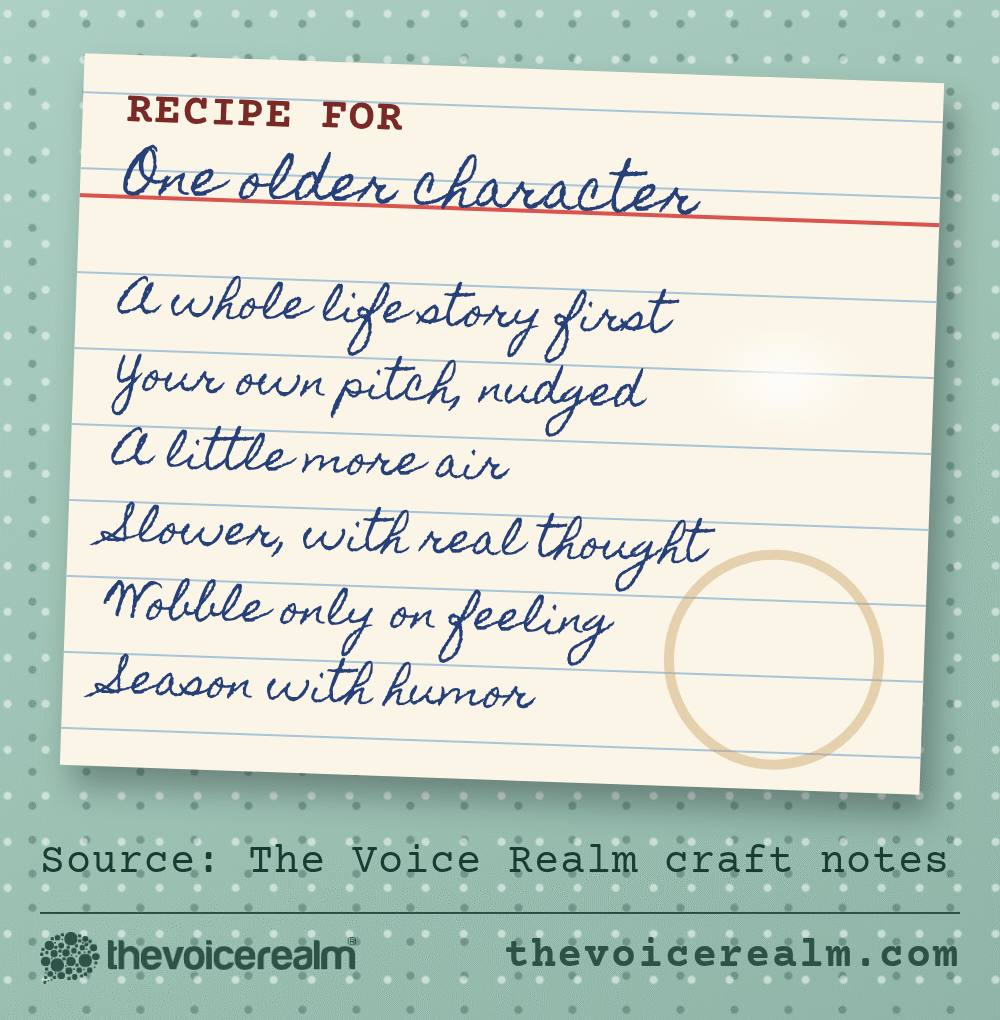
When the audition lands, work through it in order. Write two or three lines about who this person is. Decide their age and health. Then build the voice from the recipe card above, one layer at a time, and listen back after each one before you add the next. It works as a reminder to pin by your mic, too.
“Give them eighty years of somebody, and the voice will follow.”
The Voice RealmPost this quote
Record a take in your own voice first, then the character. Play them back to back. Can you hear the person, or just the effect? Then record one more take where you pull everything back by half. More often than not, the subtler take is the one that books. If you’re new to character work, the broader guide on building character voices from scratch is a good companion to this one, and structured coaching at Voice Master Academy can help you build a range of ages you can call on at any audition.
And look after the instrument while you’re at it. Older voices are breathy and soft, which means you can play them all day if you do it right. If your throat starts to complain, the voice is wrong, not your character.
Sources: “Vocal Disorders As We Age”, Grabscheid Voice and Swallowing Center, Mount Sinai; “Am I Experiencing Age-Related Voice Issues?”, Mount Sinai Today; “Age-Related Voice Changes Are Common But Treatable”, University Hospitals; “Here’s how your voice changes as you age”, Weill Cornell Medicine, Sean Parker Institute for the Voice.
Ready to get booked?
See the jobs open right nowAbout Sarah Robbins
Sarah Robbins writes for The Voice Realm about finding voice over work, home studios, casting and the business side of voice acting.