Blog
Blog

This guide is for anyone who does a pretty good grumpy wizard at parties and wonders how that turns into actual animation work. Maybe you’ve got a handful of silly voices already. Maybe you’ve never tried one on purpose. Either way, the gap between “funny voice” and “character a studio will cast” is smaller than you’d think, and it’s mostly about acting, not tricks.
Below is a way to build a character voice from scratch, keep it steady across a whole session, and do all of it without leaving your throat in pieces. It leans on advice from Dee Bradley Baker, a veteran animation and games voice actor who shares his thinking for free on his site, and from a speech-language pathologist who works with voice actors.
A character voice starts with a person, not a sound
The most common beginner mistake is starting with the noise. You pick a squeaky register or a gravelly growl, then try to hang a personality on it. The result tends to sound like exactly what it is: a voice being done.
Working the other way round is more reliable. Decide who this is first. How old are they? How big? What do they want in this scene, and from whom? Are they the smartest one in the room, or do they think they are? Once you know that, a lot of the sound chooses itself. A tiny, anxious creature who’s trying to be brave will breathe, pitch and pace differently from a lazy dragon who can’t be bothered to lift his head.
Baker’s point about animation is that you’re the one who has to supply the whole world. On his page about seeing the scene, he writes that a voice actor is usually alone in a booth with only a script, and has to picture the scenery, timing and gags that don’t exist yet: “It’s as if you must ‘see it’ before it ever exists.” He’s also clear about what happens when you skip that step: “Without this visualizing, a voice performance will come off as unrooted, flat or lacking authentic connection.”
So before you make a sound, look at the character art if you have it, read the description twice and picture the scene. Where are they standing? Who’s in front of them? What just happened?
Know your default before you move away from it
Every actor has a natural centre, the kind of role they fall into without trying. Baker calls it your default, and he sees finding it as the first job, not a limitation: “This default talent, your unique ‘super power,’ if you will, is the thing that ‘pops’ about you.”
That matters for character work because you need a map before you can go exploring. Record yourself reading a short paragraph in your own easy voice. Listen for where your pitch sits, how fast you talk, how much melody you use and what attitude comes out when you’re not thinking about it. That’s your home base. Every character you build is a set of deliberate moves away from it.
Baker is also encouraging about how far those moves can go. On the same page he writes, “As a professional artist, you have much more within yourself than anyone thought possible, including you.” Range grows with practice, and the only way to find yours is to try things on purpose and listen back honestly.
The six dials you can turn
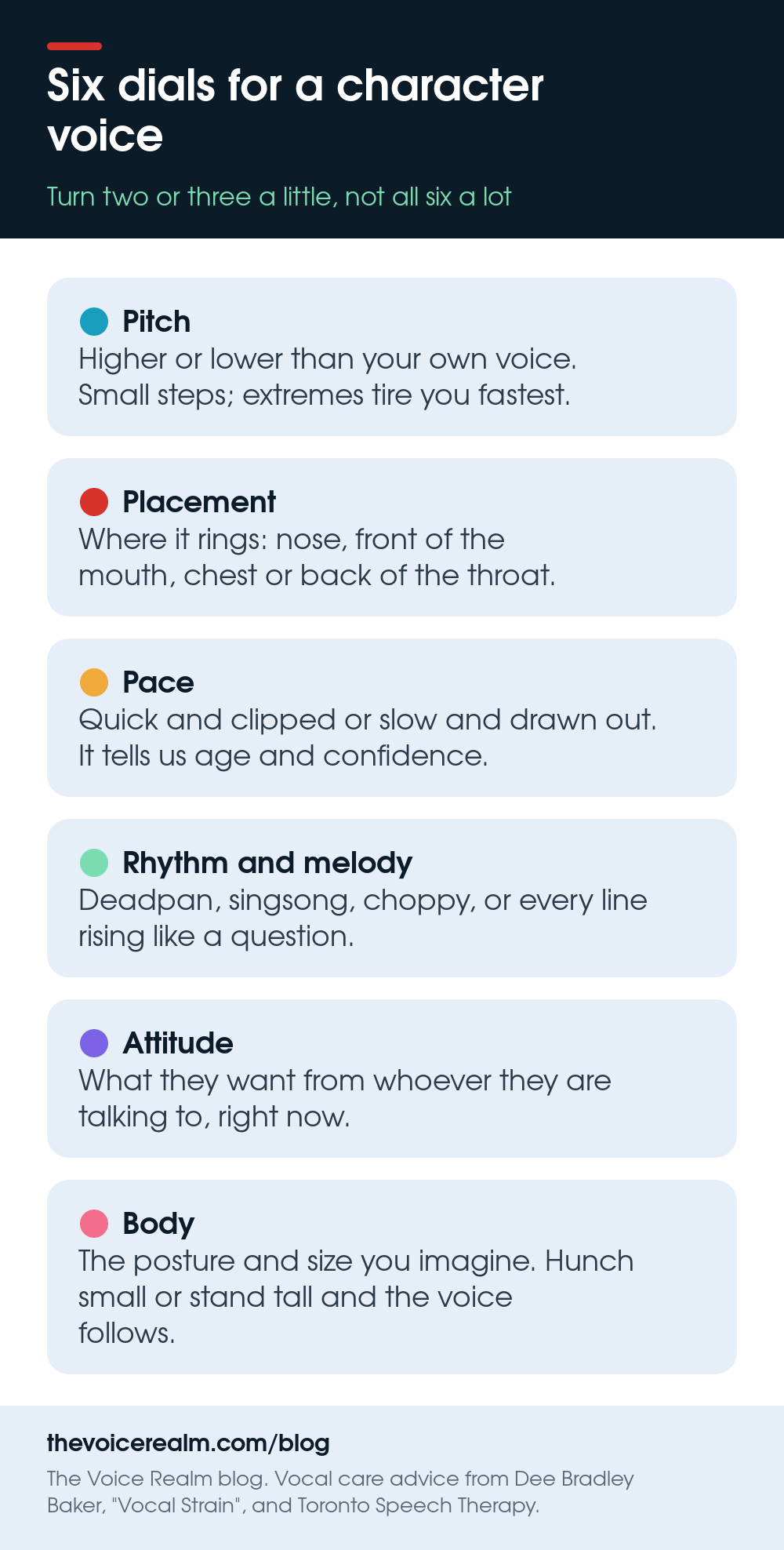
Once you know who the character is, you shape the sound with a handful of controls. Think of them as dials rather than switches. Small turns on two or three of them usually beat big turns on all six, and they’re much easier to hold for an hour.
- Pitch. Higher or lower than your default. A small step goes a long way, and extreme pitches are the quickest route to a tired voice.
- Placement. Where the voice seems to ring. Try sending it into your nose, to the front of your mouth, down into your chest, or toward the back of your throat, and listen to how the character’s personality changes with each.
- Pace. Quick and clipped, or slow and drawn out. Pace tells the audience a lot about age, confidence and intelligence before a single joke lands.
- Rhythm and melody. Flat and deadpan, singsong, choppy, or rising at the end of every line as if everything’s a question.
- Attitude. What the character wants from whoever they’re talking to. Wanting to impress, to escape, to be left alone or to win the argument will colour every line.
- Body. The posture and size you imagine while you speak. Hunch into a small creature, stand tall for a king, and the voice follows. This is one reason many animation actors move a lot in the booth.
© The Voice Realm
Build a character in five steps
Here’s a routine you can run on any character description, from a talking toaster to a villainous aunt.
- Write three facts and one want. Age, size, one personality trait, and what they want right now. “Old, small, suspicious, wants the kids off his lawn” is plenty.
- Pick two dials. Choose the two that best express those facts. For the suspicious old man, maybe a slower pace and a pinched placement toward the nose.
- Find the body. Stand or sit the way the character would. Let the posture settle before you speak.
- Improvise before you read. Talk as the character about anything for a minute: their breakfast, the weather, the neighbours. Improvising finds the voice faster than reading lines, because you’re not worried about the script.
- Record an anchor line and name it. Once it clicks, record a single sentence that captures the character, save it with a name, and write the dial settings next to it in a notebook.
That last step turns one good afternoon into a library. Over a few months you’ll build a notebook of characters you can call up in seconds, which is exactly what a quick-turnaround audition asks for.
A small mirror on the desk helps too. Your face and mouth shape change the sound, and watching yourself hold a sneer or a wide-eyed grin makes it easier to keep a character consistent. It’s one of the cheapest bits of kit in any booth.

 VoiceEditSuiteRaw take in, clean take out.Breaths, dead air and room noise, gone.Show me
If you’re new to acting in general, training speeds all of this up. Voice Master Academy has courses that start from the basics and build toward character and animation reads.

© The Voice Realm
Keep the voice the same on page forty
A character that sounds great on line one and drifts by line fifty is a real problem for a studio, because scenes are recorded out of order and edited together. Consistency is part of the job.
- Play your anchor line before every session and again after each break. Match it before you start recording.
- Watch the dial that drifts. For most people it’s pitch creeping back toward default as they tire, or pace speeding up as they relax into the script.
- Keep your emotional range inside the character. An angry line or a sad line should still be the same person. Change the intensity, not the identity.
- Mark the script. A quick note in the margin where the character shifts mood saves you from guessing mid-take.
Protect your voice while you play
Character work asks more of your voice than a friendly narration does. Squeezed placements, extreme pitches, roars and screams all add up, and animation and games sessions can run long.
Baker writes about this plainly on his vocal strain page: “Your voice is comprised of muscles that can be blown out or damaged from overuse just like a leg or elbow.” He singles out games as the hardest on the voice: “Video game VO can be great fun but it is typically the most vocally stressful form of voice acting.” If that’s where you’re headed, our guide to what game work really asks of a voice actor is worth reading next.
Jesse Nerenberg, a speech-language pathologist at Toronto Speech Therapy, describes the same pressures from the clinic side: “Screaming battle cries, portraying intense emotions, and performing for long extended sessions can push the voice to its limits.” Between the actor and the clinician, the advice lines up neatly:
- Warm up first. Nerenberg compares it to an athlete: “You do not want to jump from 0 to 100 in an instant.” Gentle humming, lip trills and easy sirens are enough.
- Put the heavy stuff last. Baker suggests you “Request that the more strenuous vocal work (screams, dying, roaring, etc) be at the end of the session”, and Nerenberg agrees: “If the session involves shouting or extreme vocal effects, try to do these takes last to avoid early fatigue.”
- Ask before you start. Baker recommends mapping the session with the producer up front and asking, “Is there screaming, dying, fighting or anything else that can be vocally stressful?”
- Use breath, not squeeze. Power for a big line should come from the air, not from clamping your throat. Our piece on letting the breath do the heavy lifting has a simple daily routine.
- Speak up when it hurts. “Let them know if you need a break or it’s too hard on the voice,” Baker writes. A good director would rather lose ten minutes than lose you for a week.
- Rest afterwards. Nerenberg’s image is a good one to remember: “Think of your voice as a battery.” He also warns against whispering to save it, which can strain the voice more than normal speech.
If a character hurts to do, that’s information, not a test of toughness. Change the placement, bring the pitch closer to home, or get the sound from a different part of the body. Baker’s line is that training teaches you “how to get more expression and power from their voice with less work and strain.” For the everyday side of looking after your instrument, see our vocal health guide.
Auditioning with a character
When a character audition lands in your inbox, the same process applies, just faster. Read the description and look at any art. Pick your dials. Improvise for a minute. Then record.
Give the casting team a real choice, not three copies of the same read. A first take that follows the brief closely and a second that takes a bold, specific swing is a common approach. Keep each take clean and short, and don’t slate in the character voice unless the brief asks for it.
Baker has a line about auditions that applies to all of this: “you are not just being directed in a session or audition, you are directing yourself.” At home, nobody’s there to tell you the voice slipped or the joke didn’t land. Listen back with fresh ears before you send anything.
Once you’ve got two or three characters you can call up reliably, start looking for places to use them. Our voice over jobs board is a good way to see what studios are casting right now.
The short version
Build the person before the sound. Know your default, then move away from it on purpose with two or three dials: pitch, placement, pace, melody, attitude and body. Improvise to find the voice, record an anchor line, and keep a notebook of every character that works. Play the anchor before every session so the voice stays put. Warm up, put the screams last, use breath instead of squeeze, and speak up when something hurts. Your voice is the only one you get, and every character you’ll ever play lives inside it.
Sources: Dee Bradley Baker, I Want To Be A Voice Actor, “Seeing It”, “Beyond Your Default” and “Vocal Strain”; Jesse Nerenberg, Toronto Speech Therapy, “Essential Vocal Care For Video Game Voice-Over Actors”. This article is general guidance, not medical advice; if your voice stays hoarse or sore, see a doctor or speech-language pathologist.
Ready to get booked?
See the jobs open right nowAbout Sarah Robbins
Sarah Robbins writes for The Voice Realm about finding voice over work, home studios, casting and the business side of voice acting.