Blog
Blog

This one’s for anyone who’s been sent a script with a number next to it. Thirty seconds. Sixty. “Must fit to picture.” Maybe it’s your first commercial audition, maybe you’ve been reading for years and you’re tired of discovering at take six that the copy simply won’t fit. Either way, timing is a skill you can work out on paper before you ever press record.
Here’s how many words fit in the common spot lengths, why the answer changes from job to job, the words that take longer than they look, and what to do when a script is too long for its slot.
The number to remember is 150
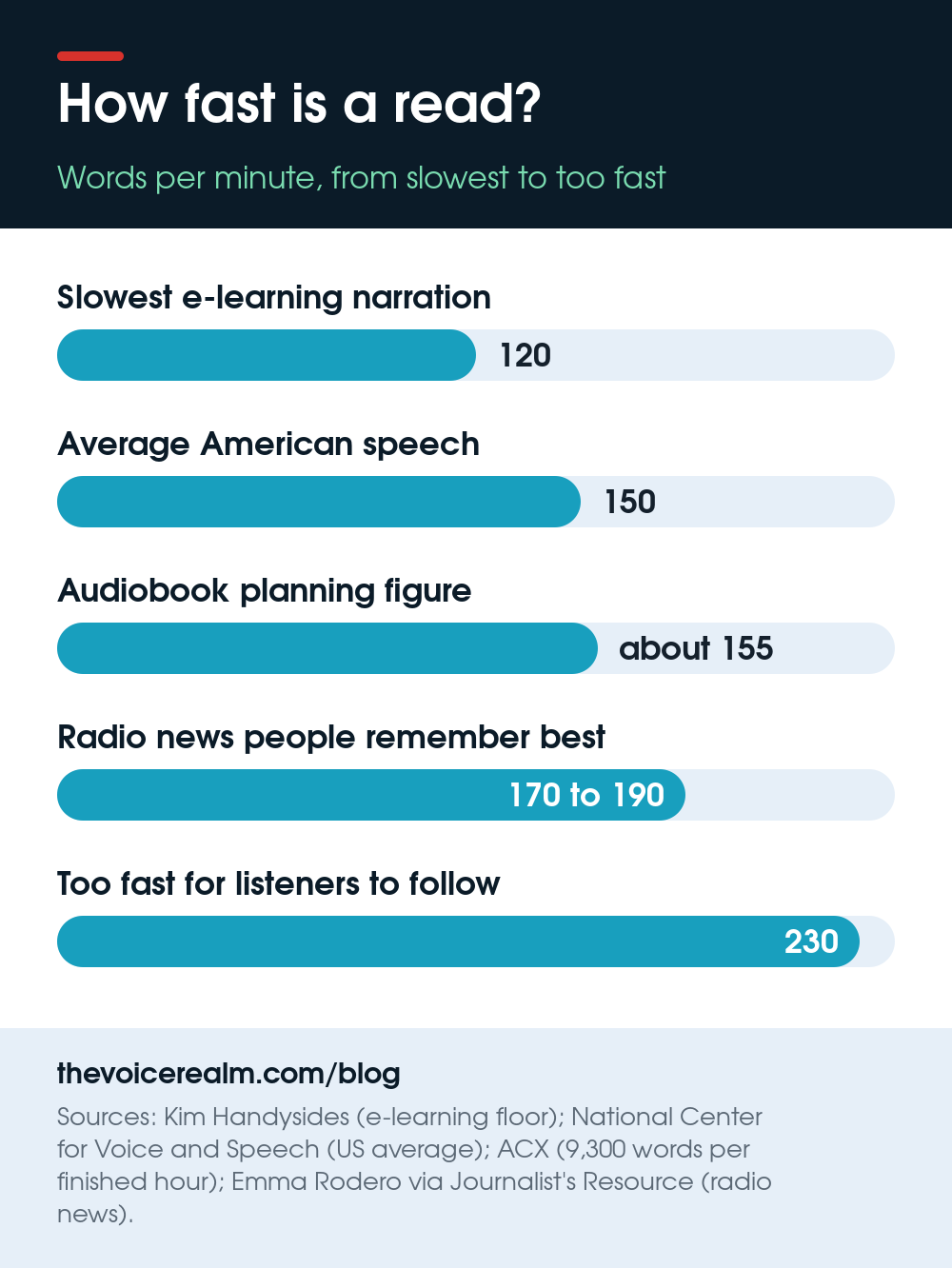
Start with ordinary speech. The National Center for Voice and Speech, in its tutorial on voice qualities, puts it simply: “The average rate of speech for English speakers in the United States is about 150 words per minute.”
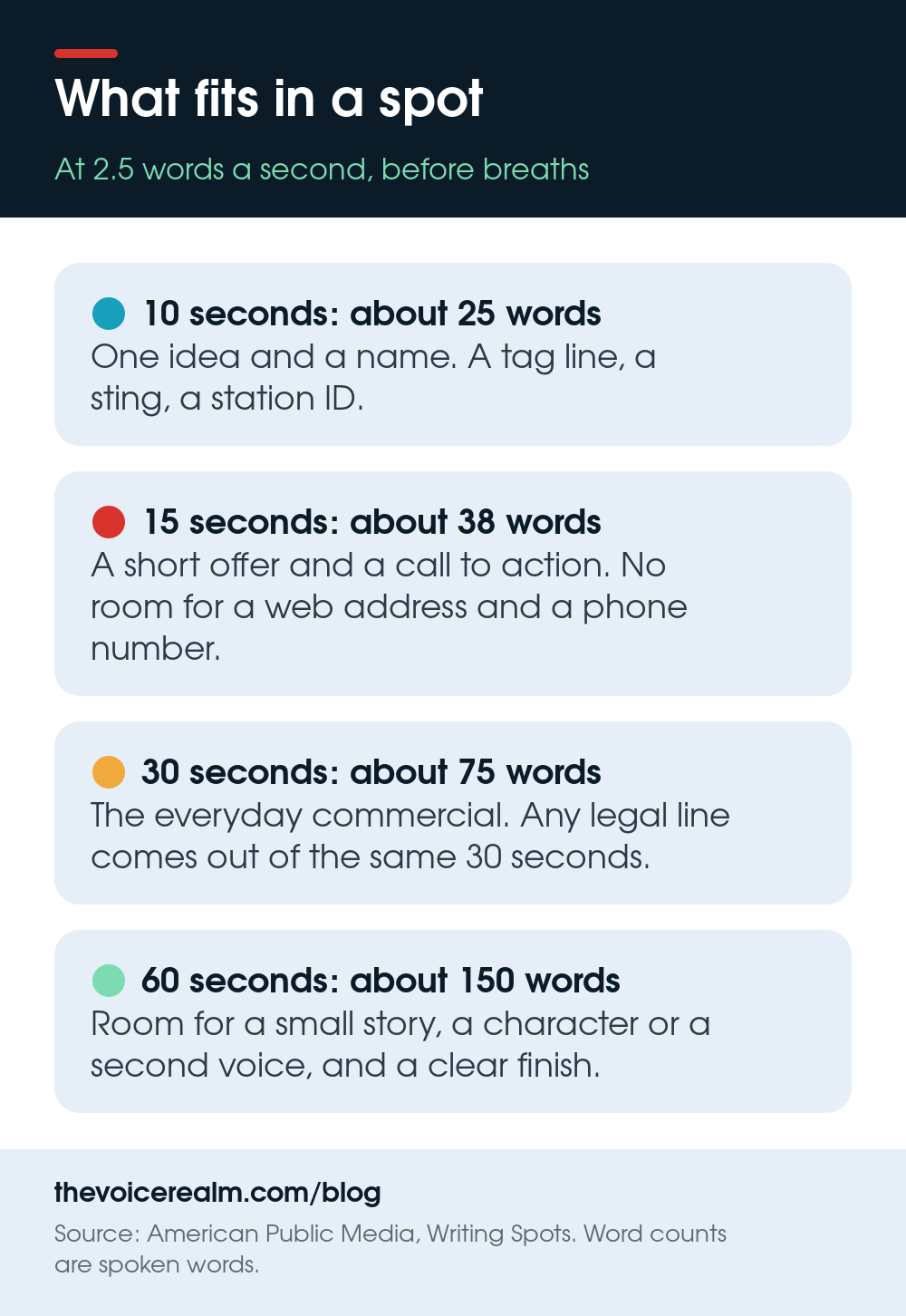
That works out to two and a half words a second, and broadcasters plan around exactly that figure. American Public Media’s guide for sponsors writing radio spots tells them to “set the timer at 2.5 words per second for an accurate measurement,” and gives the word counts that follow from it: “A 30-second spot is approximately 75 words in length,” and “A 60-second spot is approximately 150 words in length.” A 15-second spot holds about 38 words, and a 10-second spot about 25.
So if a 30-second script lands in your inbox with 75 words on it, you can relax. If it’s got 95, you already know something has to give, and you know it before the session, not during it.
Why one number isn’t the whole story
The 150 figure is an average, and voice work covers a wide spread of paces. A warm, intimate ad for a bank can run slower than conversation. A car dealer’s weekend sale can run much faster. Here’s where some of the other numbers sit.
Audiobooks. A 2019 review of reading and speaking rates by the psychologist Marc Brysbaert, published in the Journal of Memory and Language, puts audiobook narration at between 140 and 180 words per minute. For planning, the audiobook platform ACX uses a single figure: “We estimate that about 9,300 words equals one hour of finished audio.” That’s a little over 150 words a minute, once you account for the pauses between chapters and scenes.
E-learning. Training narration tends to sit at or a little under conversational pace, because learners need to take things in. Voice actor Kim Handysides, writing on her own site about timing e-learning video, sets a floor: “The slowest speech is at about 120 words per minute and is used for people learning to read or speak English. Any pace slower than 120 words sounds odd.” Our guide to e-learning narration covers the rest of that genre’s sound.
News and fast reads. A study by the communication researcher Emma Rodero, summarised by Journalist’s Resource at Harvard’s Shorenstein Center, played radio news to listeners at different speeds. They rated 150 words a minute as slow, and “A speed of 170 to 190 words per minute was rated as ‘normal.'” The news items people remembered best sat in that same band.
The useful lesson there runs both ways. Go too slow and you lose people: “News that is delivered too slowly fails to gain a listener’s attention while news that is delivered too quickly produces ‘cognitive overload.'” At the fast end, the study found, 230 words a minute was too much for listeners to process.
© The Voice Realm
Count the words you’ll say, not the words on the page
A word count from a word processor counts what’s written. Your clock runs on what’s said. They’re often different, and the difference is always in the same direction.
Numbers. “1,250” is one word on the page and four or five out loud. “8:30” is two. A phone number can be ten words on its own. The University of Florida’s guide to broadcast news writing advises rounding off numbers “unless the exact number is significant,” and gives the example of “a little more than 34 million dollars,” rather than the full figure read digit by digit.
Web addresses. “hillsidebakery.com” is one word to your software and four to your mouth: hillside, bakery, dot, com. Add a “www” and you’ve lost another second. American Public Media’s own rules for broadcast sponsorship allow “Either a web address or a vanity phone number, but not both,” which tells you how much time each one costs.
Names, lists and brand lines. Product names often need to be said slowly and clearly, because they’re the point of the ad. Lists need a beat between items. A brand’s slogan usually has a set read the client wants to hear exactly.
- 2.5 words a second. About 75 words in a 30-second spot, 150 in a 60.
- 150 words a minute. Average American conversation, and a good first guess for most reads.
- 9,300 words. Roughly one finished hour of audiobook.
- 120 words a minute. About as slow as narration can go before it sounds odd.
A worked example, start to finish
Here’s a 30-second radio script for a made-up bakery, counted the way it will actually be spoken. The web address and the time are the two spots where the page undercounts.
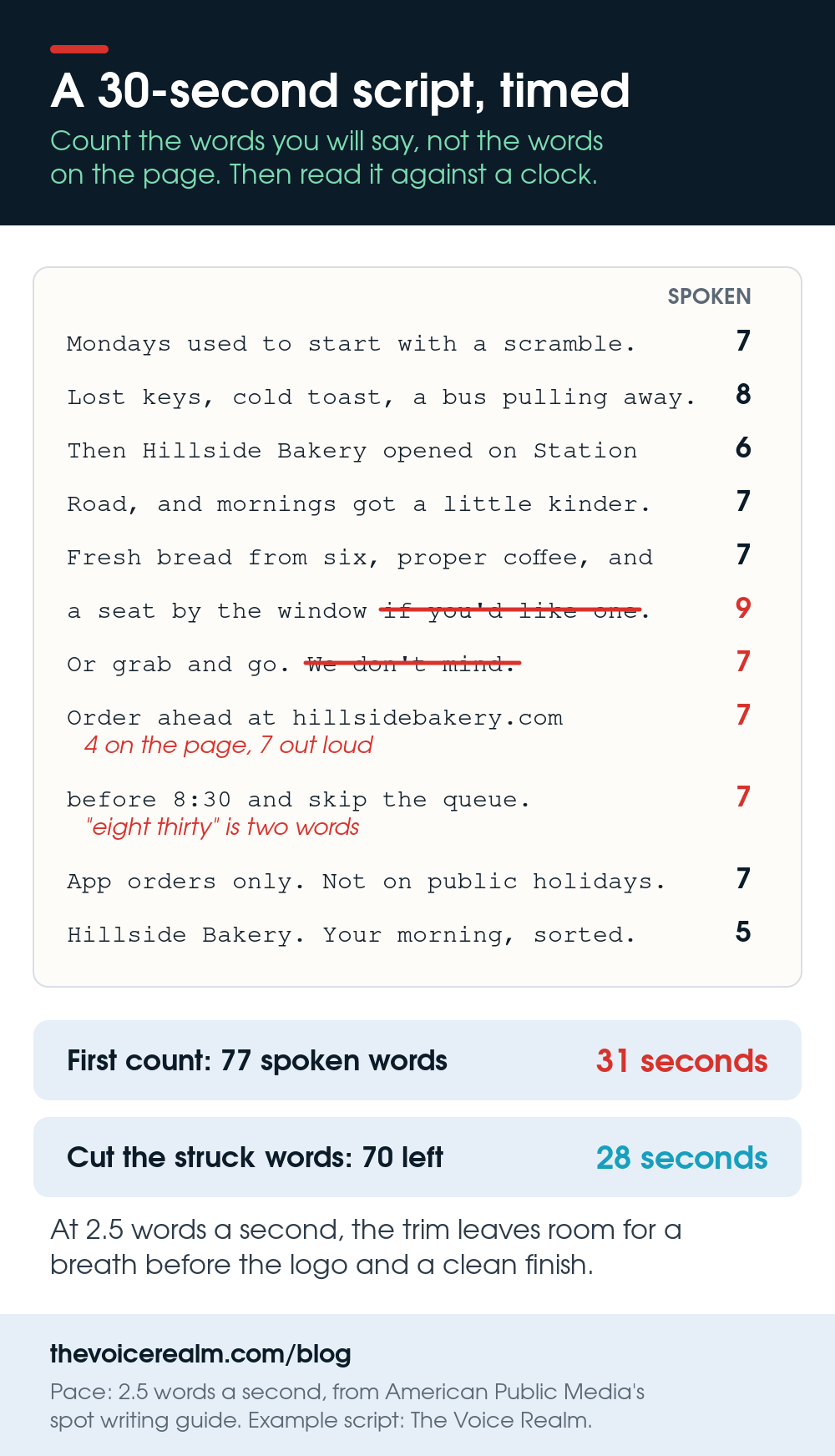
The web address and the time cost more out loud than they do on paper. © The Voice Realm
The page says 73 words. Spoken, it’s 77. At two and a half words a second that’s about 31 seconds before you’ve added a single breath, which means it’ll come out at 33 or 34 in a natural read. Too long.
The fix here is gentle. “If you’d like one” and “We don’t mind” are nice touches, but nothing in the ad depends on them. Lose both and you’re at 70 spoken words, about 28 seconds, with room to land the last line. You don’t make that cut yourself in a booked job. You suggest it, and the client decides.
Timing it out loud
The arithmetic tells you whether a script is in the right neighbourhood. Only a read tells you whether it fits. Here’s the routine that works:
- Count the spoken words and divide by 2.5 for a rough time in seconds.
- Read it aloud at the pace the brief asks for, with a stopwatch running. Not in your head: silent reading is much faster than speech.
- Read it again, because the first read is always a little rushed or a little careful.
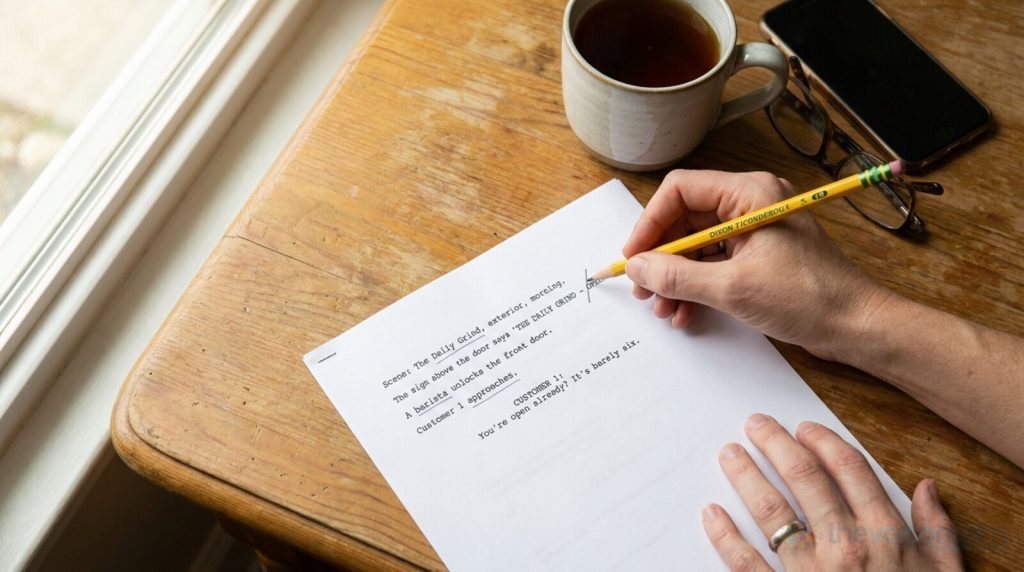
- Mark the tight spots in pencil: where you had to hurry, where you ran out of air.
- Decide early. If the honest read is more than a second or two over, tell the client before the session, with a suggested trim.
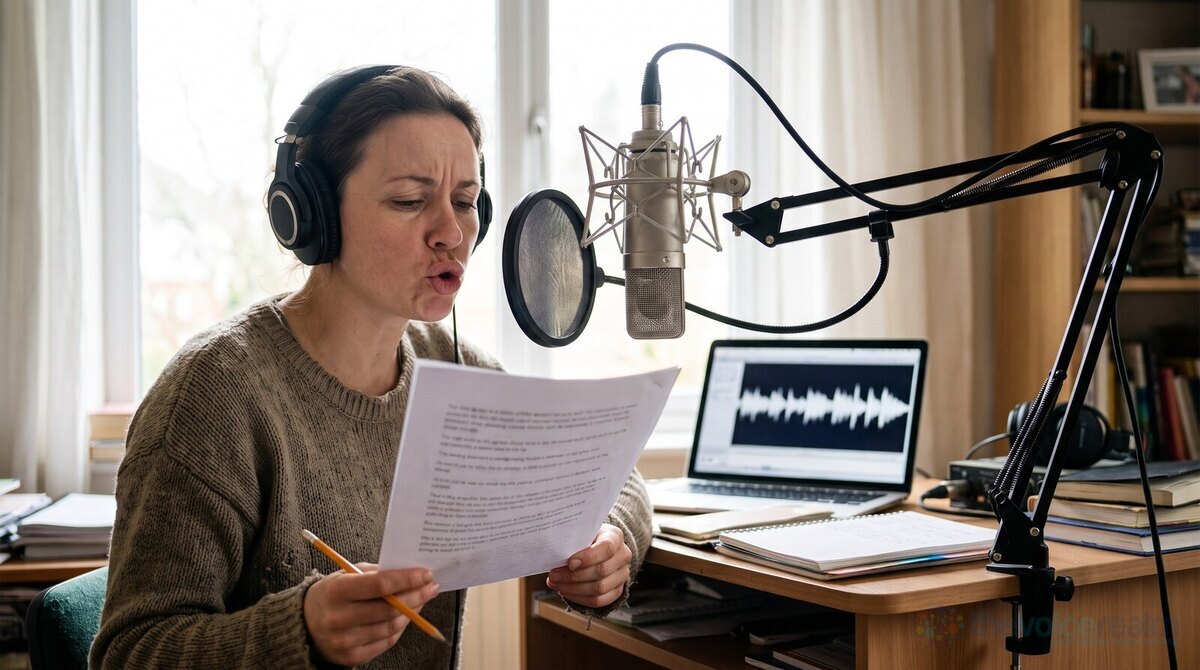
Time it out loud, at the pace the brief asks for. © The Voice Realm
Mark the timing on the script itself, in the top corner: the word count, the target time and your first read time. It sits alongside the rest of the notes in our guide to marking up a script before you read it.
The legal line at the end
Many commercials end with a tag: terms and conditions, an offer end date, a rate disclaimer. It’s the part of the script most likely to blow the timing, and the part clients most often want rattled off at double speed.
 VOICEMASTERACADEMYTwenty modules, one at a time.Breath controlHome studioCommercial techniqueAuditionsStart module oneNo experience needed.
That rarely helps anyone. Radiocentre, the body that clears UK radio ads, has reported that when long terms and conditions are read out, “only 4% of listeners say they can recall any salient facts.” A tag needs to be clear enough to understand, and that takes time.
So treat the tag as part of the count from the start. Read it faster than the body copy if that’s the style of the spot, but keep every word clean. If the main copy plus a clear tag won’t fit, the conversation to have is about the main copy.
© The Voice Realm
When a script is too long
It happens all the time, and it isn’t your fault. A script gets written by a team, every person adds a line, and nobody reads it out loud before it’s sent. What you do next matters more than the problem itself.
Don’t just speed up. A fast read that still fits might be exactly right for a sale, but forcing a warm, conversational script into a rushed pace wrecks the very thing the client wanted. Rodero’s research is a reminder that speed affects what people take in, not only how they feel.
Instead, time an honest read and tell the client what you found: “The script runs about 34 seconds at a natural pace. If we lose these two phrases it lands at 30 with room to breathe. Happy to read it either way.” That message makes you look like a pro, and it often saves a second session. If there’s no time to ask, record the full read as asked and add a trimmed alternative as a second file.
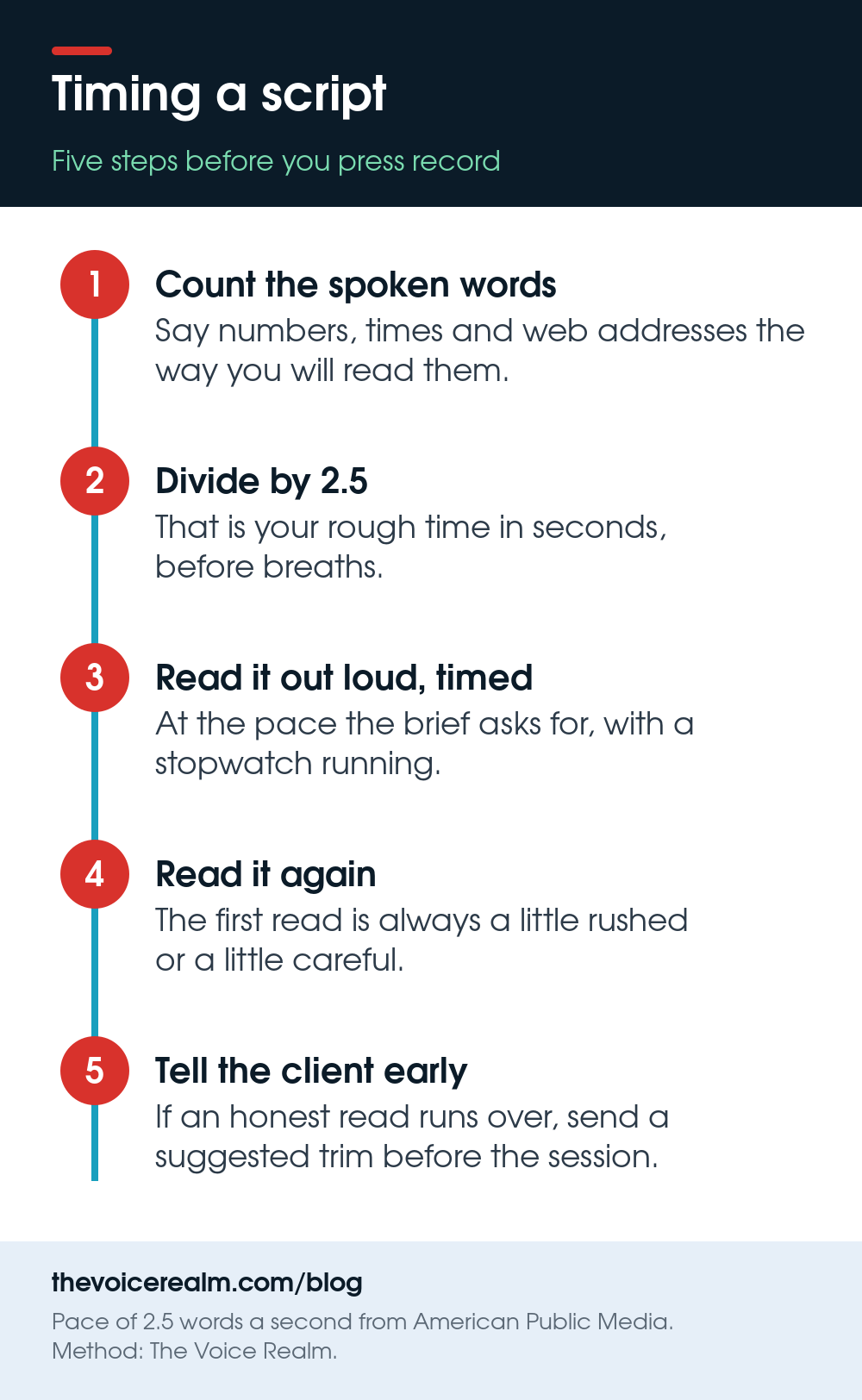
© The Voice Realm
Commercial work is where this comes up most. Our guide to getting into commercial voice over covers the read styles that go with each pace.
Timing to picture
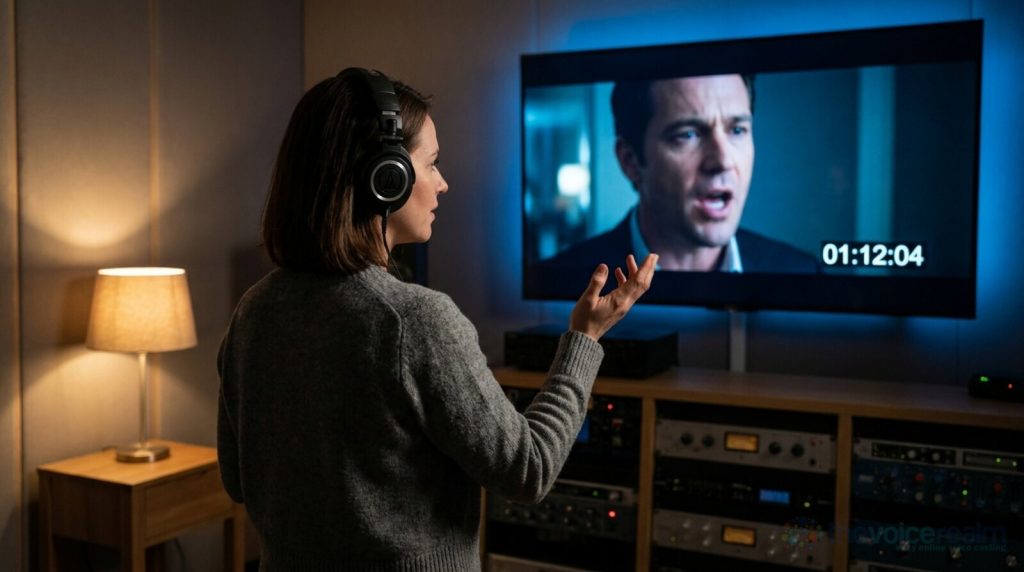
When there’s video, the clock isn’t the whole picture. A 30-second video might have a logo on screen for the last four seconds and the client may want silence there. A product shot might need the product name to land on it. Ask for the video or a rough cut whenever there is one, and time your read against it rather than a stopwatch.

Watch the picture first, with the sound off. © The Voice Realm
Watch it through once with the sound off before you read. Note where the cuts fall and where on-screen text appears, so you’re not talking over words the viewer is trying to read. Then read along with the picture until the big moments match up. Within a fraction of a second is good enough for most clients. If it needs to be exact, the editor will nudge a word or two.
Long-form jobs use the same arithmetic on a larger scale. A 4,500-word training script at 150 words a minute is roughly 30 minutes of finished narration, which tells you how long the session will take, how many breaks you’ll need and what to quote. Count first, and very little about timing will catch you out.
Sources: National Center for Voice and Speech, “Voice Qualities”; American Public Media, “Writing Spots”; Marc Brysbaert, “How many words do we read per minute? A review and meta-analysis of reading rate”, Journal of Memory and Language, 2019; ACX, “Money Talks: Paying, and Getting Paid, For Your Audiobook”; Kim Handysides, “Timing in eLearning Videos”; Journalist’s Resource, “Radio news: How the pace, density of broadcasts affect what audiences understand, remember”; University of Florida IFAS Extension, “News Writing for Television and Radio”; Radiocentre, “Radio industry tackles over-lengthy advertising terms and conditions”.
Ready to get booked?
See the jobs open right nowAbout Sarah Robbins
Sarah Robbins writes for The Voice Realm about finding voice over work, home studios, casting and the business side of voice acting.