Blog
Blog

Every voice actor meets the word eventually. It’s a surname in a corporate video, a village in an audiobook, a drug name in an e-learning module, and you have no idea how to say it. This guide is for narrators, commercial and corporate voices, and anyone who reads other people’s words for a living. It’s about how to find the right pronunciation quickly, where to look and in what order, and how to write it down so you say it the same way on page 300 as on page three.
Why a wrong name costs more than a retake
Mispronouncing a name feels small in the booth. It doesn’t feel small to the listener. Audiobook narrator Karen Commins, who runs the Narrator’s Roadmap site, puts it plainly: “Incorrect pronunciations immediately take the audiobook listener out of the story.” The same is true of a training video read to a company full of people who know how their own chief executive says her name.
Broadcasters have always taken this seriously. Writing for NPR Training, Jerome Socolovsky says getting names right “shows we know our stuff and conveys respect.” At Voice of America, which has kept a pronunciation guide for its announcers for decades, broadcaster Jim Tedder made the same case: using the correct pronunciation of a name shows the speaker cares about the listener, and it builds credibility.
There’s a practical side too. A wrong name caught at the client’s end means a pickup session, a re-edit and an awkward email. A wrong name nobody catches means it goes out into the world with your voice on it.
Find every word before you need it
Research starts with a read-through, not with the first stumble. Go through the whole script with a pencil and mark anything you aren’t sure about: names, places, foreign phrases, brand names, acronyms, technical terms. Our guide to marking up a script before you record shows a simple way to flag them so they jump out at you later.
Be honest with yourself about the words you think you know. Commins again: “If you only think you know how a word is pronounced, you should look it up. I’ve been surprised more times than I can count!” She gives a good example of why: “Albany, GA is NOT pronounced the same way as Albany, NY, as anyone who lives there will quickly tell you!”
For a long book, this is real work. Many narrators budget prep time for every finished hour, and pronunciation research is a big part of it. If you’re heading into long-form narration, our guide to becoming an audiobook narrator covers how that prep fits into the job as a whole.
Go to the person first
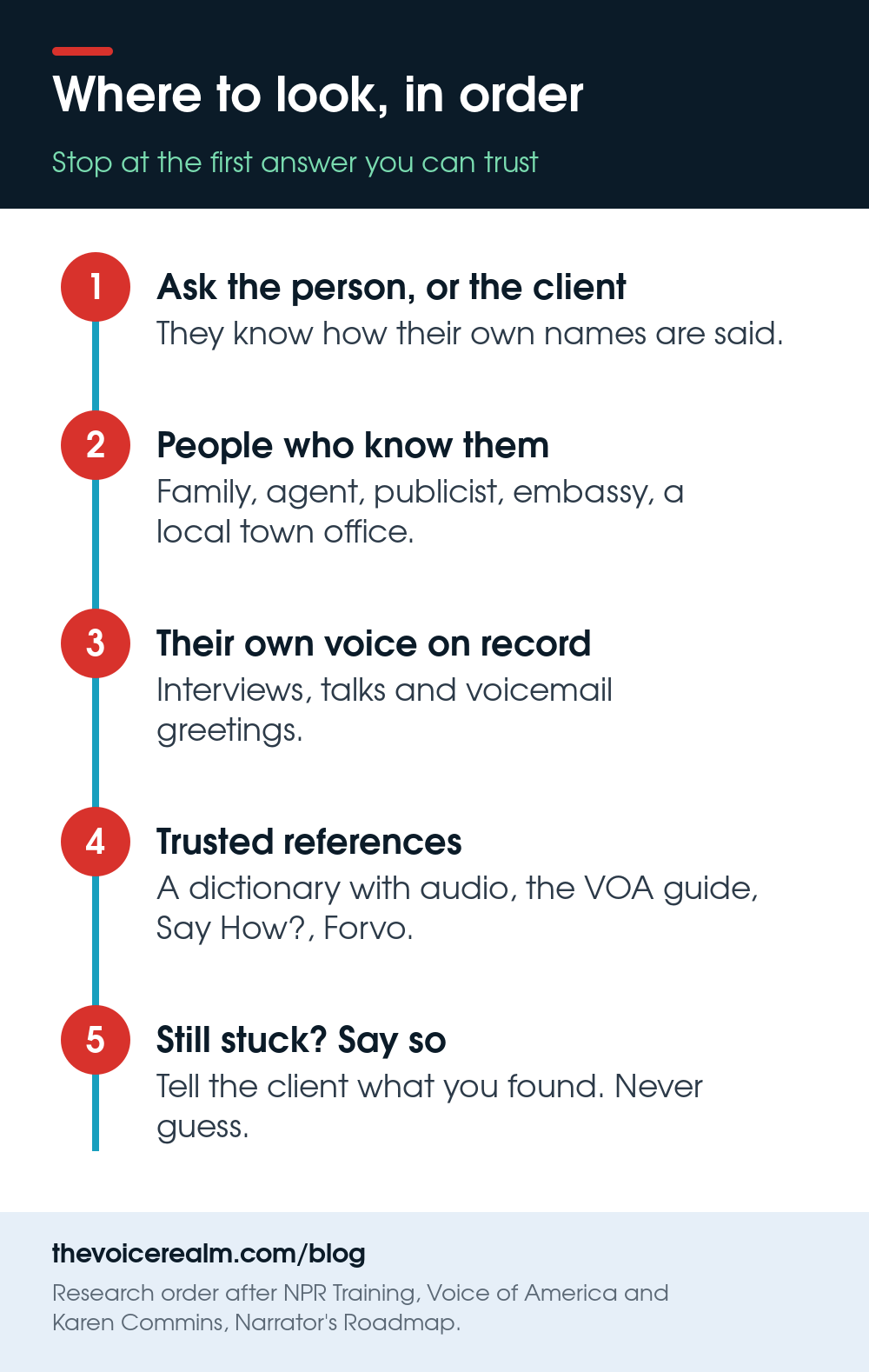
The best source for how a name is said is the person who owns it. NPR’s advice to its reporters is simple: if you’re talking to someone, “just ask them to say their name on tape.” For a voice actor, the equivalent is asking your client. If the script names their founder, their town or their product, they know how it’s said, and most are glad you asked.
If you can’t reach the person, reach someone close to them. NPR suggests “a family member, close friend, co-worker, attorney, agent, publicist, embassy or government official, or anyone else who speaks the person’s language.” Voice of America works the same way: “The most direct way is to get in contact with the actual person for each name. Other sources include VOA language services, embassies, the United Nations, colleagues of the newsmaker, and outside experts.”
For places, ring a local. Commins says “a phone call will be your quickest and easiest way to learn a pronunciation,” and suggests a town clerk, the chamber of commerce, librarians or a hotel front desk. People are usually delighted to be asked. On an audiobook, the author is your first call for invented names and places, through the publisher or producer if they hired you.

A two-minute call beats an hour of guessing. © The Voice Realm
Then find them saying it
When you can’t ask, listen. NPR’s next step is to “look for a video or audio recording in which they introduce themselves.” Interviews, conference talks, podcasts and voicemail greetings are all gold, because people say their own names without thinking about it.
Commins has two tricks worth stealing. Search for the name plus the word “interview”, because “interviews tend to include introductions.” And when you find a long video, open its transcript, search it for the word and jump straight to that moment rather than scrubbing through forty minutes of talk. For ordinary words in a particular accent, YouGlish searches YouTube for clips of real people saying a word and lets you choose English from the US, UK, Australia and other places.

Interviews are gold: people say their own names without thinking. © The Voice Realm
Listen more than once, and to more than one clip if you can. One person’s slip shouldn’t become your pronunciation.
Reference sites, and which ones to trust
For ordinary English words, a good dictionary with audio is the first stop, and Merriam-Webster is the one many US narrators reach for. For names in the news, Voice of America opened its pronunciation guide to the public in 2000, and VOA has said its “database has nearly 7,000 entries, most of which have an attached audio clip.” The Library of Congress has its own guide to the names of public figures, called Say How?, made for its talking book narrators.
For other languages, Forvo collects recordings from native speakers. Commins describes it as “a pronunciation site of volunteer native speakers in hundreds of languages,” with the honest warning that “the sound quality varies across samples.” Narrator Amy Deuchler liked it for the reason that matters most: “I love Forvo because it has humans speaking the words, not AI.”
That last point is the one to hold on to. Commins warns that “Sites with pronunciations created by artificial intelligence are suspect and may yield incorrect pronunciations,” and that “Google Translate doesn’t necessarily speak words with the correct emphasis.” A machine reading text aloud is guessing too. It’s just guessing confidently.
“If you can’t find an authoritative source, rewrite the script to avoid the name. DON’T GUESS!”
Jerome Socolovsky, NPR Training
Place names play by their own rules
Places are trickier than people, because there’s often more than one right answer. NPR’s approach is a sensible default. Big, famous cities keep their English names: “Don’t call the capital of France ‘pahr-EE’.” Countries are said in English too, unless the official name is the foreign one. Smaller towns and cities get the local pronunciation, unless they have an official English name.
The aim isn’t to show off. NPR’s guidelines ask its presenters to say names “as they are pronounced by the person or by residents of the place. However, they are not supposed to sound as if they’re splicing in a native speaker.” That’s a good line for narrators. Get the sounds right, keep your own voice, and don’t suddenly switch into a full accent for one word in the middle of an English sentence.
For audiobooks there’s one more filter: the book itself. Commins notes that when sources disagree, you’ll decide “based on book-based factors like the textual context, author’s style, time period of the story, and dialect of the character.” A character from Georgia says Albany the Georgia way.
Write it so you can say it
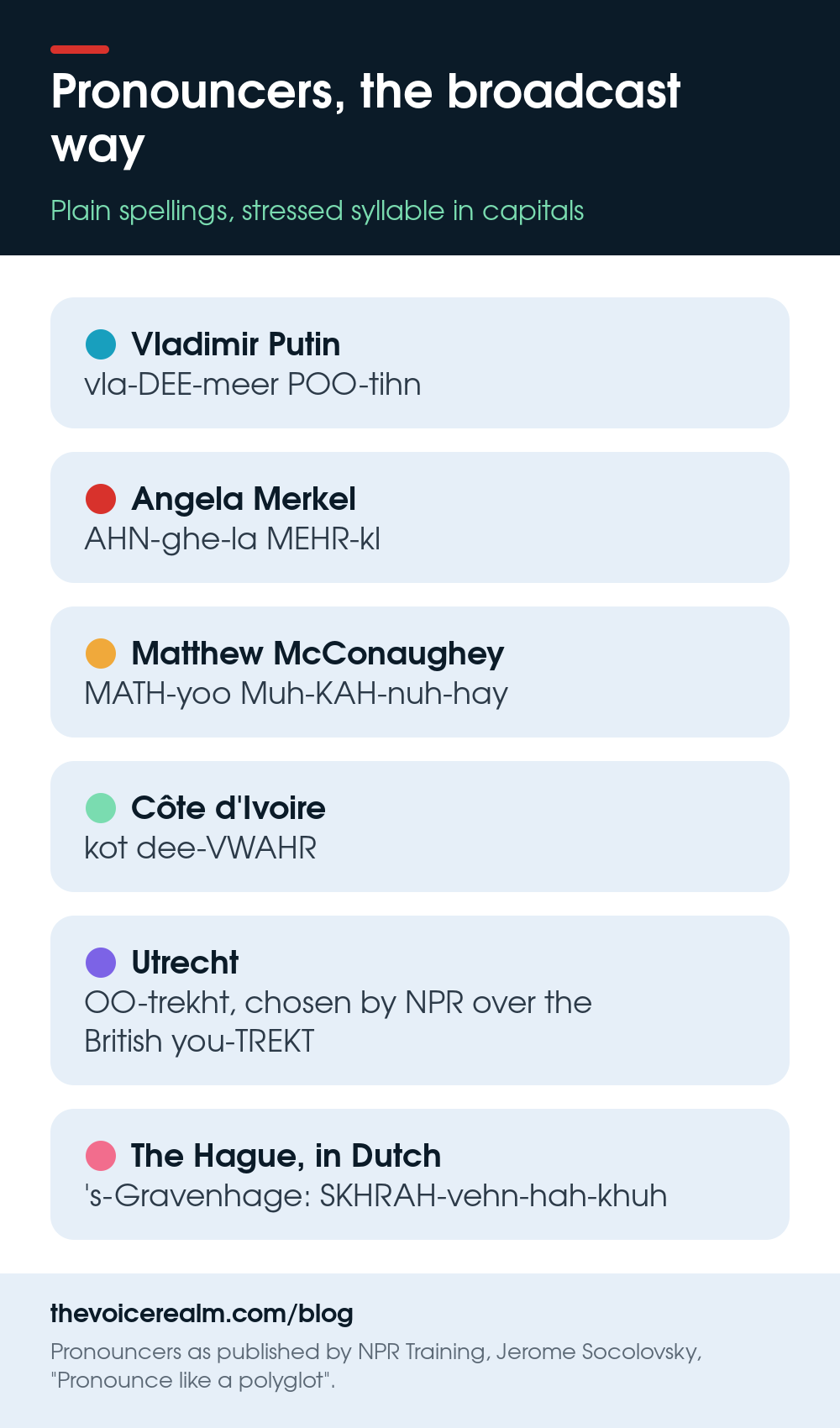
Once you’ve found the right pronunciation, write it down in a form you can read at speed. Broadcasters call this a pronouncer. NPR’s advice is to skip the dictionary symbols and “use straightforward spellings that an English speaker will easily understand,” and to put the stressed syllable in capitals. Its own example is the former Mexican president Andrés Manuel López Obrador, written as “ahn-DREHS mahn-WELL LOH-pehss oh-brah-DOOR.”
 VOICEMASTERACADEMYTwenty modules, one at a time.Breath controlHome studioCommercial techniqueAuditionsStart module oneNo experience needed.
Put the pronouncer right there in your script, above or beside the word. Dave Pignanelli, a supervising senior producer on NPR’s newscasts, goes further and suggests writing only the pronouncer in the script, then practising until you don’t need to look: “Practice saying the name before going into the studio.” Memorising a tricky name means you aren’t decoding it mid-sentence, which is exactly when a read goes stiff.
If the pronouncer looks odd, that’s fine. It only has to work for you. Some narrators also keep a short audio memo of the word on their phone, recorded from the source, so they can hear it again just before the take.
© The Voice Realm
Practise it in the sentence, not on its own
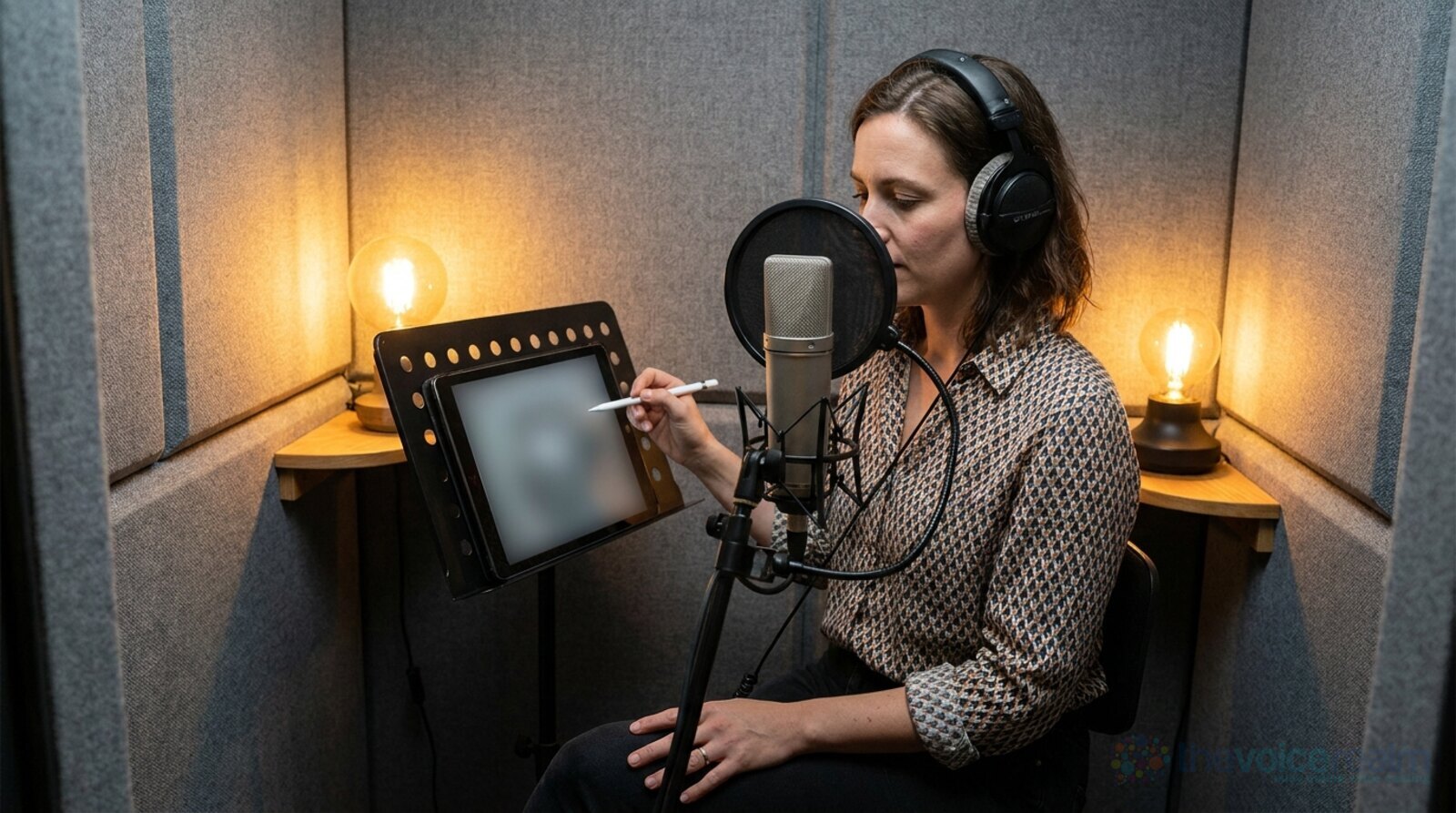
A name you can say perfectly on its own can still trip you up in context. Say the whole sentence it lives in, a few times, at the speed you’ll record it. The sounds around a word change how it sits in your mouth, especially when you’re moving from English into another language and back again.
Practise the whole sentence, at recording speed. © The Voice Realm
NPR’s Jerome Socolovsky, who reported from Spain in the 2000s, describes softening a foreign name or slowing down a touch around it, because “Different languages use different parts of the mouth, and a slight pause benefits both the listener and the speaker.” That tiny breath before the name is often all it needs.
Keep a pronunciation log
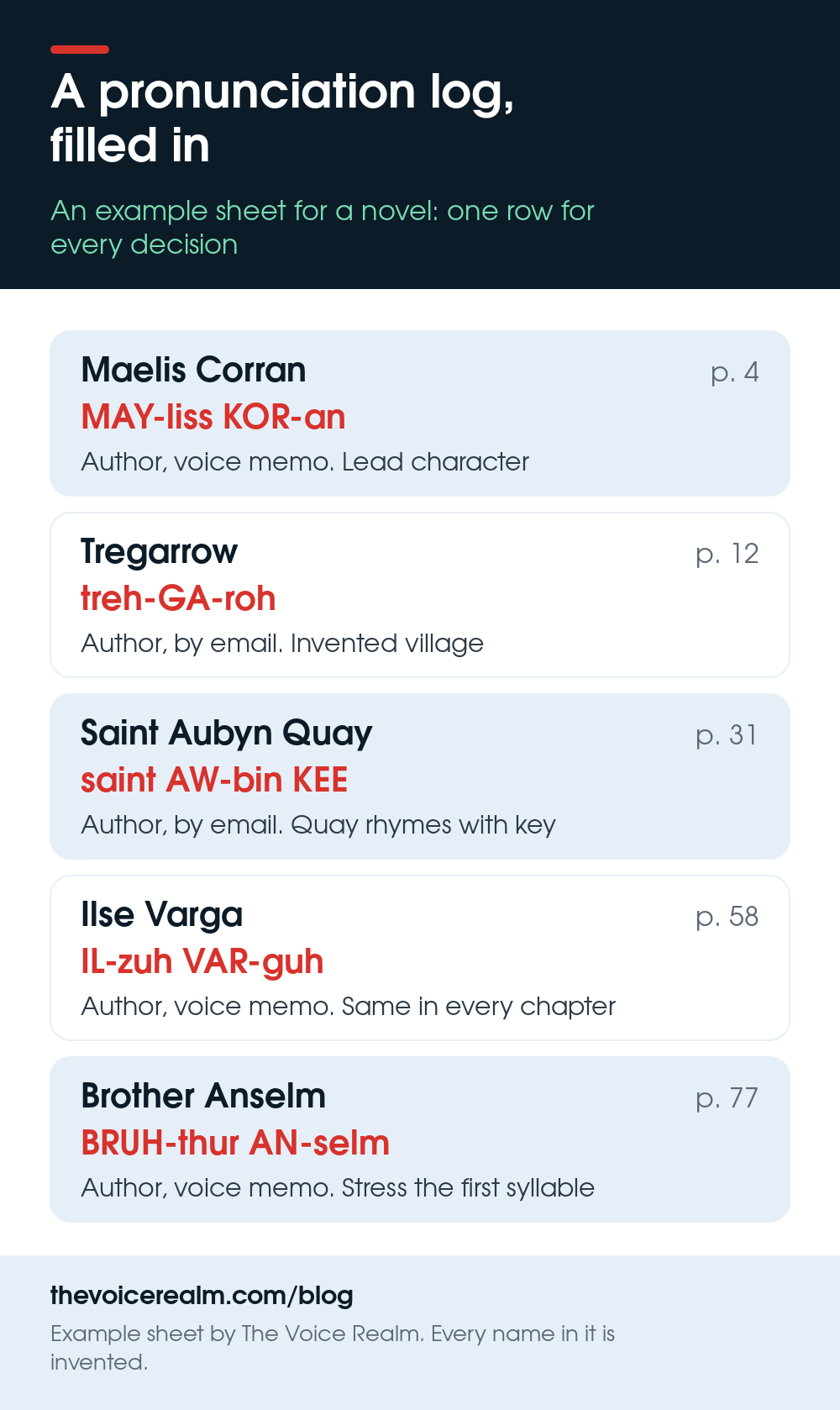
Write down every decision you make: the word, where it appears, your pronouncer, where you got it and anything you’d want to remember next time. It doesn’t need to be fancy. A spreadsheet or a page in your notes app is plenty.
© The Voice Realm
The log pays off three ways. It keeps you consistent across a long project, so a name doesn’t drift between chapters. It gives your proofer or client something to check against. And it saves you work later. Commins keeps hers for the long run: “I’ve been surprised to see a word I previously researched show up in a dissimilar book.” The same is true of corporate clients, who come back with the same product names year after year. It’s useful for narration genres with heavy terminology too, like e-learning voice over, where the same technical terms turn up module after module.
When you still can’t find it
Sometimes the trail goes cold. The name is rare, the person is gone, nobody answers the phone. Don’t quietly pick something and hope. Tell the client what you found and what you couldn’t, offer your best-supported option, and ask whether they’d like you to go with it, check with someone on their side, or reword the line. In a news script NPR’s answer is to rewrite around the name. In a client script, that’s the client’s call, but they’ll be glad you asked.
© The Voice Realm
Pronunciation research is one of those jobs nobody sees when it’s done well. That’s the point. The listener hears a name said with confidence and never thinks about it again, and the client hears someone who did their homework. That’s a voice they’ll book next time.
Sources: Jerome Socolovsky, NPR Training, “Pronounce like a polyglot: saying foreign names on air”; Karen Commins, Narrator’s Roadmap, “How to Do Pronunciation Research”; Inside VOA, “Pronunciation Guide”.
Ready to get booked?
See the jobs open right nowAbout Sarah Robbins
Sarah Robbins writes for The Voice Realm about finding voice over work, home studios, casting and the business side of voice acting.