Blog

This one’s for voice actors who keep a tin of throat lozenges in the booth, the car and the coat pocket, just in case. Winter is here, the heating is on, half the people you know are coughing, and you’ve got a session on Thursday. It feels sensible to suck something soothing on the way to the mic.
Some lozenges help a little. Some make things worse while feeling great. Below is what a lozenge can and can’t reach, what voice clinicians say about menthol and numbing drops, what to keep in the drawer instead, and how to stop a sweet from turning into clicks on your track.
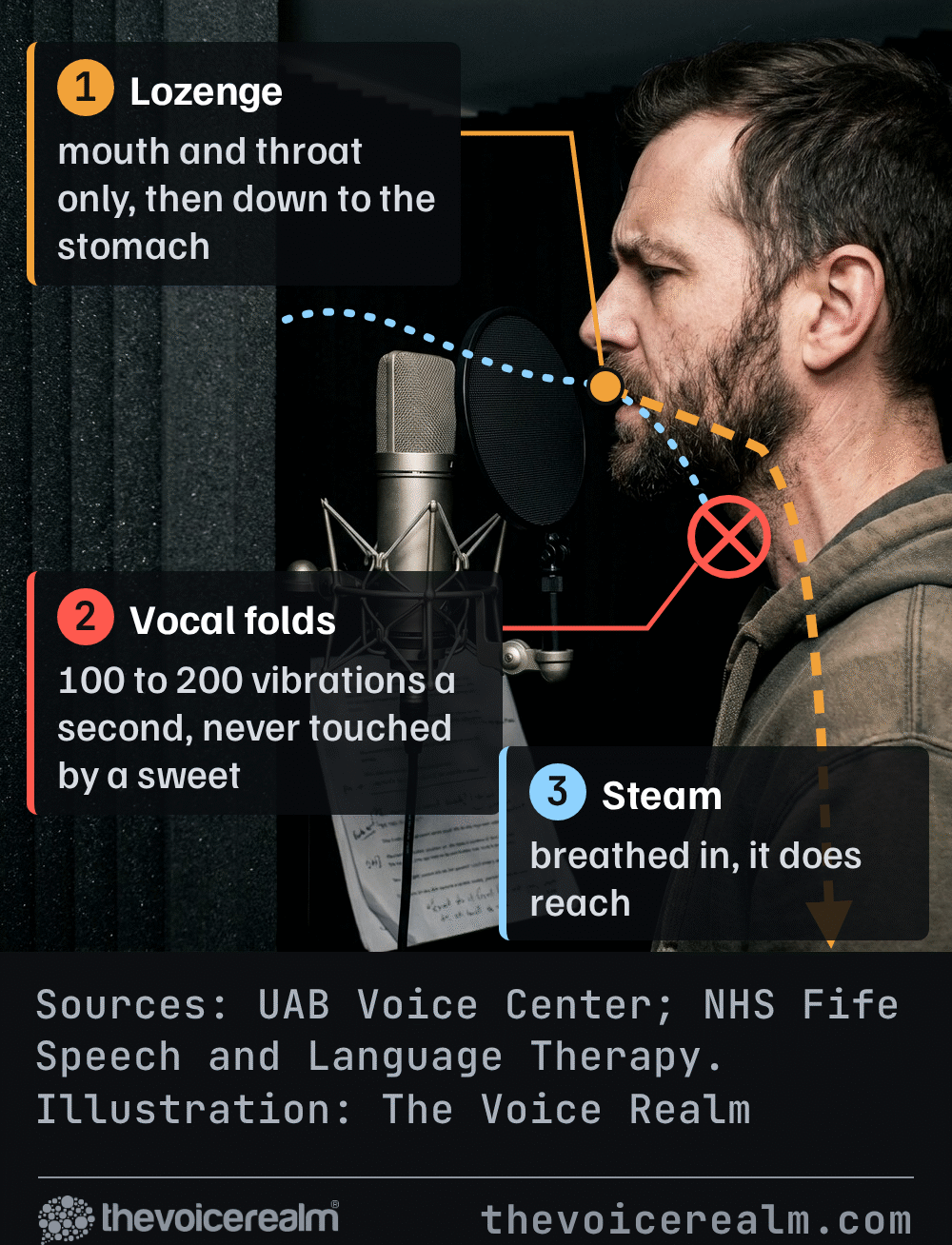
A lozenge never touches your vocal folds
Start with the plumbing. When you swallow, your airway closes over so that food and drink go down the food pipe behind it. Your vocal folds sit at the top of that airway, which is exactly why a crumb that goes down the wrong way makes you cough so hard. Everything a lozenge releases, the sugar, the syrup, the flavouring, slides past your voice box on the way to your stomach.
Edie Hapner, co-director of the University of Alabama at Birmingham Voice Center, makes the point plainly. “While lozenges can help hydrate your mouth and throat, they don’t reach or directly soothe your vocal folds,” she told UAB News. In her view, the idea that cough drops give your voice all the care it needs is one of the oldest myths around.
That doesn’t make lozenges useless. A moist mouth reads better than a dry one, and anything that gets your saliva going helps your tongue and lips move cleanly. A sweet can also take the edge off a tickly cough, and every cough you don’t do is one less hard slam of the folds against each other. Just be clear about what you’re buying: comfort in the mouth and throat, not a treatment for the part that makes the sound.

© The Voice Realm
Menthol feels cool and leaves you drier
The strong, icy lozenges are the ones most people grab when their throat feels rough. That cold rush feels like relief. It’s mostly a sensation, though, and the voice specialists aren’t fans.
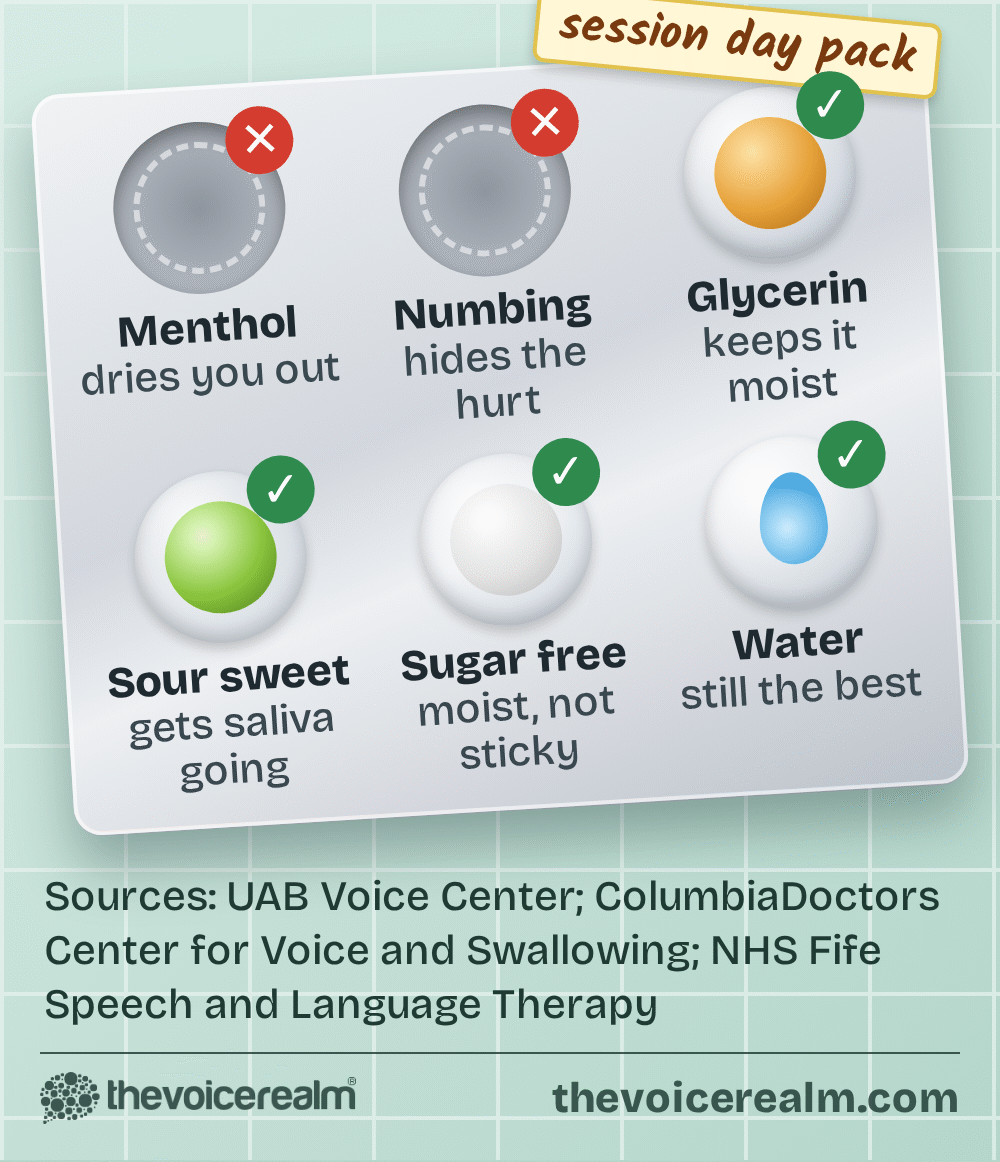
“Menthol-based lozenges can be quite drying and may worsen throat irritation,” Hapner says. In a separate UAB piece on winter air she goes further: “When trying to relieve a dry throat, avoid menthol-based cough drops, as they can be dehydrating and worsen the problem.”
The Center for Voice and Swallowing at Columbia University Irving Medical Center, which runs a voice program for Broadway performers, lands in the same place. In its advice for professional voice users, it lists menthol or eucalyptus cough drops alongside antihistamines as treatments to avoid until you know how they affect you, because “they can have a drying effect, which can increase risk of voice injury.”
So if you love the icy ones, save them for a day off. On a session day, the cool feeling isn’t worth the drier folds an hour later, right when you’re on page twelve of a long script.
© The Voice Realm
Numbing lozenges switch off your warning light
The second group to watch is the medicated kind. The NHS page on sore throats says a pharmacist can suggest “medicated lozenges containing a local anaesthetic, antiseptic, or anti-inflammatory medicine.” The anaesthetic ones are the problem for a working voice, because they do exactly what the label promises. They numb.
Pain is useful information when you talk for a living. It’s how your body tells you to stop pushing. A voice care leaflet from NHS Fife’s speech and language therapy team spells out the risk: “Be mindful that over the counter medicines e.g. medicinal sweets can contain anaesthetics to numb pain. This will reduce your awareness of when your throat hurts and may stop you knowing when you need to rest your voice.”
Comfort you can feel
Keeps your mouth moist and your saliva moving. If your throat starts to ache halfway through a session, you’ll still know about it and can take a break.
Comfort that hides the bill
Takes away the ache, so you keep reading at full effort through a throat that’s asking you to stop. You find out what it cost the next morning.
The same leaflet warns against lozenges that “may have a drying effect, can be irritants or can numb sensation,” so it’s not only the strongest medicated ones. Read the back of the box. If you see “local anaesthetic” on it, or an ingredient like benzocaine or lidocaine, that’s a numbing product. Throat sprays work the same way, and the NHS notes there’s “little proof they help when used on their own” anyway.
None of this means you should suffer through a genuinely sore throat on a day off. It means you shouldn’t numb your throat and then go and record two hours of narration on it.
What to keep in the drawer instead
The good news is the better options are boring and cheap. Hapner recommends glycerin-based lozenges instead, which keep the throat moist without the drying effect. Glycerin pastilles are the soft, slightly chewy kind, and they tend to dissolve slowly without the cold blast. The Columbia team lists glycerin throat lozenges in its own advice for performers dealing with throat irritation.
Hapner also mentions a trick that costs almost nothing: tart candies, to “stimulate saliva production and keep the throat moist.” Anything sour makes your mouth water, and that’s the moisture your articulators actually use.
The NHS Fife leaflet keeps it even simpler for anyone with a cold or sore throat: “take plenty of cool drinks, suck sugar free sweets or chew gum to keep your mouth moist.” And if you catch yourself clearing your throat over and over, it suggests swapping the clear for a sip of water or a sugar free sweet. We’ve written more about why that habit is so rough on your voice in our piece on constant throat clearing.
Water still does most of the heavy lifting. A lozenge moistens your mouth for ten minutes. Drinking steadily through the day keeps the whole system supplied, including the thin layer of moisture on your folds that no sweet can reach.

© The Voice Realm
Sugar, stickiness and the clicks on your track
Here’s the part nobody mentions on the packet. A sugary or syrupy lozenge leaves your mouth sticky, and a sticky mouth clicks. Every time your tongue leaves the roof of your mouth or your lips part, the microphone hears a tiny wet snap. Five minutes after a honey lemon drop is about the worst time to start a quiet audiobook chapter.
 VOICEMASTERACADEMYLearn the craft in order.Module one is freeStart module oneTwenty modules, start to finish.
A few habits keep the sweet without the noise:
- Finish it early. Let a lozenge dissolve completely ten or fifteen minutes before you record, not in the booth between takes.
- Rinse, then sip. Swish plain room temperature water round your mouth after the sweet, then take a proper drink.
- Go sour or sugar free on session days. They get saliva flowing without coating your tongue in syrup.
- Keep apple slices nearby. Plenty of narrators swear by a bite of green apple to cut through a sticky mouth mid session.
If clicks are already a problem for you, our guide to stopping mouth noise at the mic goes through the causes one by one. And for what to eat and drink in the hour before you record, there’s a full rundown on eating before a voice over session.
Dry rooms do more damage than any sweet can fix
Lozenge season and heating season are the same season, and that’s not a coincidence. Your throat feels scratchy in winter largely because the air inside is dry. UAB’s voice team points to “the colder months when there is less humidity in the air and in our homes/offices and dry forced heat” as the time voices suffer.
What dry air does is make your folds work harder. “When vocal folds become dry, they require more effort to vibrate, which can result in voice fatigue and changes in sound quality,” Hapner explains. More effort over a long session is how a voice that felt fine at ten sounds tired by twelve.
The fixes are low tech. NHS Fife suggests you “place bowls of water on or near a radiator, have house plants in water, or hang a damp towel over the radiator,” along with sipping water and ventilating rooms. It also recommends gentle steam, because “the steam rising from hot water reaches, soothes and moistens your larynx.” That’s the big difference. Steam is breathed in, so it travels through the airway where a lozenge never goes.
A small humidifier in a booth or a spare room studio is worth thinking about too, as long as it’s quiet and you switch it off while you record. Our guide to hydration and steam for voice actors covers how much to drink and how to steam without scalding yourself.

© The Voice Realm
When a lozenge is the right call
On a healthy day, a plain or glycerin lozenge is fine. It’s comforting on a long drive, it settles a tickle before an audition, and it keeps your mouth moist on a dry flight. Treat it as a small comfort, finish it before you record, and drink water alongside it.
When you’re actually ill, the question changes. A lozenge can make a sore throat feel better, but it won’t make it heal faster, and a numbing one can let you talk yourself into a much longer recovery. The NHS says sore throats “normally get better by themselves within a week,” and suggests seeing a GP if yours doesn’t improve after a week or if you get them often.
If your voice itself has changed, hoarse, breathy, cracking or tiring quickly, no sweet can tell you why. As Hapner puts it, “Only a specialist who can directly examine your vocal folds can accurately diagnose the cause of your voice change.” For a professional voice, that means an ear, nose and throat doctor, ideally one who works with singers and speakers.
And if you’re trying to decide whether to record through a cold at all, our guide on recording voice over with a cold walks through when to push on, when to adjust and when to move the session.
© The Voice Realm
The short version
A lozenge is a treat for your mouth, not medicine for your voice. On a session morning, the things that genuinely help are less exciting: water from the moment you wake, a damp towel over the radiator the night before, a few minutes of steam, and a sour sweet finished well before you walk into the booth.
Keep the icy ones and the numbing ones for days when nobody’s listening. Then, when your voice is rested and ready, there are fresh castings most days on the voice over jobs board.
Sources: Teresa Hicks, UAB News, “Protect your voice: Expert tips to keep your vocal cords strong and healthy”; UAB Department of Otolaryngology, “How seasonal dry air affects your voice”; ColumbiaDoctors Center for Voice and Swallowing, “For the Professional Voice”; NHS Fife Speech and Language Therapy, “Voice Care Information”; NHS, “Sore throat”.
Ready to get booked?
See the jobs open right nowAbout Sarah Robbins
Sarah Robbins writes for The Voice Realm about finding voice over work, home studios, casting and the business side of voice acting.