Blog
This is for the voice actor who’s been told to “get someone to look at your vocal cords” and has been finding reasons not to ring. Maybe you’ve been hoarse for a month. Maybe your top has gone, or your voice gives out by lunch, and every website has a different theory. At some point guessing has to stop and somebody has to look. Here’s what that appointment is like, so the only surprise is how quick it is.
We’re not doctors. What follows comes from hospitals and voice specialists, plus the questions a working performer ought to walk in with.
When a rough voice stops being “just a cold”
A croaky week after a cold is ordinary. The line most people need to know comes from the NIDCD, the US government’s institute for voice and hearing: “You should see your doctor if your voice has been hoarse for more than three weeks, especially if you haven’t had a cold or the flu.”
Some things shouldn’t wait three weeks. The same page says to see a doctor if you’re coughing up blood, have difficulty swallowing, feel a lump in your neck, have pain when you speak or swallow, have trouble breathing, or lose your voice completely for more than a few days. If breathing is hard right now, that’s an emergency, not a booking.
The Voice Foundation is stricter for smokers, and it makes a point that long-time raspers tend to miss. “Even if a patient’s voice has been hoarse since childhood,” it says, a voice complaint should be evaluated by a specialist. Sounding like gravel for twenty years might be your brand. It’s still worth knowing why.
If your voice vanished suddenly during a shout, a scream session or a hard sneeze, stop talking and call. That can be a bleed in the vocal fold, and the NIDCD says a hemorrhage “must be treated immediately with total voice rest and a trip to the doctor.”
© The Voice Realm
Who you’re actually booking with
Your family doctor may be able to look down your throat, but they can’t see your vocal folds that way. You want an otolaryngologist, better known as an ENT, or better still a laryngologist, who’s an ENT specializing in the voice box. Many voice clinics pair them with a speech-language pathologist, and either may hold the camera.
There’s a split in the jobs, though. The American Speech-Language-Hearing Association says physicians are the only professionals “qualified and licensed to render medical diagnoses related to the identification of laryngeal pathology as it affects voice.” The therapist often understands how you’re using the voice. The physician tells you what’s on it. For a performer, a clinic with both is gold.
When you ring, ask one plain question: “Do you do stroboscopy here?” Not every ENT office has the equipment, and it’s the part that matters most to you.
Why an ordinary light isn’t enough
When you speak, your vocal folds open and close somewhere around a hundred times a second for a low voice, and over two hundred for a high one. Cleveland Clinic puts the problem simply: “These vibrations are so fast that you can’t see them with the naked eye.” Under a steady light, vibrating folds are a blur with edges.
So the clinic uses a strobe. It’s the same trick that makes a spinning fan look still at a disco. The Voice Foundation describes it as “controlled high-speed flashes of light timed to the frequency of the patient’s voice,” which give “a slow motion-like view of vocal fold vibration during sound production.” A little microphone listens to your pitch and tells the light when to fire.
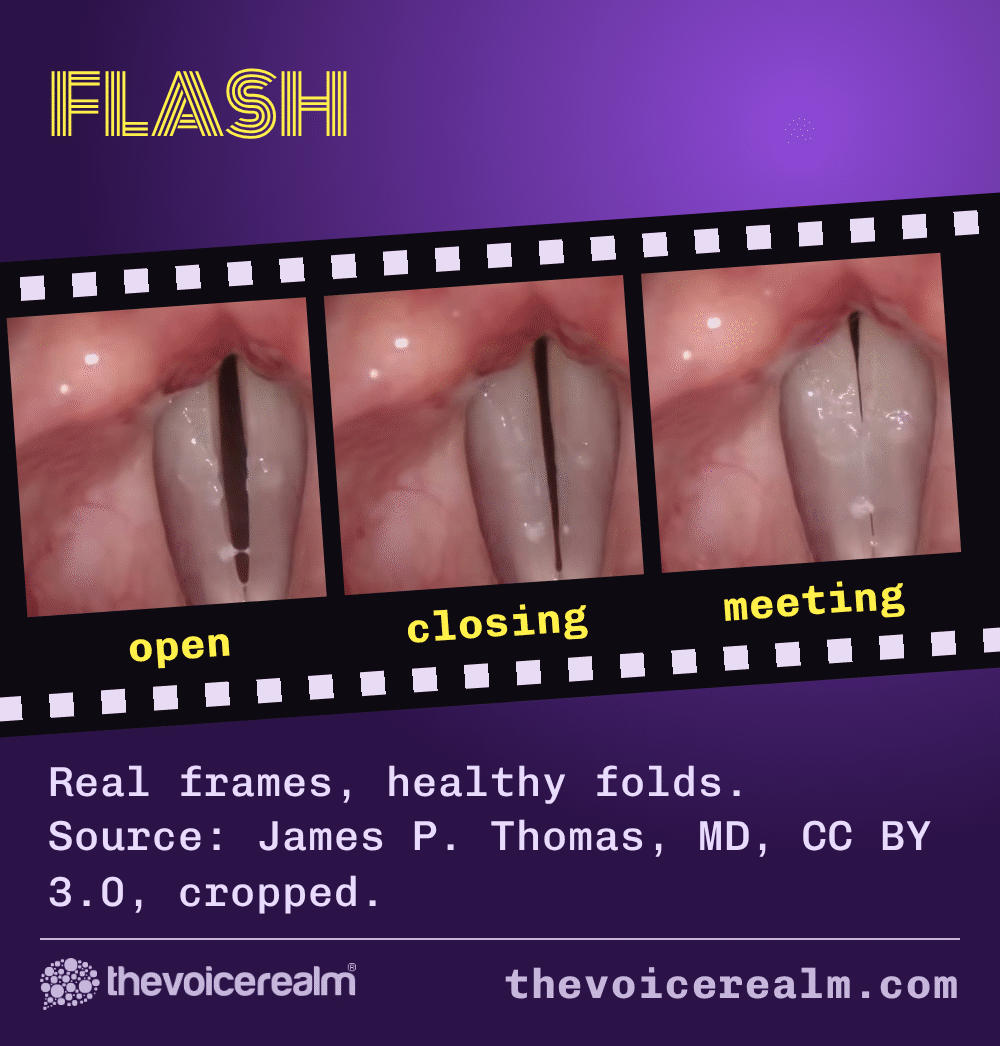
Image: James P. Thomas, CC BY 3.0
What can they learn from slow motion that they can’t from a still? Whether both folds move evenly. Whether they meet all the way along. Whether there’s a stiff patch that isn’t rippling like the rest. A small nodule and a small cyst can look alike sitting still, and they get treated differently. If nodules are what’s worrying you, we’ve covered what they are and how they’re usually handled.
Through the nose or over the tongue
There are two ways in, and it’s fair to ask which one you’ll get.
The rigid scope goes over the tongue. Someone holds your tongue in a bit of gauze while a narrow metal telescope looks down from the back of your mouth. The picture is the sharper of the two. The trade, the Voice Foundation notes, is that with the tongue held you can’t talk or sing properly. You’ll manage an “eee” and not much else.
The flexible scope is a thin bendy tube that goes up one nostril and down behind the palate. It isn’t as clear, but it “allows examination of the voice box in action.” You can speak. You can sing. You can read copy. If your trouble only shows up in character voices or long sentences, this is the view that might catch it, so say so.
Some clinics do both in one visit. Nobody’s being thorough at you for fun. They answer different questions.
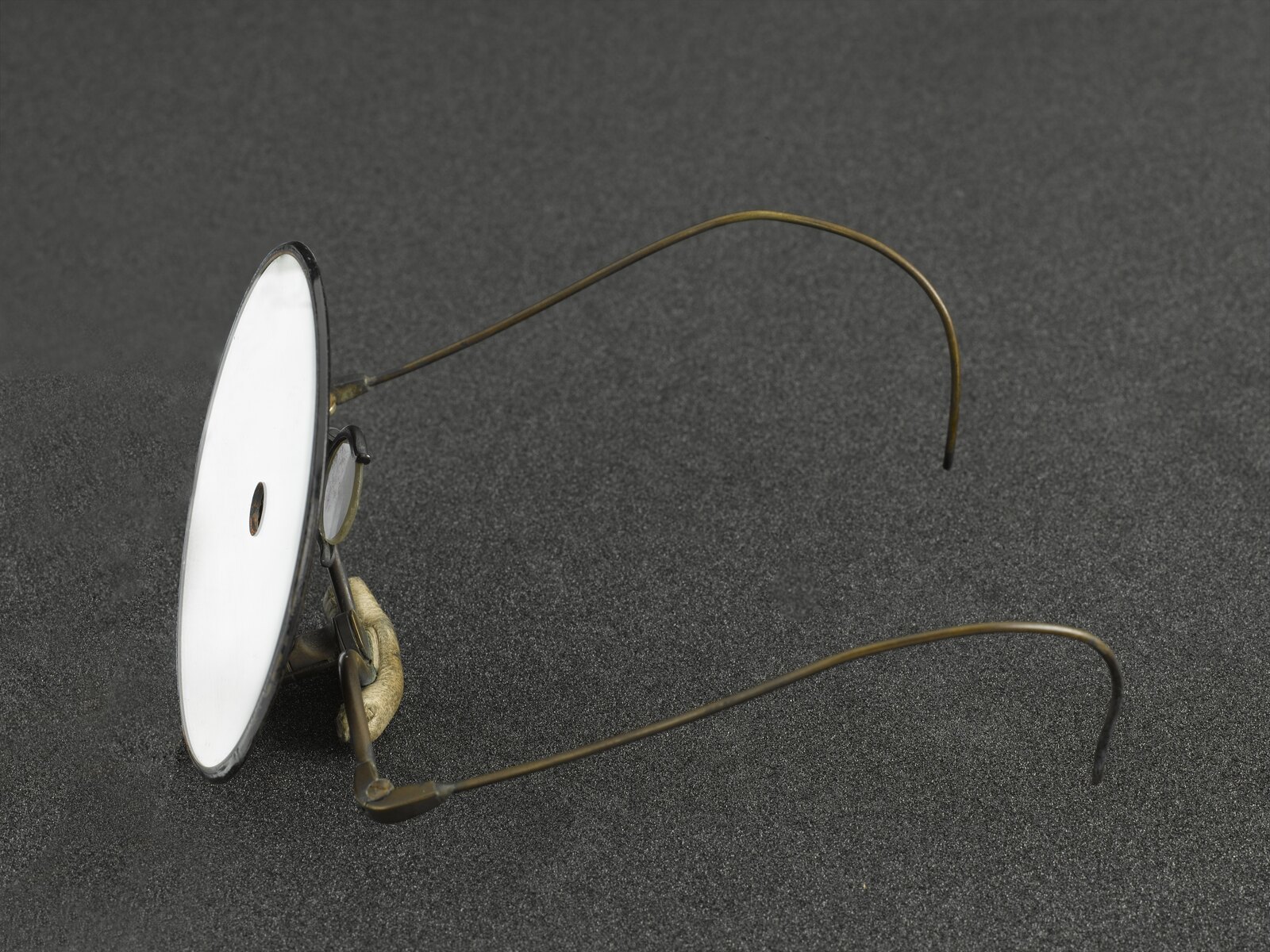
Before cameras: a doctor's head mirror and spectacle frame, 1870 to 1900, owned by Sir Lauder Brunton. Image: Wellcome Collection, CC BY 4.0
The appointment, minute by minute
First comes talking. You’ll be asked how the trouble started, when you noticed, how often it happens, what sets it off and what helps. Then usually a look at your ears, nose, mouth and neck.
For the nose route you’ll get numbing medicine, as a spray or gel. Cleveland Clinic warns that it “may taste bitter, and you might want to cough at first.” Your throat goes odd and thick. You can still breathe and swallow, even when it feels as if you can’t.
 VOICEMASTERACADEMYLearn the craft in order.Module one is freeStart module oneTwenty modules, start to finish.
Then the scope goes in. Michelle Soummers, a speech pathologist at Ohio State’s medical center, tells patients to expect “a little bit of pressure as we pass this through your nose.” On the video she has her patient say “pop, pop, pop,” then breathe through the nose, then “hee, hee, hee,” then slide from low to high. She adds something you’ll want to hear: “People who use their voice professionally will be asked to sing during the scope typically.”
“After a laryngoscopy, you shouldn’t be having any discomfort or anything. Typically, if it’s done correctly, you shouldn’t have really felt it much.”
Michelle Soummers, speech-language pathologist, Ohio State Wexner Medical CenterPost this quote
How long does it take? Depends who’s counting. Wake Forest Baptist says its video exam lasts “around 1-2 minutes.” Cleveland Clinic says the recording part “may take 15 to 20 minutes.” Take that as the range, and block out the morning.
If you’re a gagger, tell them before they start. Breathing through the nose, looking at a fixed point and keeping your shoulders down all help, and these people have met your gag reflex before.
Walk in with one card, not a life story
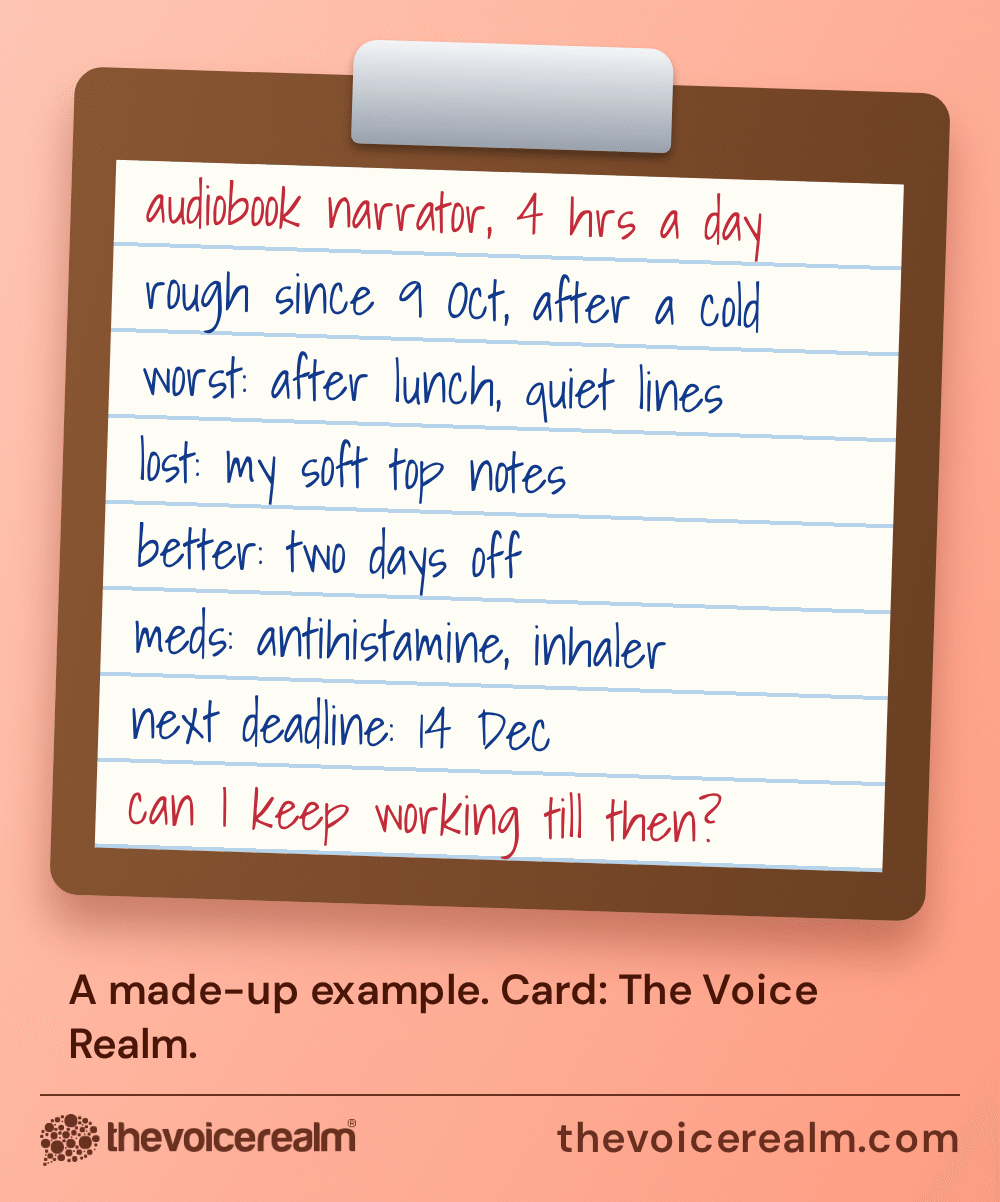
Ten minutes with a specialist goes fast, and adrenaline eats the details. Write one card the night before and hand it over. Put your job in the first line, in hours, because “I talk a lot” means nothing and “four hours of narration a day” means plenty.
Bring your medication list, including inhalers, antihistamines, reflux tablets and anything herbal. Mention surgery, even old surgery, especially if you had a breathing tube. And bring sound. Nobody else in that waiting room has a dated, high-quality archive of their own voice. Put a clean file from six months ago and one from last week on your phone, same script if you can, twenty seconds each. Your clinician may not need them. If your voice happens to behave beautifully on the day, you’ll be glad you’ve got evidence.
One more tip: don’t save your voice for a week so you’ll look good on camera. Go in as you normally are. You’re there to show them the problem.
© The Voice Realm
Should you book work that afternoon?
We wouldn’t. Cleveland Clinic says the numbing “may take an hour or two to wear off completely,” and that you may need to avoid eating while your throat’s numb and stick to water or clear liquids. Another of its pages puts the numb feeling nearer thirty minutes. Either way, you can’t judge your own effort when you can’t feel your throat, and pushing without feedback is how people get hurt.
Keep the rest of the day for admin. If there’s a session you can’t move, ask the clinic about it beforehand. And don’t have a long cry-it-out phone call about the results on the way home. Text.
What to ask when the picture’s on the screen
This is the best bit. Often you’ll see the recording with them there and then, and you may get an answer on the spot. Ask to watch it. Seeing your own folds move is strange, and a bit moving, and it makes everything afterward easier to understand.
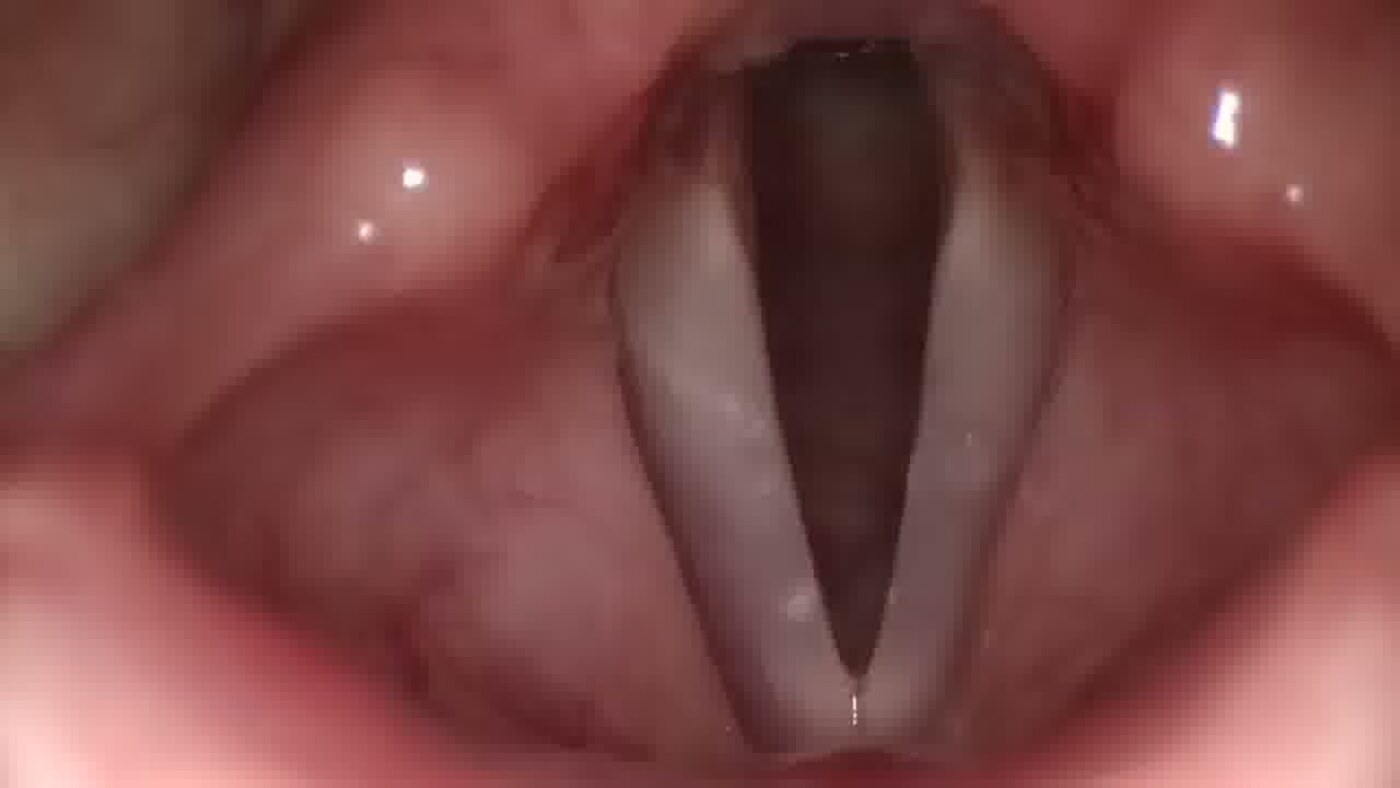
The view on the screen: healthy vocal folds wide open, between sounds. Image: James P. Thomas, CC BY 3.0
- Can you show me what you’re seeing, and what normal would look like?
- Is this something I did, something I have, or something that’ll pass?
- Can I record this week? How many hours, and what should I leave out?
- Do I need rest, therapy, medicine, or more tests?
- Can I have a copy of the video and the report?
- When should somebody look again?
That copy matters. If you ever have a problem again, a picture of your healthy or healing folds gives the next doctor something to compare with. Some singers get one on purpose while everything’s fine, for that reason. If you scream for games or narrate full time, ask your clinic whether a baseline makes sense for you.
Often the folds look fine, and the news is that the muscles around them are working too hard. That’s still an answer, and a treatable one. Our piece on muscle tension dysphonia explains where that road goes. And if the prescription is quiet, read up on how strict vocal rest really needs to be, then do what your own clinician says.
Make the call before the next busy month
The worst time to find out is the week you’re booked solid. Specialist waits can be long, so ring while you’re merely worried. You can always cancel if it clears up. A few odd minutes and a numb nose is a small price for knowing what’s going on with the thing you work with every day.
Sources: “What Is Hoarseness?”, NIDCD; “Videostroboscopy” and “Laryngoscopy”, Cleveland Clinic; “Laryngoscopy/Stroboscopy” and “Diagnosis, Treatment, Prevention”, The Voice Foundation; “Voice Disorders”, ASHA; “What to expect when having a laryngoscopy”, Ohio State Wexner Medical Center; “Video Laryngostroboscopy”, Atrium Health Wake Forest Baptist. Images: James P. Thomas, CC BY 3.0; Wellcome Collection, CC BY 4.0.
Ready to get booked?
See the jobs open right nowAbout Sarah Robbins
Sarah Robbins writes for The Voice Realm about finding voice over work, home studios, casting and the business side of voice acting.