Blog
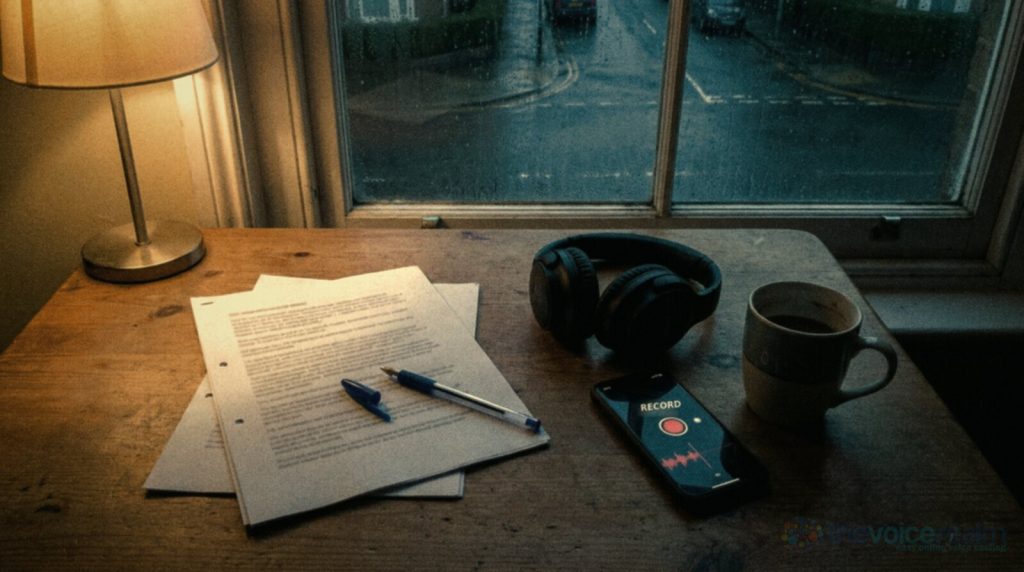
This one’s for the voice actor with ADHD, diagnosed or quietly suspecting it, who can disappear into a character for four hours and then can’t make themselves send a two line invoice. If you’ve ever lost an afternoon to re-editing one breath, or found the booth door open because you wandered off mid-take to look for a pencil, you’re in the right place.
We’re not clinicians, and nothing here is a diagnosis. What follows leans on NHS guidance and the Royal College of Psychiatrists for the facts, and on the way voice work is actually done for the rest.
Plenty of the job suits an ADHD brain
Start with the good news, because it’s real. The NHS describes ADHD as “a condition that can affect how you focus,” and adds: “If you have ADHD, you may have trouble with things like concentrating and sitting still.” Read that list and voice work sounds like the worst possible fit. A small room, a still body, a long script.
Except the work isn’t one long stretch of sameness. Every job is a new script, a new client, a new character and often a new deadline. Short commercial reads are over in minutes. Auditions arrive in bursts. Variety is built in, and for a lot of people with ADHD that’s exactly what keeps the motor running.
The Royal College of Psychiatrists notes something many performers recognise straight away: “Some people with ADHD find that they can ‘hyper-focus’ on things they are interested in.” It also says: “Other people with ADHD find that they perform better in a crisis when the situation demands their full attention.” A live directed session, with a director in your ears and a client listening in, is that kind of moment. Plenty of actors with ADHD say they’re at their sharpest when the red light is on and someone’s waiting.
So the goal isn’t to fix your brain to suit the job. It’s to shape the job around the brain you’ve got.
Hyperfocus is brilliant until it eats the afternoon
Hyperfocus is the superpower and the trap in one. NHS Greater Glasgow and Clyde describes it as being “able to become completely absorbed in an activity or task you enjoy,” and that’s a perfect description of a good narration day. It’s also a perfect description of spending three hours removing mouth clicks from a file that was already clean.
The same guidance says: “It can be hard to keep track of how much time is passing or to estimate how long a task will take.” For a freelancer who quotes by the job, that matters twice. You lose the afternoon, and you can’t tell how long the next job will really take, so you price it wrong.
Two habits help. First, write down a guess before you start (“this e-learning module: 90 minutes to record, 60 to edit”) and note the real time when you finish. After a dozen jobs you’ll have your own numbers instead of a feeling. Second, give the edit a finish line that isn’t “when it’s perfect”. One pass for noise, one pass for timing, one listen through, then it goes. While you’re setting limits, our guide to how long you can sensibly record in a day is worth a read, because your ears tire long before hyperfocus admits it.
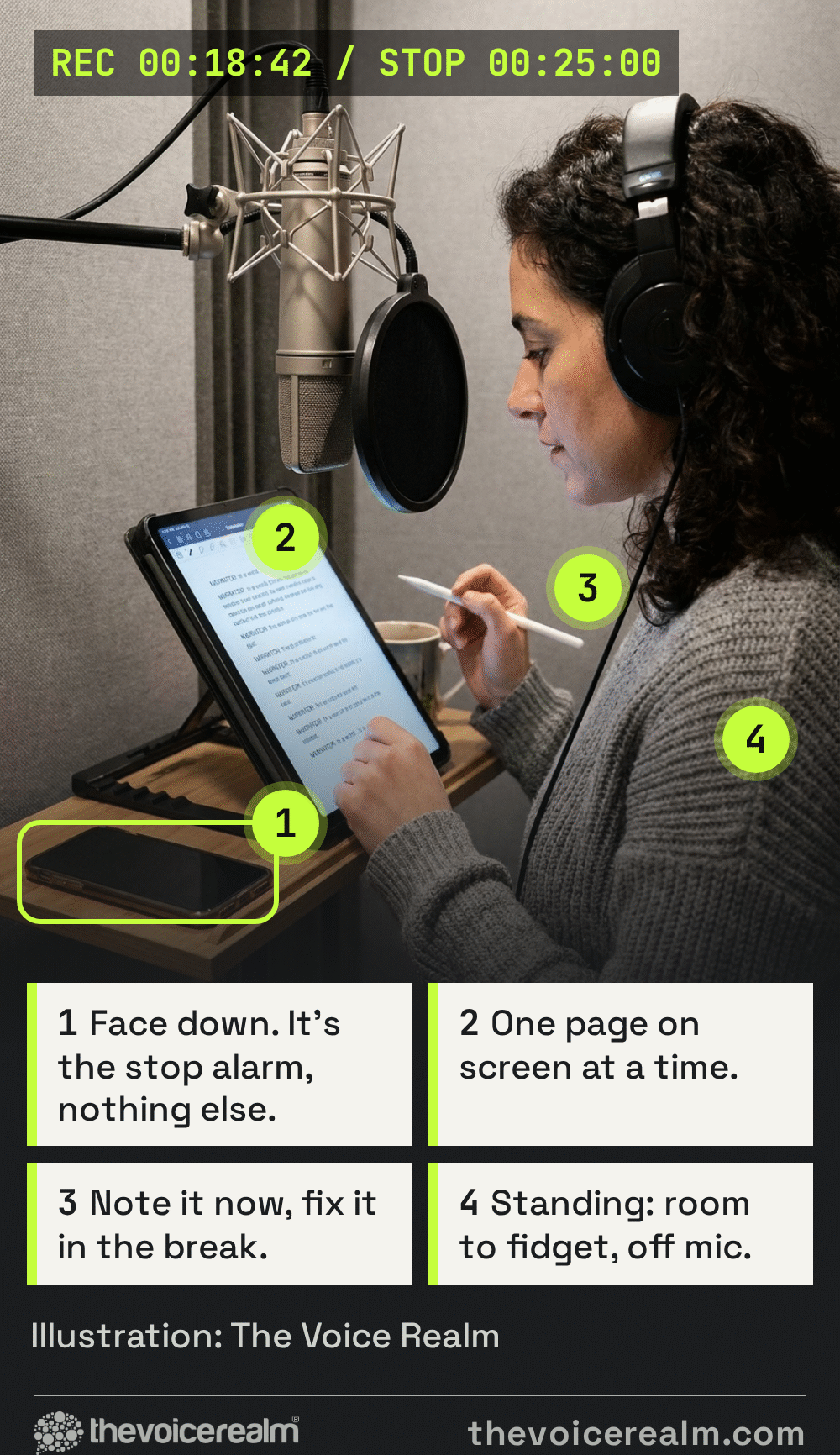
NHS Greater Glasgow and Clyde’s tip is simple and works: “Set alarms to go off when you need to wrap up the activity and move on to something else.” Not a gentle reminder you’ll swipe away. A loud alarm, set before you start, for the time you said you’d stop.
© The Voice Realm
Put the clock outside your head
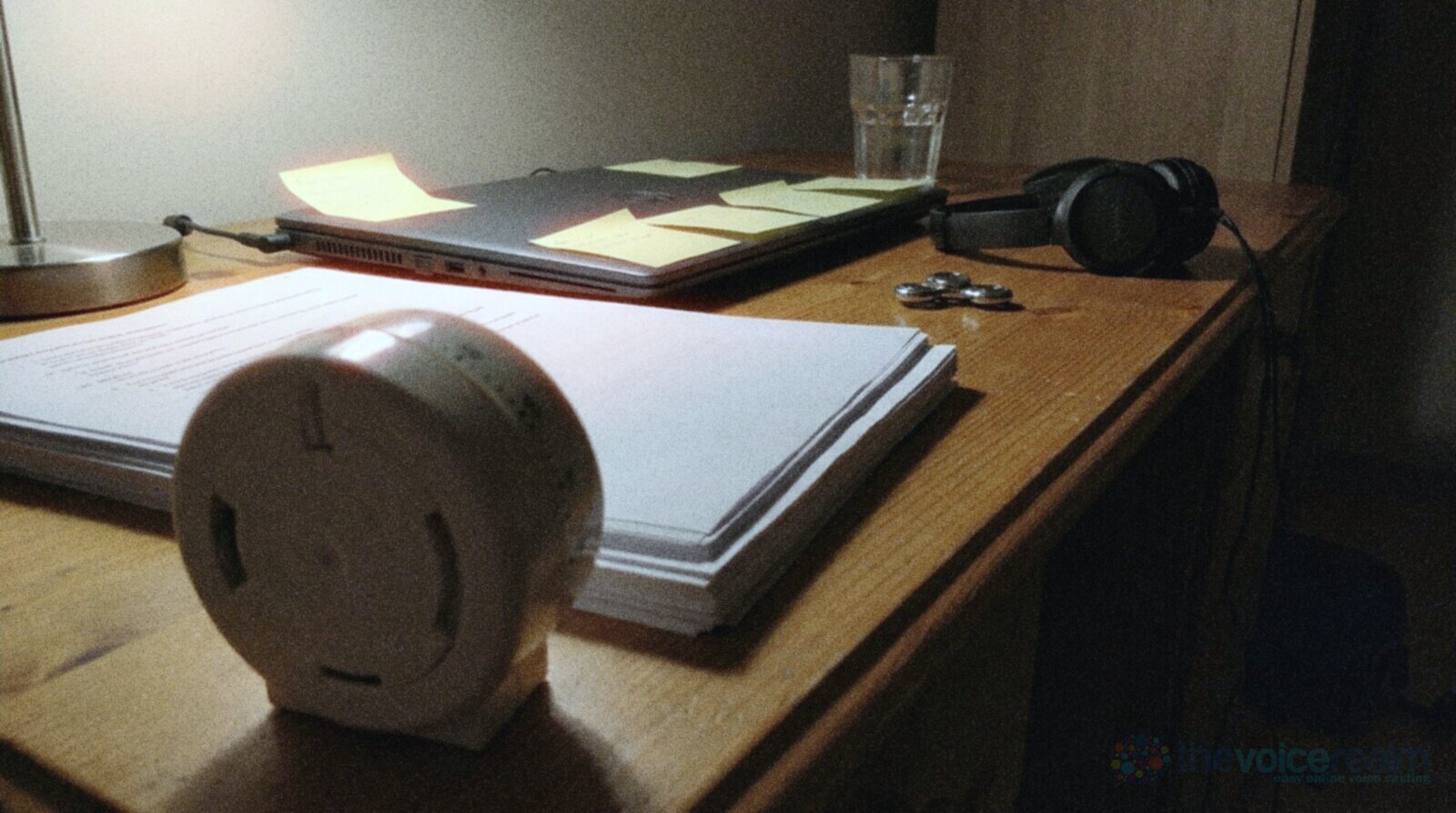
Leicestershire Partnership NHS Trust puts it plainly: “People with ADHD often lose track of time, so using external time cues can really help.” It goes on: “Timers, alarms, calendar alerts and countdown reminders provide structure, so you don’t have to hold it in your head.”
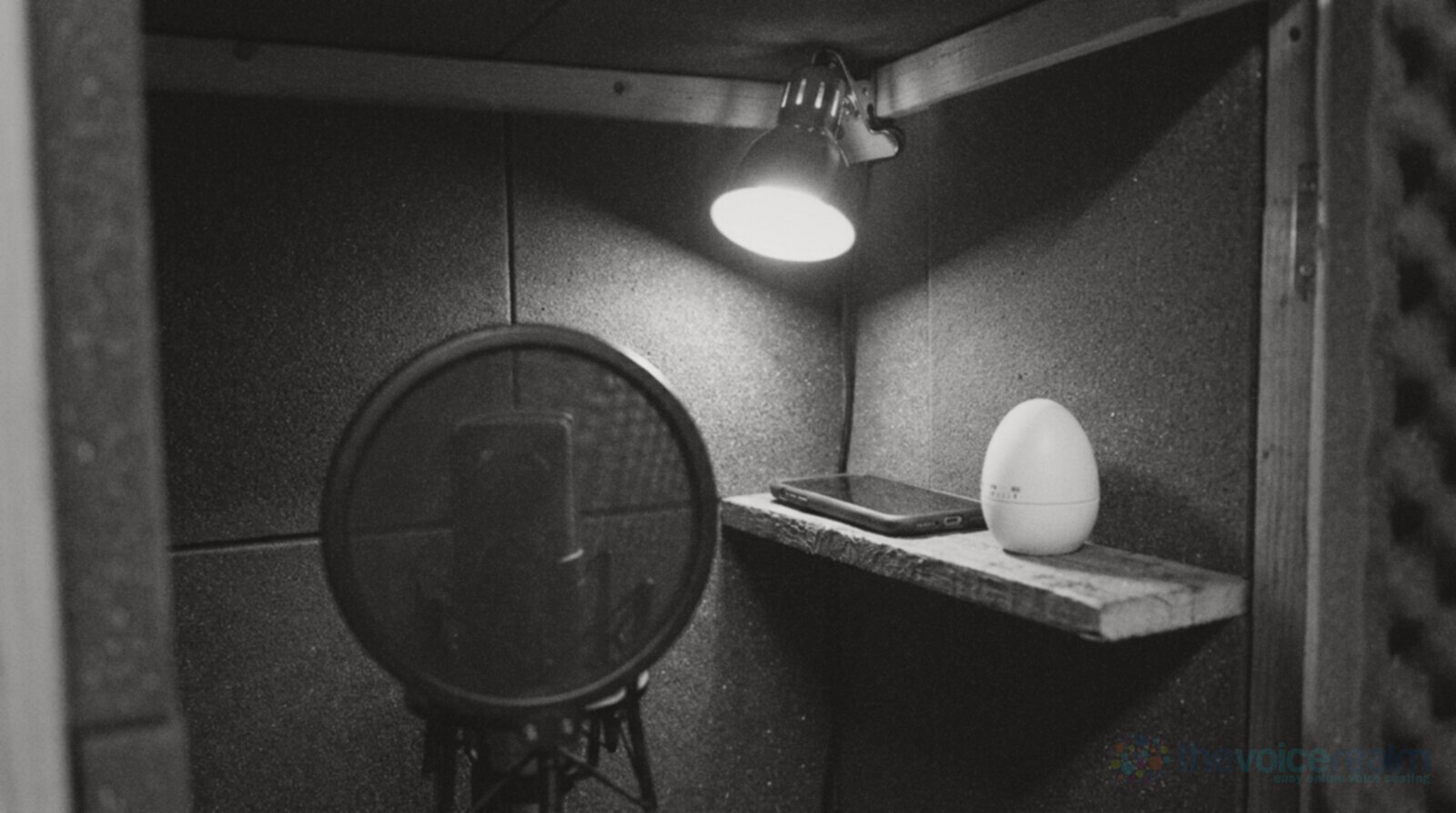
In the booth, that means a timer you can see without touching your phone. A cheap wind-up kitchen timer is ideal. It’s silent while it runs (check yours doesn’t tick loud enough for the mic to hear, or keep it outside the booth door), it rings when it’s done, and nobody has ever been distracted by a notification on one.
© The Voice Realm
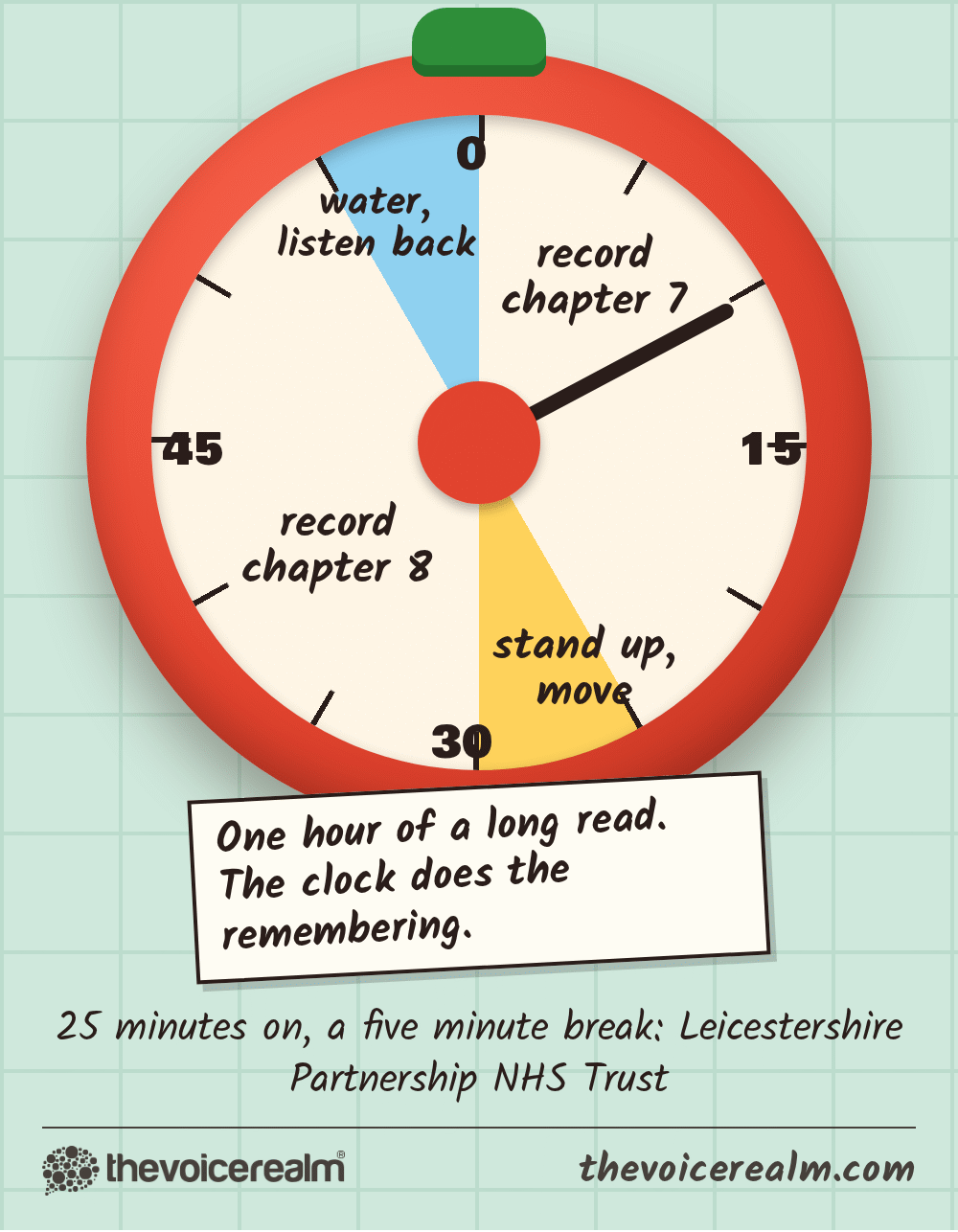
The same trust suggests working in blocks, 25 minutes on and a five minute break. For recording, that rhythm fits surprisingly well. Twenty-five minutes is long enough to get into a chapter or a module and short enough that your voice and your attention are both still fresh when you stop. The break is where the jobs that pull you away (water, a stretch, checking the client’s email) get to happen, so they stop happening mid-take.
Keep the phone face down, on silent, and ideally out of arm’s reach. If it’s your timer, use a full screen countdown app and lock the screen to it. Every glance at a message costs more than the glance.
Restless body, still microphone
Adult hyperactivity often doesn’t look like the bouncing child people picture. NHS Greater Glasgow and Clyde says: “As an adult, hyperactivity might not look like constant movement, you might feel it as a sense of inner restlessness.” In a quiet room with a sensitive mic, that restlessness turns into noise: a chair creak, a foot tapping on a hollow floor, a ring knocking the stand.
Don’t fight it. Give it somewhere to go.
- Stand to record. You can shift your weight, bend a knee and move your hands without the chair talking back. Put down a rug or a foam mat so your feet don’t thump.
- Take off anything that clicks. Rings, bracelets, a watch, a hoodie with zip pulls.
- Move on purpose between takes. Shake your hands out, roll your shoulders, take a step back from the mic. Movement in the gaps means less of it leaks into the takes.
- Use your hands for the read. Gesture with the line the way you would in conversation. Most good reads have the body in them anyway.
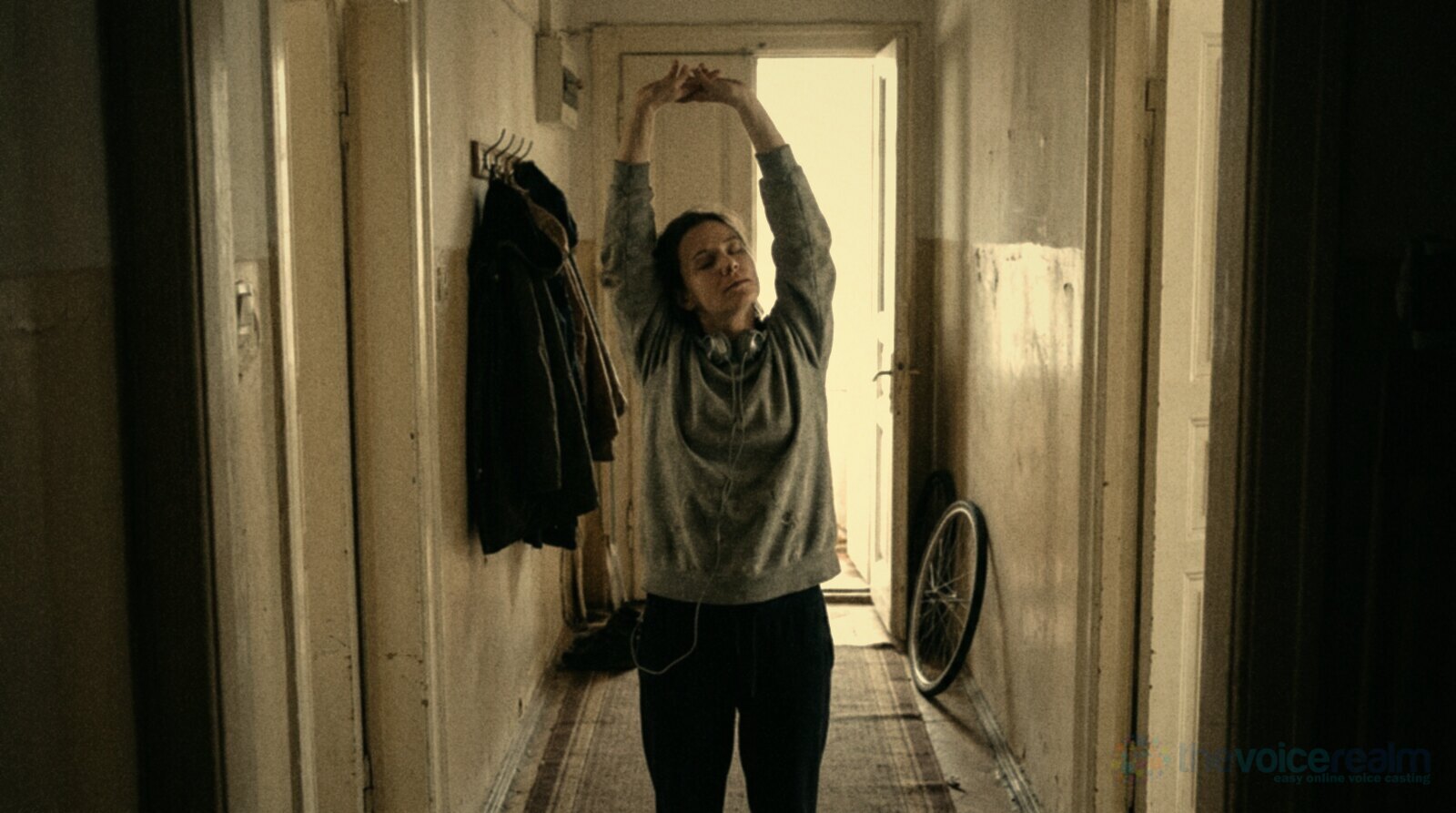
The five minute breaks are for proper movement. Walk to the kitchen and back, climb the stairs, stretch your arms over your head. You’ll come back to the mic looser, and a looser body usually means a more natural read.
© The Voice Realm
Long reads: audiobooks, e-learning and big files
Long form is where ADHD and voice work clash hardest. An audiobook can run to many finished hours, and every one of them takes several hours of recording and editing behind it. The job isn’t hard minute to minute. It’s hard because it goes on.
 VOICEMASTERACADEMYLearn the craft in order.Module one is freeStart module oneTwenty modules, start to finish.
NHS Greater Glasgow and Clyde suggests: “Build 5 to 10-minute breaks into long projects and time-consuming activities.” It also says: “Break down big tasks to achievable, small steps and write a list of small steps.” For a book, that means the job is never “record the book”. It’s “chapter 7, pages 112 to 126”. Small enough to start today, and small enough to finish today, which matters more than people admit.
© The Voice Realm
A few more things that make long reads kinder:
Prep in a different session from recording. Reading ahead and marking names, characters and tricky lines is a different kind of attention from performing, and switching between them every page is tiring. Do a prep block, take a break, then record what you prepped.
Record with punch and roll if your software allows it. When you fluff, you back up a sentence and carry on, instead of stopping, scrolling and losing your place. The method is laid out in our piece on fixing a fluff without losing your flow, and it keeps you in the read rather than in the edit window.
Keep a short running note beside you for everything your brain throws up mid-chapter: “email the author about that name”, “buy more water”, “is that a typo on page 140?” Write it, forget it, carry on. You’ll deal with the list in the next break.
If reading itself is a struggle as well, because ADHD and dyslexia often turn up together, our guide for dyslexic voice actors covers script formats, fonts and tablet set-ups that help.
Deadlines, invoices and the boring half of the business
Most voice actors with ADHD will tell you the booth isn’t the hard part. The hard part is everything around it. The Royal College of Psychiatrists lists “poor time management, missed appointments, frequent late and unfinished projects” among the things friends and family might notice. In a freelance business those turn into missed auditions, late files and unsent invoices, and nobody chases an invoice you never sent.
Build the business so the boring jobs happen without needing a good day.
One calendar, everything in it. Every session, every delivery date and every audition deadline goes in the same calendar the moment you agree to it, with an alert the day before and another two hours before. Put the deadline a day earlier than the client’s real one. Your calendar can lie to you kindly.

© The Voice Realm
Invoice in the same sitting as delivery. Make sending the invoice part of sending the files, not a separate job for later. A saved invoice template with your details already in it turns a dreaded task into two minutes of typing.
Batch auditions. Instead of jumping on every audition the moment it lands, pick one or two set times a day for them. That keeps the bursts of excitement from wrecking the job you’re meant to be finishing. Our voice over jobs board lists new castings throughout the day, so there’s no need to watch it like a kettle.
Body doubling for admin. Many people with ADHD find dull tasks easier with someone else around, even if that person is doing their own work. A friend on a video call while you both do your paperwork counts.
- Guess, then time it. Write down how long a job should take and log how long it did. Your quotes get honest fast.
- Alarm before you start. Set the stop time first, so hyperfocus has an exit.
- Stand up and move between takes. Restlessness that has somewhere to go stays off the recording.
- Invoice with the files. Delivery and invoice leave in the same sitting, every time.
Should you tell a client or a director?
That’s your call, and there’s no wrong answer. The NHS notes that “At your workplace or place of study, you can request changes to help you manage your ADHD.” As a freelancer you don’t have an HR department, but you do have the right to ask for the way you work best.
Most of the time, you don’t need to mention a diagnosis at all. Ask for what helps, in plain production language. “Could you send the script the night before?” “Can we take a two minute break at the half hour?” “Could you put the direction notes in the email as well as saying them?” Those are normal requests that any good director will say yes to, and none of them needs an explanation.
If you do choose to tell someone, keep it practical. Say what helps rather than what’s hard: “I do my best work in focused blocks, so I’ll check in every half hour” lands far better than an apology.
The Royal College of Psychiatrists makes a point worth hearing if you’ve spent years covering for yourself: “People with ADHD will often develop ways to hide their symptoms, and doing so can be very exhausting.” Building systems that do the remembering for you isn’t a crutch. It’s how you stop spending half your energy pretending.
Getting assessed, and getting support
If none of this is diagnosed but all of it sounds familiar, talk to your doctor. The NHS says symptoms “usually start before the age of 12,” so an assessment will usually ask about childhood as well as now, and it can help to bring someone who knew you then. Treatment, coaching and simple workplace changes are all options worth asking about. In the meantime, every habit in this article is useful whether you have a diagnosis or not.
Plenty of working voice actors have ADHD. The ones who last aren’t the ones who’ve beaten it. They’re the ones who’ve built a booth, a calendar and a working day that let their focus do what it’s good at, and stop it doing the rest.
Sources: NHS, “ADHD in adults”; Royal College of Psychiatrists, “ADHD in adults”; Leicestershire Partnership NHS Trust, “Strategies and support”; NHS Greater Glasgow and Clyde, “ADHD”, MyApp: My Mental Health.
Ready to get booked?
See the jobs open right nowAbout Sarah Robbins
Sarah Robbins writes for The Voice Realm about finding voice over work, home studios, casting and the business side of voice acting.