Blog
This one’s for working voice actors who’ve had a contract land with the word “synthetic” in it, or who’ve wondered what would happen if their voice turned up somewhere they never recorded. You can’t stop every bad actor on the internet. You can make sure nobody gets your voice through a contract you signed, and you can be ready if a copy turns up anyway. That covers most of what’s in your control, and it’s more than most people do.
None of this is legal advice. It’s a working actor’s guide to the clauses, the laws and the habits that matter, with the official sources at the end so you can check them yourself.
Your voice is data now, and it doesn’t take much
A few years ago, building a convincing copy of someone’s voice needed hours of clean studio audio. Not any more. The US Federal Trade Commission warned families back in 2023 that a scammer only needs “a short audio clip of your family member’s voice” and a voice cloning program to fake a call from someone they love.
If a short clip is enough for a scam call, think about what a voice actor puts out into the world: demos, auditions, finished commercials, hours of narration. Clean, dry, well recorded speech is exactly what these tools like best.
That doesn’t mean hiding your work. You can’t build a career without people hearing you. It means being deliberate about two things you do control: what you sign, and what you can prove later.
The FTC’s advice for families is worth passing on to your own, too: “Don’t trust the voice. Call the person who supposedly contacted you and verify the story. Use a phone number you know is theirs.” If your voice is out there, your parents should know that a call that sounds like you might not be you.

© The Voice Realm
A usage licence and a voice model are different things
Every voice job already comes with usage terms: where the recording runs, for how long, in which markets. We’ve covered that in detail in our guide to how usage rights work. The AI question sits on top of that, and it’s a much bigger ask.
When a client licenses a recording, they get the words you said. When a client gets the right to train a model on you, they get the ability to make you say anything, forever, without booking you again. Those are not the same deal, and they shouldn’t cost the same.
They get what you read
The script you recorded, in the media and markets you agreed, for the time you agreed. New lines mean a new session and a new fee.
They get you
Any words, in any project the terms allow, possibly with no end date. If you ever agree to this, it’s a separate deal, priced and limited on its own.
Some actors do license synthetic versions of their voices on their own terms, and that’s a legitimate choice. The point is that it should be a choice you make with your eyes open, not something buried in paragraph 14 of a contract for a 30 second radio spot.
Read every contract for the clause that gives your voice away
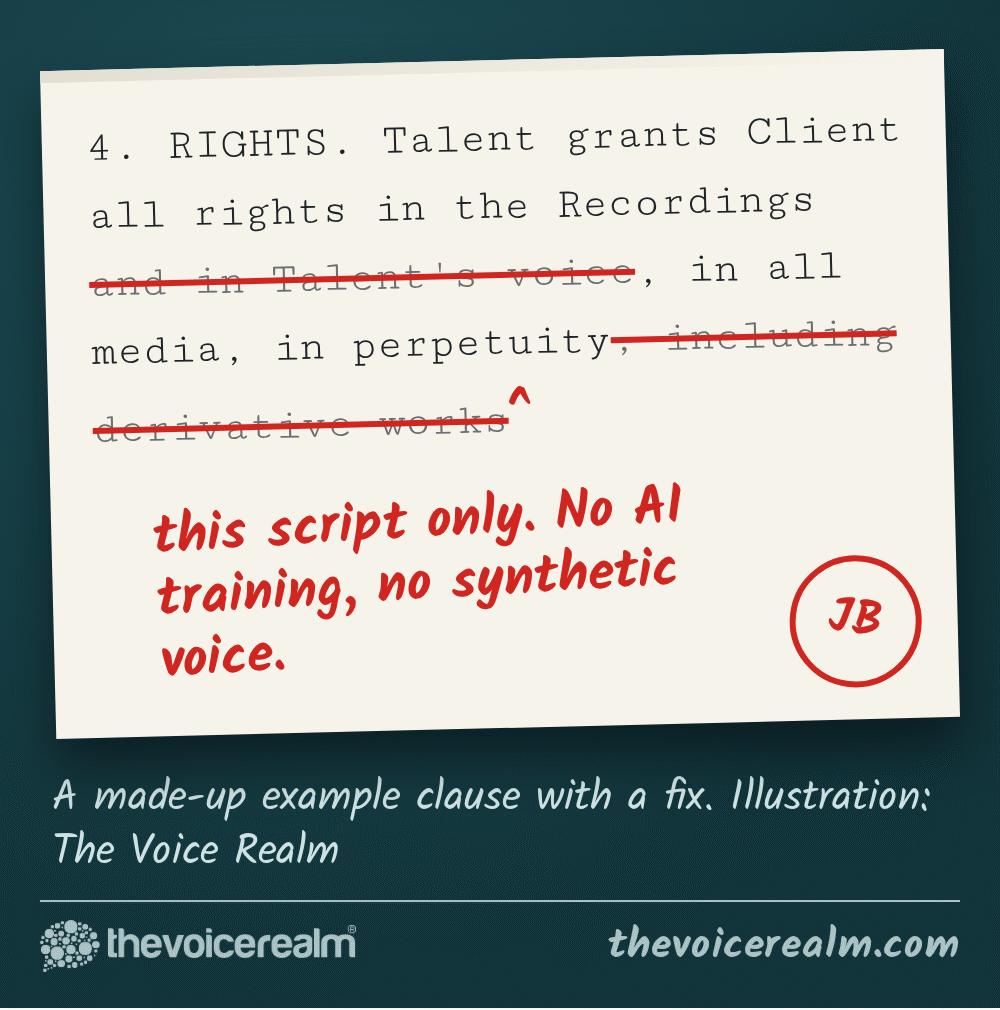
The risky wording rarely says “we will clone you”. It hides in broad grants of rights. When a contract arrives, search it for these words before you sign: simulate, synthetic, digital replica, digital double, machine learning, artificial intelligence, train, derivative works, and any phrase like “all media now known or hereafter devised” or “in perpetuity”.
None of those words is automatically a problem. “In perpetuity” for a finished recording might be a fair, well paid buyout. The trouble starts when a broad grant covers your voice itself rather than the recording, or when “derivative works” could be read to include a model built from your sessions.
If you find a clause like that, you don’t have to walk away. Ask for it to be narrowed. Most clients aren’t trying to steal anything; they’ve used a template from a lawyer who wanted every right possible. A polite note asking to limit the grant to the recorded script, and to rule out AI training, is often accepted without a fuss. Our walk through a voice over contract covers the rest of the document, line by line.
Keep your changes small and specific. A client’s legal team will accept “for this project only, no synthetic use” far more readily than three pages of new terms.
© The Voice Realm
When the contract says nothing, add a rider
Plenty of small clients send a two line email and a purchase order. No clause at all can be as risky as a bad one, because nothing says what they can’t do with your files.
The National Association of Voice Actors (NAVA) publishes a free Synthetic Voice/Artificial Intelligence rider for exactly this. Its own instructions are clear about when to use it: “This rider is only necessary if the contract you get from the client does not already address Artificial Intelligence (AI) or “cloning” your voice.”
The heart of it is one sentence, and it’s worth reading in full: “Client shall not utilize any recording or performance of Talent to simulate talent’s voice or likeness, or to create any synthesized or “digital double” voice or likeness of Talent.”
NAVA also says the rider is “not a “take it or leave it” Rider.” In other words, it’s a starting point you can adjust with a client, not an ultimatum. Attach it to your quote, mention it in one friendly line, and most clients will simply sign it.
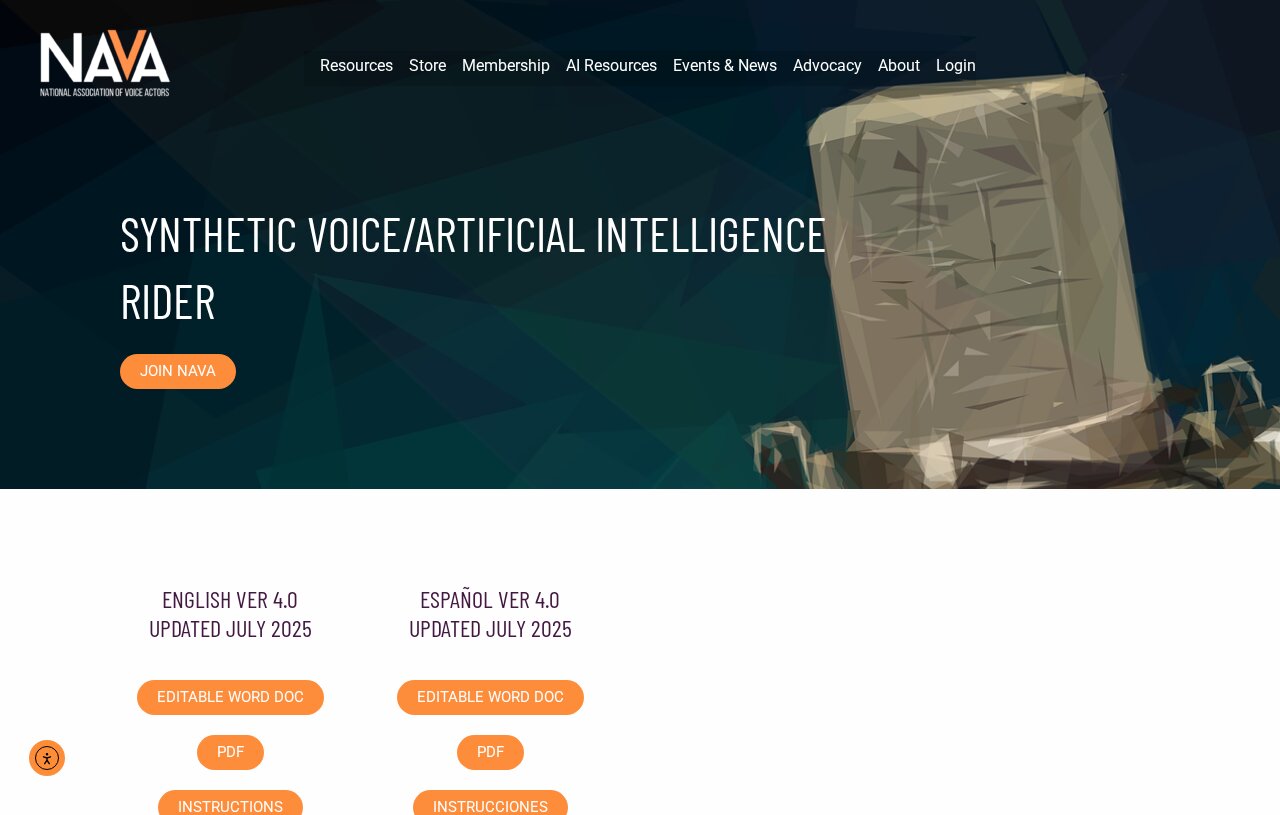
NAVA's free AI rider page, as it looked on 27 November 2026. Image: screenshot, navavoices.org
What the law says, and where
The law is catching up, slowly and unevenly. Where you live, and where your client is, both matter.
Tennessee was first. Its ELVIS Act took effect on 1 July 2024. The governor’s office described it this way: “The ELVIS Act builds upon existing state rule protecting against the unauthorized use of someone’s likeness by adding “voice” to the realm it protects.” The act defines voice to include a simulation of it, so an AI copy counts.
California passed AB 2602 in 2024. For performances made from 1 January 2025, a contract clause letting a digital replica of you do new work can be unenforceable if it doesn’t give a reasonably specific description of the intended uses and you weren’t represented by a lawyer or a union when you signed. A companion law, AB 1836, covers digital replicas of performers who have died.
 VOICEMASTERACADEMYFirst read to first booking.Twenty modules. The first one is free.Start free
US union work has its own rules. SAG-AFTRA’s guidance on its 2023 TV and theatrical contracts says the same rules apply to your voice as to your face, and that “Consent is required for each use of a digital replica with some very limited exceptions.”
In the UK, Equity’s AI vision statement says: “Artists have the right to consent (and not consent) when their performance, voice or likeness is recorded, used or reproduced by machine learning systems and equivalent technology.” The union says new collective AI protections will be part of Equity PACT film and TV contracts from January 2027.
Nationally in the US, the NO FAKES Act is not law yet. As of late November 2026, the Senate version has been approved by the Judiciary Committee and is waiting on the Senate calendar; the House version is still with committee. If you work in Australia, we looked at where Australian voice actors stand on AI earlier this year.
The practical takeaway: a good contract protects you everywhere, while the law only protects you in some places. Don’t rely on the law to fix a clause you could have fixed before signing.
Keep a paper trail you can find in five minutes
If you ever need to prove a voice is a copy of yours, or that a client agreed not to train on your work, you’ll need records. Not a vague memory of an email from two years ago.
Make a folder for every job, named with the date and client. In it, keep the signed contract or the email thread where terms were agreed, the AI rider if you sent one, the script, and your raw session files with their original dates. Raw takes matter more than people think: they show what you actually said, when, and in what room.
Keep a second copy somewhere off your computer. It’s dull admin, and it’s the thing a lawyer will ask for first.
© The Voice Realm
It also helps to keep your public footprint tidy. Know which demos and samples are online and where. If you ever spot your voice somewhere new, you’ll want to tell quickly whether it’s a real job you forgot about or something you never recorded.
If you find a clone of your voice
It’s an awful feeling, hearing yourself say something you never said. Take a breath. Your first job is to capture the evidence before it disappears, because uploads get deleted and accounts get renamed.
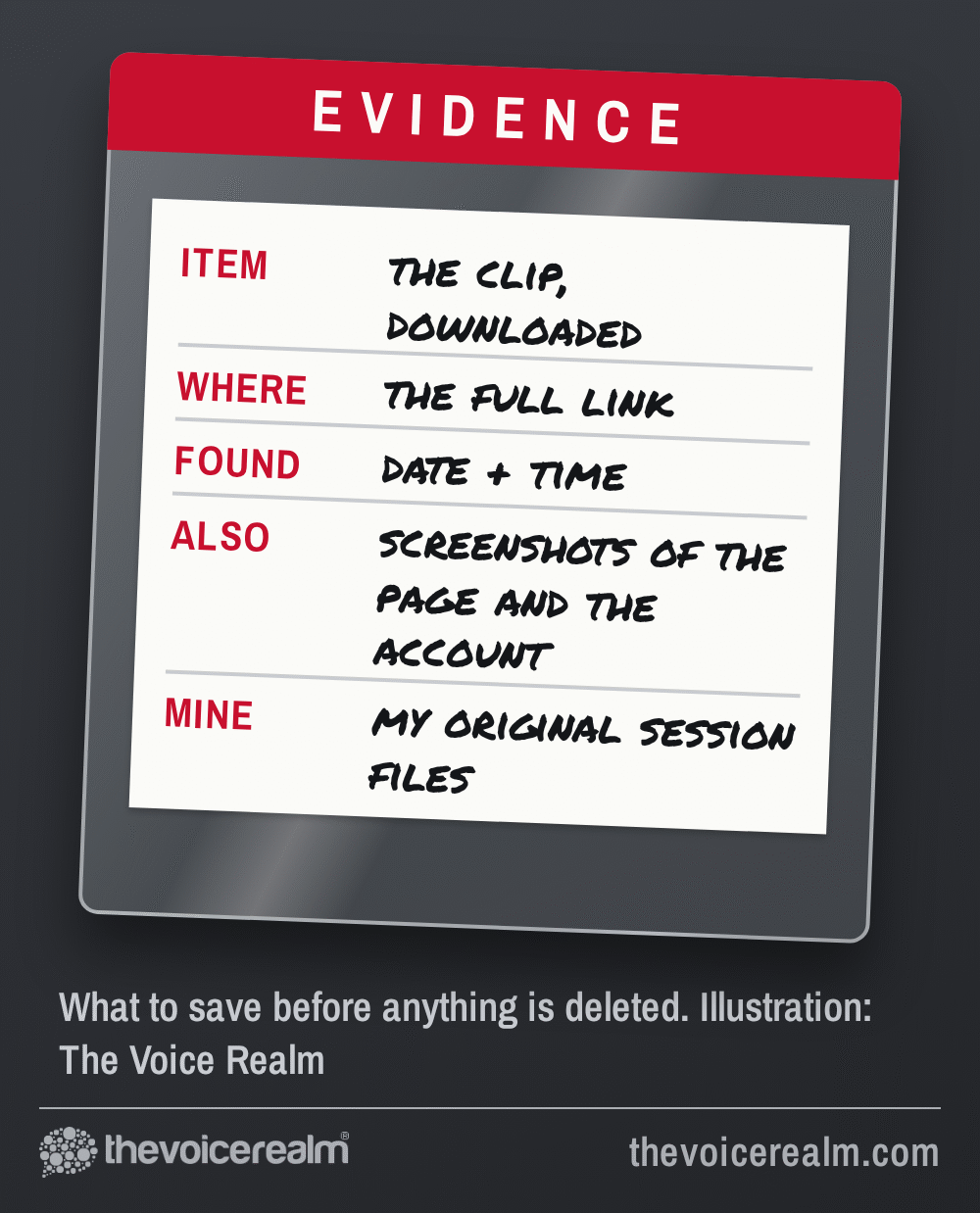
© The Voice Realm
Once you’ve saved everything, use the platform’s own reporting route. Most video, audio and social platforms now have a specific report option for impersonation or AI content made without consent, and it’s usually faster than any letter.
If the clone came from a client’s recordings, go back to your contract and your rider, then write to the client in plain terms: what you found, which clause it breaches, and what you want to happen. Union members should call their union early; that’s what the dues are for. For anything serious, such as a clone used to sell products or to put words in your mouth that damage your reputation, talk to a lawyer who works in entertainment or publicity rights.
And if someone uses your cloned voice to scam people, report it to the police and to your country’s fraud reporting service as well. In the US, the FTC takes reports at ReportFraud.ftc.gov.
Five questions to ask before you say yes
You don’t need to interrogate every client. For any job where the terms are vague, or the word “AI” appears anywhere, these questions in a short, friendly email cover most of the risk:
- Will the recordings be used only for this project and the usage we’ve agreed?
- Will any part of my recordings be used to train or test AI or text to speech models?
- Will my voice be edited to say anything I didn’t record?
- If the script changes later, will you book me for new lines?
- Can we add a short AI clause or rider to the agreement?
A client who answers yes, no, no, yes, yes is a client you can work with happily. A client who won’t answer at all has told you something too.
Your voice is the one thing in this business nobody else can supply. Give the paperwork the same care you give the script, keep your records where you can find them, and you’ll be ahead of almost everyone.
Sources: “Scammers use AI to enhance their family emergency schemes”, Federal Trade Commission, 20 March 2023; “Synthetic Voice/Artificial Intelligence Rider” and its instructions, National Association of Voice Actors, version 4.0; “Gov. Lee Signs ELVIS Act Into Law”, Office of the Governor of Tennessee, 21 March 2024, and “Public Chapter No. 588”, Tennessee Secretary of State; “AB 2602” and “AB 1836”, California Legislative Information; “Artificial Intelligence Resources”, SAG-AFTRA; “Equity’s AI vision statement” and “Stop AI Stealing the Show”, Equity; “S.4591, NO FAKES Act of 2026, all actions”, Congress.gov.
Ready to get booked?
See the jobs open right nowAbout Sarah Robbins
Sarah Robbins writes for The Voice Realm about finding voice over work, home studios, casting and the business side of voice acting.