
Vocal Health for Voice Actors: How to Protect the Only Instrument You Own
A guitarist can buy a new guitar. A voice actor gets one instrument, for life, and it lives in the same body that catches colds, drinks coffee, argues with the kids and sleeps badly before a big session. Most working voice actors learn to look after it the hard way, after a week of lost bookings and a hoarse apology to a client. This guide is the easier way: what the voice clinics actually say, what it means in a home studio, and the few habits that separate people who record for thirty years from people who burn out in five.
What you’re actually working with
The sound of your voice starts with two small bands of tissue in the larynx. The National Institute on Deafness and Other Communication Disorders (NIDCD), part of the US National Institutes of Health, puts it plainly:
“The sound of our voice is produced by vibration of the vocal folds, which are two bands of smooth muscle tissue.”
Those bands open and close very fast. A typical adult male speaking voice sits somewhere between 90 and 155 cycles a second, a typical adult female voice between 165 and 255. Take the low end of that: at 120 cycles a second, an hour of voiced sound is more than 400,000 collisions. An audiobook narrator doing a six-hour day is asking a piece of tissue the size of a fingernail to hit itself a couple of million times, then do it again tomorrow.
Nothing about that is fragile when the folds are hydrated, warm and used well. Everything about it gets fragile when they’re dry, cold and pushed. That’s the whole subject, really. The rest of this guide is the detail.
Water, and the drinks that undo it
Every voice clinic starts here, and voice actors nod and then go and make another coffee. The point that gets missed is how hydration works. Water you swallow doesn’t touch the vocal folds on the way down (if it did, you’d be choking). It hydrates them from the inside, through the bloodstream, which takes time. The glass of water on the mic stand is nice for a dry mouth. The water you drank all morning is what’s keeping the folds supple at two in the afternoon.
The NIDCD’s advice on the drinks most of us reach for:
“If you drink caffeinated beverages or alcohol, balance your intake with plenty of water.”
Notice it doesn’t say quit. Coffee before a session is fine. Coffee instead of water, all day, on a day with three sessions, is how a voice ends up scratchy by the last one. A simple rule that working narrators use: one glass of water for every coffee or glass of wine, on top of what you’d drink anyway.
The room you record in is drying you out
This one surprises people. Home studios are small, closed, often padded with foam, and many sit under an air-conditioning vent or a radiator. All of that makes for dry air, and dry air dries the folds with every breath. The NIDCD is specific about it:
“Use a humidifier in your home. This is especially important in winter or in dry climates. Thirty percent humidity is recommended.”
A cheap hygrometer will tell you where your booth sits. If it’s reading in the low twenties, which is common in heated rooms in winter and in air-conditioned ones in summer, a small humidifier in the room (not in the booth while the mic is live, it makes noise) is one of the cheapest upgrades your voice will ever get. It also helps the head cold you’re trying to sing through in January.
Warm up, and what a warm-up is for
Athletes don’t sprint from cold and voice actors shouldn’t either. The clinics all recommend a warm-up, and the exercises they list are the same ones a speech pathologist would give you. Cleveland Clinic’s page on voice therapy names them: humming, lip trills (“a technique that involves making a buzzing sound with your lips”), tongue trills, and “straw phonation (a technique that requires vocalizing through a straw).”
The straw one deserves a closer look, because it’s the strangest and it’s the one with the most science behind it. Humming or gliding up and down through a drinking straw belongs to a family called semi-occluded vocal tract exercises. Ingo Titze, the voice scientist who did more than anyone to explain why they work, described the effect in the Journal of Singing in 2018. The partial blockage at the lips builds a little pressure behind it, which holds the vocal folds slightly apart while they vibrate, so they can work through a full range of pitch and volume without slamming together. His summary of why the exercise is so forgiving:
“The beauty of the exercises is that most of these effects occur simultaneously without much voluntary adjustment. The system self-regulates.”
In practice: two or three minutes of gentle humming, then a minute of sirens up and down through a straw, then a few lip trills. That’s a warm-up. It doesn’t need to be a performance, it needs to happen before the first take, not after the first retake.
Vocal naps
The NIDCD has a lovely phrase for the habit that working voice actors rate above every other. “Take vocal naps,” it says, and rest your voice throughout the day.
Silence, in other words. Not talking to the dog, not taking a client call, not running lines under your breath. Between a morning session and an afternoon one, twenty quiet minutes will do more for the second session than any lozenge, and lozenges mostly numb the signal that tells you to stop.
If you record long-form, the same idea applies inside the session. Audiobook narrators who last tend to work in blocks of forty to fifty minutes with real breaks between them, and they stop the day when the voice starts to change rather than when the chapter ends. The one who pushes on for “just one more chapter” is the one editing out pickups tomorrow with a voice that sounds different from yesterday’s, which the proofer will hear.
Two habits to stop this week
Whispering. It feels gentle. It isn’t. The NIDCD lists it alongside screaming as an extreme to avoid:
“Avoid using the extremes of your vocal range, such as screaming or whispering.”
A whisper holds the folds tight and drives air through the gap, which dries and strains them. If a script calls for a whispered read, that’s a few lines with a mic six inches away, fine. Whispering all evening to “save” a tired voice does the opposite.
Throat clearing. The NIDCD lists repeated throat clearing as a warning sign, and clinicians treat it as a habit to break because each clear slams the folds together to shift mucus that mostly comes straight back. Swallow instead, sip water, or hum a note and let the vibration move it. If you’re clearing your throat all day, that’s usually reflux or post-nasal drip, and both are treatable once you know that’s what it is.
Smoke, reflux and the things that aren’t about technique
Some of what damages a voice has nothing to do with how you use it. The NIDCD is blunt on smoke: “Don’t smoke, and avoid second-hand smoke. Smoke irritates the vocal folds.” Vaping isn’t a loophole; the American Speech-Language-Hearing Association tells students to “abstain from smoking and vaping” in the same breath.
Reflux is the quiet one. Stomach acid reaching the larynx overnight produces a morning voice that’s low, rough and slow to clear, and a lot of voice actors put that down to age or “not being a morning person.” The NIDCD lists gastroesophageal reflux among the common causes of hoarseness. If your voice is worst first thing and improves through the day, mention reflux to your doctor. A late-night meal before an early session is a bad trade.
When to stop recording and see someone
Here’s the line every voice actor should know. Bernadette Mayfield-Clarke, PhD, CCC-SLP, the 2025 president of the American Speech-Language-Hearing Association, gave it in the association’s August 2025 guidance:
“Anyone who has hoarseness or other symptoms of vocal strain for longer than 2 weeks should seek an evaluation.”
The NIDCD’s hoarseness page draws the line at three weeks, “especially if you haven’t had a cold or the flu.” Two or three, the point is the same: hoarseness that outlasts a cold is not something to push through with more takes and honey. The NIDCD’s own list of what can be behind it runs from laryngitis and simple overuse through reflux, vocal nodules, polyps and cysts, to a vocal fold hemorrhage, which is what happens when a small blood vessel in the fold bursts under strain. Most of these are very treatable when they’re caught. All of them get worse when you keep recording on them.
The person to see is an ear, nose and throat specialist, ideally a laryngologist, who will look at the folds directly. If the answer is voice therapy, Cleveland Clinic describes what to expect: “Most people need voice therapy a few times per month for several months.” That’s the same exercises as the warm-up above, prescribed properly, plus retraining of the habits that caused the problem. Singers and broadcasters do it routinely. Voice actors should think of it the same way.
What this looks like on a working day
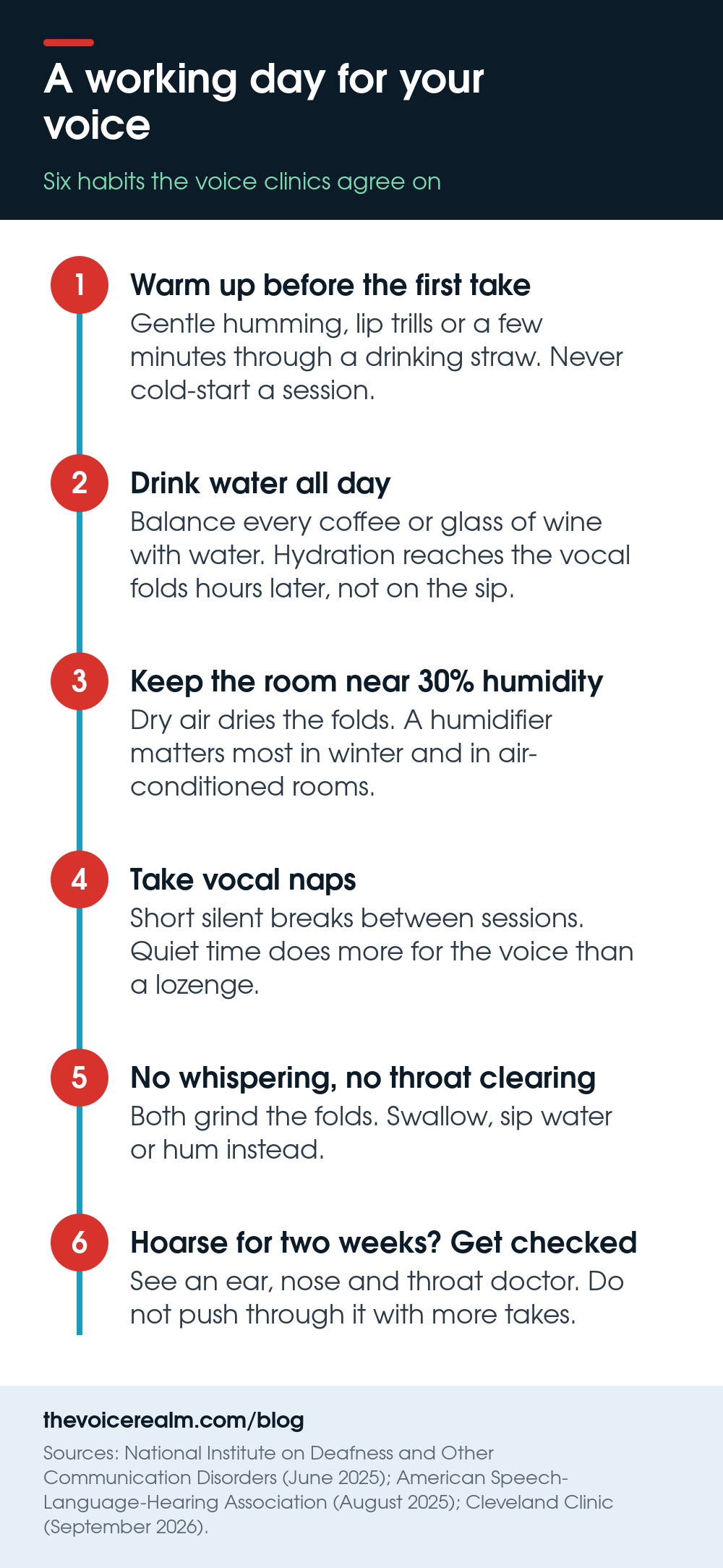
Put together, the clinics’ advice comes down to a routine that takes almost no time and fits around any schedule.
- Morning: water before coffee. Ten minutes of humming, straw sirens and lip trills before the first session, in the car if it has to be.
- In the booth: a hygrometer you actually look at. Sessions in blocks with silent breaks. Stop when the tone changes, not when the page ends.
- Between sessions: quiet. No phone calls in the gap. Water, not another espresso.
- Evening: nothing to eat for a couple of hours before bed if reflux is a suspect. No whispering to save the voice; just don’t use it.
- Every day: if it’s been hoarse for two weeks, book the appointment. Clients would far rather you moved a session than sent them a strained read.
The last point matters more than it sounds. When a client on our platform shortlists a voice, they’re listening for a sound they can rely on across a project, sometimes across years of a brand. A voice that’s the same on Friday afternoon as it was on Monday morning is the one that gets the repeat booking. Looking after your instrument isn’t a wellness habit. It’s the product.
If fatigue is your particular problem, we’ve covered the mechanics of it before in how to reduce vocal fatigue, and if you’re building a booth, the humidity point above belongs on the list next to the usual home studio mistakes.
Sources: National Institute on Deafness and Other Communication Disorders, “Taking Care of Your Voice” (updated June 2025) and “Hoarseness”; American Speech-Language-Hearing Association, “Protect Your Voice This Back-to-School Season” (August 7, 2025); Cleveland Clinic, “Voice Therapy” (reviewed September 2026); Ingo Titze, “Major Benefits of Semi-Occluded Vocal Tract Exercises,” Journal of Singing, January/February 2018. This article is general information, not medical advice; see a doctor about any voice problem that persists.