Blog
Blog
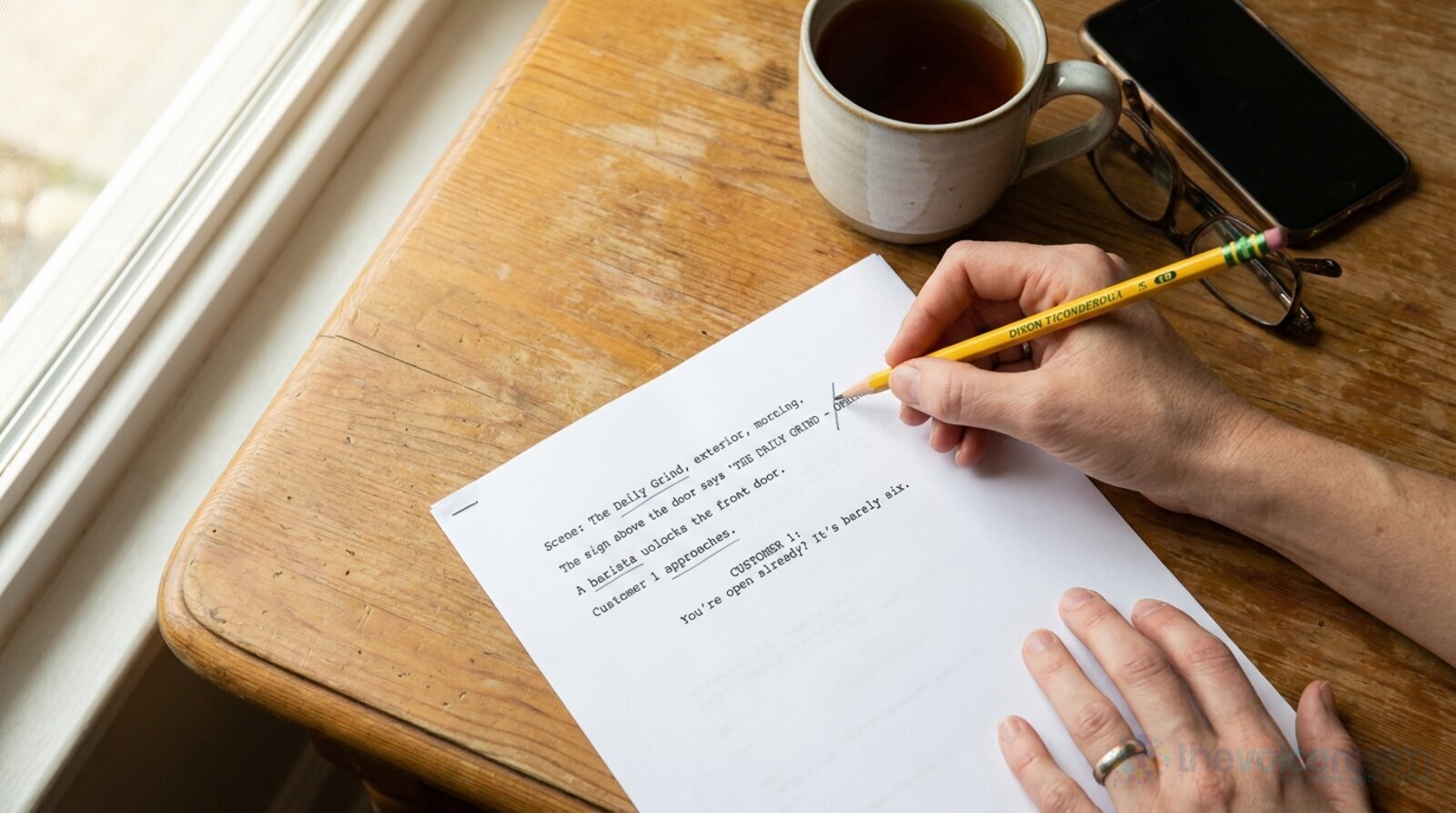
This one’s for voice actors who get a script, read it once, press record and then wonder why the take sounds like someone reading. It’s also for anyone who’s been told to “make it more conversational” and had no idea what to change. Most of the answer happens before you open your mouth, with a pencil.
Marking up a script is how working voice actors turn a page of words into a plan for a performance. It’s quick once you’ve got the habit, it’s the same whether the job is a thirty-second spot or a forty-slide course, and it makes the difference between a read that wanders and one that goes somewhere on purpose. Here’s a way to do it, pass by pass, with the marks worth using and the ones that just add clutter.
Why a clean read needs a messy page
Writers write for the eye. Commas go where grammar wants them, sentences run long because they look fine on paper, and the most important word is often buried in the middle. When you read that aloud exactly as punctuated, you sound like you’re reading, because you are.
Speech has its own shape. People talk in short chunks, lean on one word in each chunk, breathe where the thought allows it and change gear when the idea turns. A marked-up script is simply that shape drawn over the writer’s text, so that when the red light’s on you’re following the speech, not the punctuation.
It also saves your voice and your session time. A plan means fewer takes, fewer run-out-of-air stumbles, fewer pick-ups for a mispronounced brand name. On an audition, it’s the difference between sending something considered and sending your first attempt.
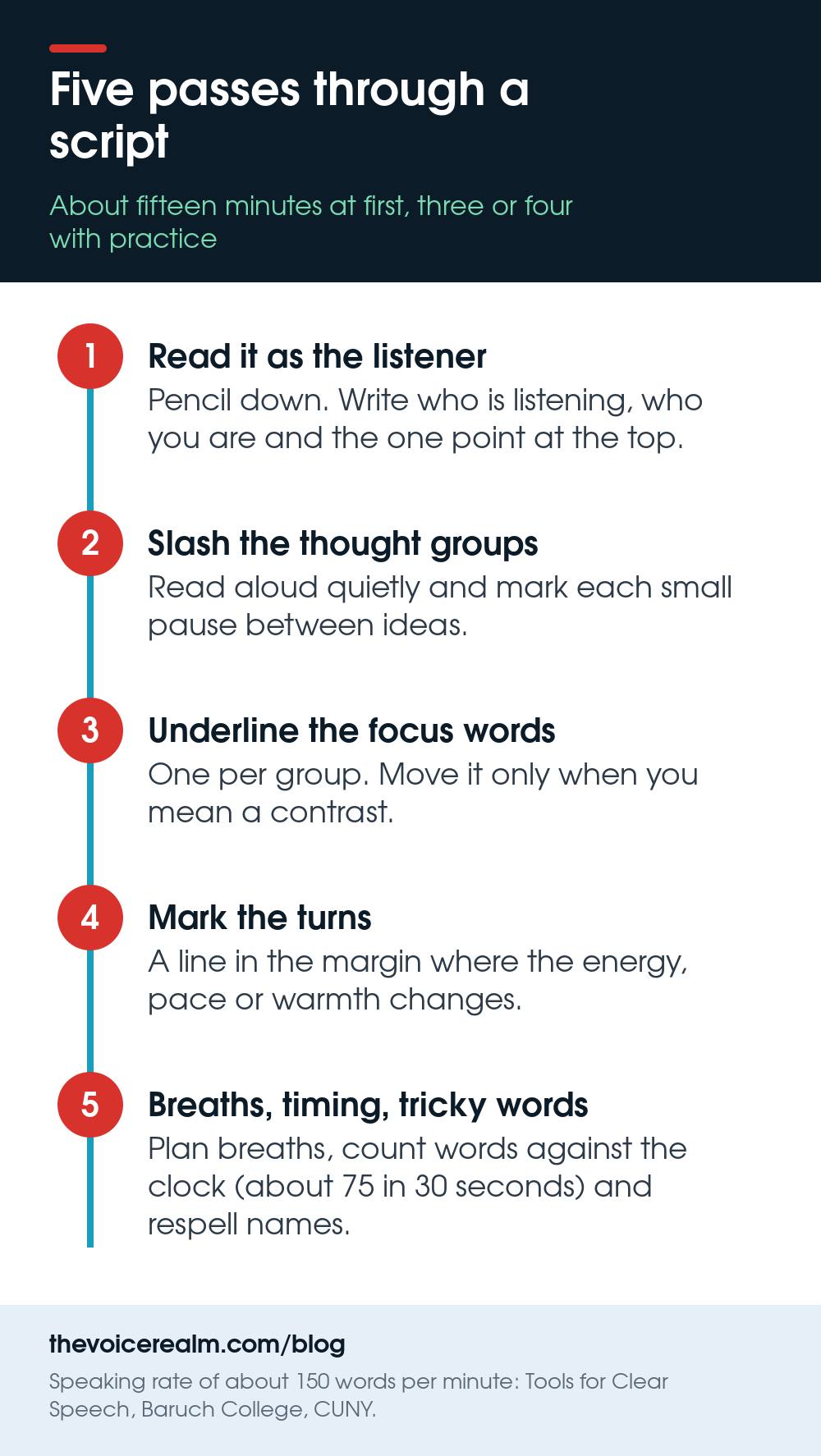
Pass one: read it as the listener, pencil down
Before you mark anything, read the whole script once for sense. No voice, no performance. You’re answering three questions.
Who’s listening? A nervous first-time buyer, a nurse on a night shift doing compliance training, a nine-year-old gamer. Write it at the top of the page in a few words. This single note does more for a read than every other mark put together, because it tells you how close to stand, how fast to go and how much to explain.
Who am I? The brand’s friendly expert, a tired parent, the narrator of a mystery. Again, a few words at the top.
What’s the point? Every script has one thing it needs the listener to remember or do. Find it and circle it. In a commercial it’s usually the product benefit and the call to action. In e-learning it’s the learning outcome. In a character scene it’s what the character wants. If you’ve worked on the real-person read in commercials, this is where that read starts: knowing who you’re talking to and why.
Pass two: slash the thought groups
Now pick up the pencil. Read the script aloud, quietly, and put a small forward slash wherever a natural speaker would take a tiny pause between ideas.
Speech teachers call these chunks thought groups. The Tools for Clear Speech programme at Baruch College, City University of New York, explains that they “allow you to organize your speech into groups of words that make up a single idea,” and that they help a listener “by organizing your ideas into comprehensible ‘packages’ that are easy to process.”
The important thing for voice actors is that thought groups don’t always follow the punctuation. The same page points out that “thought groups are not always separated by punctuation,” and gives the example sentence “The only thing I’m interested in is completing this project on time,” which it divides into two thought groups, with the break after “interested in” and no comma in sight.
That’s why slashing beats trusting the commas. It’s also where you make real acting choices, because Baruch notes that “a single sentence may be divided into different thought groups, thereby affecting the meaning.” Try “Tickets are free for members / and their guests” against “Tickets are free / for members and their guests.” Same words, two different emphases, and only one of them is what the client means.
Use a single slash for a small lift between ideas and a double slash for a proper stop, the kind of pause where a new thought begins. Most scripts need far more single slashes than doubles.
Pass three: underline one word in each group
Inside each thought group, one word carries the weight. Baruch calls it the focus word and describes it as “a word that receives the most stress in a thought group,” adding that it “tends to be the last important word in a thought group.”
That default is worth knowing, because it tells you where not to push. In “The only thing I’m interested in / is completing this project on time,” the focus words are “interested” and “time.” Read it that way and it sounds like a person. Lean on “only” and “this” and “project” as well and it sounds like a presenter trying too hard.
The default can move, though, and moving it is how you act with emphasis. The same Baruch page says “focus words can change depending on the speaker’s meaning and mood.” Contrast is the classic case. In “It’s not the price that matters, it’s what you get for it,” the focus falls on “price” and “get,” because those are the two things being set against each other.
Underline one word per group, two at most. If you’ve underlined half the page, you haven’t marked emphasis, you’ve marked panic. The underlines should look sparse. That’s how natural speech sounds: most words just ride along.
A related trap is the brand name. Clients want it heard, and new voice actors respond by hitting it every time. Say it clearly and let it land once, usually the first time and at the close. After that, treat it like any other noun. Nobody who loves a product says its name like an announcement.
Pass four: mark the turns
Most scripts change direction at least once. A commercial moves from problem to solution. A narration moves from background to the point. A scene moves from polite to angry. Those turns are where a listener either stays with you or drifts off.
Draw a short horizontal line across the margin at each turn, with a word or two beside it about what changes: “now the good news,” “gets serious,” “lighter.” You’re giving your future self a cue to shift energy, pace or warmth, rather than reading the whole thing at the same level.
If the script has a list, mark it too. Lists are where reads go sing-song, every item rising in the same pattern. Put a small arrow over the last item, pointing down, so you remember to land it and close the list.
Pass five: breaths, timing and tricky words
Breaths. Put a small tick or a circled “B” wherever you’ll breathe. Double slashes are the obvious places, but in long sentences you’ll need to plan a sneaky top-up at a single slash as well. If you tend to run out of air mid-line, our guide to breathing before the words covers the support side; the mark-up is just where you decide when.
Timing. Commercials come with a time, and it’s worth knowing roughly how many words fit before you start. Baruch’s page on speaking rate puts the average English speaker at “about 150 words per minute.” At that pace, a thirty-second spot holds about seventy-five words. Count the script. If it’s well over that, you know the read will need pace, and you can mark the places where you’ll let it breathe and the places where you’ll move. If it’s well under, you know you’ve got room for the pauses. Write the word count and the target time in the top corner.

 VoiceEditSuiteEleven tools. One browser tab.Auto Clean UpACX PrepStudio RescueSee the toolsBuilt for working voice actors.
Pronunciations. Circle every name, place, drug, technical term or brand you’re not certain about, and write the pronunciation above it in your own spelling: “SHWAHR-tsuh,” “fuh-NOM-uh-non.” Check anything uncertain with the client before the session, not after the delivery. A mispronounced brand name is the fastest route to a re-record, and the only one that’s entirely avoidable.
The marks worth using, and the ones that aren’t
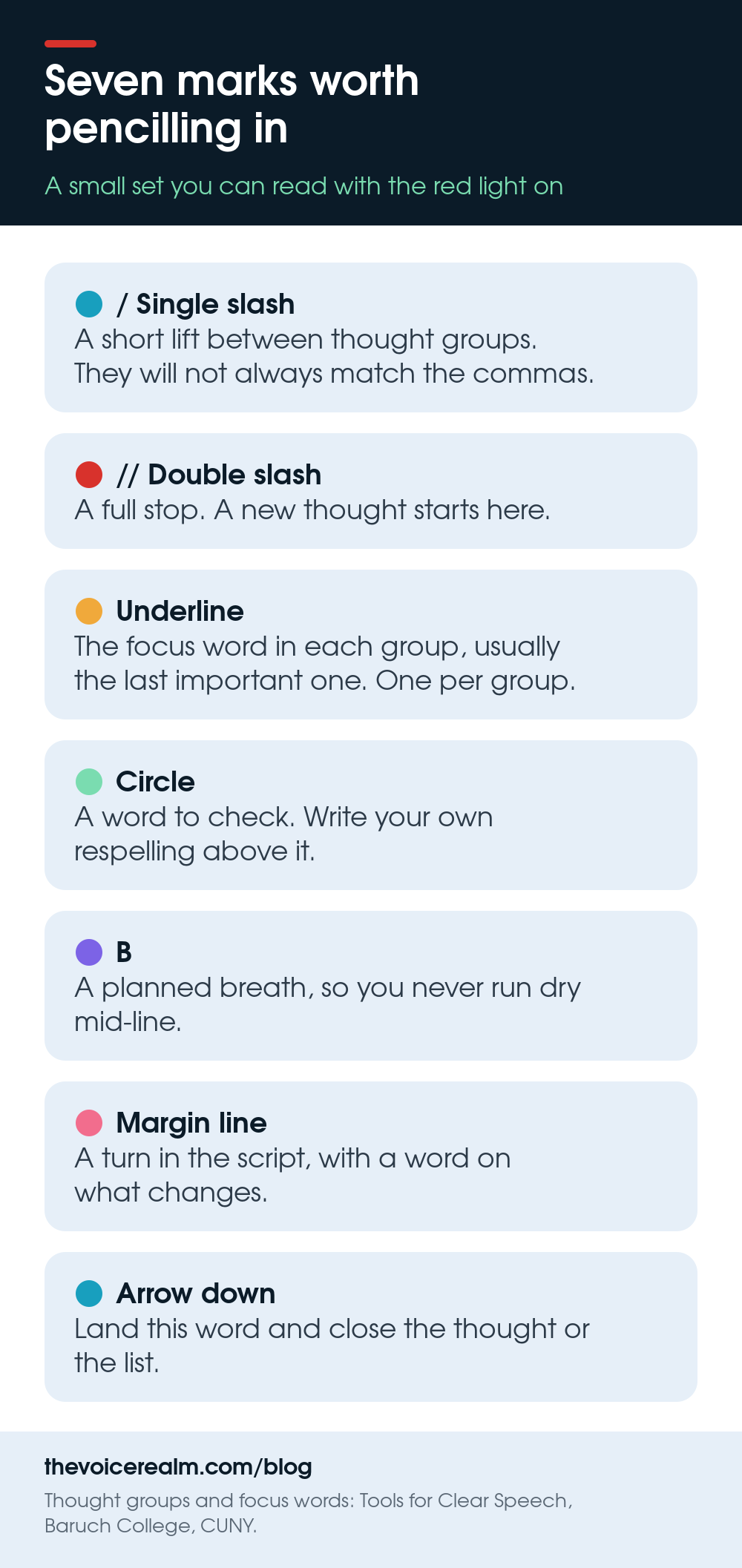
Every voice actor ends up with a personal system, and that’s fine as long as you can read it at a glance with the red light on. Here’s a small, practical set.
- / a short lift between thought groups
- // a full stop, a new thought
- Underline the focus word in a group
- Circle a word to check pronunciation, with a respelling above
- B or a tick for a planned breath
- A line in the margin for a turn, with a word on what changes
- An arrow down over a word that should land and finish
What doesn’t help: colour-coding with six highlighters, arrows above every syllable, or full sentences of notes in the margins. If you have to stop and decode a mark mid-take, it’s working against you. The page should look lightly touched, not graffitied.
© The Voice Realm
A worked example
Here’s a short, made-up radio script, first as written:
“Mornings are hard enough. That’s why Hillside Bakery opens at six, with fresh bread, proper coffee and a seat by the window if you want one. Or grab and go. We don’t mind. Hillside Bakery, on Station Road. Your morning, sorted.”
And here it is with the thought groups slashed and the focus words in bold:
“Mornings are hard enough. // That’s why Hillside Bakery / opens at six, / with fresh bread, / proper coffee / and a seat by the window / if you want one. // Or grab and go. / We don’t mind. // Hillside Bakery, / on Station Road. // Your morning, / sorted.”
Notes at the top: listener, a commuter who’s already late. Me, the friendly person behind the counter. Point, we’re open early. Turn at “Or grab and go,” lighter, a small shrug. Arrow down on “sorted.” About forty words, so there’s room in thirty seconds to let the list breathe. Breaths after “enough” and after “want one.”
Notice what isn’t marked. “Hillside Bakery” isn’t underlined the first time because the focus in that group is on “six,” the news. The brand gets its clear moment in the tag. “Proper” isn’t underlined because the coffee is the thing, and a light touch on “proper” does the work without a mark.
Paper, tablet or screen
Most voice actors now read from a tablet or a monitor, and the same marks work in any PDF app with a pencil tool. A tablet has two big advantages: it’s silent, where paper rustles on the mic, and you can keep a clean copy and a marked copy side by side.
Whichever you use, mark on a copy, never on the only version, because direction in the session will change things and you’ll want a clean page to start over. When a director or client asks for a different read, rub out and re-mark rather than trying to remember. And keep the timing and listener notes visible at the top, not scrolled away.
For long-form work like e-learning, where you might have forty short files, the mark-up is lighter but the pronunciations list becomes the most valuable thing you own. Our guide to getting into e-learning voice over covers how that work is organised and why consistency across files matters so much.
© The Voice Realm
Practise it until it’s quick
The first few scripts will take you fifteen minutes to mark. That’s fine. After a few weeks it takes three or four, and most of it happens in your head as you read. The pencil just confirms it.
A good way to practise is to take any piece of writing, a news article, a product page, a menu, and mark up one paragraph a day as though it’s a script. Record it before and after marking. The difference is usually obvious on the first try. If you want guided practice with feedback on your reads, Voice Master Academy has beginner training built around exactly this kind of script work. And once you’re comfortable, try it on real briefs from our voice over jobs board, marking the script before you record the audition.
The short version
Read once as the listener and write down who they are, who you are and what the point is. Slash the thought groups, which won’t always match the commas. Underline one focus word per group, usually the last important one, and move it only when you mean to. Mark the turns, land the lists, plan your breaths, count the words against the clock and respell anything you might trip on. Keep the marks few and readable. Then put the pencil down and talk to the person you wrote at the top of the page.
Sources: Tools for Clear Speech, Baruch College, City University of New York, “Thought Groups”, “Focus Words and Prominence” and “Speaking Rate”.
Ready to get booked?
See the jobs open right nowAbout Sarah Robbins
Sarah Robbins writes for The Voice Realm about finding voice over work, home studios, casting and the business side of voice acting.