Blog
Blog

“Can you smile a bit more on that one?” is probably the note voice actors hear more than any other. It turns up in commercial sessions, phone menu jobs, explainer videos and kids’ games. If you’re starting out, it can feel like a strange thing to ask of someone nobody can see. It isn’t. Listeners really can hear a smile, and the research on it is surprisingly useful once you’re standing at the mic. Here’s what a smile does to your sound, why it works on the people listening, and how to set exactly the right amount for the job in front of you.
Yes, people can hear a smile
The best known study on this came out of the University of Portsmouth. Amy Drahota and her colleagues interviewed volunteers with a list of questions that started serious and got steadily sillier, and the volunteers had to answer every one with the same line: “I do in the summer.” The interviews were filmed, so the team could see exactly what each face was doing on each answer.
Then they played the audio alone to a new group of listeners. According to the university’s release, “listeners were able to hear the different types of smile the speaker made as he or she went through the wacky interview.” Same five words every time. The only thing changing was the face.
“When we listen to people speaking we may be picking up on all sorts of cues, even unconsciously, which help us to interpret the speaker,” Drahota said. The study, published in the journal Speech Communication, also suggested some people simply have smilier voices than others. That’s worth knowing about yourself. Some voices read as warm before they’ve tried. Others need a bit more help.
What a smile does to the sound
The physics is simpler than it sounds. Your voice starts as a buzz at the vocal folds, and the tube above them, your throat and mouth, shapes that buzz into vowels. Change the shape of the tube and you change the sound.
When you smile, your lips pull back and spread. That makes the tube a little shorter and the opening wider, and a shorter tube rings at higher frequencies. The result is a brighter, lighter colour to every vowel, even if the note you’re speaking on stays put. That’s why a smile isn’t the same as going up in pitch, and why pushing your pitch up to sound happy usually comes across as nervous instead.
A team led from the IRCAM lab in Paris tested this directly. They built a piece of software that changes a recording only in the ways a smile changes it, and nothing else. The panel below shows what they moved and what they left alone.
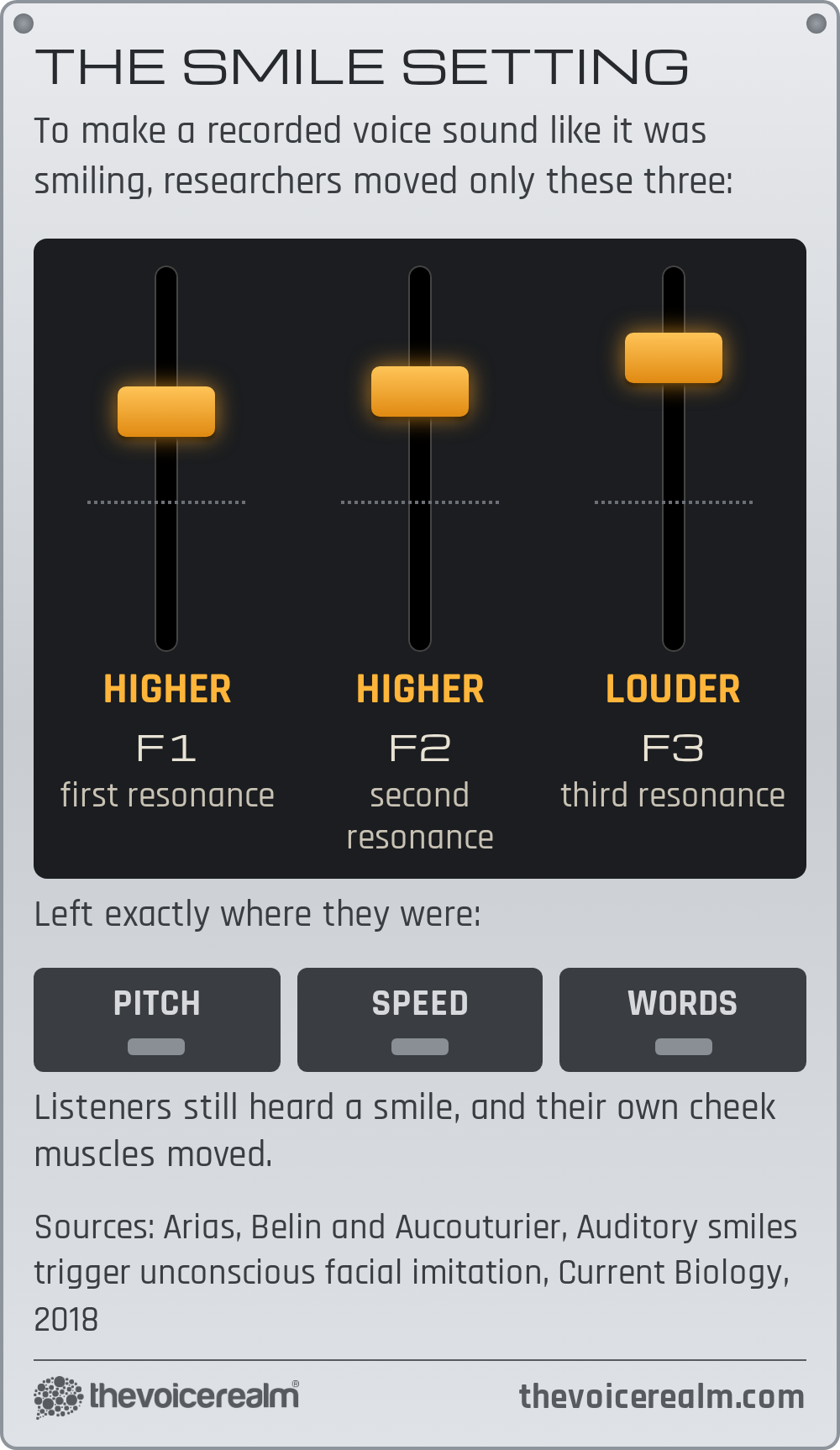
© The Voice Realm
Your listener smiles back
Here’s the part that should change how you think about the note. In the same study, published in Current Biology in 2018 by Pablo Arias, Pascal Belin and Jean-Julien Aucouturier, people listened to sentences with and without the smile effect while sensors watched the muscles in their faces.
The researchers reported that “listeners’ zygomatic muscles tracked auditory smile gestures even when they did not consciously detect them.” The zygomatic muscles are the ones that lift your cheeks when you smile. In plain words: when a voice smiled, the listener’s own face started to smile too, even when they couldn’t say whether the voice was smiling.
That’s the whole case for the smile in a commercial or a phone greeting. You’re not decorating the line. You’re nudging the listener’s face, and with it their mood, a little towards yours. It’s also why a fake one doesn’t work as well as you’d hope, which brings us to the next bit.
© The Voice Realm
Not every smile sounds the same
The Portsmouth team didn’t just record smile or no smile. They sorted the smiles by type, and the listeners could tell them apart. The strongest was the full smile, which Drahota described as the one “in which the lips are drawn back, the cheeks are raised and crows-feet wrinkles appear around the eyes.” There was also a mouth-only smile without the eyes, and a suppressed smile, “where the speaker is trying to hide their smile by pulling their lips in or down as they speak.”
For voice actors this is good news and a warning. The good news: there’s a whole range to play with, not an on and off switch. The warning: a polite mouth-only smile is audibly different from one that reaches your eyes. If you grin because you’ve been told to, without anything to grin about, listeners may hear the difference even if they can’t name it. “It’s possible that we interpret these ‘flavours’ in someone’s voice almost without noticing,” Drahota said.
The suppressed smile is a gift for character work, by the way. A character trying not to laugh at a funeral, a kid hiding a secret, a detective who knows something you don’t. All of those live in that pulled-in, held-back sound.

© The Voice Realm
How to put a real smile in your read
The trick is to give yourself something to smile about, rather than just moving your face. A few habits that work in the booth:
- Find the reason. Picture the one person you’re talking to and why this news is good for them. A friend who’s about to save money smiles differently from a stranger.
- Smile before the first word. Set the face in the breath before you speak, or the opening words come out flat and the smile arrives late.
- Let it reach your eyes. If your cheeks lift and your eyes crinkle, you’re in the full smile. If only your mouth moved, think of something funny and try again.
- Keep your pitch where it was. The smile should brighten your sound, not lift your note or speed you up. If it does both, slow down and drop back to your normal starting pitch.
- Keep the consonants crisp. A wide smile can soften words like “free” and “please”. Finish the ends of words on purpose.
A mirror helps for the first few weeks. So does a photo of someone who makes you laugh, taped next to your script. It sounds silly. It works.
 VOICEMASTERACADEMYTwenty modules, one at a time.Breath controlHome studioCommercial techniqueAuditionsStart module oneNo experience needed.
Watch out for the smile drifting through a long read, too. It’s easy to start bright and slowly go back to neutral by the third paragraph. Mark the lines where the smile matters most in pencil, and give yourself a fresh reason at each one. This is the same instinct behind the real-person read that commercial clients ask for: you’re a person talking to a person, not an announcer selling at them.
© The Voice Realm
How much smile does the job want?
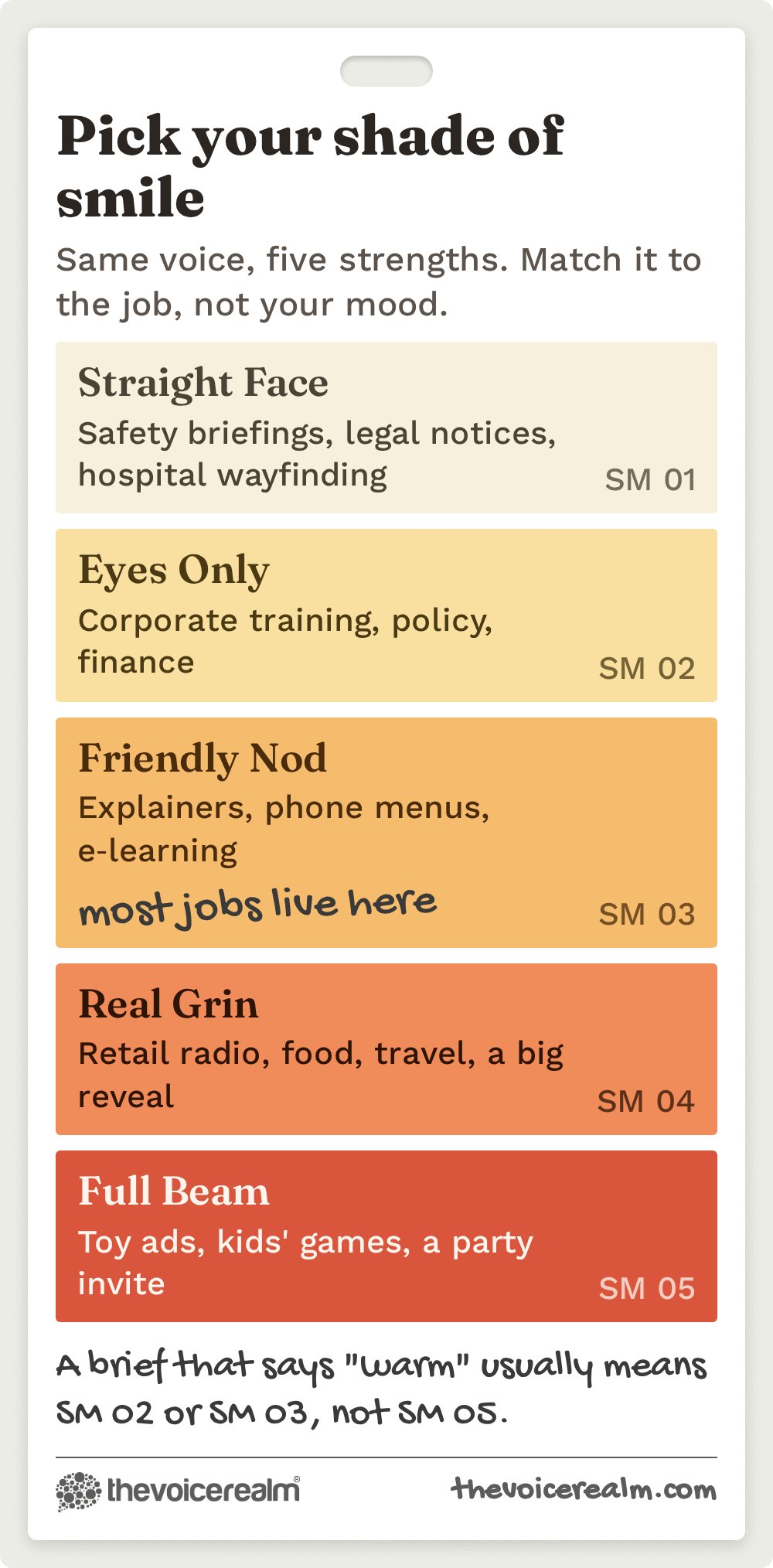
Smile is a dial, not a switch, and getting the amount right matters as much as having one at all. Too little and a cheerful script sounds bored. Too much and it sounds like you’re laughing at the listener.
Read the brief for clues. Words like “friendly”, “warm”, “upbeat” and “energetic” all ask for some smile, but different amounts. “Warm” is usually less than people think, which is why our piece on what common voice over directions really mean is worth a look before your next session. Listen to the client’s reference tracks if they sent any, and to their old ads if they didn’t.
When you really can’t tell, record two takes at different strengths and label them clearly. Clients love a choice, and it shows you’ve thought about the read rather than guessed.
© The Voice Realm
When to wipe it off completely
Some scripts need no smile at all, and getting this wrong is worse than being a little flat on a happy one. Health warnings, safety instructions, bad news, a charity appeal about something painful. A smile there sounds careless, because the listener hears that you’re pleased about something they aren’t.
Watch for the habit, too. Plenty of voice actors who do a lot of upbeat work start smiling by default, even on serious corporate copy. Play back a sombre read and listen for that brightness. If it’s there, relax your cheeks, soften your jaw, and think about the listener’s worry instead of your delivery.
Phone work sits in the middle. A greeting wants a smile, but a message about a delay or a missed payment wants a calm, kind face instead. If you voice phone systems, our guide to recording phone prompts callers follow goes into how the tone should change from one prompt to the next.
Check it on playback
Your face can feel like it’s beaming while your recording sounds polite at best. The only test that counts is the playback. Record the same line three ways, no smile, a light smile and a full grin, and listen back with your eyes closed. Most people are surprised how small the difference is between the first two, and how big it is with the third.
Then try it on someone else. Play the three takes to a friend in a random order and ask which one sounds happiest. If they pick the right one every time, your smile is reading. If they can’t tell, you’ve got more room to go.
Once you can set the smile on purpose, you’ll find it’s one of the quickest ways to change a read in a live session. A director says “warmer”, you lift your cheeks a touch, and the take is done. When you’re ready to try it on real briefs, the voice over jobs board is full of scripts that ask for exactly this.
Sources: “Smile, And The World Can Hear You, Even If You Hide”, University of Portsmouth via ScienceDaily, January 2008, on Drahota, Costall and Reddy, “The vocal communication of different kinds of smile”, Speech Communication; “Auditory smiles trigger unconscious facial imitation”, Arias, Belin and Aucouturier, Current Biology, 2018.
Ready to get booked?
See the jobs open right nowAbout Sarah Robbins
Sarah Robbins writes for The Voice Realm about finding voice over work, home studios, casting and the business side of voice acting.