Blog

Sooner or later every voice actor gets the same advice: don’t just wait for castings, go and find the people who hire voices. Write to the e-learning team, the explainer studio, the podcast producer, the game developer. This guide is for voice actors who want to send those emails, get replies, and stay on the right side of the rules while they do it.
It’s a small job done well. One person, one email, one reason to write. Done properly, it builds the kind of client who comes back. Done badly, it gets you blocked, ignored or, in a few places, in trouble with a regulator.
Who to write to, and why one at a time
The best list you’ll ever have is short. Think about who actually commissions the kind of voice work you do. If you’re a natural e-learning narrator, that’s the learning teams inside companies and the studios that build courses for them. If you’re good at warm, conversational reads, it’s the small video studios making explainers and product films. If you voice characters, it’s indie game developers and animation studios.
Then go looking for a person, not an inbox. A studio’s website, a LinkedIn page or the credits on work you’ve admired will often tell you who produces the audio or casts the voices. A named producer reads email. “info@” mostly reads invoices.
Write to five people a week, not five hundred. You’ll have time to look at their work, mention something real, and follow up properly. Bulk sending is how voice actors end up in spam folders, and once a sending address gets a reputation there, it’s slow to shake.

© The Voice Realm
The rules are lighter for business email, but they’re real
A short, honest note to a business about your services is ordinary marketing in most places. It still has rules, and they differ by country. This isn’t legal advice, but here’s what the regulators themselves say.
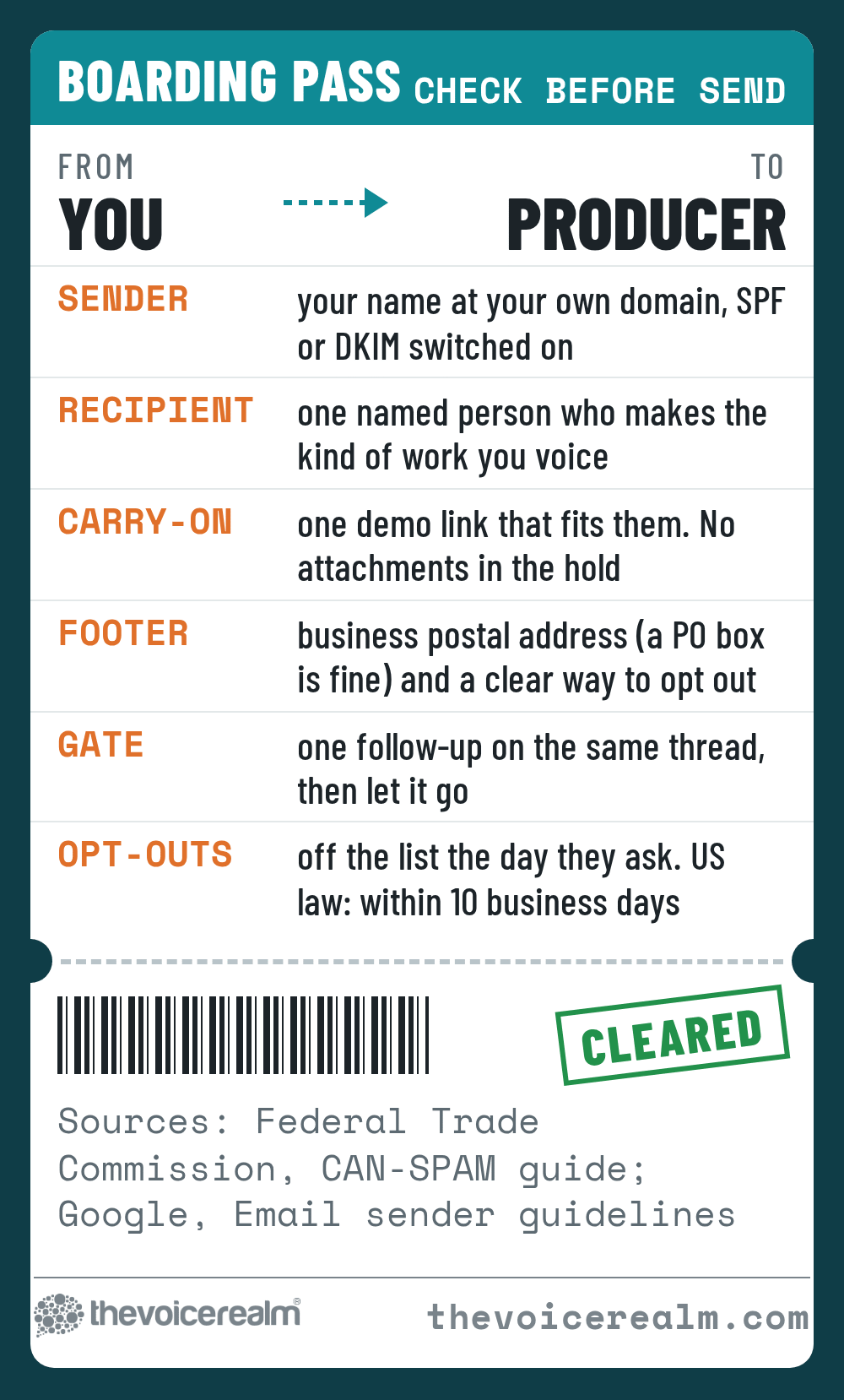
In the United States, the CAN-SPAM Act covers it. The Federal Trade Commission’s guide is clear on the business question: “The law makes no exception for business-to-business email.” The main requirements are simple. Your From line and subject must be honest. “Your message must include your valid physical postal address.” It must explain how to opt out, and “you must honor a recipient’s opt-out request within 10 business days.”
The address part worries home-based actors, understandably. The FTC says it “can be your current street address, a post office box you’ve registered with the U.S. Postal Service, or a private mailbox you’ve registered with a commercial mail receiving agency.” A PO box in your business name solves the privacy problem neatly.
In the UK, the Information Commissioner’s Office says “the PECR rule on direct marketing by electronic mail does not apply to corporate subscribers,” which means limited companies. You still must “not disguise or conceal your identity” and must “give a valid address for business to opt-out or unsubscribe from your messages.” The catch is that sole traders and some partnerships “are treated the same as individuals and have greater protections under PECR.” A freelance producer working under their own name is in that group, so cold marketing email to them needs more care.
In Australia, the Spam Act is stricter about consent, and the Australian Communications and Media Authority enforces it. Read its business guidance before you write to anyone there, and keep a note of why you thought each person was happy to hear from you.
Whichever country you’re in, the safe habits overlap. Say who you are. Give a real address. Make it easy to say no. And when someone says no, take them off your list that day.

© The Voice Realm
Send from your own name and your own domain
An email from yourname@yourname.com looks like a business. One from a free webmail address with numbers in it looks like a hobby, and spam filters are less trusting of it, too.
If you have a website, set up email on its domain and turn on the authentication your email host offers. Google’s sender guidelines for Gmail tell every sender to “set up SPF or DKIM email authentication for your sending domains.” Those are settings, usually a couple of lines your host walks you through, that prove the email really came from you. Without them, more of your messages land in spam.
“The law makes no exception for business-to-business email.”
Federal Trade Commission, CAN-SPAM Act: A Compliance Guide for BusinessPost this quote
Google also watches how often people mark your mail as spam. Its guidelines say to “keep spam rates reported in Postmaster Tools below 0.10% and avoid ever reaching a spam rate of 0.30% or higher.” That’s a tiny margin. A handful of annoyed recipients, out of a small list, can do real damage to where all your email lands, including invoices and session links. One more reason to write to fewer people, better.
A subject line that tells the truth
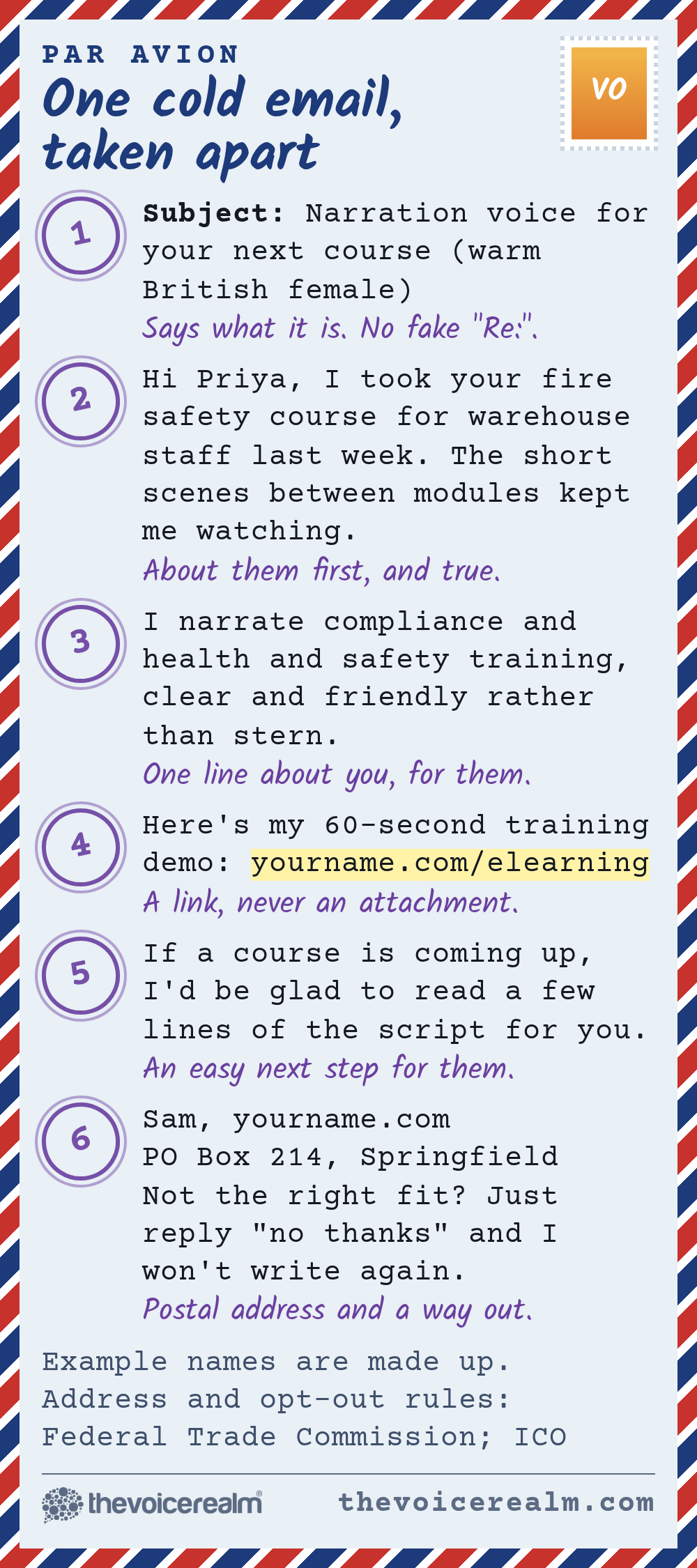
The FTC is plain about this one too: the subject line “must accurately reflect the content of the message.” That rules out the tricks: a fake “Re:”, “Following up on our call” when there wasn’t a call, “Quick question” when there isn’t one.
Honest subject lines work better anyway, because the person you’re writing to is busy and wants to know what this is. A few that do the job:
- Narration voice for your next course (warm British female)
- A voice for your next onboarding film
- Character voices for indie games, demo inside
Specific beats clever. A producer scanning their inbox should know who you are and what you do before they open it.

© The Voice Realm
What goes in the email, and what stays out
Keep it short enough to read on a phone without scrolling much. Five short paragraphs is plenty. A structure that works:
Open with them, not you. One line that shows you’ve looked at their work: a course they made, a game they shipped, a film you liked and why. If you can’t write that line honestly, they’re not the right person to email yet.
 VOICEMASTERACADEMYTwenty modules, one at a time.Breath controlHome studioCommercial techniqueAuditionsStart module oneNo experience needed.
Then one or two lines about you, aimed at what they make. Not your whole career. If they make medical training, say you narrate medical and compliance courses and you’re comfortable with drug names. If they make games, say what kind of characters you play.
Give one link to a demo that matches their work. A link, not an attachment. Attachments from strangers get blocked or ignored, and they make your email heavier to deliver. If your demo isn’t in shape yet, sort that first; our guide to what makes a demo get listened to walks through it.
Close with an easy next step. “If you’ve got a project coming up, I’d be happy to send a custom read of a few lines.” Not “Let me know if you need anything,” which asks them to do the thinking.
Then the footer: your name, your website, your business postal address, and a plain line such as “Not the right fit? Reply ‘no thanks’ and I won’t email again.” That one line covers the opt-out and makes you look like someone who respects their time.
© The Voice Realm
Follow up once, then let it go
Producers miss emails. They’re on deadline, they read it on a train, they mean to reply and don’t. A single, friendly follow-up a week or two later is normal and often gets the reply the first one didn’t.
Make the follow-up shorter than the original, and give it a fresh reason to exist: a new piece of work, a different demo that suits them better, or simply a two-line check-in. Reply on the same thread so they can see the first message.
If there’s still nothing after that, stop. Silence is an answer. Put a note in your list to try again in a few months only if you have something new to show them, like a fresh demo or a finished project in their field. Anyone who said no, or asked you to stop, doesn’t get that later email at all.
Keep a simple list, and keep it clean
A spreadsheet is enough. One row per person: name, company, role, where you found them, what you liked about their work, date you emailed, date you followed up, what happened. Add a column for “do not contact,” and check it before every send.
This list is worth more than it looks. After a year of steady, careful outreach, it’s a map of who makes what in your niche. Some of them will have booked you. Others will remember your name when the right script comes along.
Keep it private and only collect what you need. You’re storing information about real people, and in the UK and Europe that brings its own data protection duties.
© The Voice Realm
When someone writes back
Answer fast, and answer what they asked. If they want a custom read, do it properly: their script, your best take, clean audio, delivered as they asked. If they ask about rates, be ready with a clear quote; our guide to quoting a voice job without underselling it covers what to ask before you name a number, and how usage changes the price.
If they say “not right now,” thank them and mean it. That’s not a rejection. It’s a producer who now knows your name, has heard your voice and has your email in their inbox. Plenty of good client relationships start exactly there.
And keep auditioning while you do this. Outreach builds your own client list over months; open castings, like the ones on our voice over jobs board, put work in front of you this week. The two feed each other. A booking gives you something new to put in the next email.
Sources: Federal Trade Commission, “CAN-SPAM Act: A Compliance Guide for Business”; Information Commissioner’s Office, “Business-to-business marketing”; Google, “Email sender guidelines”
Ready to get booked?
See the jobs open right nowAbout Sarah Robbins
Sarah Robbins writes for The Voice Realm about finding voice over work, home studios, casting and the business side of voice acting.