Blog
Blog
Your child does every voice in the bedtime story, narrates the dog’s thoughts at dinner and has a better cartoon villain laugh than anyone in the family. Now they want to do it for real. It’s a lovely ambition, and children really do get paid to voice cartoons, games, toys and adverts. But the route in looks nothing like the one for adults, and most of the early work falls on you, the parent.
This guide is for parents of children and young teens who want to try voice acting. It covers the work that exists, the skills that matter far more than funny voices, how to record safely at home, and the legal side, using California and the UK as worked examples because both spell their rules out clearly. Rules differ from place to place, so treat those sections as a map of what to ask, then check with your own state or council.
Children voice children, and that’s the whole point
When a studio needs a seven year old in an animated series, a toddler giggling in a nappy advert or a ten year old guiding players through a learning game, it often wants a real child. Adults with young-sounding voices book plenty of kid roles too, especially in long-running animation where a child’s voice would change mid-series. The thing a real child brings is the part adults find hardest to fake: the rhythm of a kid who isn’t performing.
The kinds of job that come up for young voices include animation and preschool television, video games and educational apps, toys and talking books, radio and online adverts, school and e-learning material made for children, and audiobooks for younger listeners. Some are one short session. Others run for years.
Sounding like a real kid is the job
Here’s the trap most families fall into. A child who’s great at voices gets coached into a big, bright, cartoon delivery, and the result sounds like an adult’s idea of a child. Directors usually want the opposite. They want your daughter to sound like your daughter, talking to a friend.
So before anyone works on a squeaky robot or a growly monster, help your child notice how they talk when nobody’s watching. Record them telling you about their day, then record them reading the same story off a page. The difference between those two clips is the gap they’ll spend their first year closing. Character voices come later, and our guide to building a character before finding the sound works just as well for a twelve year old as for an adult.
Reading well comes before any voices
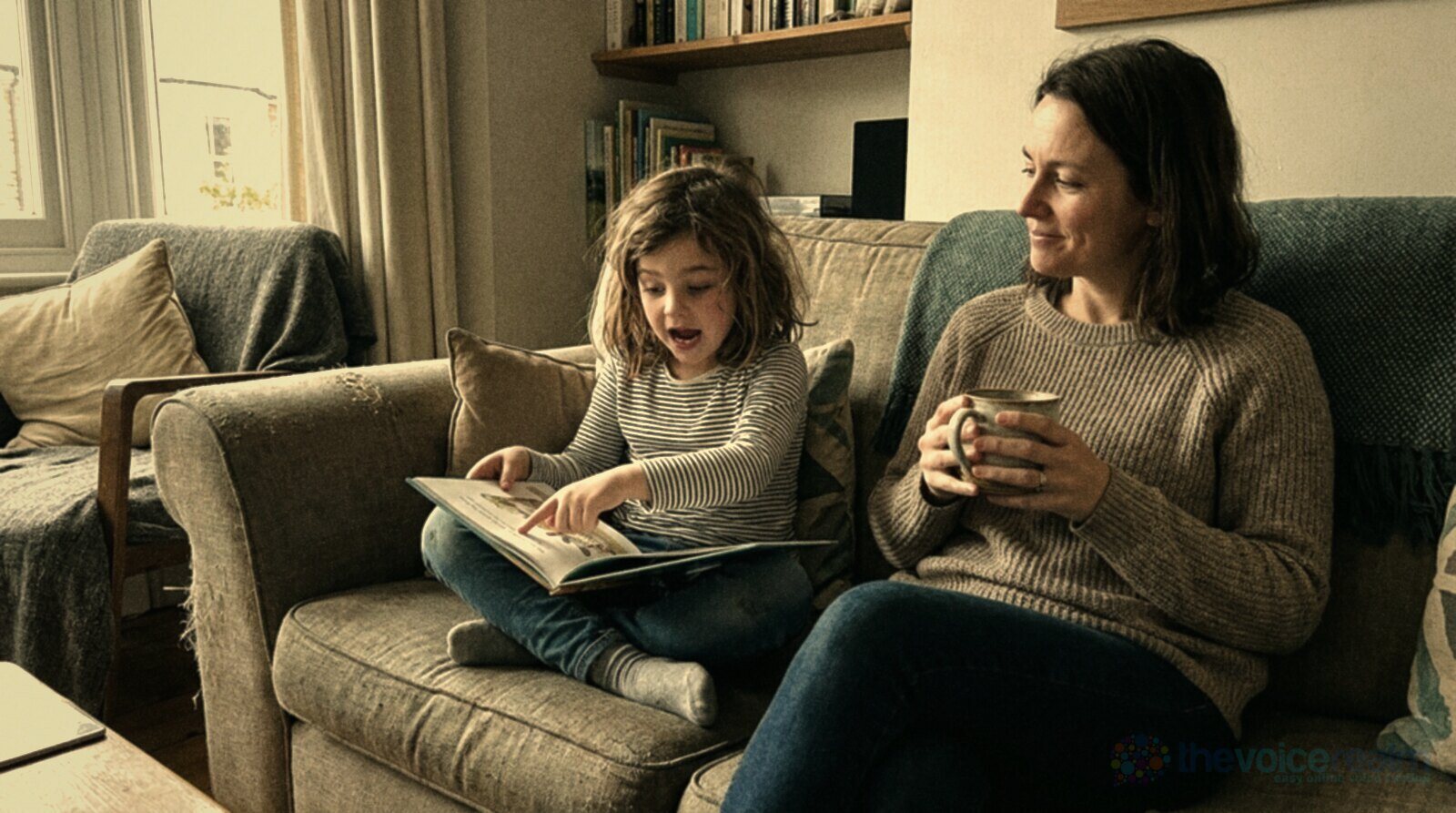
Voice work is reading out loud, sometimes from a script they’ve only just seen, while sounding as if the words just occurred to them. A child who still sounds out long words will struggle, however charming they are. That’s not a reason to wait forever. It’s a reason to read aloud together, a lot.
Swap the bedtime story around and let them read to you. Pick books with dialogue so they get used to switching between narrator and characters. Ask them who’s talking and how that person feels before they read a line, and let them try it two different ways. Ten minutes a day of this does more than any expensive class for a young beginner.

© The Voice Realm
Practice that feels like play
Children improve fastest when it doesn’t feel like homework. A few games that build real skills:
- The cereal box advert. Read the back of a cereal box as if you’re telling a friend about it, then as a sports commentator, then as a sleepy bear. It teaches them to change intent, not just pitch.
- Same line, new reason. Say “I’m not going” because you’re scared, because you’re cross, because it’s a joke. Directors ask for exactly this.
- Cartoon dub. Mute a short scene from a show they love and let them voice it. Timing to someone else’s mouth is a real skill in dubbing and animation.
- Listen back. Record on a phone and play it straight back. Kids hate their recorded voice at first, like everyone does, and the only cure is hearing it often.
A quick vocal warm-up before any practice is a good habit to start early, and the five minute routine we use is gentle enough for younger voices. Skip anything that strains, and never let practice turn into shouting.
Recording at home, with you in the room
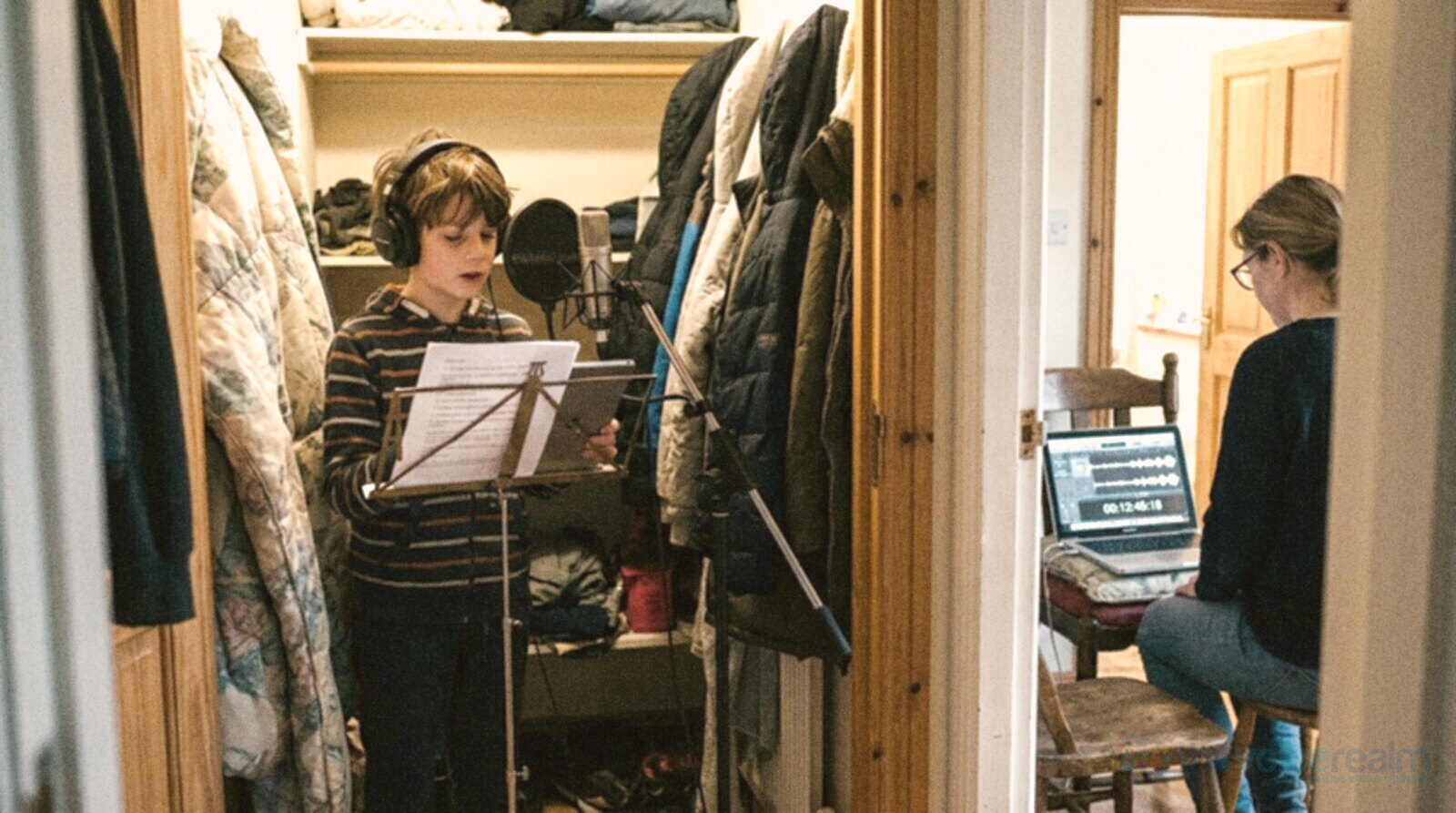
Many auditions and some whole jobs are now recorded at home and sent in as audio files. For a child, that means a quiet corner, a decent microphone, closed headphones and an adult running the computer. A wardrobe full of coats is a surprisingly good booth, because soft things stop the echo that makes a bedroom recording sound cheap. If you want to go further, our guide to treating a room for recording starts with the wall behind the person speaking.
Your job in the room is part engineer, part director, part bodyguard. Keep sessions short, with breaks and water. You handle every email, every login and every file upload. Your child’s school, home address and full name stay off their profile, their demo and anything they post. A first name or a stage name is plenty. If a remote session runs over video, you’re in the room or on the call the whole time.
© The Voice Realm
The paperwork depends on where you live
This is where parents get caught out. Child performers are protected by law in many places, and voice work usually counts as performance even when nobody sees your child’s face. Two examples show what that can look like.
California is the clearest case in the United States. The state’s Labor Commissioner says that “Minors aged 15 days to 18 years employed in the entertainment industry must have a permit to work, and employers must have a permit to employ.” It adds that these permits “are also required for minors making phonographic recordings,” and that “Permits are required even when the entertainment is noncommercial in nature.”
The application asks for a parent’s signature and a school record. For school age children, a school official confirms attendance, grades and health, and the form is blunt about the standard: “All Areas Must state SATISFACTORY for issuance of permit.” The permit lasts six months, so you’ll renew it twice a year. For 14 to 17 year olds there’s an extra step: the state says they “must also complete sexual harassment prevention training before obtaining a minor’s entertainment work permit,” with a parent present for the training.
How long a child can work in a day
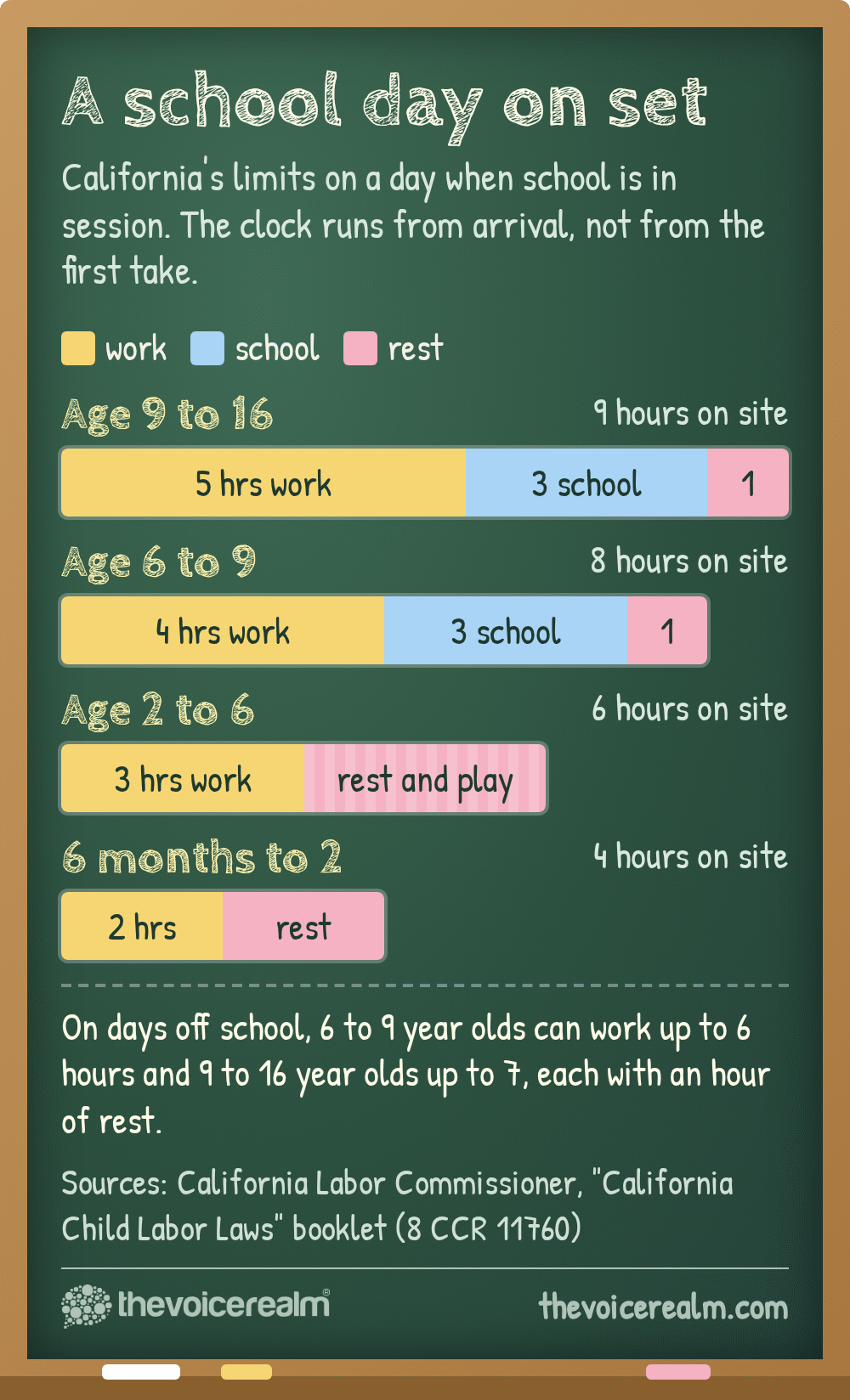
The hours rules are where young performers really differ from adults. California sets limits by age, and the clock covers the whole time a child is at the place of work, not just the minutes in front of the microphone. Schooling and rest come out of the same day. The chalkboard at the end of this section shows how the time splits on a school day.

 VoiceEditSuiteYour breath. Your pace. Your edit.Auto Clean Up learns your pace from every file and puts your own pause back wherever it cuts a mistake.See how it worksLearns from numbers, never your audio. Never used to train AI.
There’s one detail worth knowing for voice work in particular. California normally requires a studio teacher on set with working children, but its child labor booklet makes an exception: “Minors under 16 do not require the presence of a studio teacher for up to one hour for wardrobe, make-up, hair-dressing, promotional publicity, personal appearances or audio recording if these activities are not on the set, if school is not in session and if the parent or guardian is present.” Short recording sessions in the holidays, with you there, are exactly the kind of job that tends to fit.
© The Voice Realm
Fifteen percent goes into a trust
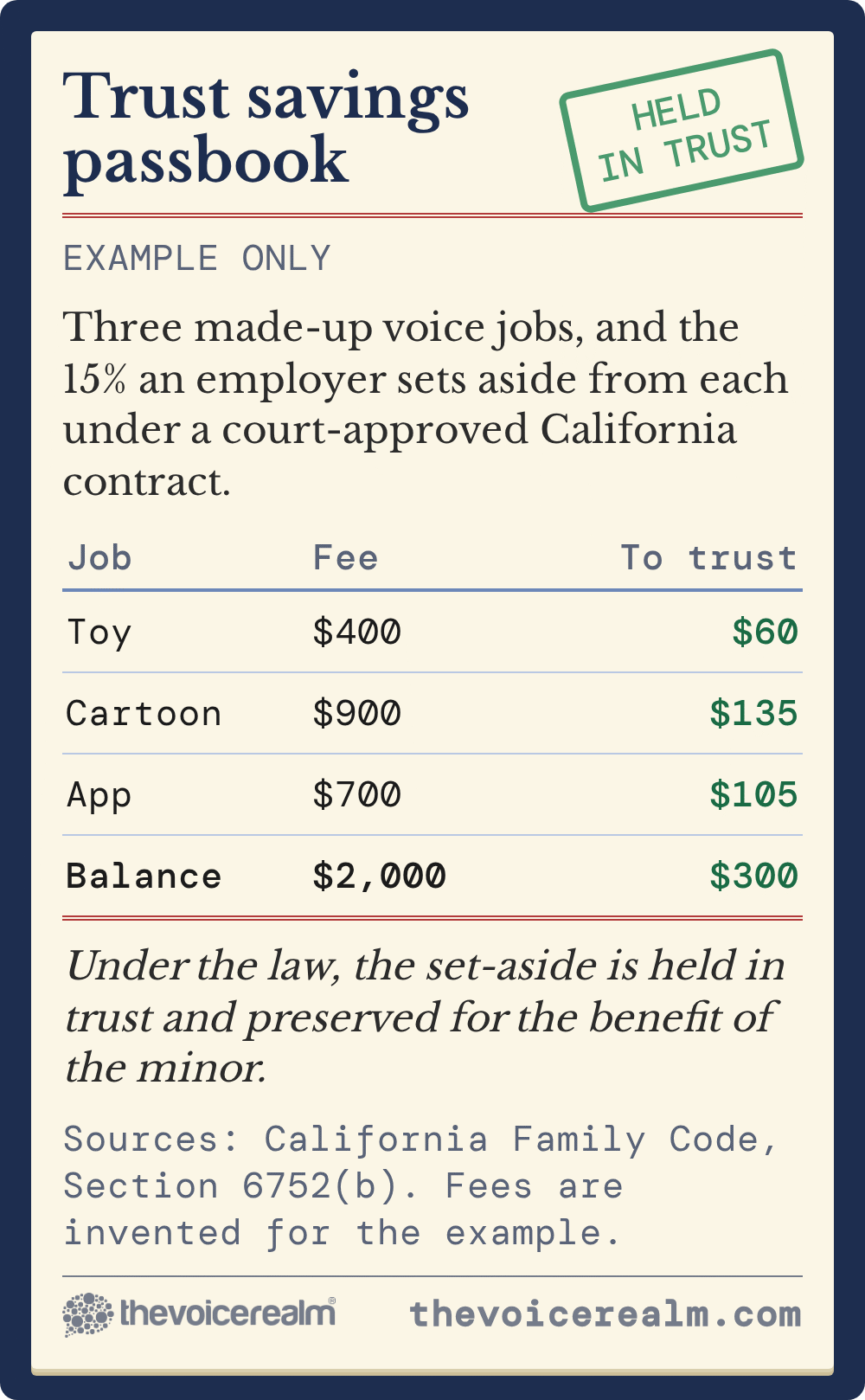
California is also home to the Coogan law, named after the child star Jackie Coogan. Under Family Code section 6752, when a court approves a child’s entertainment contract, it “shall require that 15 percent of the minor’s gross earnings pursuant to the contract be set aside by the minor’s employer.” That money is “held in trust, in an account or other savings plan, and preserved for the benefit of the minor.”
In practice, families open a trust account, often called a Coogan account, before the work starts. The same section has the trustee give the employer a copy of the trustee’s statement within ten business days of the job starting, so have it ready. Even if you live somewhere without a rule like this, it’s a good habit: put a share of every fee aside for your child, in their name, where nobody can spend it on the car.
© The Voice Realm
In the UK, the council licenses the child
In England it’s handled by the local authority where the child lives. Wandsworth Council’s guidance puts it plainly: “Children (including infants and any young person of legal school age) working in entertainment must be licensed for that work by the local authority in which they live.” A licence is needed when the work is paid, when the child would miss school, when they’ll work for more than four days, or when they’ve performed in the previous six months, among other cases.
Timing matters. The council says “Applications should be made 21 days before the licence is required,” so a job that lands on Monday for Thursday can be a problem. The person producing the recording completes the first part of the form and becomes the licence holder. You complete the second part with a recent photo, a birth certificate or passport, and a letter from school agreeing to any absences, and often a doctor’s letter too. Your own council’s website will have its version of the form.
Agents, scams and the money you shouldn’t spend
Some children book work through talent agents who represent young performers, and a good children’s agent is worth having once your child can read a script confidently and take direction. Our guide to getting a voice over agent explains how agents work and what they look for. A real agent earns their money when your child earns theirs.
- Who gets paid first. Be wary of anyone who asks for a big fee before your child has had a single audition.
- What you actually get. A “showcase” or “portfolio package” is not the same as representation.
- Whether the demo fits the age. A young child needs a short, natural recording, not an expensive produced reel they’ll outgrow in a year.
- Who has your child’s details. Keep contact, school and home information with you, not on a public profile.
As for demos, keep it simple. A minute of your child reading naturally, a little dialogue and one or two characters they genuinely do well is enough to start. Their voice will change, sometimes fast, so anything you spend now has a short shelf life.
School first, and a calendar on the fridge
Both California and the UK tie a child’s work to their schooling, and that’s a good instinct for any family. If grades or attendance slip, the paperwork stops anyway. Keep a family calendar with auditions, sessions and school commitments on it, and agree a simple rule together: homework and sleep come before any booking.
It also helps to talk about rejection early. Most auditions don’t book, for adults and children alike, and usually it has nothing to do with how good the read was. The client wanted someone older, younger, or just different. Celebrate the auditions they’re proud of, not the results.

© The Voice Realm
Keeping a young voice healthy
Children’s voices are still growing, and teens’ voices change during puberty, sometimes in the middle of a job. Don’t push a child to hold a voice that strains them, and stop if they’re hoarse. Screams, crying and monster growls should be short, few, and done at the end of a session, never repeated over and over. Plenty of water, rest after a cold, and no performing through a sore throat.
When a teen’s voice drops, it can feel like the end of something. Usually it’s the start of a different range of roles. Many adults who work in voice over started young, took a break while their voice settled, and came back with better reading skills than everyone else in the room.
If your teenager is ready to learn the craft properly, structured lessons can help, and Voice Master Academy is a sensible place for an older beginner to start. For younger children, keep it playful, keep it short, and keep reading together. The child who loves reading out loud at eight is the one with the head start at sixteen.
Sources: California Labor Commissioner’s Office, “Child Labor Laws: Information on minors and employment”; California Division of Labor Standards Enforcement, “Application for Permission to Work in the Entertainment Industry” (DLSE 277); California Labor Commissioner, “California Child Labor Laws” booklet; California Family Code, “Section 6752”; Wandsworth Borough Council, “Child Performance Licence”.
Ready to get booked?
See the jobs open right nowAbout Sarah Robbins
Sarah Robbins writes for The Voice Realm about finding voice over work, home studios, casting and the business side of voice acting.