Blog

If you’ve been waiting for a new MEAA voice over rate card for 2026, you can stop refreshing. As of late October 2026, the card in force is still the one MEAA Equity put out for 1 July 2025. The only voiceover document the union has added this year is an amended standard performance contract template, posted in May. The rates themselves haven’t moved.
So this is the full picture of voice over rates in Australia for 2026: what the union rates are, what they actually add up to on a real job, and why a growing share of Australian voice over work is now booked well outside them. It’s written for producers, agencies and in-house marketing teams pricing a job, and for voice over artists deciding what to charge.
Is there a new MEAA rate card for 2026?
No. The MEAA Voiceover Industry Rate Card says its rates are “effective from July 1, 2025 with CPI reviewed annually based on market conditions.” An annual review is on the books, but nothing new has been published on MEAA’s resources library for voiceover since the July 2025 card and its two explanatory memos. If a review lands, we’ll update this page.
The 2025 card was a big rewrite rather than a price rise. It was built by the MEAA Alliance of Voice Artists committee after focus groups with members, meetings with agents and talks with casting directors, and it replaced the old 2023 commercial card. The biggest change is how it describes where an ad runs, because the old card was written before streaming TV and social video took over the media plan.
© The Voice Realm
TV, streaming and online ads
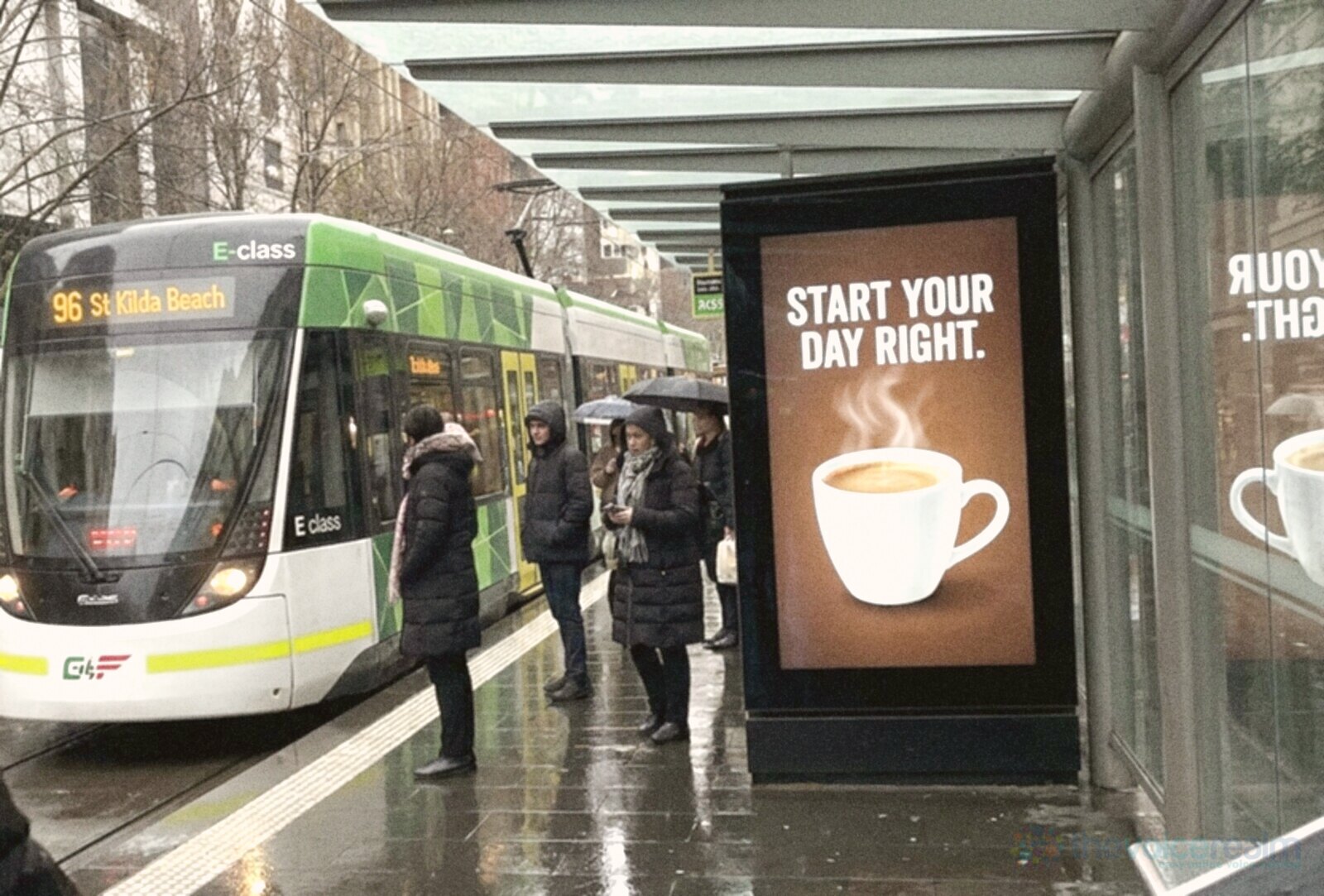
The card now calls these visual commercials, and it splits them into five platforms: television (free to air and pay TV), BVOD and SVOD (catch up services and streaming, including free ad supported channels), PIP or paid internet placement (social media ads, in game and in app ads, paid web, email and search ads), single digital out of home (stadium screens, shop displays, digital billboards) and cinema.
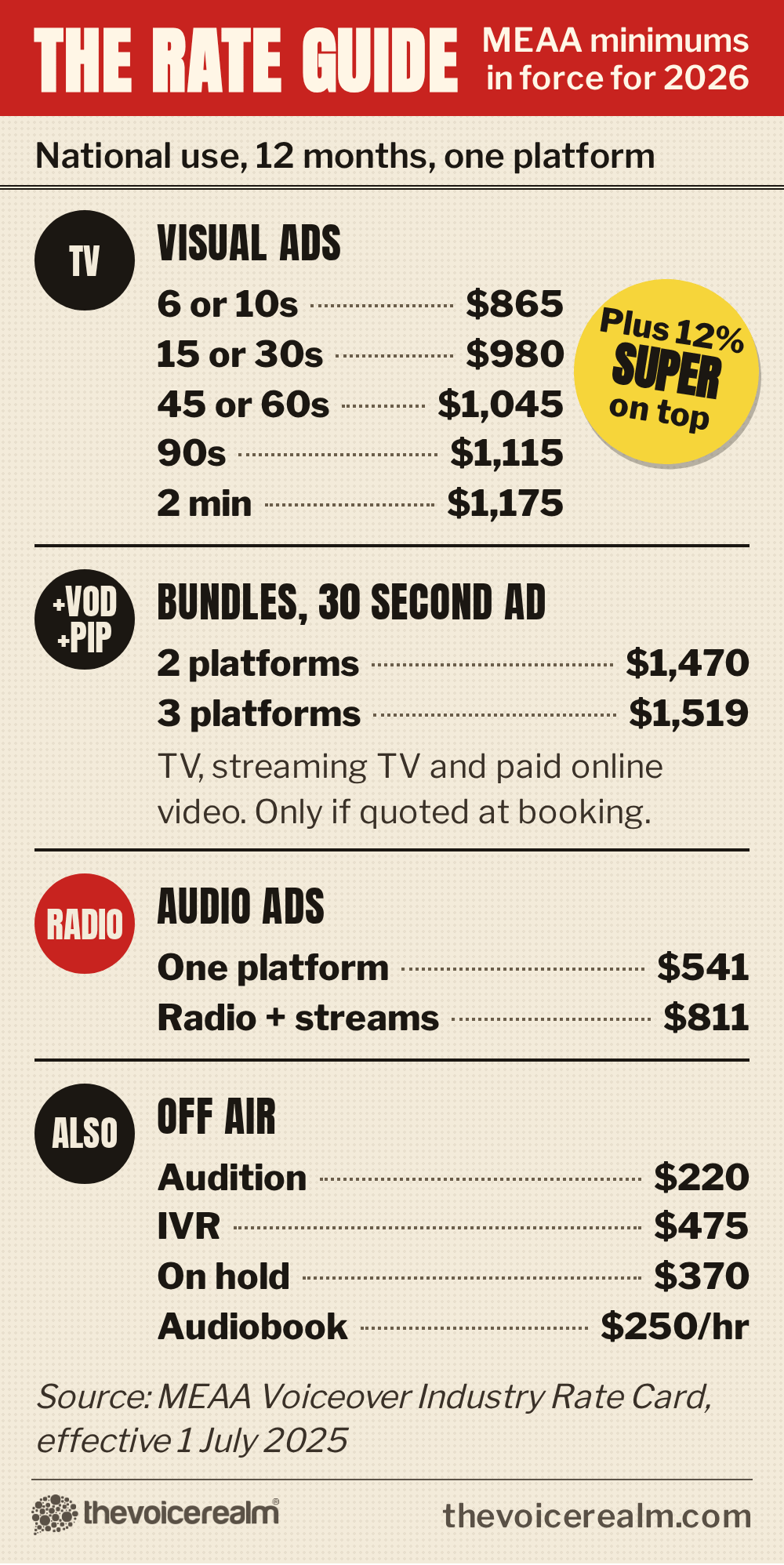
Fees are per product, per hour, per platform and per track. For national use, which means more than one state, the 12 month minimums are:
- 6 or 10 seconds: $865
- 15 or 30 seconds: $980
- 45 or 60 seconds: $1,045
- 90 seconds: $1,115
- 2 minutes: $1,175
Shorter runs cost less. A national 30 second ad is $785 for four to six months and $590 for three. Ads that run in a single state drop again: $645 for a 30 second spot over 12 months, $545 for four to six months and $445 for three.
Bundles are where the 2025 card changed the most. Run the same ad on TV and streaming, and the second platform adds 50 per cent of the fee. Add paid online video as a third, and it adds another 5 per cent. A 30 second national ad on all three for a year comes to $1,519. There are two catches. Bundles only work at the national rate, and they only apply “if quoted at the time of booking.” Miss that, and every platform is billed at the full fee. Cinema and digital out of home can’t be bundled at all. Cinema is always billed at 100 per cent, and all out of home use is capped at 200 per cent.
If the voice has to be synced to picture, add $250 per commercial up to 60 seconds, or $320 over that.
© The Voice Realm
Radio and audio streaming
Audio commercials are simpler. Radio covers AM, FM, DAB+ and internet radio. Audio streaming covers music and podcast apps. The fee covers up to five tracks for one product in an hour.
The national rate is $541 for 12 months, $479 for four to six months and $422 for three. A single state campaign is $458, $422 and $381. Running on radio and streaming together costs $811 for the year, again only if it’s quoted at booking. Audio was the only part of the card to get the previously agreed 3 per cent CPI increase in 2025.
Moving an ad between worlds costs extra. Take a TV ad’s soundtrack and run it on radio, and the artist is owed another 100 per cent of the national audio fee for each audio platform. The same rule works the other way for a radio ad that ends up on screen.
Corporate, phone, audiobooks and dubbing
The card also sets minimums for work that never goes to air:
- Corporate narration for internal use: $325 for up to three minutes of content in a 30 minute session, $485 for longer pieces in a session of up to an hour.
- Online video on the client’s own website or socials: $380 and $670 on the same terms.
- Intranet e-learning: $485.
- Phone systems for Australian use: IVR at least $475 per entity, on hold messages at least $370.
- Audiobooks: $250 per finished hour in a studio, with home recording and editing by negotiation, and an extra $100 prep fee per narrator when a book has two or more.
- Dubbing foreign language or accented characters: $125 an hour for non credited characters of 50 words or less, $175 an hour for credited characters, each with a two and a half hour minimum call.
Audio description and network promos are by negotiation.
The extras that change the total
This is where quotes go wrong. The headline fee is rarely what the job costs.
- Super. The card says its rates “DO NOT include Superannuation.” Super is owed at 12 per cent on top, whether the artist invoices with a tax file number or an ABN.
- Submissions. A recording made to demonstrate a script before the job is confirmed is $220, the same as a revision of a track that hasn’t gone to air.
- Character voices. Anything beyond the artist’s normal reading voice, including an accent, adds $220 per character, per track.
- Overseas use. The whole Australian fee is multiplied: 100 per cent each for New Zealand, Singapore and Hong Kong, 200 per cent for Asia Pacific, 300 per cent for the UK or Europe, 500 per cent for the US and 600 per cent for global use.
- Name and politics. Using the artist’s name in a campaign doubles the fee. So does any political ad.
One more clause matters more every year. The card bans using any part of a recording to train AI or build a voice clone “without the explicit and informed written consent of the artist,” and says an AI generated voiceover is paid at the same rate, for the same usage, as one recorded in a studio.
Why the rates haven’t kept up
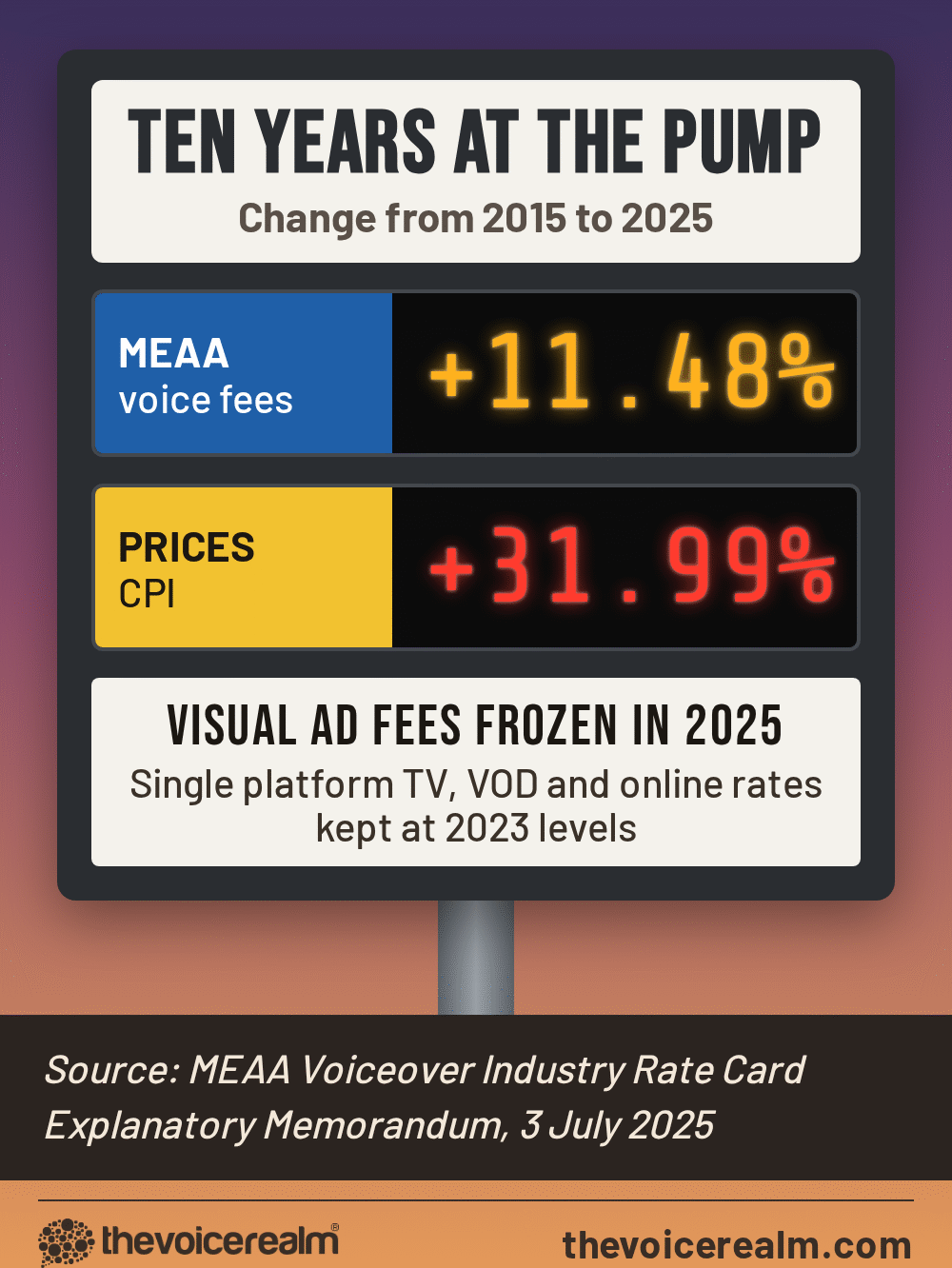
MEAA’s own explanatory memo is frank about this. From the 2015 commercial card to 2025, union voiceover fees rose 11.48 per cent across two increases. Over the same years, prices rose 31.99 per cent. Voice fees fell a long way behind the cost of living.
The 2025 card didn’t close that gap. Because the new bundle structure pushed some totals up, MEAA chose to “freeze individual Visual Commercial Platform fees at those set in the 2023 MEAA Commercial Rate Card,” with no CPI increase. Only audio got its 3 per cent.
That tells you something about the market the card is written for. Union minimums are a floor for broadcast work booked through the traditional chain of agency, casting director and talent agent. They aren’t the price most Australian voice work changes hands at any more.
© The Voice Realm
Most voice work is now booked outside the union card
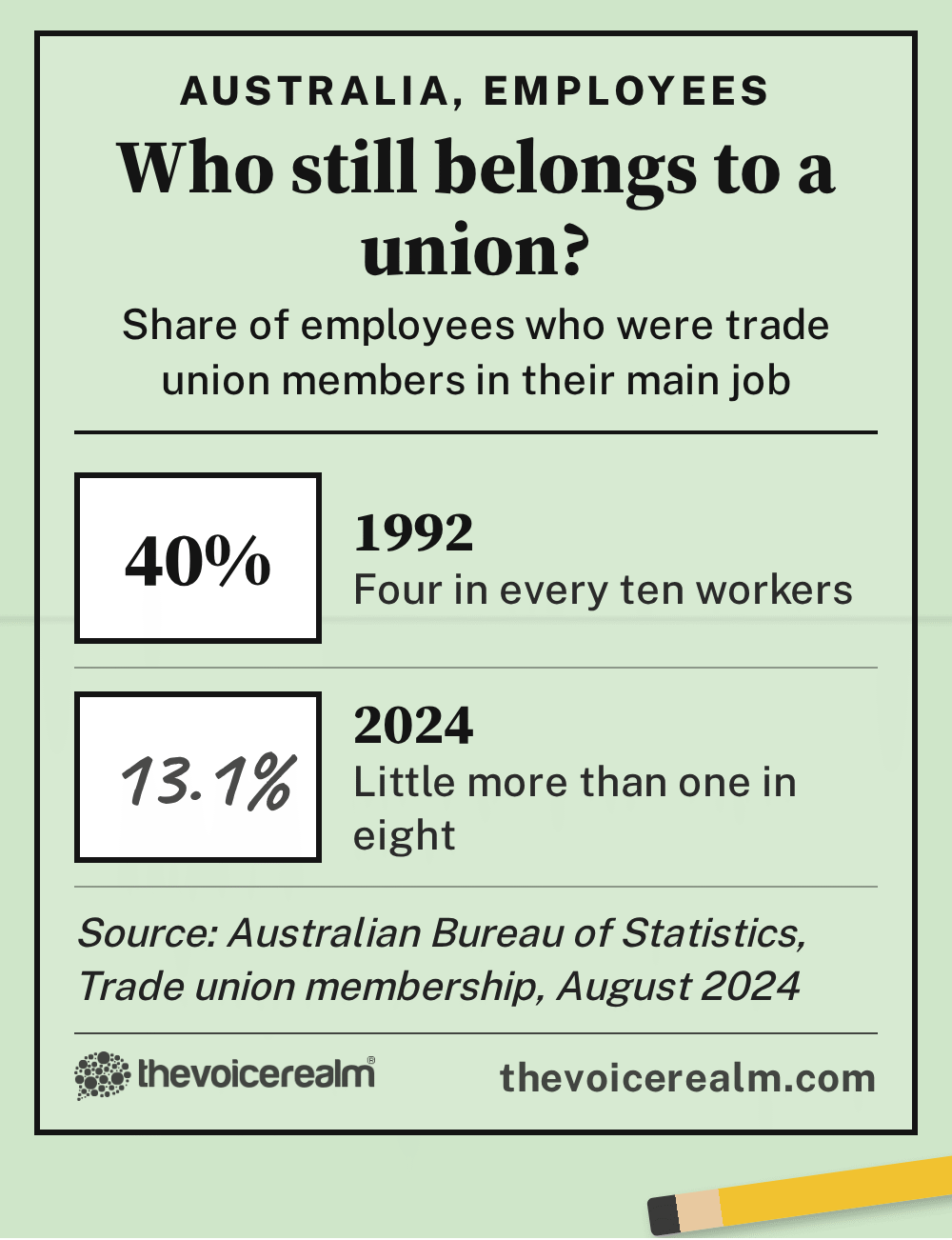
Start with union membership itself. In August 2024, the Australian Bureau of Statistics found 13.1 per cent of employees were members of a trade union in their main job. In 1992 it was 40 per cent. Most voice over artists aren’t employees at all. They’re freelancers working from home studios, which puts them even further from collective agreements.
 VoiceEditSuiteIt edits like you would, and it gets better every file.Every fix you make in the editor teaches Auto Clean Up more, so each file comes back sounding like you edited it yourself.See how it worksLearns from numbers, never your audio. Never used to train AI.
Then look at what the card actually is. The federal government’s Creative Workplaces site, which lists rate guides for artists, puts it plainly: these rates “are a guide only and are not enforceable.” It also says self-employed artists “get to decide what price they will accept for their work.” There’s no award that sets a legal minimum for a 30 second voice over, and nothing stops an artist and a client agreeing their own terms.
And look at what’s being made. The card is built around national TV campaigns, but the brief landing on most desks now is something else: a 90 second explainer for a website, a run of social ads for one state, a training module for 400 staff, a phone menu, a podcast intro, a product video for a trade show screen. That work is commissioned by small agencies, in-house brand teams, production houses, e-learning developers and creators. Many of them have never booked a voice through an agent, and they aren’t going to start with a five page rate card that bills a $220 submission fee per audition.
So most of them book direct, on a published price, and that’s where voice casting marketplaces come in.
© The Voice Realm
Where agencies and creatives are booking voices now
A casting marketplace like The Voice Realm Australia flips the old process. Instead of asking an agent who’s available and waiting for a quote, a producer posts the script for free, hears auditions from real Australian voice over artists reading that actual script, picks the one they like and pays one published fee. There’s no submission fee for auditions, no haggling over usage, and no surprise line items when the invoice arrives.
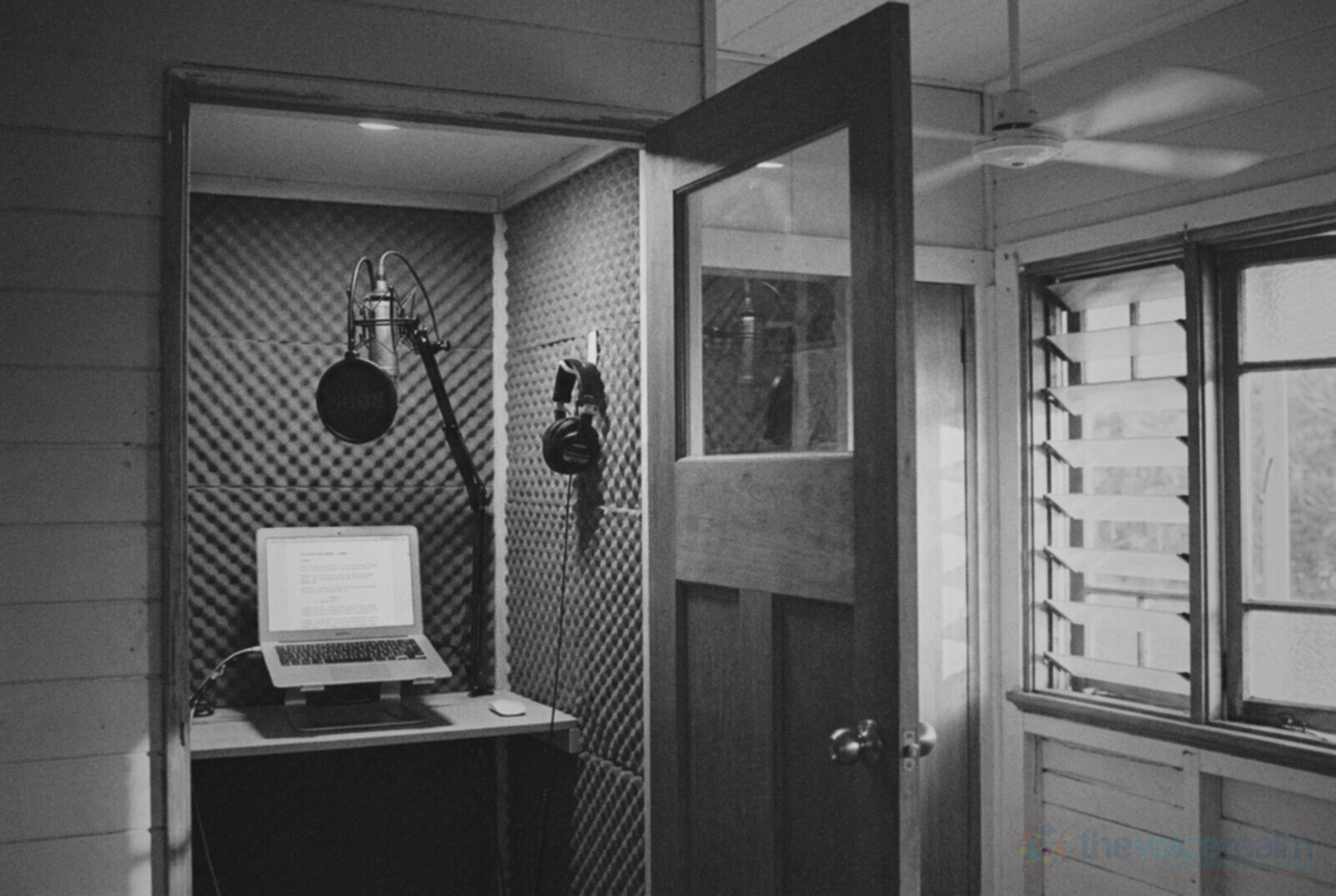
The voices are professionals, hand-picked before they can audition, recording from their own studios. What’s different is that they’ve chosen to work on a public, non-union rate card for this kind of work, because it brings them a steady stream of jobs they’d never hear about through an agent. It’s also why a regional business that wants an Aussie voice for a radio ad can afford a professional for the first time.
© The Voice Realm
The same jobs, two price tags
Here’s how the union minimums compare with our published voice over rates for Australia, which every artist on the site has already agreed to:
Union rate card
30 second TV ad, national, 12 months: $980 plus 12 per cent super. Online video up to three minutes: $380. E-learning: $485. On hold messages: from $370. Each recorded audition: $220.
Published card
30 second commercial, national, 12 months: about $640. Local: $107. Online explainer up to two minutes: $265. E-learning up to five minutes: $322. On hold, up to 100 words: $114. Auditions: free.
It isn’t cheaper across the board, and we wouldn’t want it to be. Long form audiobook narration on our card is $400 per finished hour, well above the union’s $250, because narration is skilled, slow, tiring work and we think it should be paid that way. Where our card comes in lower is the short commercial and corporate work that makes up most of the volume, and where the union structure was never designed to fit.
For a full walk through of pricing a job yourself, including usage and revisions, our guide to quoting a voice over job breaks it down line by line. And if you also cast in the US, the same logic applies to the SAG-AFTRA voice over rates.
Our take
The MEAA card does a job, and it does it well. It protects artists on big broadcast campaigns, it spells out what agencies owe for streaming and social placements, and its AI consent clause is something every voice over artist in the country should know by heart. If you’re booking a national TV campaign through an agency, use it.
But it’s a guide for one corner of the market, and that corner keeps shrinking. Fees have fallen behind inflation by twenty points in ten years, union membership is a third of what it was, and most of the scripts being recorded in Australia today are videos, modules and messages the card was never built around.
For those jobs, a published non-union rate is fairer to everyone. Clients see the price before they start. Artists know exactly what they’ll earn before they audition, and they choose which jobs to take. Nobody pays $220 to hear a voice read their script.
Quick answers
What is the MEAA rate for a 30 second TV ad?
$980 for national use over 12 months on one platform, plus 12 per cent super. A single state campaign is $645.
Do MEAA voice over rates include super?
No. Super is paid on top at 12 per cent, even when the artist invoices on an ABN.
Is the MEAA rate card compulsory?
No. Rate guides for independent artists are recommended minimums, not enforceable law. They apply when both sides agree to union terms.
How much is a radio voice over in Australia?
Under the MEAA card, $541 for a national radio campaign over 12 months, or $458 for one state. On a non-union marketplace, a local 30 second spot starts at around $107.
When will the next MEAA rate card come out?
The card says rates are reviewed against CPI every year, but no 2026 update had been published by late October 2026.
Sources: “MEAA Voiceover Industry Rate Card,” effective 1 July 2025, and “MEAA Voiceover Industry Rate Card Explanatory Memorandum,” 3 July 2025, MEAA Equity; “Trade union membership, August 2024,” Australian Bureau of Statistics; “Rate guides,” Creative Workplaces; The Voice Realm Australia published rate card, October 2026.
Ready to get booked?
See the jobs open right nowAbout Sarah Robbins
Sarah Robbins writes for The Voice Realm about finding voice over work, home studios, casting and the business side of voice acting.