Blog

This one’s for anyone who talks for a living and has noticed their voice isn’t doing what it used to. Maybe the soft, close read for a meditation client keeps breaking up. Maybe a few top notes have gone missing from your character voices, or you’re hoarse by lunchtime on a day that used to be easy. Most of the time that’s a tired voice, and a quiet evening sorts it out. Sometimes it’s vocal nodules, and they don’t leave just because you ignore them.
Here’s what nodules are, why people who use their voices for work get them, when it’s time to see someone, and what recovery looks like for a working voice actor. It’s a guide, not a diagnosis. If your voice has changed and stayed changed, the only person who can tell you why is a specialist looking at your vocal folds.
A callus in the one place you can’t see
Your vocal folds are two small bands of tissue that meet and vibrate many times a second whenever you make a sound. Nodules are small, hard bumps that grow where they meet. Cleveland Clinic puts it plainly: “These callus-like growths develop in the midpoint of your vocal cords.”
The US National Institute on Deafness and Other Communication Disorders (NIDCD) uses the same picture. Nodules “form in pairs on opposite sides of the vocal folds as the result of too much pressure or friction, much like the way a callus forms on the foot from a shoe that’s too tight.”
That callus picture is the key to the whole thing. A callus isn’t something you caught. It’s your body toughening a spot that keeps getting hit. Nodules usually come from how a voice is used, which is the good news, because how a voice is used can change. The less good news comes from the American Speech-Language-Hearing Association’s public health site: “These nodules can get larger and stiffer if vocal misuse continues.”
Why voice actors are near the front of the queue
Cleveland Clinic’s list of who gets them reads like a staff room: “Anyone can get them, but they’re most common in children, heavy voice users such as teachers, trainers and coaches, and professional voice users such as singers and speakers.” NIDCD adds that nodules are sometimes called singer’s nodes “because they are a frequent problem among professional singers.”
Teachers are the best studied group, and the numbers are sobering. A 2004 study by Nelson Roy and colleagues in the Journal of Speech, Language, and Hearing Research compared teachers with people in other jobs and found “the prevalence of voice disorders during their lifetime (57.7% for teachers vs. 28.8% for nonteachers)”. That’s voice problems of every kind, not only nodules, but the pattern is clear: talk all day, every day, and your folds pay for it.
Nobody has run the same study on voice actors, yet our working days rhyme with a teacher’s. Long narration sessions, a game session full of battle cries, an hour of whispered intimacy for a sleep app, then three auditions before dinner. And most of us work alone, so there’s nobody in the room to say you sound rough today and maybe that’s enough.

© The Voice Realm
What it sounds like before anyone finds it
Cleveland Clinic lists the symptoms as hoarseness, breathiness, vocal fatigue, loss of your voice, loss of vocal range and a voice that breaks easily. The University of Iowa’s head and neck protocols add one that matters a lot in a booth: “inability to produce voice with soft volume”. UCI Health explains the breathiness: “In later stages, nodules can become large enough to prevent vocal cord closure. This causes air to escape while you are speaking.”
Here’s how that tends to show up at the mic. The quiet, close read is the first casualty: you drop to a murmur and the sound crackles or vanishes. There’s more air in your voice than there used to be, and no amount of EQ takes it out. The top of your range shrinks. A session that used to leave you fine now leaves you croaky, and the croak is still there the next morning. You find yourself pushing to get a clean take, and pushing is exactly what made the bumps in the first place.
Your own recordings are evidence, so use them. Once a month, read the same paragraph at the same distance with the same settings and save it with the date in the file name. When something feels off, play this month’s file against one from last spring. You’ll hear a change long before you can describe it.
Back after a quiet night
Croaky after a long or shouty day, clear again after rest and sleep. Hoarse with a cold, and it clears as the cold does. Soft reads still work once you’re warmed up.
Changed and staying changed
Hoarse or breathy most days for weeks, with no cold to blame. Soft reads break up every time. Notes you used to have aren’t coming back. You’re pushing just to sound normal.
Two, three or four weeks: when to book
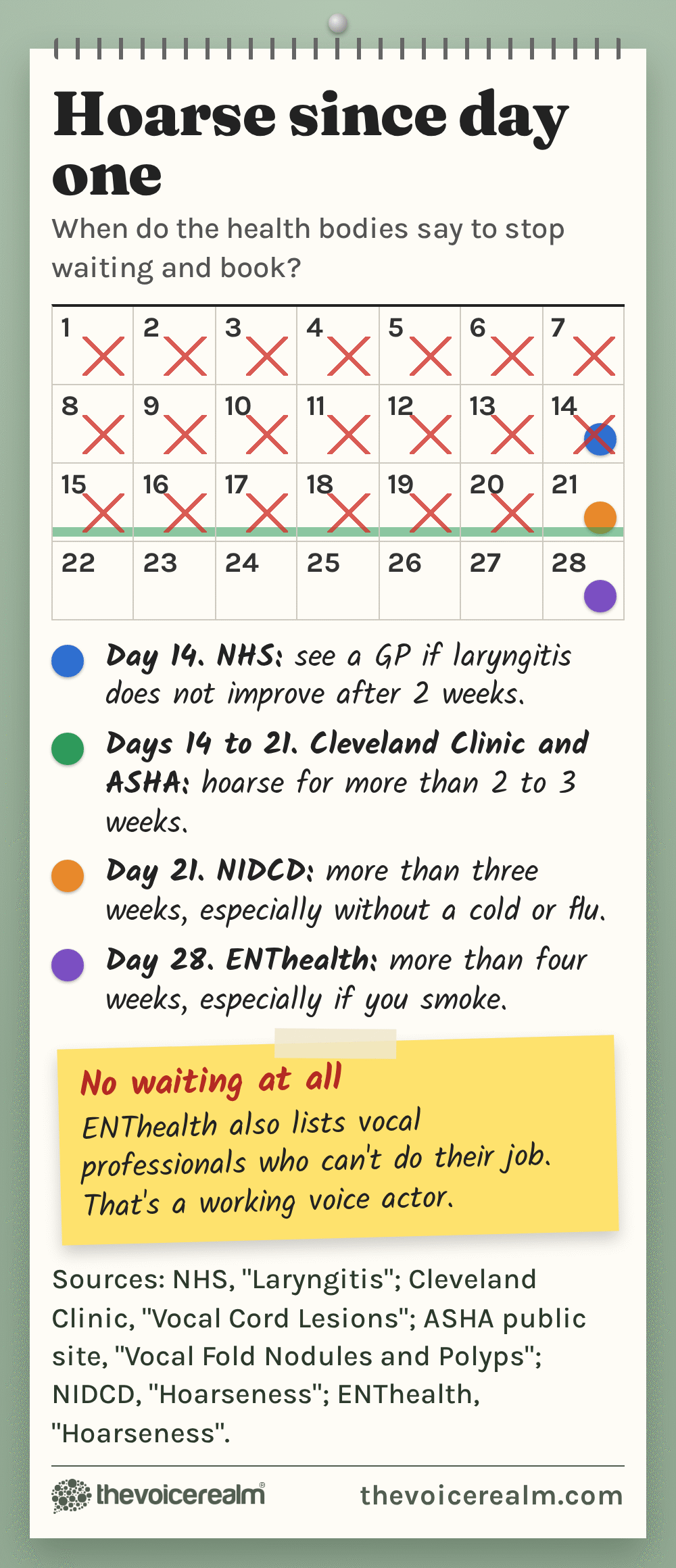
The medical sources don’t all give the same number, and the calendar at the end of this section shows the spread, from two weeks to four. Don’t hang on for the longest one. The clearest line comes from NIDCD: “You should see your doctor if your voice has been hoarse for more than three weeks, especially if you haven’t had a cold or the flu.”
ENThealth, the American Academy of Otolaryngology’s patient site, also lists a reason to go that comes with no wait at all: “Vocal professionals (singer, teacher, public speaker) who cannot do their job”. That’s you. If your voice is costing you work, that’s reason enough to book.
A few practical things make that appointment worth more. Write down the day the hoarseness started; you’ll be asked, and memory is vague after three weeks. Tell the doctor you use your voice for a living, and ask to be seen by an ear, nose and throat specialist or a voice clinic, which usually has a laryngologist and a speech-language pathologist working side by side. And if breathing or swallowing is ever a struggle, don’t wait for any number at all.
© The Voice Realm
What actually happens at the voice clinic
The exam is quicker and less dramatic than most people fear. UCI Health: “Nodules are diagnosed in the office during a laryngoscopy and stroboscopy. They are usually seen in the midportion of the vocal folds. Typically, both vocal cords will have nodules.” A thin scope looks at your folds through the nose or mouth, and the stroboscope does the clever part. In the words of the ASHA site, “A flashing light, called a stroboscope, lets the team watch your vocal folds move.” Cleveland Clinic calls stroboscopy “the gold standard for evaluating hoarseness.”
Bring three things. A clean recording of your voice from a good month, so they can hear your normal. A rough list of a typical week: hours at the mic, the genres, any shouting, singing or long phone calls. And anything else that touches your throat, from allergy medicine to heartburn, because silent reflux can roughen a voice on its own and the clinic will want to rule it in or out. Ask if you can see the video afterwards. Seeing your own folds makes every piece of advice that follows a lot easier to stick to.
Nodules, polyps and cysts aren’t the same thing
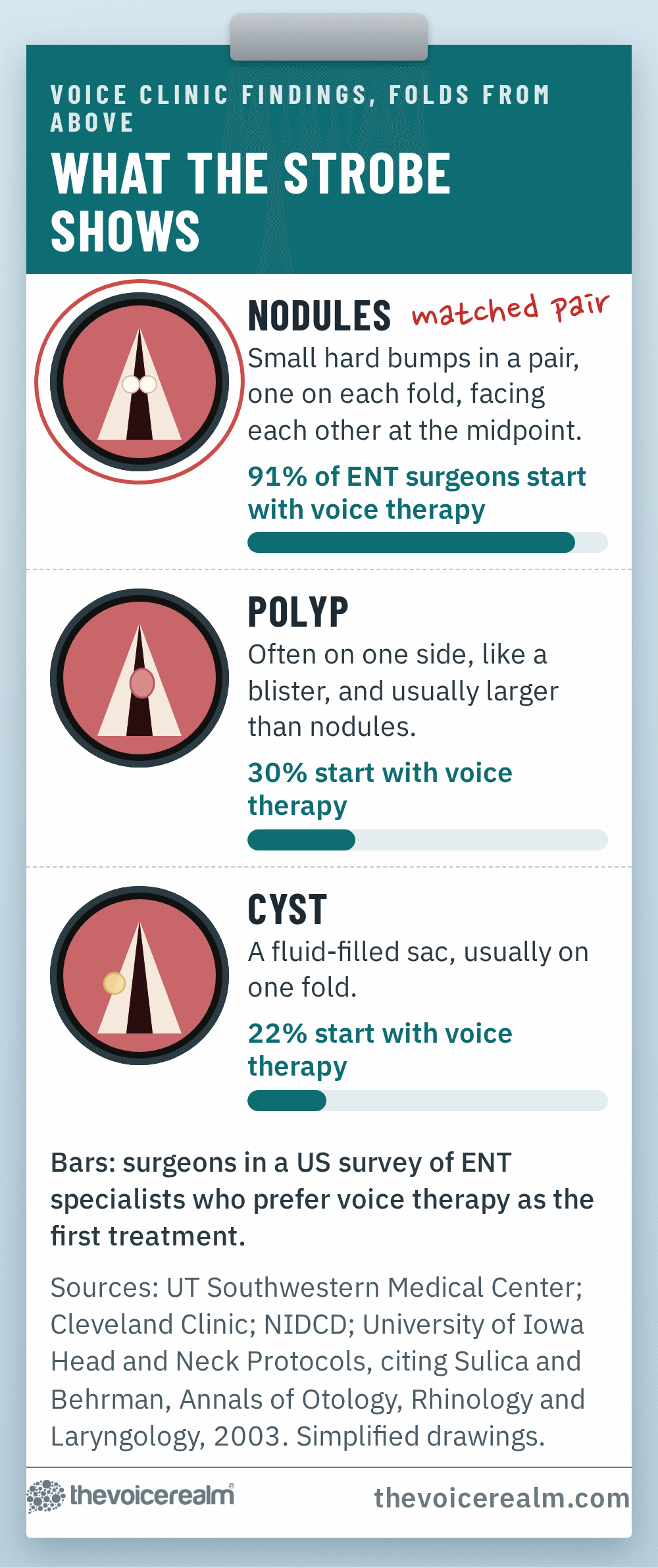
The scope might find something other than nodules, and the name matters because it changes the plan. The ASHA site has a neat way to tell the first two apart: “Some people consider a nodule to be like a callus and a polyp to be like a blister.” Nodules come in matched pairs. A polyp, NIDCD notes, “typically occurs only on one side of the vocal fold”, and Cleveland Clinic says polyps are “usually larger than nodules.” A cyst, in UT Southwestern Medical Center’s description, is a fluid-filled sac that usually appears on one fold.
 VOICEMASTERACADEMYTwenty modules, one at a time.Breath controlHome studioCommercial techniqueAuditionsStart module oneNo experience needed.
The reason this matters to you is treatment. Cleveland Clinic again: “Unlike nodules, polyps and cysts don’t typically improve with voice therapy.” So two singers with the same hoarse voice can walk out with very different plans, one with a speech therapist’s card and one with a surgery date. Don’t diagnose yourself from a symptom list. Get the look.
© The Voice Realm
Voice therapy comes first, and it usually works
For nodules, the first answer is almost never a scalpel. Cleveland Clinic: “Nodules are typically treated conservatively with voice therapy under the guidance of a speech therapist.” UCI Health: “Voice therapy with a speech language pathologist is the first step in the treatment of vocal cord nodules.”
Voice therapy isn’t a lecture about drinking water. It’s practical work on how you make sound: breath, the way notes start, where the voice sits, how much you squeeze, and how you use your voice across the whole day, not only at the mic. The University of Iowa’s protocol suggests starting with “2 sessions per week for six weeks”, adjusted to how you respond. Cleveland Clinic’s timescale for the result: “Nodules usually improve within two to six months with voice therapy or vocal rest.”
Surgery is held back for the stubborn cases. UCI Health: “While uncommon, surgery may be used to remove nodules.” The ASHA site says it’s “usually done only when they are large or have been there for a long time.” The Iowa protocol goes further and tells surgeons to get to know a patient for a year, with repeat checks, before offering an operation for nodules at all. If anyone suggests surgery first, a second opinion from a voice specialist is a fair ask.

© The Voice Realm
Working while you heal
Recovery doesn’t always mean shutting the studio. It means changing the shape of the work, with your therapist’s say on what’s safe. Some things that help:
- Shorter sessions, more breaks. Book the long narration in pieces across several days, and stop before the voice tells you to. Our guide to how many hours a day you can record has the pacing that working narrators use.
- Pick the gentle jobs for now. Conversational reads, yes. Battle cries, creature voices and a full day of hard sell, not yet.
- Rest doesn’t mean whisper. The NHS advice for a strained voice is “do not talk loudly or whisper”, because whispering strains too. Quiet, easy speech is kinder than a forced hush.
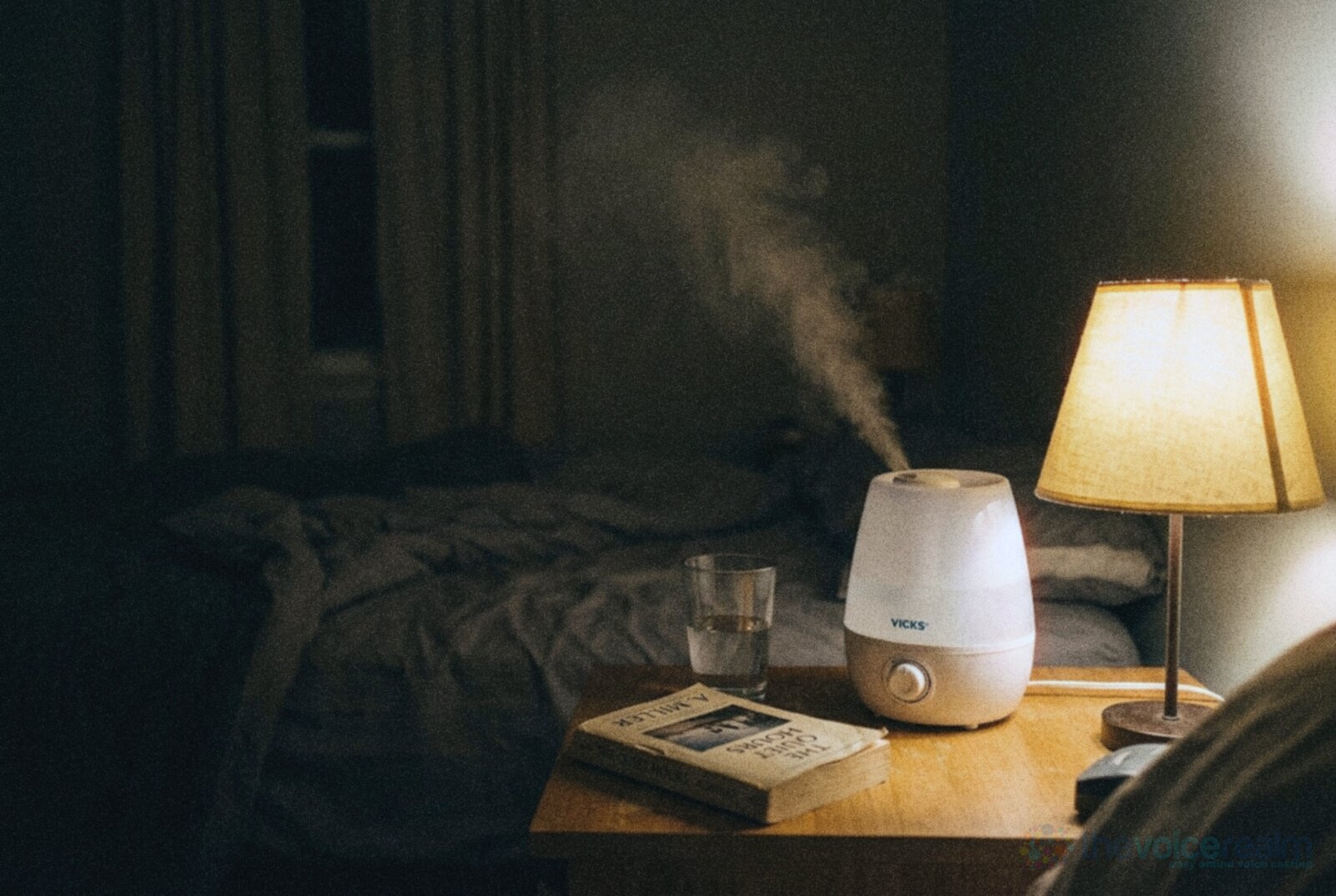
- Drink, and keep the air kind. NIDCD: “Resting, reducing voice use, and drinking lots of water should help relieve hoarseness from misuse or overuse.” A dry bedroom heater doesn’t help either.
- Count the voice you use off the mic. Phone calls, noisy bars, the gym, cheering at the kids’ football. ENThealth’s advice for heavy talkers is to “Use a microphone or other type of voice amplification if your job requires a lot of talking (like teaching or public speaking).”
As for clients, they don’t need your medical notes. “My voice needs a couple of days, can we record Thursday?” is a sentence producers hear all the time. A rescheduled session costs you a day. A session recorded on a damaged voice can cost you the client.
© The Voice Realm
Habits that keep the callus from coming back
Nodules that have gone can come back if the habits that made them come back too. The good news is that the habits are simple, and most working voices already know them. Cleveland Clinic’s prevention list includes two that fit the booth exactly: “Warm up your voice before singing or prolonged speaking.” and “Rest your voice in anticipation of future speaking obligations.”
So warm up every recording day, even a short one; a five minute routine before the mic is plenty. Keep the quiet day before a big session quiet. Spread the heavy jobs out so a screaming session never lands the day before a long book. Keep making your monthly reference read, because it’s the first place a change will show. And make one rule non-negotiable: when you hear the rasp, stop. The extra take you push for today is the one that costs you next month.
Your voice is a working part, like a dancer’s knees. Nobody admires a dancer who limps through rehearsal. Look after the folds, get the scope when something’s changed, and you’ll be doing this for a very long time.
Sources: Cleveland Clinic, “Vocal Cord Lesions” (reviewed December 2022); National Institute on Deafness and Other Communication Disorders, “Hoarseness”; Communication Health Support Association, the American Speech-Language-Hearing Association’s public site, “Vocal Fold Nodules and Polyps” (reviewed May 2026); UCI Health, “Vocal Cord Nodule”; UT Southwestern Medical Center, “Vocal Cord Nodules, Polyps, and Cysts”; University of Iowa, “Vocal Nodules”, Iowa Head and Neck Protocols; ENThealth, American Academy of Otolaryngology, Head and Neck Surgery, “Hoarseness”; NHS, “Laryngitis”; Roy N. and others, “Prevalence of voice disorders in teachers and the general population”, Journal of Speech, Language, and Hearing Research, 2004.
Ready to get booked?
See the jobs open right nowAbout Sarah Robbins
Sarah Robbins writes for The Voice Realm about finding voice over work, home studios, casting and the business side of voice acting.