Blog
Blog

You wouldn’t sprint out of bed. So why does the first take of the day so often come straight out of a cold voice, five minutes after the coffee? This guide is for voice actors at any stage who want a short warm-up they’ll actually do: what to do, in what order, how long each part takes, and what voice clinics say about it.
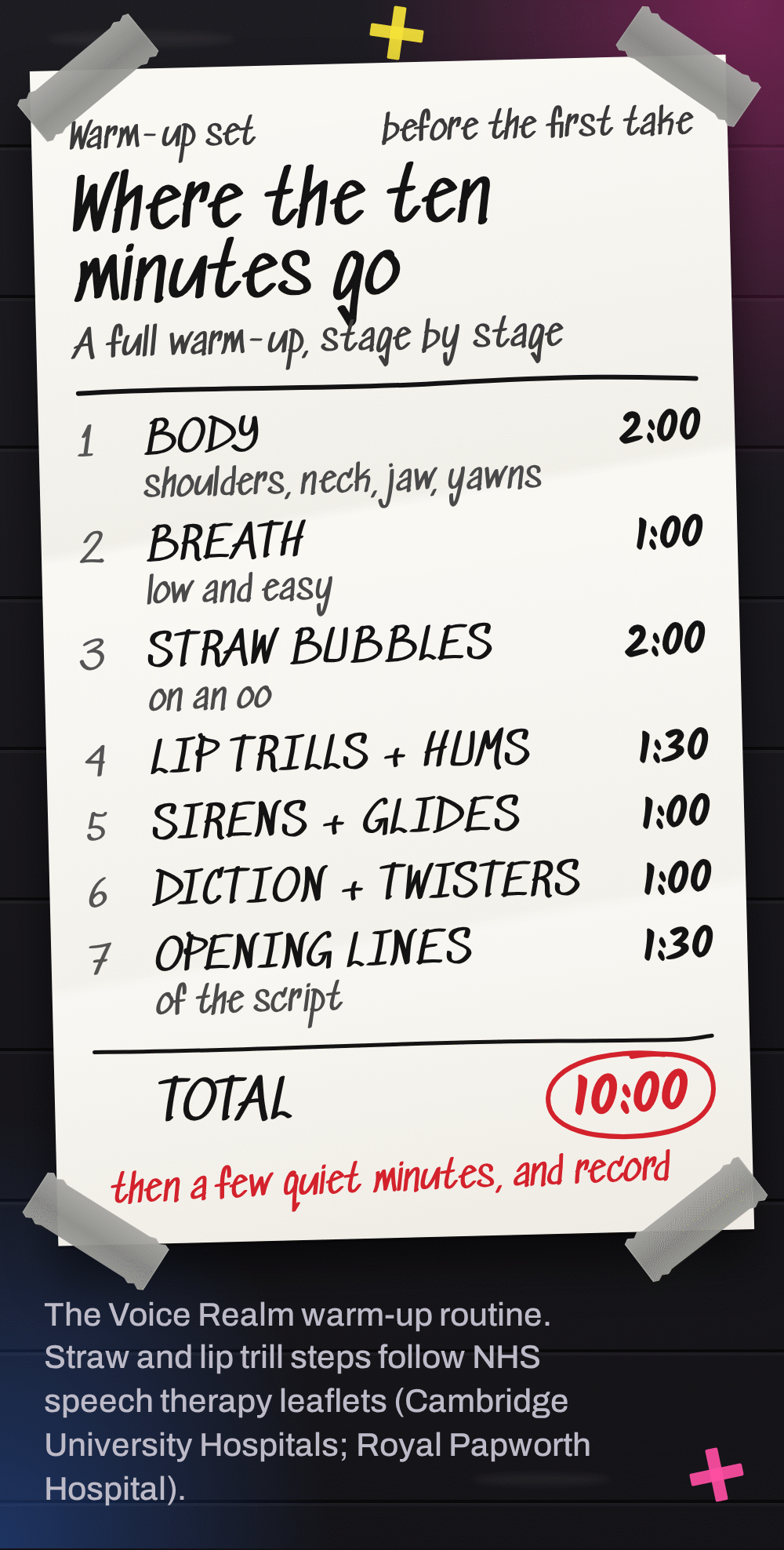
The whole routine fits in about ten minutes. On a rushed morning, there’s a three-minute version further down.
Why a speaking voice needs warming up at all
It’s easy to think warm-ups are for singers. But a voice over day can mean hours of talking at a steady, controlled level, with a character shout, a whisper or a long audiobook chapter mixed in. That’s a lot of work for two small folds of tissue in your throat.
The voice team at UT Southwestern Medical Center puts the scale of it plainly: “Your vocal cords vibrate more than 100 times a second when you speak, and they need that mucus to help them stay lubricated.” That lubrication comes from water you drank hours ago, not the sip you take at the mic, so in a real sense your warm-up starts with the glass of water at breakfast.
The American Speech-Language-Hearing Association compares it to sport: “Similar to warming up your body before exercise, warming up your voice before a busy day with gentle humming can loosen up the muscles and prevent injury.” That’s the whole aim. You’re not rehearsing a performance. You’re getting a voice that’s loose, hydrated and responsive before the red light goes on.
© The Voice Realm
Loosen the body first, because tension travels
A tight neck, raised shoulders and a clenched jaw all end up in the sound. Stand if you can, feet under your hips, knees soft, and work from the top down.
- Roll your shoulders slowly back five times, then let them drop and stay dropped.
- Tip your head towards one shoulder and breathe there for a few seconds, then the other side. Let the weight of your head do it. No pulling, no cracking.
- Let your jaw hang open and rub the hinge just in front of your ears with your fingertips, in small circles.
- Yawn, properly, with a sigh on the way out. A big yawn stretches the throat and lifts the soft palate in one go.
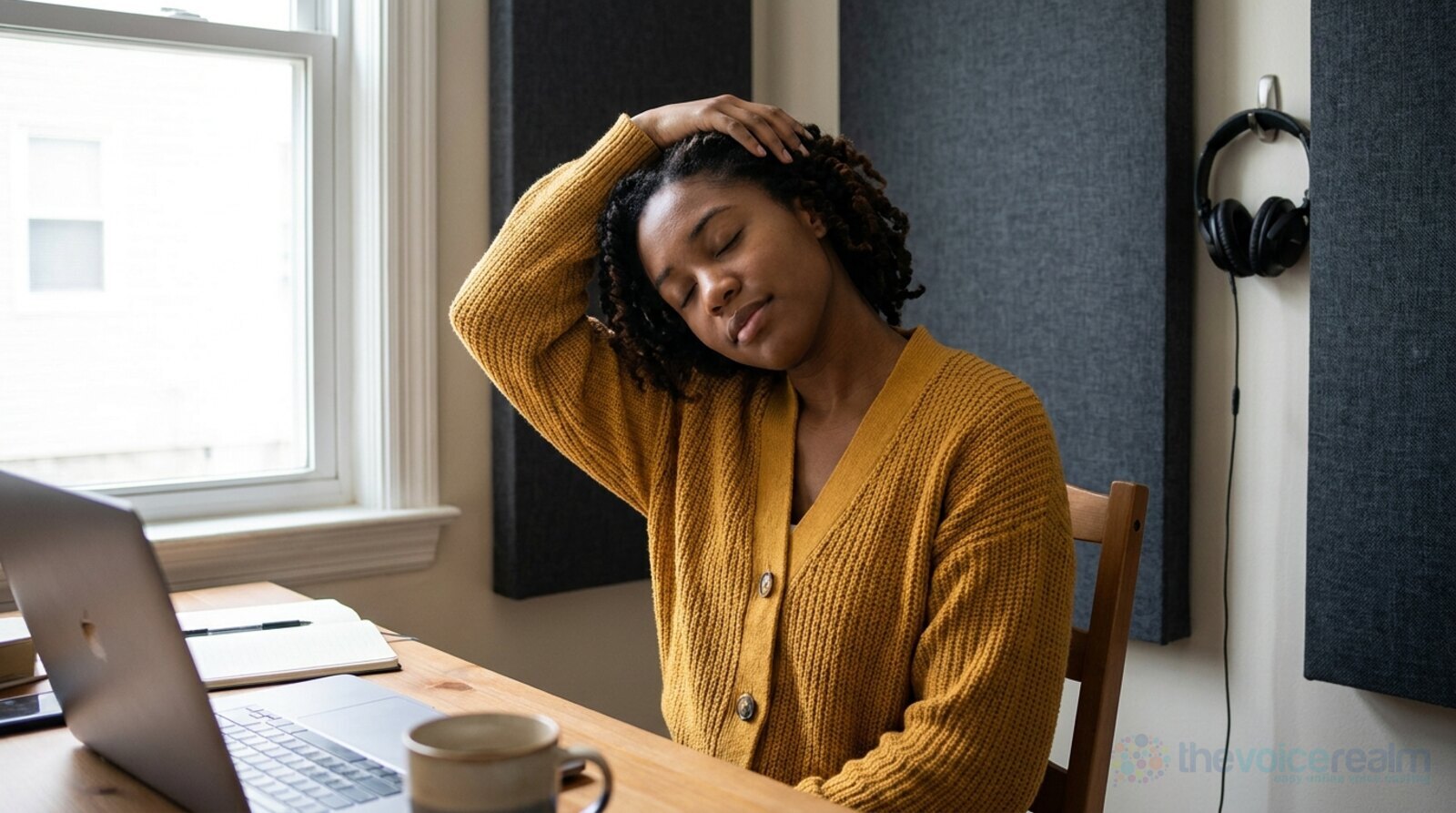
Let the weight of the head do the stretch. No pulling. © The Voice Realm
Two minutes is plenty. This isn’t a workout. You’re telling your body the day has started and the shoulders aren’t invited to the session.
Wake up the breath without forcing it
Next, a minute or so of easy breathing. Rest a hand on your belly, breathe in through your nose for a slow count of four and feel the hand move out. Then let the air go on a long, quiet “sss”, steady like a slow puncture, for as long as it’s comfortable. Do that four or five times.
Don’t go for a record. The point is a low, relaxed breath that feeds the voice without your chest and shoulders heaving. If you want to go further, we’ve written a whole piece on where the air should go before the words.
The straw: a voice clinic favourite
If you only do one exercise, make it this one. Sounding through a straw belongs to a family that speech therapists call semi-occluded vocal tract exercises. They partly close off the front of the mouth, so the voice works against a little back pressure. The speech and language therapy team at Cambridge University Hospitals says these exercises “build the air pressure below the vocal cords to enable them to come together with less muscular effort.”
Their patient leaflet sets it up simply: “Half fill a cup with room temperature water.” Put an ordinary drinking straw in, bent towards you, and keep it off the bottom of the cup. Then, in the leaflet’s words: “Now make the sound ‘oo’ while you are blowing bubbles. Your cheeks should start to wobble more and you should feel a vibration around the front of your face.”
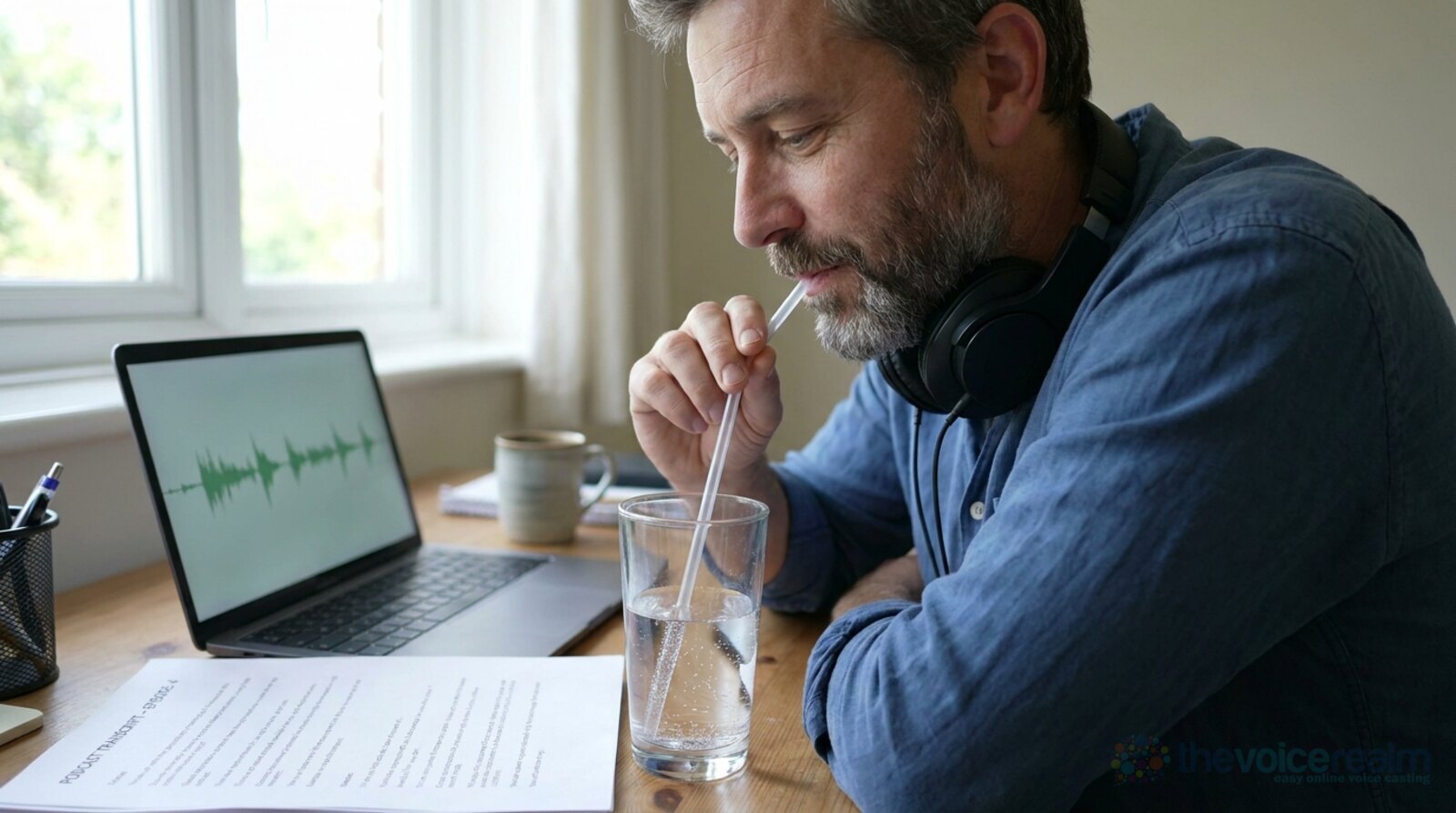
Small, steady bubbles through a straw, with a soft “oo” behind them. © The Voice Realm
Do ten of those on one easy note, then let the pitch slide slowly up and down while you bubble, like a lazy siren. If the bubbles go wild and splashy, you’re blowing too hard. Small, steady bubbles are what you’re after.
The same leaflet notes the exercises “can also be used as a warm-up or cool down”, which is a good reason to keep the glass and straw on the desk all day. A minute of bubbles after a long session is a nice way to hand your voice back to normal life.
Lip trills and hums: buzz before you speak
A lip trill is the “brrr” a child makes pretending to drive a car. It sounds silly and it works. Royal Papworth Hospital’s patient advice sheet on lip trills says they aim to “Release tension in the lips and mouth” and to “Improve pitch range without straining the voice.”
The sheet’s one technical note matters most: “Do not try to lip trill with pursed lips. Your lips should be relaxed and vibrating freely.” If your lips keep stalling, rest a fingertip lightly on each cheek, just beside the corners of your mouth. It takes some of the load off and the trill usually catches.
Trill on a comfortable note, then slide it up and down a little. The same sheet tells you to “stop if you feel any discomfort or tension”, which is the rule for every exercise in this routine.
Then hum. Lips closed, teeth apart, a gentle “mmm” you can feel buzzing on your lips and the bridge of your nose. Humming is the quietest warm-up there is, so it’s the one to reach for in a hotel room or a shared flat before an early remote session.
Sirens and glides: find the whole range
Commercial copy can sit low and warm, then a character audition asks you to jump half an octave. Sirens get the whole range moving before you need it.
 VoiceEditSuiteEleven tools. One browser tab.Auto Clean UpACX PrepStudio RescueSee the toolsBuilt for working voice actors.
On an “ng” sound, the one at the end of “sing”, slide from the bottom of your voice to the top and back down, as smoothly as you can, like a siren passing in the street. Then try it on an “oo” and an “ee”. Keep it light and quiet. A crack or a wobbly patch is normal first thing in the morning and usually smooths out after a few passes. Don’t chase the top notes; they’ll come when the voice is ready.
Wake up the mouth: diction that sounds like real copy
Now the parts that shape the words: lips, tongue, teeth and jaw. Start with big, slow vowel shapes, a wide “ee” and then a round “oo”, five times each. Then stretch your tongue out and down towards your chin, and run it around the outside of your teeth, both directions.
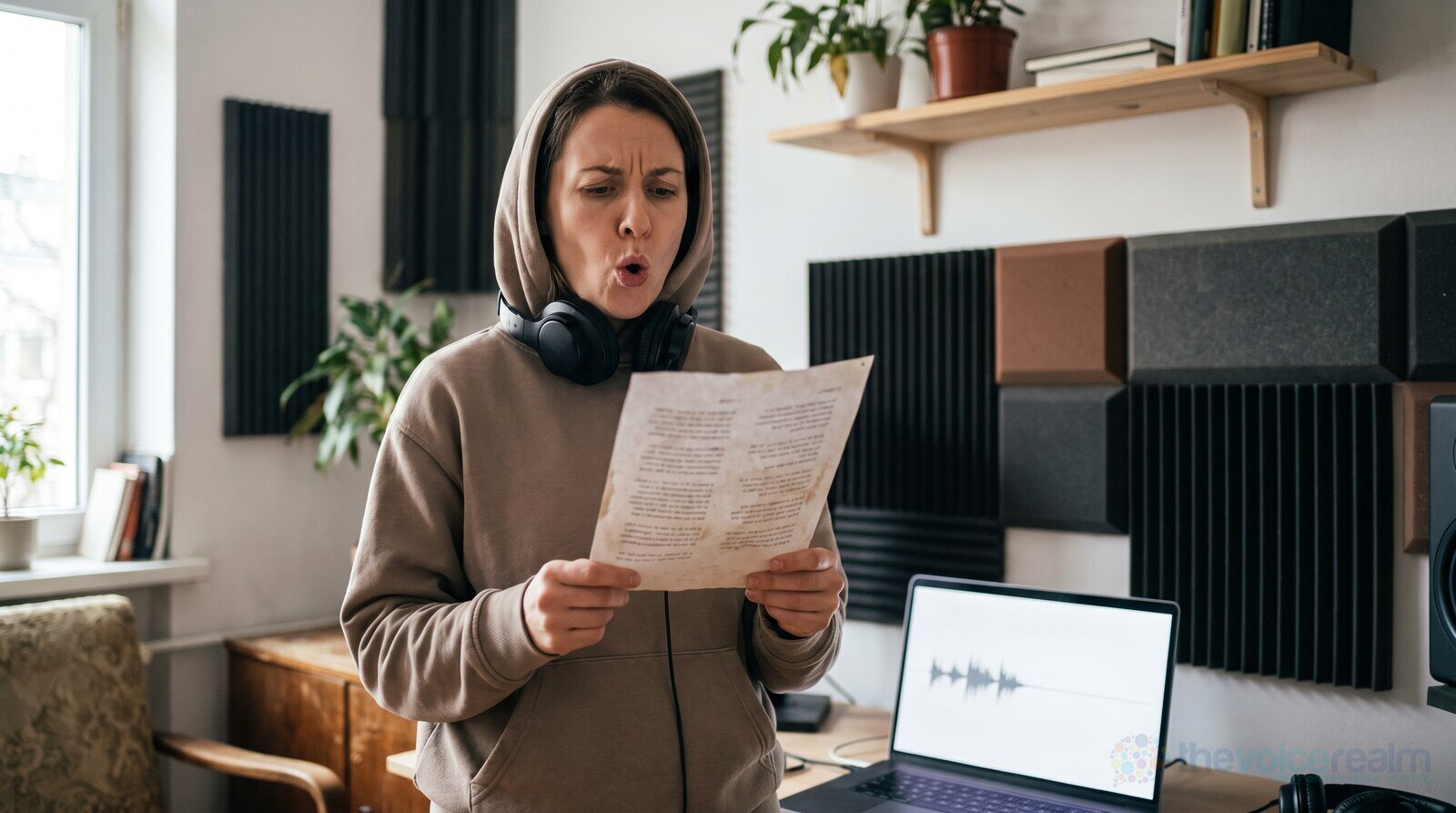
Big, slow vowel shapes wake up the lips and jaw before any tongue twisters. © The Voice Realm
Tongue twisters come next, with one voice actor’s twist: say them at a normal pace, with meaning, as if they were a line of copy. Speed isn’t the skill. Clean, relaxed and conversational is. A few that hit the tricky sounds:
- “Red leather, yellow leather” for L and R.
- “Unique New York, you know you need unique New York” for the tongue tip and the Y glide.
- “The tip of the tongue, the teeth, the lips” for crisp T and D endings.
One minute, then stop. Overdoing twisters is a quick route to a tight jaw, which is the opposite of the point.
Finish on the script itself
The last couple of minutes belong to the job in front of you. Read the first paragraph of today’s script out loud, at full performance level, twice. You’ll catch the awkward word, find where the breaths go and settle the energy before the record button turns it into a take.
Different jobs ask for different finishing touches, so tune the last part of the warm-up to whatever the day is going to ask of you. A quiet narration day and a loud game session don’t want the same preparation.
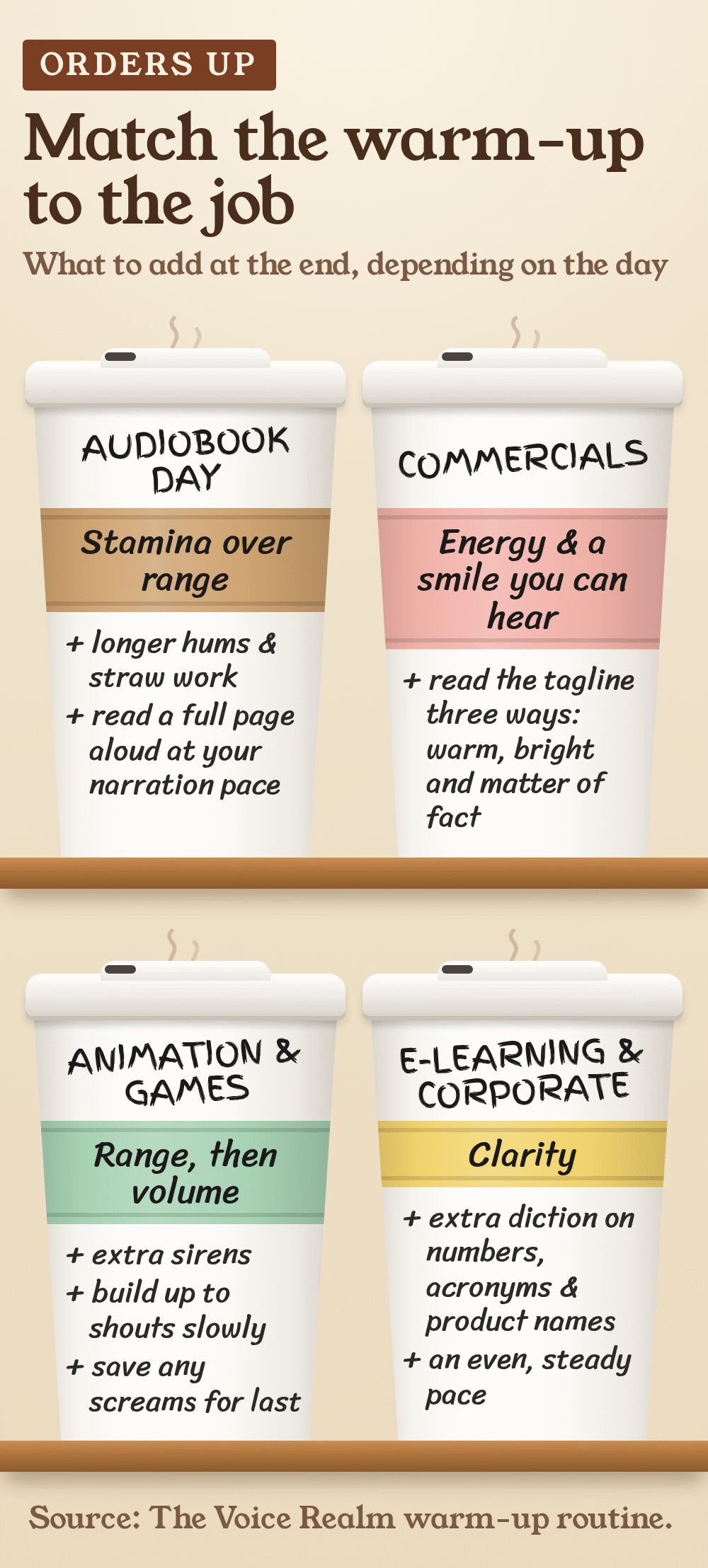
© The Voice Realm
Then stop for a few minutes. Really.
Here’s the part most routines skip. A team of voice researchers led from Lund University in Sweden asked healthy speakers to rate how much effort their voice took before and after a five-minute warm-up, and published the results in 2023. The result runs against what you’d expect: “Five minutes of vocal warm-up caused increased self-perceived vocal effort in vocally healthy individuals.”
The next line is the useful one: “After a 5-min rest in silence following completion of the vocal warm-up, vocal effort ratings returned to baseline levels in both groups.” The feeling of effort also faded faster for the group that had used straw-style exercises.
It was a small study of young speakers, not working voice actors, so don’t build a religion on it. But the practical lesson is easy to follow. Warm up, then give yourself a few quiet minutes: refill the water, check your levels, read the script through silently. Then record.
- Yawn and drop the shoulders. Two big yawns with a sigh, five slow shoulder rolls. Thirty seconds.
- Straw bubbles. An easy “oo” through a straw into water, then a few slow slides up and down. One minute.
- Lip trill slides. Loose lips, gentle “brrr” up and down. Thirty seconds.
- Two reads of the opening lines. Out loud, full energy, then a sip of water and a quiet minute before the first take.
It isn’t as good as the full ten minutes. It’s a lot better than nothing, and it fits between an email from a client and a booking that starts in a quarter of an hour.
When a warm-up isn’t the answer
A warm-up gets a healthy voice ready. It can’t fix a voice that’s hurt, and more exercises can make a sore throat worse. The UT Southwestern team is direct about it: “It’s not normal to feel pain when you’re using your voice.” They also advise seeing a laryngologist, a throat doctor who specialises in the voice, “if you have been hoarse for two weeks or longer.” The American Speech-Language-Hearing Association gives the same two-week marker for an ear, nose and throat check.
The same clinic has a tip worth carrying into every session: “It’s actually more vocally healthy to cough once than clear your throat multiple times.” Swallow, sip water or hum instead of that habitual throat clear.
If you’re fighting a cold right now, our guide on whether to record, adjust or rest when you’re ill walks through the decision. And for the habits that look after your voice between sessions, there’s our longer piece on keeping your instrument in shape.
Make it a habit you’ll actually keep
The best warm-up is the one you do every day without thinking about it. Same order, same place, same time. Keep a glass and a straw beside the mic, and do the body part while the kettle boils. After a week, it stops feeling like an extra job and starts feeling like turning the lights on in the studio.
If you’re new to all this and want someone to listen and tell you what your voice actually needs, working with a coach at Voice Master Academy is a good place to start. Then, once you’re warm, go and find something to use it on: the voice over jobs board has fresh castings most days.
Sources: “Voice care: Sorting fact from fiction”, UT Southwestern Medical Center; “Protect Your Voice This Back-to-School Season”, American Speech-Language-Hearing Association, August 2025; “Semi occluded vocal tract exercises”, Cambridge University Hospitals NHS Foundation Trust; “Lip trills exercises”, Royal Papworth Hospital NHS Foundation Trust; “Effects of warm-up exercises on self-assessed vocal effort”, Whitling, Wan, Berardi and Hunter, Logopedics Phoniatrics Vocology, 2023.
Ready to get booked?
See the jobs open right nowAbout Sarah Robbins
Sarah Robbins writes for The Voice Realm about finding voice over work, home studios, casting and the business side of voice acting.