Blog

This one’s for anyone who has played back a take and winced at a honk, a whine or that stuffed up, holding your nose sound. Maybe a client wrote “a bit nasal” in their notes. Maybe you just can’t stop hearing it now. The good news is that nasality is one of the easier things in a voice to test for at home, and most of what causes it in healthy adults can be trained. Here’s how to tell which kind you’ve got, why it happens and what to do about it before your next session.
Two opposite problems share one word
When people say a voice sounds nasal, they can mean two completely different things. Speech pathologists keep them apart, and so should you, because the fixes point in opposite directions.
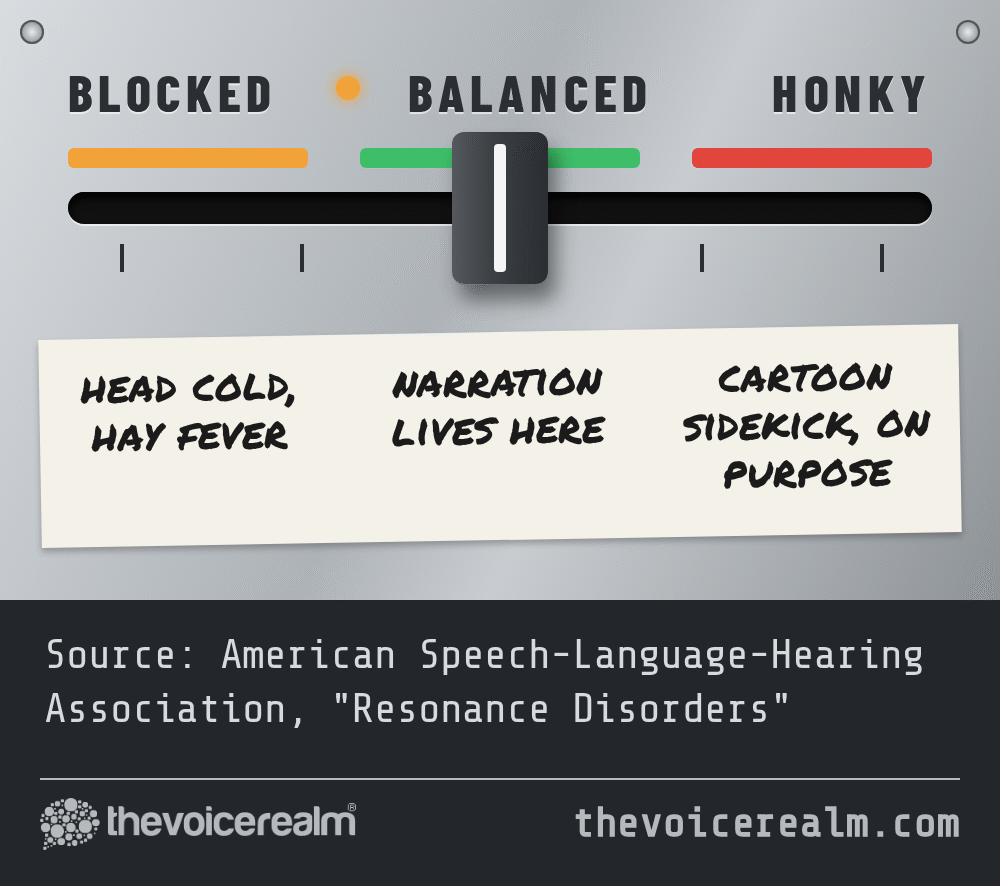
The American Speech-Language-Hearing Association describes the first, hypernasality, as what “occurs when there is abnormal sound energy in the nasal cavity during production of voiced, oral sounds.” In plain terms, sound that should leave through your mouth is leaking up behind the soft palate and out through your nose. The second, hyponasality, is the reverse: too little nose on the sounds that need it.
Hypernasal
Vowels sound whiny or honky. Words with no M, N or NG in them still buzz in the nose. It often creeps in when you’re tired, tense or pushing for brightness.
Hyponasal
You sound like you have a cold. “Morning” turns into “Bordig”. It usually means something is blocking the nasal airway, from a cold or hay fever to swollen tissue.
Here’s a detail that surprises people. ASHA is clear that “Resonance disorders are not voice disorders, although they are often mislabeled as such.” Your vocal folds can be perfectly healthy while the space above them is shaping the sound badly. That’s why throat sprays and steam rarely touch a hypernasal sound. The problem lives higher up.
The thirty second pinch test
You don’t need a clinic to get a first answer. You need your own nose and two sentences.
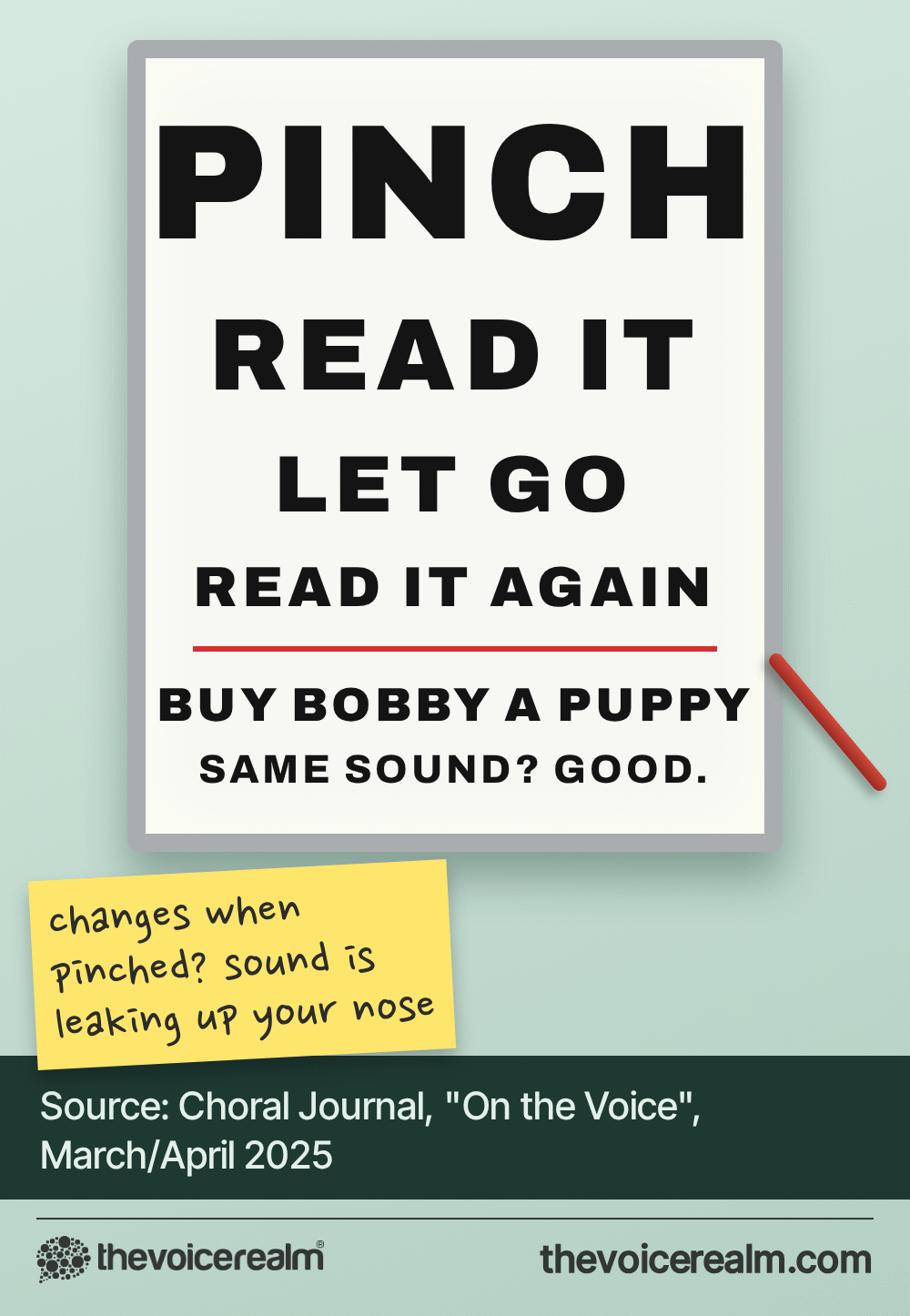
The trick works because of what pinching does. Close your nostrils and any sound that should be travelling out of your mouth won’t care. Sound that’s sneaking through your nose will suddenly get trapped, and you’ll hear it. The Choral Journal’s “On the Voice” column puts it neatly: “If there is nasality in the tone, the sound of the voice will change when the nose is pinched; if there is no nasality, the sound will not change.”
The sentence matters. Pick one with no nasal consonants at all, so every sound in it should come out of your mouth. “Buy Bobby a puppy” is the classic, and so are “Take a cookie” and “She sees the sheep.” If your voice turns muffled or boomy on those when you pinch, sound is leaking where it shouldn’t.
Then try the opposite. Say “Mama made some lemon jam” with your nose pinched. That one should sound completely wrong, because it’s packed with nasal consonants. If it barely changes, your nose wasn’t open in the first place, and you’re on the hyponasal side.
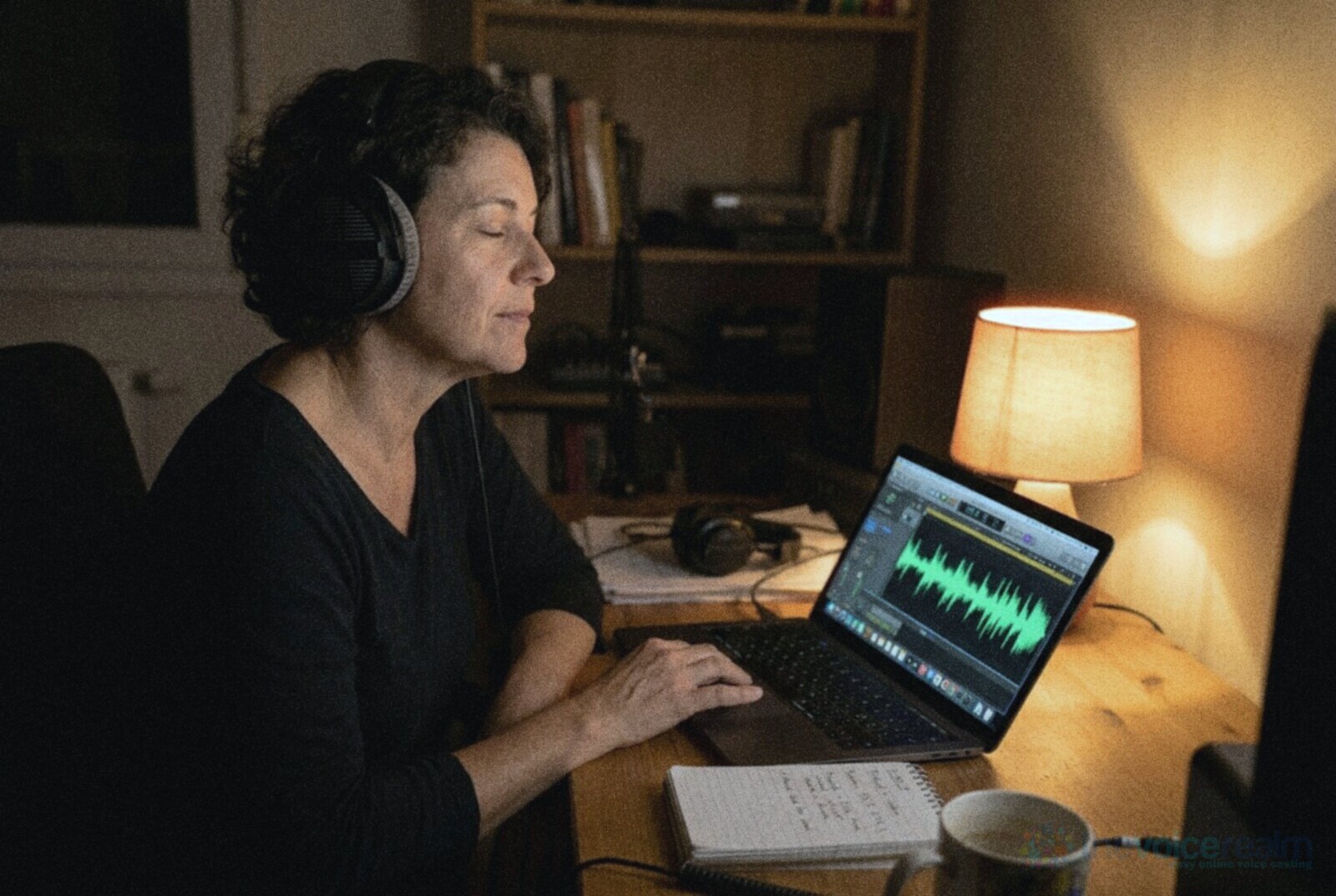
Record both versions on your phone rather than trusting your ears in the moment. You hear your own voice partly through the bones of your skull, which muddies exactly the thing you’re trying to judge.
© The Voice Realm
Too much nose: why air leaks through
The soft palate is the muscular back part of the roof of your mouth. For most speech sounds it lifts and seals against the back of the throat, closing the door to the nose. For M, N and NG it drops and opens the door. A hypernasal voice is a door that doesn’t close firmly enough.
In children and in some adults there’s a structural or medical reason, and that’s a job for a specialist. But in working voice actors the cause is very often a habit. Writing for clinicians, the team at Adult Speech Therapy notes that “Sometimes hypernasality is present even without structural or neurological impairments.” Voice actors build these habits for understandable reasons.
- Chasing brightness. Being told to “smile” or “lift it” can push the sound up into the face and nose instead of forward through the mouth.
- A lazy palate late in the day. Muscles tire. A palate that seals nicely at 9am may be half closed by your fourth hour of e-learning.
- A tight jaw. Read with your teeth almost touching and the sound has less room to leave through the mouth, so more of it finds the nose. If that sounds familiar, our piece on letting go of jaw tension pairs well with this one.
- Accent and character carryover. Some regional accents sit further into the nose, and so does that whiny sidekick you voiced all week.
None of these mean anything is wrong with you. They mean the setting has drifted, and settings can be moved.
© The Voice Realm
Not enough nose: the blocked cold sound
The hyponasal side is usually simpler to explain. Something is in the way. ASHA lists “Swelling (with or without nasal congestion) due to allergic rhinitis, common cold, adenoid hypertrophy” among the causes, along with other obstructions in the nose and the space behind it.
For a voice actor that mostly means two things: colds and allergies. If you’re stuffed up on a session day, no amount of technique will open a blocked airway, and pushing harder just tires your voice. We’ve covered what to do when you have to record with a cold and how hay fever season affects your sound in more detail, including when it’s smarter to move a session than to fight through it.
If you sound blocked all year round, even when you feel fine, that’s worth mentioning to a GP. A deviated septum, enlarged adenoids or long term swelling can all keep the airway narrow, and they’re medical questions, not vocal ones.

© The Voice Realm
Exercises to lift the soft palate
If your pinch test pointed at too much nose, these drills help you feel the palate move and give you control of it. Do them for five minutes before a session and again whenever you hear the honk creep back.
Start with a yawn. The soft palate lifts at the start of a yawn, and feeling that lift is half the battle. The Choral Journal suggests that “Students can try yawning to feel the soft palate lifting (while being careful not to overextend the jaw during the yawn).” Notice the cool, open feeling at the back of your mouth. That’s the shape you want to keep, gently, while you speak.
 VoiceEditSuiteScript Accuracy CheckerEvery word checked against the script.Every flub and missing word, found for you.See how it works
Sing, then switch. Hum “ng” as in the end of “sing”, then open straight into “ah”. On “ng” the palate is down and the sound buzzes in your nose. On “ah” it should snap up and the buzz should vanish. Go back and forth slowly, ten times. You’re training the switch, not the hum.
Use pairs. Read pairs that differ only in the nasal sound: “bad, man”, “bead, mean”, “dough, no”. Pinch your nose on the first word of each pair. It should stay clear. Let go for the second word, which needs the nose.
Aim the sound at the script. Hold your script page about an arm’s length away and imagine each word landing on it. It sounds silly, but it pulls the sound forward through your mouth instead of up into your face.
Loosen everything else. Drop your shoulders, unclench your jaw and let your tongue lie flat behind your lower teeth. Tension anywhere above the collarbones tends to pull the sound back and up.
Recheck with the pinch test at the end. Progress is usually quick for habit based nasality, often within a couple of weeks of daily practice. If you’re newer to this and want someone to hear it with you, a coach at Voice Master Academy can tell you in one lesson which side you’re on and drill it with you.

© The Voice Realm
When nasal is the right call
Here’s the fun twist. Nasality isn’t always a fault. The Choral Journal makes the same point about singing: “Nasality can be appropriate in certain styles of singing.” The same is true in voice acting.
A whiny kid brother, a fussy bureaucrat, a cartoon rat, a nervous sidekick, a country twang in a radio spot: plenty of characters live on the nasal side on purpose. Now and then a cold remedy ad even wants a deliberately blocked voice for the “before” line. The skill isn’t removing nasality forever. It’s being able to dial it up and down on demand and knowing where your natural setting sits.
That’s why the drills above matter even if your default read is fine. A voice actor who can move the palate at will has more characters available. If you want to build that range on purpose, our guide to building character voices that last is a good next step. Just make sure the nasal setting stays with the character and doesn’t follow you into your next narration job.
The best habit is to listen back cold. Leave a take for an hour, play it on headphones with your eyes closed and ask one question: is this nose on purpose?
© The Voice Realm
When to see a professional
Most adult voice actors with a nasal sound have a habit, a cold or an allergy. But some signs point to something a drill won’t fix:
- You hear air hissing out of your nose on sounds like S, P or T.
- Liquid comes out of your nose when you drink.
- The nasality appeared suddenly, after surgery, an injury or illness.
- Your nose has been blocked for months, not days.
- Weeks of daily practice haven’t moved the pinch test at all.
Any of those is a reason to see your GP, who can refer you on to an ENT doctor or a speech pathologist. As The Royal Children’s Hospital Melbourne explains about nasal speech in its patient information, a speech pathologist “can assess and diagnose nasal speech, and plan the best treatment.” That holds for adults too. They have tools, from simple listening tests to scopes that watch the palate move, that no home recording can match.
For everyone else, keep it simple. Check yourself with a pinch every week or so, and train the switch until your nose only joins in when you invite it.
Sources: American Speech-Language-Hearing Association, “Resonance Disorders”, Practice Portal. Choral Journal, “On the Voice”, March/April 2025. Adult Speech Therapy, “6 Hypernasal Speech Treatment Ideas for Adults”. The Royal Children’s Hospital Melbourne, “Nasal speech”, Kids Health Info.
Ready to get booked?
See the jobs open right nowAbout Sarah Robbins
Sarah Robbins writes for The Voice Realm about finding voice over work, home studios, casting and the business side of voice acting.