Blog

This one’s for every voice actor who’s finished a long session with an aching face, a tired sound and no idea why. Very often the answer is sitting just in front of your ears. The jaw is one of the busiest muscle groups you own, it tightens up when you concentrate, and when it tightens, your voice usually follows. Here’s how to spot it, the simple release moves that speech therapists actually hand to patients, and how to read a script without bracing your face against it.
Where jaw tension hides in a voice actor
Jaw tension rarely announces itself. It creeps in while you’re doing something else: chasing a tricky line, editing late at night, reading a long legal disclaimer for the fourth time. You only notice the result.
Here are the signs voice actors tend to report:
- Your back teeth are touching when you’re not eating. At rest they shouldn’t be.
- Your face aches around the cheeks or in front of the ears after a long read.
- Your sound gets thinner, brighter or more nasal as the session goes on.
- You over-articulate, chewing every consonant as if the words might escape.
- Your jaw clicks, or you wake with a sore face or a headache at the temples.
None of those proves anything on its own. Put two or three together, though, and the jaw is a good first suspect.
Concentration is the big trigger. Watch someone threading a needle or filling in a tax form and you’ll often see the jaw set and the lips press together. Reading copy cold is the same kind of focus. So is staring at a waveform for three hours.

© The Voice Realm
Why a tight jaw makes a tight voice
Your jaw, tongue and larynx are neighbours, and they’re tied together by muscle. The tongue’s root connects to the hyoid bone, which the larynx hangs from. Clamp the jaw and the tongue tends to stiffen with it, and a stiff tongue pulls on the voice box below. You end up working harder to make the same sound.
Leda Scearce made exactly this point in a workshop abstract on jaw and tongue tension in singers for the Voice Foundation’s 2025 symposium: “Tension in the tongue/jaw can result in increased laryngeal effort.” Voice actors use the same machinery for hours at a time, often in one fixed position, so it’s no surprise the problem travels.
The research linking jaw disorders and voice is real but modest, so it’s worth being honest about it. A small 2024 study in The Laryngoscope surveyed 53 patients at a jaw disorder clinic and found that “80% of patients presenting to TMD clinic had VHI scores above zero, but most had minimal to mild impairment.” In plain words: most people with a troubled jaw noticed some effect on their voice, but for most of them it was small, and their average scores weren’t different from people without the problem. The authors still suggested bringing in voice specialists and speech pathologists alongside dentists.
“Many singers struggle with muscle tension in the tongue and/or jaw, which are often locations for excessive effort.”
Leda Scearce, Voice Foundation symposium abstract, 2025Post this quote
So the takeaway isn’t “a tight jaw will ruin your voice”. It’s that a tight jaw is extra effort you don’t need, and over a full day of narration or a run of character auditions, extra effort adds up. If you’ve already read our piece on when tension turns into a real voice problem, the jaw is one of the first places a voice clinician will look.
© The Voice Realm
Check your jaw in thirty seconds
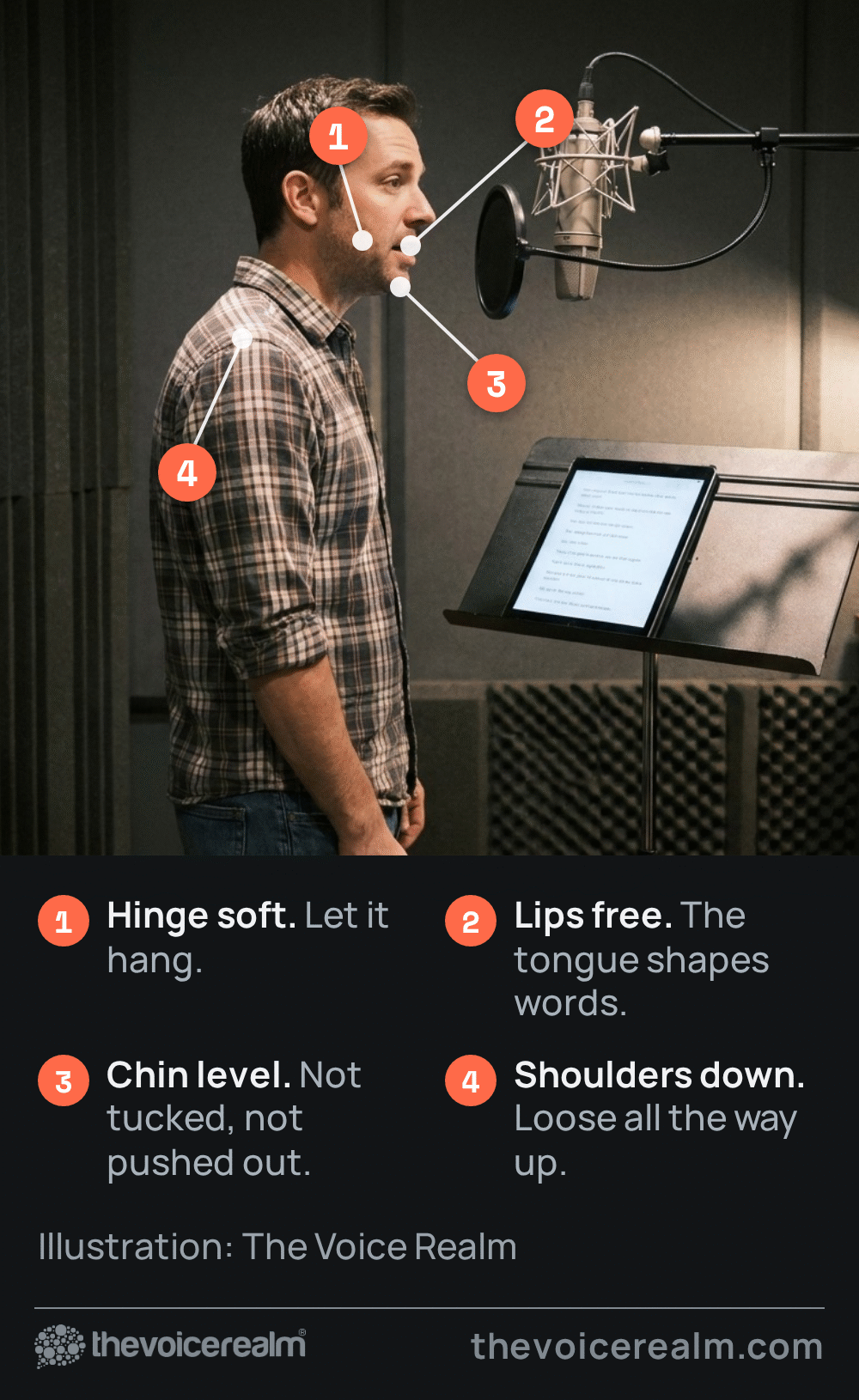
Before you fix anything, find out what your jaw is doing right now. This takes half a minute and needs nothing but a mirror.
Rest position. Close your lips lightly. Now notice your teeth. If they’re touching, let them part a little, with your lips still together. That small gap is where your jaw should live when you’re not talking or eating. The tip of your tongue can rest softly behind your lower front teeth.
The finger test. Put your fingertips just in front of your ears and clench gently. You’ll feel the muscle bulge. Now let go and feel it soften. If it never really softens, or it feels like a knot, that’s information.
The mirror test. Say a sentence from your current script while watching yourself. Does your chin push forward? Does your jaw swing to one side? Do the corners of your mouth pull back? A lot of tension shows up visually long before you feel it.
The recording test. Record the same two lines twice: once as you’d normally read them, then again after letting your jaw hang loose for ten seconds. Listen back with headphones. Many people hear a rounder, warmer sound on the second take without trying to change anything else.

© The Voice Realm
Five minutes of jaw release before the mic
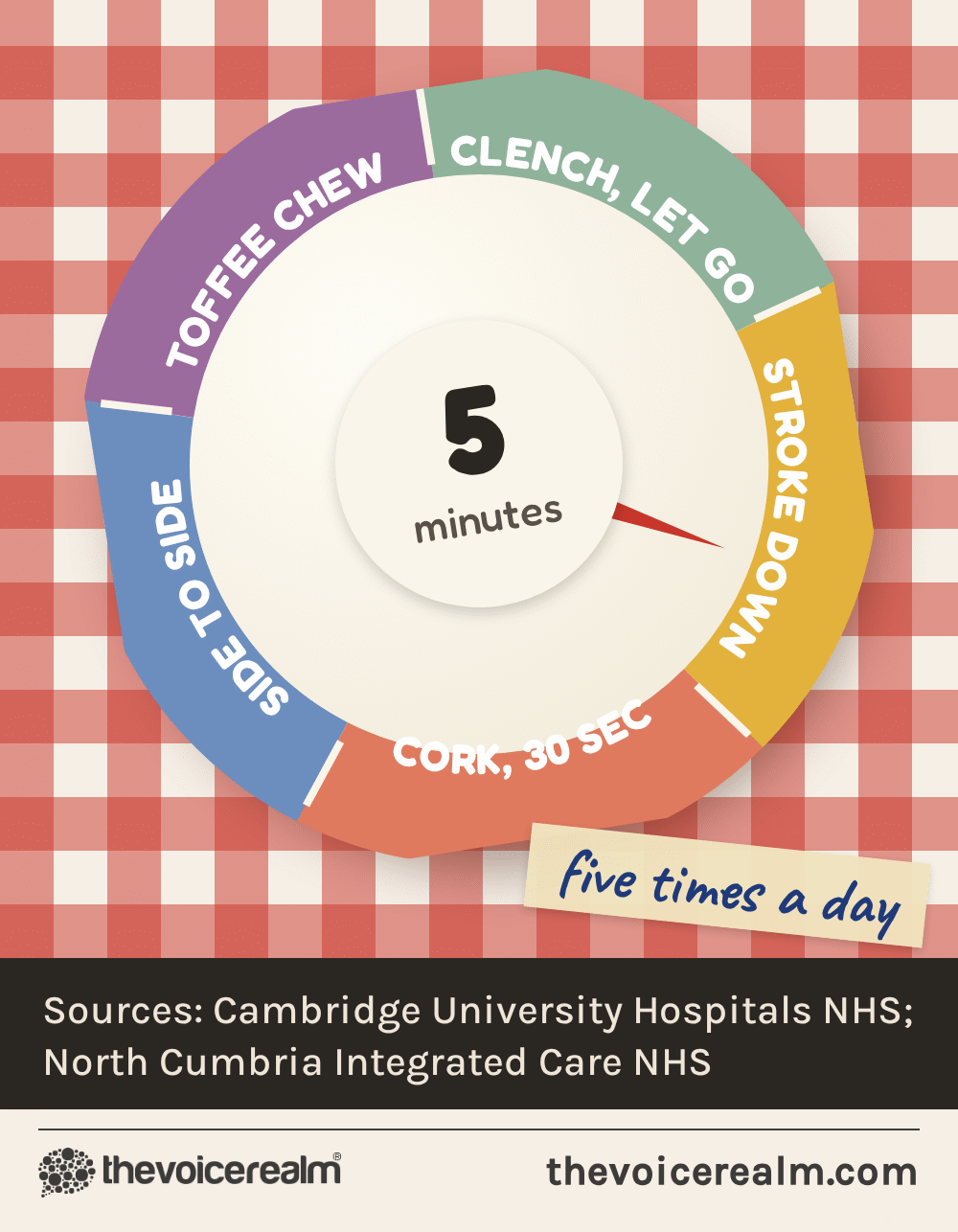
The moves below come from patient leaflets written by NHS speech and language therapists. They’re gentle, quick and need no equipment. Go slowly and never push into pain.
Start with clench and release. Cambridge University Hospitals’ flexibility sheet puts it simply: “Clench your teeth tightly together.” Then, “Now release the tension that is keeping the teeth together and feel the difference.” Do it three or four times. The contrast teaches you what loose actually feels like.
Next, the stroke down. Place your fingers on both sides of your face at jaw level and, in the same sheet’s words, “Stroke the jaw downwards, allowing it to open gently, little by little.” Keep your lips lightly together so the teeth separate behind them.
Then the cork. A leaflet from North Cumbria Integrated Care NHS Foundation Trust suggests you “drop your jaw a little, imagine you are holding a cork between your back teeth and hold it for 30 seconds.” It’s a lovely image because it gives you the size of the gap without forcing it open.
After that, side to side. With your mouth slightly open, slide the jaw gently left and hold, then right and hold, about ten seconds each way, per the same leaflet.
 VOICEMASTERACADEMYLearn the craft in order.Module one is freeStart module oneTwenty modules, start to finish.
Finish with the toffee chew, our favourite. The North Cumbria leaflet says to “Try to imagine chewing a piece of toffee or gum, which increases in size with every chewing movement.” Big, lazy, exaggerated chewing, lips closed, for twenty seconds or so. Add a hum while you chew and you’ve got a warm-up too. Our five-minute vocal warm-up slots in nicely straight after.
One caution from the same leaflet is worth repeating. If you’re already seeing a speech therapist for a voice problem, it advises patients to “Only carry out the exercises marked with a cross, under the guidance of your speech and language therapist.” Their plan for you beats a general list every time.
Make it a habit, not a rescue
The mistake most people make is doing these once, before an important session, and wondering why they didn’t help much. Tension builds all day, so release works best little and often.
Cambridge University Hospitals’ sheet suggests “A good target would be to practise them five times a day, for up to five minutes each time.” For a voice actor, that maps neatly onto a working day:
- When you get up, before your first coffee.
- Right before you step up to the mic.
- At your mid-session break.
- After a long edit, when your face has been frozen in concentration.
- Before bed, so you don’t carry the day’s clench into the night.
Set a reminder on your phone for the first week. After that, you’ll start catching the clench yourself, which is the real goal.
© The Voice Realm
At the mic: read without bracing
Release exercises buy you a loose jaw. Your setup decides whether you keep it.
Get the script up. If your copy sits low on a desk, you tilt your head down to read it and squash the space under your chin. Raise the tablet or music stand so you can read with your chin roughly level. If you’re still deciding between standing and sitting, our guide to whether to sit or stand at the mic covers the posture side in more detail.
Let the tongue and lips do the work. Clear diction comes mostly from the tip of the tongue and the lips. When you try to get crispness from the jaw instead, you end up chomping. Read a tongue twister with a tiny jaw movement and you’ll find it’s still perfectly clear.
Check your face between takes. Clients ask for “more energy” and many of us hear “more force”. Energy lives in your intention and your breath, not in a clamped jaw. Between takes, let the jaw drop, wiggle it, and go again.
Watch the hard characters. Gritty villains, big announcer reads and shouty game barks are where the jaw locks hardest. Warm up properly, take breaks more often and keep the jaw moving between lines.
Off the mic: the habits that wind it back up
What you do away from the booth matters as much as anything you do in it. The US National Institute of Dental and Craniofacial Research gives this plain advice for people with jaw pain: “Reduce habits such as jaw clenching, gum chewing, or nail biting.” For voice actors, add a few of our own:
- Editing face. Long stretches staring at a screen are prime clenching time. Every time you render a file, check your teeth.
- Phone neck. Looking down at a phone pushes the chin forward and tightens everything below it. Bring the phone up instead.
- Stress. A pending audition result or a late payment can sit in your jaw for days. Notice it, breathe out and let it go.
- Night grinding. If you wake with a sore jaw or a headache, mention it to your dentist. Some people need a night guard.

© The Voice Realm
When a sore jaw is more than tension
Most jaw tightness is the everyday kind that loosens with attention. Sometimes it’s a temporomandibular disorder, or TMD, which affects the jaw joint and the muscles around it. It’s common. The NIDCR says “TMD affects about 5% of adults in the U.S., but this number can vary depending on who is studied.”
Clicking alone isn’t usually a worry. The same NIDCR page notes that “clicking or popping sounds in the TMJs, without pain, are common, are considered normal”. What deserves a proper check is pain that keeps coming back, a jaw that locks or won’t open fully, a bite that suddenly feels different, or headaches and earaches that go with jaw use. For any of those, the NIDCR’s advice is short: “Consult a dentist or doctor.”
And if your voice itself is changing, getting hoarse or tiring fast for more than a couple of weeks, see a voice specialist or an ENT. Our wider guide to keeping your voice healthy for the long run explains who to see and when.
For everyone else, the routine is simple: catch the clench, let it go, and do it often enough that loose becomes your normal. Your voice will thank you somewhere around hour three of the next audiobook.
Sources: North Cumbria Integrated Care NHS Foundation Trust, “Speech and Language: Deconstriction”. Cambridge University Hospitals NHS Foundation Trust, “Muscular flexibility exercise sheet”. Leda Scearce, “Manual Therapy as a Modality for Treating Jaw and Tongue Tension in Singers”, Voice Foundation symposium abstract, 2025. Adessa, Kim, Tierney and Benninger, “Temporomandibular Dysfunction and Voice-Related Quality of Life Impairment”, The Laryngoscope, 2024. National Institute of Dental and Craniofacial Research, “TMD (Temporomandibular Disorders)”.
Ready to get booked?
See the jobs open right nowAbout Sarah Robbins
Sarah Robbins writes for The Voice Realm about finding voice over work, home studios, casting and the business side of voice acting.