Blog

This one’s for voice actors who have asthma, and for anyone who’s noticed their voice sounds a little rougher since they started a new inhaler. If you’ve wondered whether your preventer is behind that croak at the end of a long session, you’re not imagining it. It’s a known side effect, and for most people it’s very fixable.
Below you’ll find which inhalers can affect the voice and why, the small habits that protect it, how to talk to your doctor or pharmacist without risking your breathing, and how to plan a recording day around your doses. One thing first, and we’ll repeat it: never stop or cut down an asthma medicine on your own to save your voice. Your lungs come first. A good read needs air.
Which inhalers touch your voice
Most people with asthma carry two kinds of inhaler. The reliever, usually blue, opens the airways fast when you’re wheezy. The preventer, or a combination inhaler that does both jobs, contains a steroid that calms the inflammation in your airways over time. It’s the steroid that matters here.
Steroid inhalers are safe and work well, and they’re the reason many people with asthma can talk, sing and record all day. But a puff doesn’t all reach the lungs. Some of the medicine lands on the way down, in the mouth and the throat, close to the voice box.
Asthma + Lung UK puts it plainly: “The steroid medicine can build up on the back of your throat, mouth and tongue and cause side effects,” and it lists “a hoarse voice” among them. The NHS page on beclometasone, one of the most common preventers, includes “Dry or sore throat, or hoarse voice” in its list of common side effects.
How common is a hoarse voice from an inhaler?
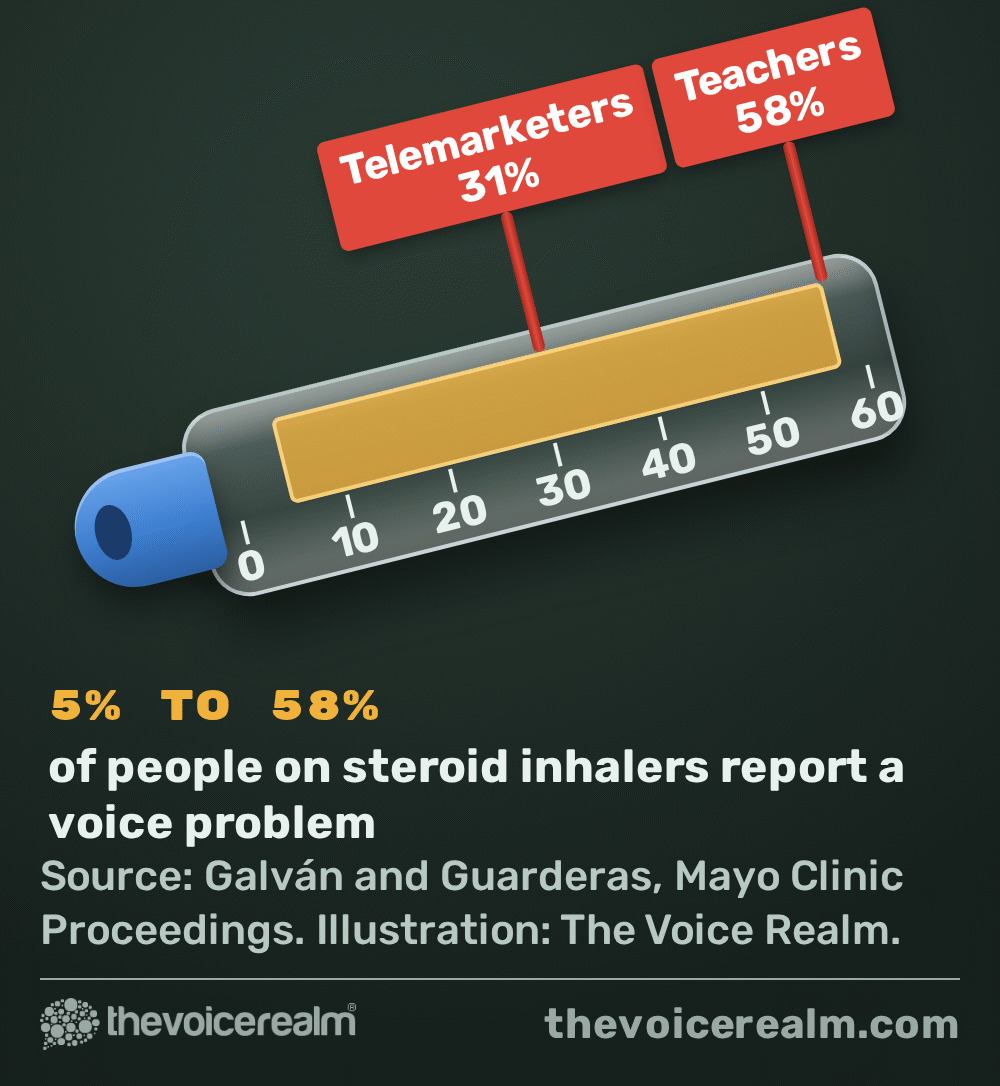
More common than most people think, and very variable. A review in Mayo Clinic Proceedings by César Galván and Juan Carlos Guarderas looked at the research on inhaled steroids and the voice. They wrote that dysphonia, the medical word for a voice problem, “has been reported to affect 5% to 58% of patients.” That’s a huge range, partly because studies measure it in different ways, and partly because people use their voices so differently.
That second point is the one to notice. The same review found the problem shows up more often in people who talk for a living, citing figures where “31% of telemarketers and 58% of teachers are affected.” A voice actor sits squarely in that group. You use your voice for hours, you hear every rough edge on playback, and a client hears it too.
The authors’ conclusion is worth keeping in mind if anyone shrugs it off: dysphonia caused by inhaled steroids “is not rare” and should be considered a frequent cause of voice problems.
What it sounds and feels like at the mic
Inhaler hoarseness tends to creep in rather than arrive overnight. Here’s what people commonly notice: a voice that’s fine first thing and frayed by the afternoon, a husky edge on quiet, close lines, a range that feels a few notes shorter at the top, more throat clearing than usual, and a dry or scratchy feeling after a dose.
Doctors have more than one explanation for why it happens. Galván and Guarderas describe an older idea of a weakening of the muscles that close the vocal folds, caused by the steroid settling on them, and another of a direct effect on the lining of the throat. Thrush is a third culprit. The NHS describes oral thrush as “a fungal infection that causes white patches, redness and soreness in your mouth,” and steroid inhalers make it more likely. If you see white patches, that’s a trip to the pharmacist, not something to push through.
None of this is the same as a cold, reflux or an allergy, though all of them can stack on top. If you’re already dealing with seasonal symptoms, our guide to allergy season and your voice helps you tell the difference.
© The Voice Realm
Rinse, spit, then speak
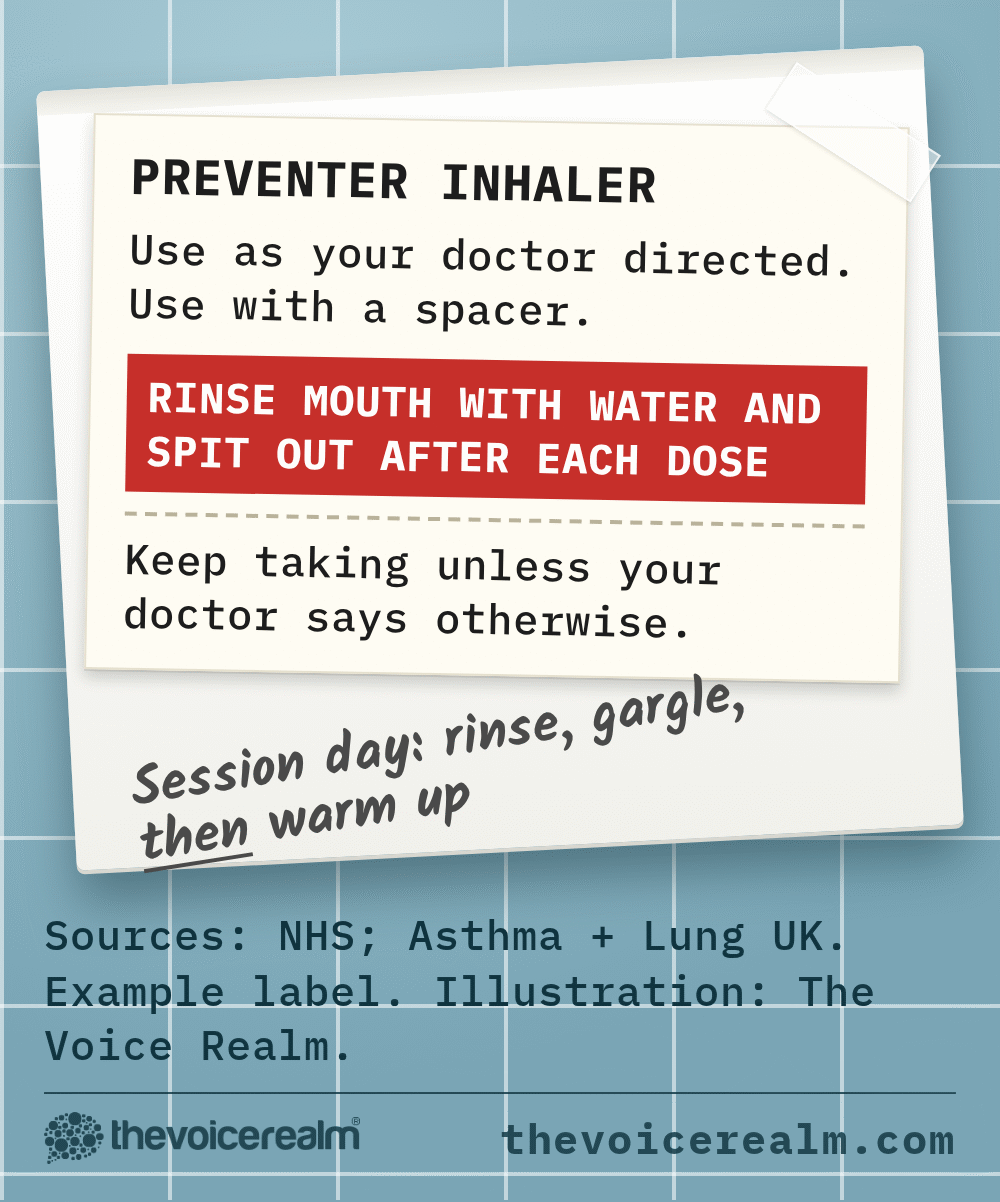
The simplest fix is also the one most people skip. After every dose of a steroid inhaler, rinse your mouth with water and spit it out. Asthma + Lung UK says this “can help to clear any medicine that is stuck in your mouth or throat and help prevent side effects.” The NHS adds brushing your teeth as another option.
Galván and Guarderas go a step further. Their advice is that “Patients should be instructed to rinse the mouth, gargle, and wash the face after inhalation.” A gargle reaches further back than a swish, which is where the medicine you care about has landed.
Make it a ritual rather than a rule you try to remember. Keep the inhaler by the bathroom sink rather than in a drawer, so you take it next to the tap and the toothbrush. Spit the water out rather than swallowing it. And keep a separate glass of room temperature water in the booth for sipping, because that’s a different job, which we cover in our piece on what hydration really does for a voice.
© The Voice Realm
The spacer: a plastic tube that saves your throat
A spacer is a plastic or metal chamber that clips onto an aerosol inhaler. You puff the medicine into the tube and breathe it in from there. The spray slows down, the big droplets drop out inside the chamber rather than on the back of your throat, and more of the dose reaches your lungs.
For a voice actor that’s a double win. The NHS says that “Using a spacer with your beclometasone inhaler can also help to prevent side effects in your mouth,” and Asthma + Lung UK agrees that a spacer “can also prevent side effects from steroid medicines in preventer or combination inhalers.” The Mayo Clinic review recommends a spacer for exactly this reason, to cut down how much of the medicine lands in the mouth and throat.
Spacers only fit aerosol inhalers, the kind you press. Ask your pharmacist or asthma nurse which one fits yours, and how to clean it. The review’s own advice is that after use a spacer “must be washed with tap water and allowed to air dry.”
Technique matters more than you’d think
A lot of hoarseness comes from medicine going where it wasn’t meant to go. That’s usually a technique problem, and it’s easy to fix once someone watches you do it.
 VOICEMASTERACADEMYTwenty modules, one at a time.Breath controlHome studioCommercial techniqueAuditionsStart module oneNo experience needed.
The two main kinds of inhaler want different breaths. In The Pharmaceutical Journal, pharmacist Grainne d’Ancona sums it up as “‘slow and steady’ for an aerosol inhaler, ‘quick and deep’ for a dry powder inhaler.” Use the wrong breath and more of the dose sticks to the back of your throat instead of travelling down.
“Keep taking the medicine but talk to your doctor, nurse or a pharmacist if the advice on how to cope does not help.”
NHS, on a hoarse voice from a beclometasone inhalerPost this quote
Most pharmacies will check your technique for free in a couple of minutes. Bring your inhaler, ask them to watch, and mention that you use your voice for work. That last bit changes the conversation, because it tells them a side effect most people shrug off is a real problem for you.

© The Voice Realm
Talking to your doctor without risking your breathing
If rinsing, a spacer and better technique haven’t sorted it after a few weeks, book a review with your GP or asthma nurse. The NHS advice for a hoarse voice is to keep taking the medicine but talk to them “if the advice on how to cope does not help and these side effects bother you or do not go away.”
There’s usually room to adjust. The Mayo Clinic review lists the options doctors tend to look at, and the first is using “the lowest effective dosage” that keeps asthma under control. The Pharmaceutical Journal calls dose optimisation “The main strategy to minimise the risk” of steroid side effects. That’s a decision for your doctor, made with your breathing in mind, not something to try at home.
Changing the device can help too. Galván and Guarderas describe a study where people moved from an aerosol inhaler to a dry powder inhaler, and “the frequency of dysphonia decreased from 21% to 6%.” A different steroid, a different inhaler or a different combination may suit your voice better. Again, your doctor decides, because the best inhaler for your voice is worthless if your asthma isn’t controlled.
What to bring to the appointment:
- A short recording. Ten seconds of your voice on a good morning and ten on a rough afternoon. You already have the gear to make it, and it says more than a description.
- Your routine. When you take each inhaler, whether you rinse, whether you use a spacer.
- How you use your voice. Hours a day at the mic, the kind of work, any shouting or character voices.
- How long it’s been going on. And whether it eases on days off.
If hoarseness lasts more than a few weeks whatever you do, ask about a referral to an ear, nose and throat specialist or a voice clinic. A rough voice that doesn’t clear up deserves a proper look, inhaler or not.

© The Voice Realm
Planning a recording day around your doses
You can’t always choose when to take your preventer, and you should follow the times your doctor gave you. But within those times, a little planning goes a long way.
If you take a morning dose, take it early, rinse and gargle, and let your voice settle while you have breakfast. Do your warm-up after that rather than straight after the puff. Our five minute warm-up for voice actors fits nicely into the gap.
Put your most delicate work first. Soft, close, intimate reads like meditation, bedtime stories or luxury ads are the first to show a husky edge. Save the brighter, more energetic reads for later in the day when your voice is warmer and any roughness hides better.
Keep your reliever inhaler in the booth. A booth is a small, warm room with soft furnishings, and if dust or a stuffy space sets off your asthma, you want the inhaler within reach, not in the kitchen. If a session runs long, take breaks, open the door, and get some fresh air in.
Tell a director if your voice is struggling on a live session. It’s far better to ask for a five minute break and a glass of water than to push through and spend the next three days recovering.
© The Voice Realm
When it isn’t the inhaler
Asthma medicine is a common cause of hoarseness, but not the only one. Reflux, allergies, a lingering cold, dry air and long hours can all produce the same rough edge, and they often overlap. If your voice changes suddenly, if you lose it altogether, if swallowing hurts or if it simply won’t recover, see a doctor. Our wider guide to protecting your voice as a voice actor covers the everyday habits that keep it in shape.
Plenty of working voice actors have asthma. Most of them manage it with a few small habits: a rinse and a gargle after every dose, a spacer if their inhaler takes one, a technique check now and then, and an honest chat with their doctor when something changes. Breathe first. The voice follows.
Sources: “Side effects of beclometasone inhalers,” NHS; “How to use a spacer with a mask for an adult,” Asthma + Lung UK; “Practical Considerations for Dysphonia Caused by Inhaled Corticosteroids,” César A. Galván and Juan Carlos Guarderas, Mayo Clinic Proceedings; “Inhaled corticosteroids: managing side effects,” Grainne d’Ancona, The Pharmaceutical Journal.
Ready to get booked?
See the jobs open right nowAbout Sarah Robbins
Sarah Robbins writes for The Voice Realm about finding voice over work, home studios, casting and the business side of voice acting.