Blog

Britain’s two big audio award nights landed in the same week, and they told two quite different stories about who gets to be a narrator. At one, a Hollywood star won for his first audiobook. At the other, on Thursday night at BFI Southbank, the narration prize went to a freelancer, silver went to an independent production, and a much loved screen actor took bronze. This piece is for UK voiceover artists who want to know what that second result says about the work, and for the producers and publishers deciding whose voice goes on their next project.
Award nights are partly a party, of course. But the shortlists and the results are also a map of what the industry thinks good sounds like this year, and this year’s map is worth reading closely.
What happened at BFI Southbank
The APAs from AudioUK are the podcast and audio production awards. They started in 2010 as the Radio Production Awards and took their current name in 2016. This year’s ceremony was hosted by the comedian Kiri Pritchard-McLean, with Audible as headline sponsor.
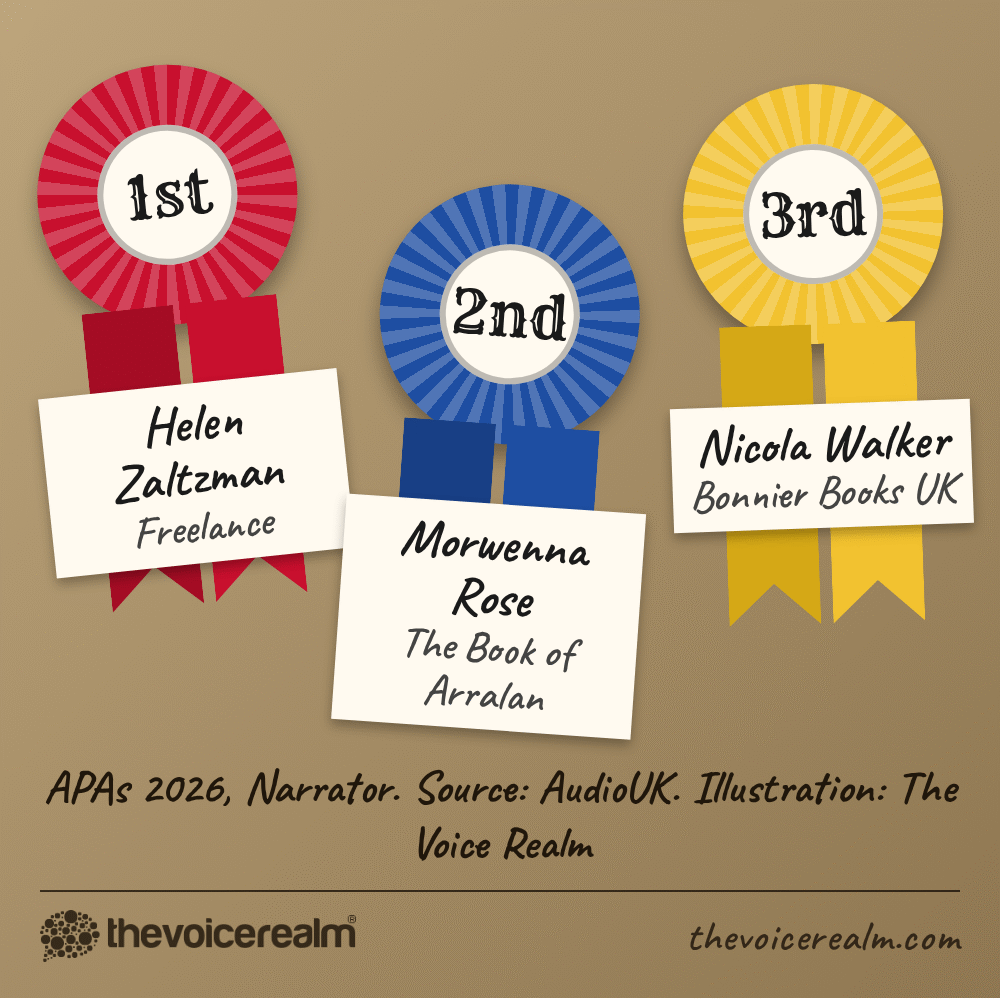
The Narrator category had a strong field. The shortlist included Nicola Walker for Bonnier Books UK, Clarke Peters for BBC Radio 4 and BBC Sounds, and Cush Jumbo for Pottermore Publishing and Audible Studios. Alongside them sat three freelancers, Helen Zaltzman, Sara Starling and Melanie Crawley, plus Morwenna Rose for The Book of Arralan.
Gold went to Helen Zaltzman, listed as freelance. Podnews names her winning entry as The Allusionist, her podcast about words and where they come from. Silver went to Morwenna Rose. Bronze went to Nicola Walker.
The Presenter/Host category went the same way. Gold went to Sean Allsop, freelance, ahead of Sean Bean for Peanut & Crumb in silver. And the night’s double winner was Chantal Romain of the Multitrack Fellowship, who took gold for both New Voice and New Producer. AudioUK said her “natural storytelling ability, creative ambition and distinctive delivery impressed judges across both categories”.
Chris Baughen, AudioUK’s chief executive, summed it up: “What makes the APAs so special is the incredible range of talent they celebrate, from established names to emerging voices and the brilliant creatives working behind the scenes.”
© The Voice Realm
A different picture three nights earlier
The same week, the British Audio Awards, known as the Speakies, held their second ceremony at the Southbank Centre’s Queen Elizabeth Hall, hosted by Sally Phillips. Their narrator prize, Best Performance: Narrator, went to James McAvoy for JD Kirk’s Recall, ahead of Adjoa Andoh, Rory Kinnear and Simon Russell Beale. Elsewhere on the list were familiar names from film and television, including Jessie Buckley, Sheridan Smith and Emma Thompson.
That’s not a criticism. Those are wonderful readers, and audiobook publishers cast stars for good reasons: a famous voice sells a title before anyone presses play. But it does mean the two nights reward slightly different things.
The book is the star
Audiobooks judged as books. Narrator honours went mostly to actors already known from stage and screen, with a separate award for a rising new voice.
The voice is the show
Audio judged as audio. Narrator gold went to a freelancer whose voice is her show, and the presenting prize went to a freelancer too.
The Speakies did make room for newcomers. Mohamed Elsandel won Best Performance for The Courier and Sachin K Sharma took Best Performance: New Voice. And Fergus Morgan of The Stage, one of the judges, said: “Audio drama is an art form brimming with imagination, innovation, talent and potential. I am delighted it is getting the recognition it has long deserved with these awards.”
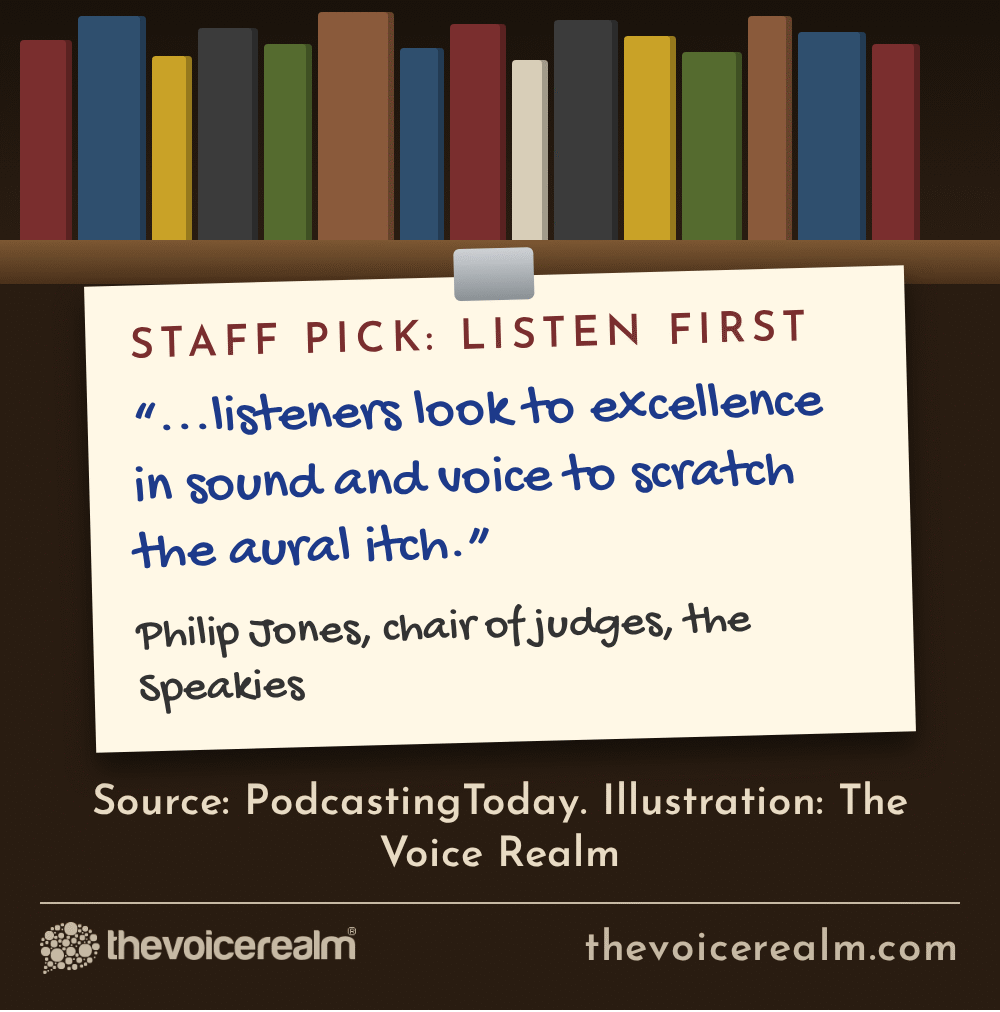
PodcastingToday also noted that the UK audiobook sector grew by 10% in 2025. A growing market needs more voices than the guest list of any awards night, which is where most working voiceover artists come in.
© The Voice Realm
What the Narrator category is really rewarding
Here’s what we think the APA judges heard. A podcast narrator isn’t reading someone else’s book once. They’re the sound of the whole thing, week after week, year after year. Listeners come back because they like being in that voice’s company. That takes a set of skills that don’t always show up in a single great performance: consistency, warmth that doesn’t tip into performance, the ability to make a complicated idea sound like a chat, and timing that survives an edit.
There’s also something about a voice that belongs to the thing it’s narrating. When the person speaking clearly cares about the subject, listeners hear it. They forgive the odd stumble, they follow a tangent, and they stay to the end. A star reading a novel brings the authority of their career with them. A podcast narrator has to earn that authority from scratch every episode, using nothing but tone, pace and the sense that there’s a real person on the other side of the headphones. That’s a hard trick, and it’s a very good thing to see it rewarded at the top of the category.
Those are exactly the skills that win ordinary voiceover work. A brand film, a museum guide, a charity appeal and a ten part documentary series all need a narrator who can hold attention without pulling focus. If you’ve ever wondered whether the quiet craft of narrating a documentary gets noticed, Thursday’s result is a decent answer.
It’s worth saying that freelance doesn’t mean amateur. Much of the UK’s narration is voiced by freelancers working from home studios and hired by the job. Seeing “Freelance” printed next to a gold award is a nice reminder of who actually keeps British audio going.
© The Voice Realm
Where the work is for UK voiceover artists
Look past the trophies and the APA winners list reads like a jobs board. There were golds for branded content, kids content, history, true crime, audio drama and an ensemble cast for Hooley Productions. There were two audiobook categories, fiction and non fiction. Every one of those needs voices, and most of them aren’t cast from the red carpet.
 VoiceEditSuiteNewYour breath. Your pace. Your edit.Learns from numbers, never your audio. Never used to train AI.See how it works
Branded podcasts need a host voice that sounds like the brand without sounding like an advert. Kids’ audio needs warmth and energy that lasts a full series. Audio drama needs actors who can play a scene with nothing but their voice. And the audiobook market needs British audiobook narrators who can deliver ten hours of clean, consistent reading for the many titles that will never get a famous name on the cover.
If you’re just starting out on the long form side, our guide to getting started as an audiobook narrator covers the first steps.
© The Voice Realm
Practical steps for voiceover artists
Make a narration demo that sounds like a show, not a showreel. One long, settled minute tells a producer far more about podcast or documentary work than six fifteen second clips with music stings.
Put your own audio out there. The Narrator gold went to a podcast. A well made podcast or audio series of your own is a calling card, and as the APAs showed, it can win prizes.
Enter awards. Freelancers can and do win. The APAs, the Speakies and the specialist awards all take entries from independent work, and a shortlisting is worth more on your website than any adjective you could write about yourself.
Practise the long read. Record twenty minutes in one go, then listen back for where your energy drops and your pitch drifts. Consistency is the skill that separates a narrator from a reader.
Know your own sound. Ask three people who don’t work in audio to describe your voice in two words. If they all say “calm” or “cheeky” or “clear”, lead with that. A narrator who knows the one thing their voice does best is much easier to cast than one who claims to do everything.
Learn the production side. Chantal Romain took gold this year as both a new voice and a new producer. Clean editing, sensible loudness and tidy file delivery make you easier to hire, and they let you make your own work instead of waiting to be asked.
Be findable by sound. Producers who book narrators listen first and read the name second. Make sure your demos are where they search, and that the first ten seconds of each one sound exactly like the job you want next.
For producers and publishers
The awards this week gave you permission to cast by ear. A famous voice is one way to sell a title. A voice that suits the material, and that listeners will happily spend hours with, is another, and the APA judges clearly rated it.
If you’re casting a branded series, a documentary or a factual audiobook, start by listening to a wide spread of narrators for documentaries and brand films rather than a shortlist of names you already know. You’ll often find the right voice is someone you haven’t heard of yet. That’s how the industry found most of the voices it now treats as famous.
And think about the long run. A podcast or series lives or dies on whether people come back, so cast for the voice listeners will want in their ears on episode forty, not just episode one. Ask for a longer test read, and listen to it on a train or in the kitchen, the way your audience actually will. If you can browse voiceover artists by how they sound before you look at who they are, you’ll make that choice on the right evidence.
© The Voice Realm
Our take
Here’s our read. Both nights were good news for British audio. The Speakies showed the audiobook business is big enough to tempt the best known actors in the country, and that’s healthy. The APAs showed that the craft of narration is still judged on what it sounds like, and that a freelancer with a microphone and a clear idea can beat a cast list.
We’d love to see more of that: room for stars and freelancers alike, and more producers who cast with their ears open. For working voiceover artists, the lesson is encouraging and practical: the skills that win everyday narration work are the same ones that took gold on Thursday. Keep sharpening them, keep making things, and keep entering.
Sources: AudioUK, “Winners Announced for the APAs from AudioUK 2026” (November 2026); Podnews, “The APAs from AudioUK: Winners 2026” (27 November 2026); AudioUK, “AudioUK unveils 2026 APAs shortlist” (26 October 2026); PodcastingToday, “British Audio Awards highlight innovation in audio storytelling” (November 2026).
Ready to get booked?
See the jobs open right nowAbout Sarah Robbins
Sarah Robbins writes for The Voice Realm about finding voice over work, home studios, casting and the business side of voice acting.