Blog
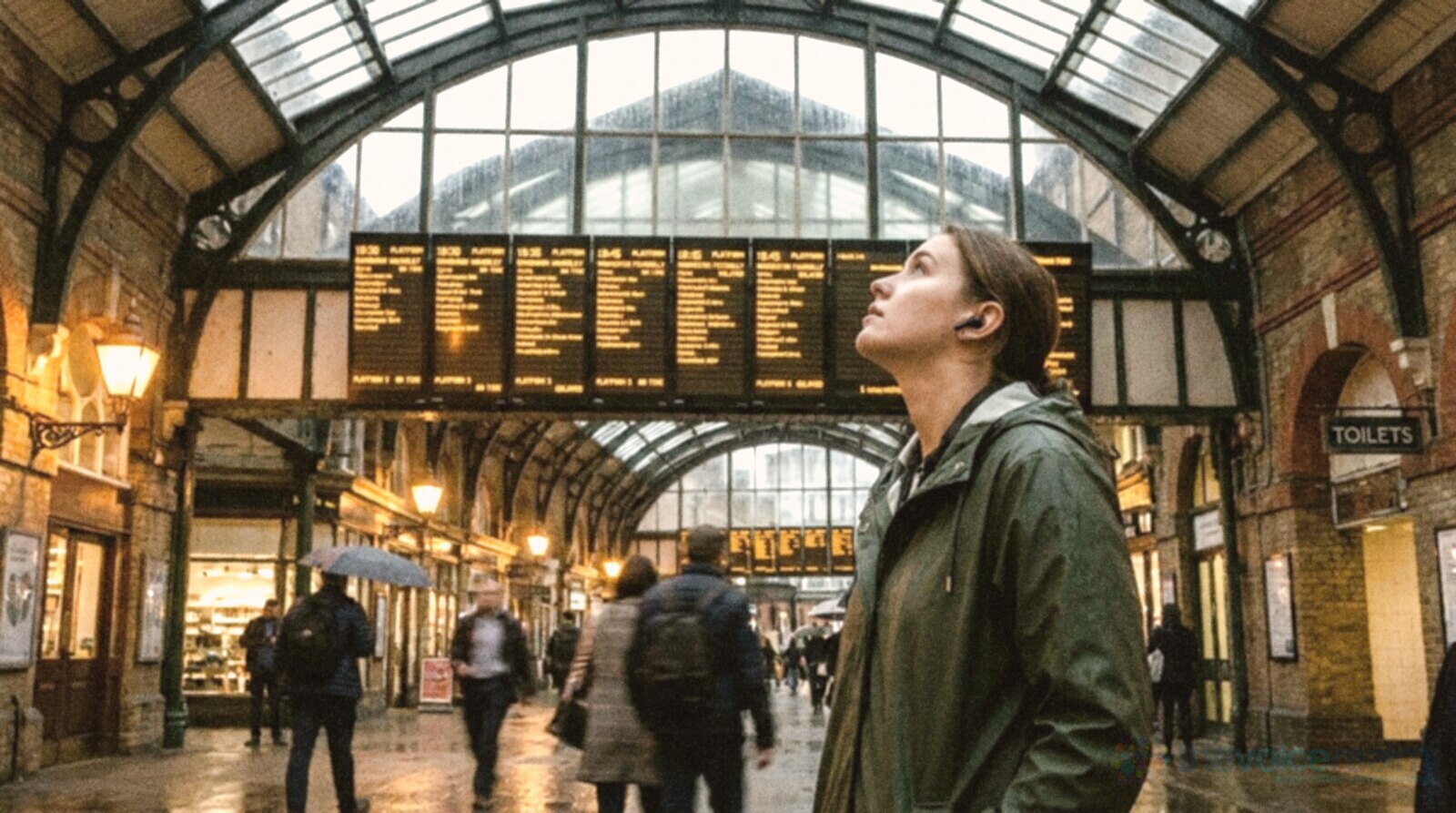
For more than a hundred years, a station announcement has worked the same way. One voice, one speaker on a pole, everybody on the platform hearing the same words at the same time, whether they caught them or not. This winter that model is quietly changing across Britain’s railways. A trial at Bristol Temple Meads sending translated announcements to passengers’ headphones runs until the end of November. A pilot in Scotland lets control rooms push spoken updates straight onto trains during disruption. And ScotRail’s on-train voice now belongs to one of its own staff. This piece is for British voiceover artists who want to understand what’s happening to the most heard voice work in the country, and where the opportunities sit.
We’ll say up front: none of this is a story about lost jobs. It’s a story about announcements becoming a system rather than a recording, and about the voices, scripts and languages that system still needs.
Three changes on three bits of track
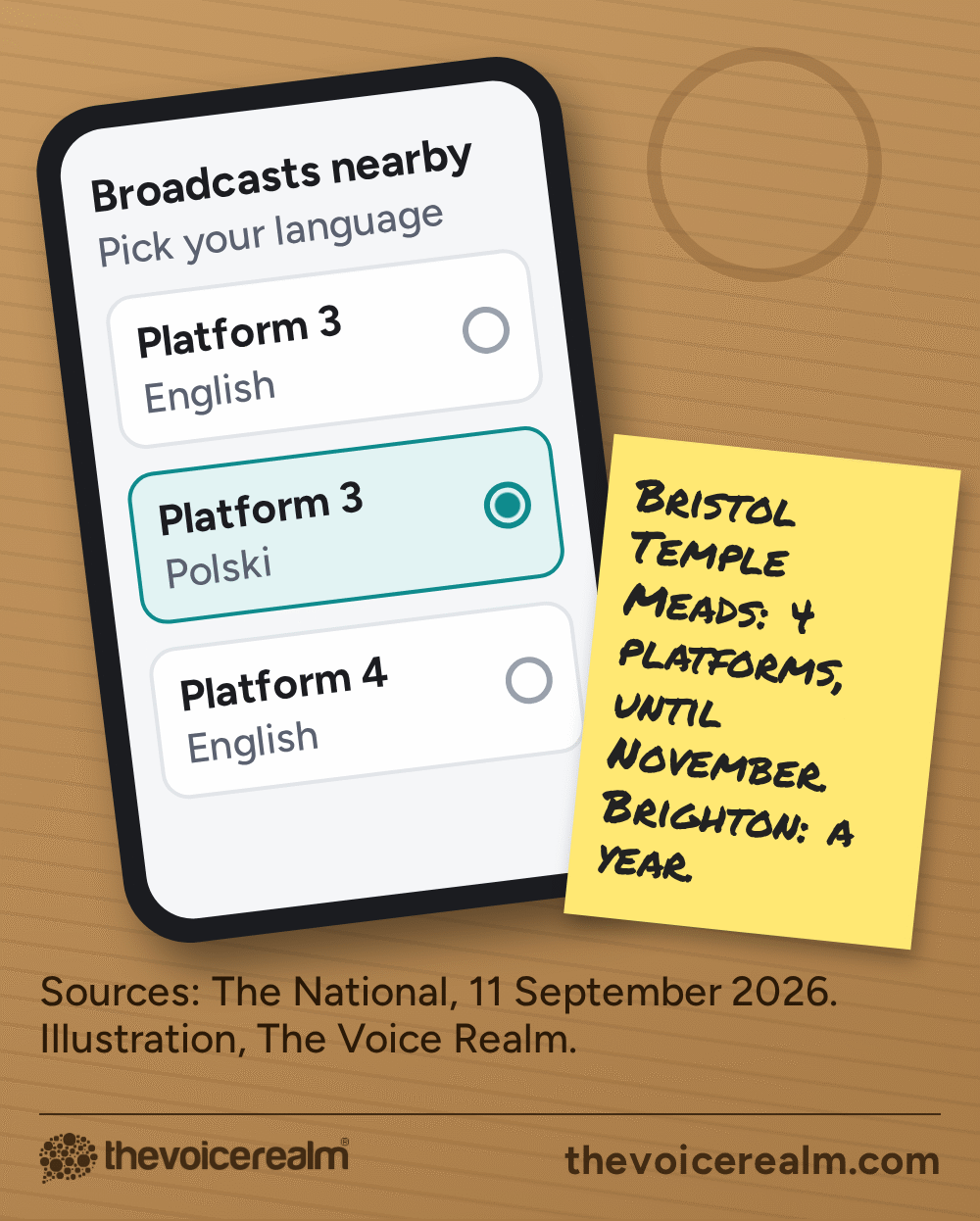
The first is the newest to most travellers. The National reported in September that Bristol Temple Meads is trialling live translations on four of its platforms until November, with a second pilot running at Brighton for a year. Passengers with the right phone and headphones can hear platform announcements in the language they choose. The paper notes that the Bristol trial pairs a Bluetooth broadcast feature called Auracast with AI translation, and that Temple Meads also has a large Polish-speaking community nearby.
Dan Scarfe, chief executive of the translation company behind it, put the ambition plainly: “For more than a century, public announcements have followed the same model: one voice speaking to everyone at once.” His next line is the one to remember: “Instead of asking every passenger to adapt to the announcement, the announcement adapts to the passenger.”
The second change is in Scotland. Since July, Network Rail, ScotRail and the Rail Delivery Group have been piloting a system called On Train Passenger Announcements on ScotRail’s Class 380 fleet. It lets the control centre send announcements directly to trains during disruption using text-to-speech, so a driver no longer has to explain the same delay twice while also driving the train. Network Rail says the pilot “will inform plans for a wider rollout across operators in Britain”.
The third is the voice itself. Last December ScotRail introduced new automated on-train announcements built from recordings by Vannessa Sloan, who works in its customer information team in Paisley and already reads live updates to stations across the network. According to ScotRail, she recorded “hundreds of words, sentences, sounds, and stations, many with challenging Scottish pronunciations, across 18 studio sessions.” The rollout to more of its trains was planned for 2026, replacing the earlier “Iona” announcements.

© The Voice Realm
What an announcement voice actually is now
Here’s the bit most people miss. When you hear a modern station or train announcement, you’re very rarely hearing one continuous recording. You’re hearing a system stitching together phrases, numbers, station names and times, or a text-to-speech voice built from a long run of studio sessions. A good announcement voice has to sound natural in sentences nobody has written yet.
That’s why ScotRail’s description is so telling. Eighteen sessions isn’t a quick voice job. It’s a careful, repetitive, highly technical piece of work, reading place names, numbers and short phrases with exactly the same energy, pitch and pace at hour five as at minute one. Anyone who has recorded a big phone menu or a long e-learning course will recognise the discipline. Consistency is the whole performance.
It also explains why the person chosen was someone who already speaks to passengers every day. ScotRail said the choice came after an internal search in which eight colleagues recorded sample announcements. Phil Campbell, its Customer Operations Director, said: “Vannessa is already a trusted and familiar voice for customers at stations.” Familiarity and trust are what an announcement voice is for.
One voice for everybody
A single recorded or live announcement through a speaker on a pole, in one language, heard by everyone on the platform whether they need it or not, and lost under a roof full of echo.
A voice for each listener
A recorded voice system that can say anything, updates sent straight to trains when things go wrong, and announcements that can reach a passenger’s own headphones in their own language.
Why the room matters as much as the voice
Anyone who has stood under the roof at Temple Meads will understand why the trial started there. The National describes the Grade I listed station as “a lottery for anyone wishing to hear travel announcements, thanks to its high metal roofs, stone arches and glass-walled sidings.” Every syllable bounces around stone and iron, and you can’t fix a listed building with acoustic panels.
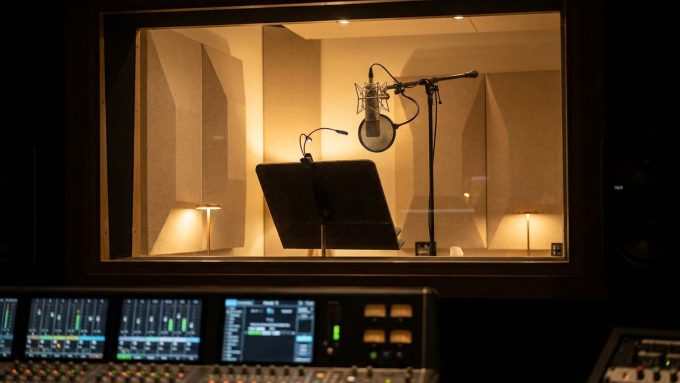
There’s a lesson in that for voiceover artists whose work ends up in public spaces. The read that sounds lovely in your treated booth is not always the read that survives a station, a shopping centre, a stadium or a hospital corridor. Clear consonants, slightly slower pacing, little breaks between the key facts and a steady level matter far more there than warmth or colour. If your diction has gone a bit soft, a few weeks of daily diction drills will do more for this kind of work than a new microphone.

© The Voice Realm
Place names are the job
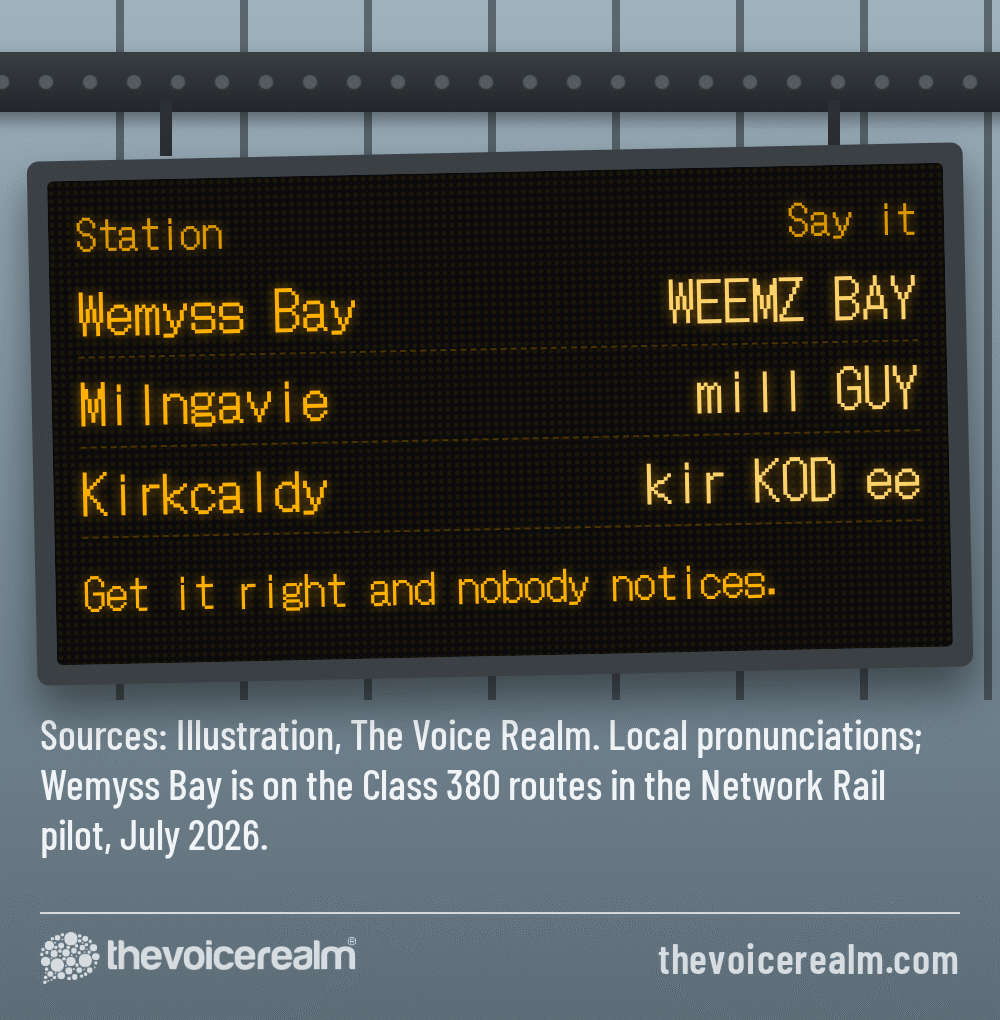
The phrase in ScotRail’s release that every Scottish voiceover artist will have smiled at is “challenging Scottish pronunciations”. Get a station name wrong on a train and you’ve told every local on board that the railway doesn’t know where it is. Get it right and nobody notices, which is exactly the point.
 VoiceEditSuiteAuto Clean Up now learns you.Your breath, your pace and every fix you make, so each file comes back sounding like you edited it yourself.See how it worksLearns from numbers, never your audio. Never used to train AI.
It’s also why so much of this work goes to local voices. A transport operator, a council or a visitor attraction in Scotland will usually want voiceover artists based in Glasgow or elsewhere in the country, people who say the names the way the passengers do without needing a guide. The same holds in Cardiff, Newcastle or Cornwall. Local pronunciation is a skill, and it’s one you can sell.
If you’re not local to the job, do the homework anyway. Our guide to checking how a name is really said walks through the sources that work, from local radio archives to council meetings online. Never guess on a place name. Ask.
© The Voice Realm
Translation changes the brief, not the need for voices
It would be easy to read the Bristol trial as machines replacing people. We’d read it differently. The trial is about reaching people who were never being reached at all: passengers who don’t speak English well, and, as The National points out, people who are deaf or hard of hearing, for whom the broadcast technology was first built. More people hearing announcements is good for everyone, including those who voice them.
But it does tell operators, venues and brands something they’ll take into every other project: a single English voice is no longer the whole job. Safety information, wayfinding, welcome messages and accessibility guides will increasingly be expected in several languages. Some of that will be machine translated live. Plenty of it, especially anything with legal, safety or brand weight, will still be recorded properly, and that needs human translation and foreign language voiceovers that are checked before anyone hears them.
For British voiceover artists who speak a second language fluently, that’s a door worth knocking on. Polish, Urdu, Punjabi, Arabic, Romanian, Welsh and Gaelic are all languages a British transport operator, council or health trust might reasonably need.
© The Voice Realm
Our take
Our view is simple. The railway is moving from recordings to systems, and that’s a lasting change. Fewer jobs will be “read these forty announcements”. More will be the long, careful build of a voice that can say anything, followed by years of that voice being heard by millions. That is serious work, and it deserves to be treated, contracted and paid as serious work, with clear terms about what the recordings can be used for and for how long.
We also think ScotRail’s choice of a staff member is a sign of what passengers respond to. Not a polished, anonymous voice, but someone who sounds like the place and is already trusted there. That’s the strongest argument a local voiceover artist has, and it applies far beyond the railway.
And we’d gently point out that the hardest moment for any announcement system is disruption. That’s when the script hasn’t been written, people are tired and cross, and tone matters more than at any other time. Voices that can sound calm, clear and human under pressure will always be needed somewhere in that chain.
Five things to do this winter
Make a public information demo. Sixty seconds of station style announcements, a safety notice and a wayfinding message, read for a big echoing space rather than a cosy booth. Keep it clean, steady and slightly slower than you’d read an advert.
Build a place name list for your patch. Write down every town, village and station within an hour of you that outsiders get wrong, with how locals say it. Put a few in your demo. It shows a client you know the territory.
Practise consistency. Record the same twenty short phrases at the start and end of a three hour session and compare them. If your pitch or energy drifts, you’ve found the skill to work on before anyone books you for a long voice build.
Offer your second language properly. If you’re fluent, record a short demo in it and say so clearly on your profile. Mention whether you can also check translated scripts.
Read every contract for a voice build twice. Know what your recordings will be used for, where, for how long and whether they can be used to build other voices. If anything is unclear, ask before the first session, not after the last.
© The Voice Realm
For the operators and venues who book voices
If you run a transport service, a hospital, a shopping centre or a visitor attraction, the cheapest win is a proper brief. Tell the voice where the announcements will be heard, send a list of local names with how they’re said, and plan sessions so the voice is fresh, not exhausted, for the hardest material. A short test in the real space before you sign off will save a rerecord.
The same voice on your safety films and your staff training videos as on your announcements also does something subtle: it tells people the whole place is run by the same careful hands. And if your passengers or visitors speak many languages, plan for that from the start rather than adding it later.
The speaker on the pole isn’t going anywhere just yet. But the voice coming out of it is becoming something more flexible, more local and more personal. For British voiceover artists who can sound like the place they come from, that’s good news.
Sources: The National, “UK train stations test live translation technology for travel announcements”, 11 September 2026; Network Rail, “Rail industry launches pilot to transform passenger information during disruption”, 21 July 2026; ScotRail, “ScotRail launches new voice announcements on Class 380 trains”, 10 December 2025.
Ready to get booked?
See the jobs open right nowAbout Sarah Robbins
Sarah Robbins writes for The Voice Realm about finding voice over work, home studios, casting and the business side of voice acting.