Blog

“Alexa, play the radio.” Millions of people in Britain say something like it every morning, usually while looking for their keys. Until now, what happened next was up to the company that made the speaker. Last week the government changed that. From April 2027, the big voice assistants will have to play the UK station you asked for, the way the station wants it played, and they won’t be allowed to slip their own adverts in front of it.
It reads like a story for broadcasters and lawyers. We think it’s a quietly good one for British voiceover artists, and here’s our read on why.
What the government decided
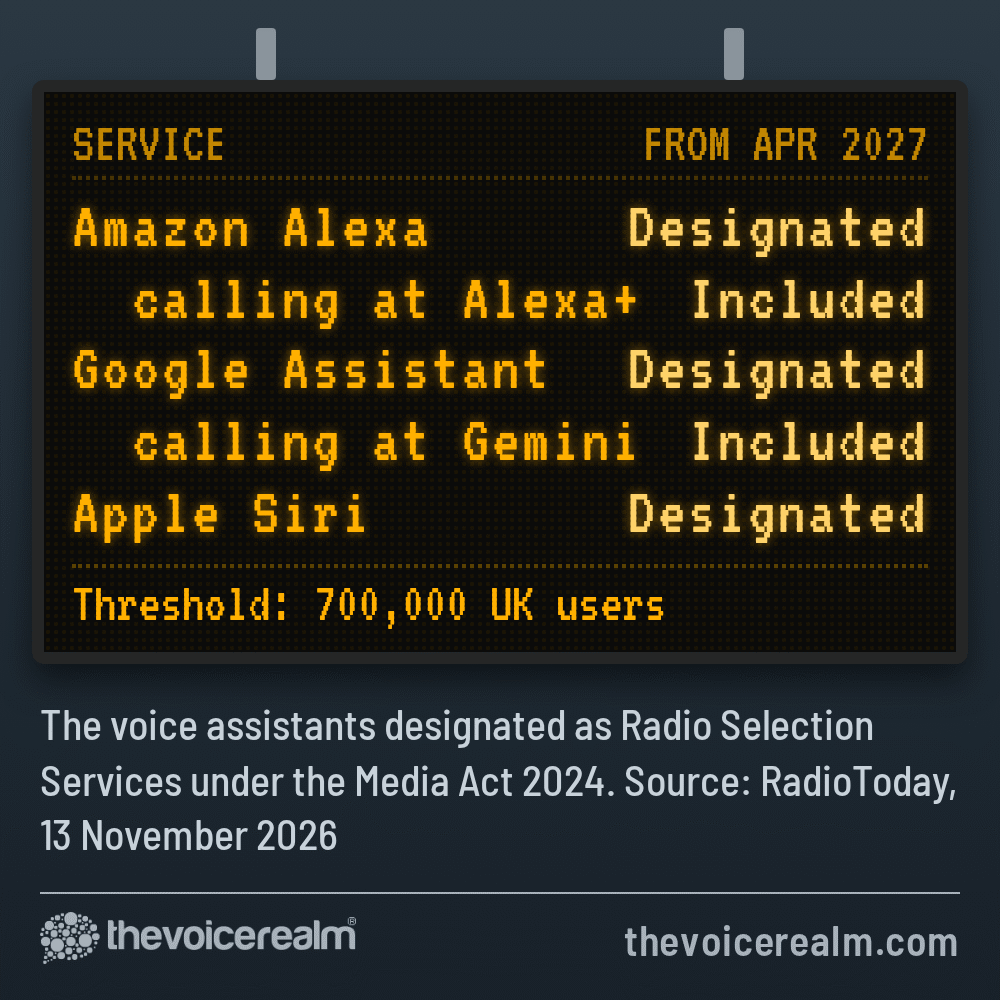
RadioToday reported on 13 November that Amazon Alexa, Google Assistant and Apple Siri have been designated as Radio Selection Services under the Media Act 2024. The rules were confirmed in a parliamentary statement by Media Minister Ian Murray on Thursday 12 November, following recommendations from Ofcom and a public consultation over the summer.
The designation reaches the newer AI versions too, including Alexa+ and Google Gemini, so the protections don’t vanish the next time a tech company rebuilds its assistant. A platform is caught once it has 700,000 UK users listening to internet radio through it, the threshold Ofcom recommended and the government accepted.
Under the rules, the designated platforms must take reasonable steps so listeners can reliably reach Ofcom licensed UK stations by voice, “without being redirected to competing services”, in RadioToday’s words. They can’t charge stations for carrying their live streams. They can’t put their own advertising or other content over those streams without permission. And broadcasters can ask for a default route, so the stream that plays is the one the station chose.
The part we’d underline is the last line of the report: the protections apply to stations of every size, so a community station gets the same safeguards as a national one when a listener asks for it by name.

© The Voice Realm
Why smart speakers matter this much
When the government opened its consultation in July, PPC Land reported the figures behind it from the consultation document: 87 per cent of the UK population listens to radio every week, and 18 per cent of all radio listening now happens through a voice-assisted device, citing RAJAR. The same document said the three designated assistants account for roughly 95 per cent of people listening to internet radio this way.
So nearly a fifth of British radio listening starts with a spoken request to a device. That’s a lot of listening to leave in the hands of three companies whose assistants are steadily becoming places to sell advertising. We wrote about how much radio Britain listened to last winter, and how much of it came through speakers in kitchens and hallways. These rules are about keeping that listening pointed at the stations.
The ad break stays with the station
This is where voiceover comes in. Commercial radio pays for itself with adverts, and a large share of those adverts are voiced by working voiceover artists: the local garage, the furniture sale, the council campaign, the national brand with a regional tag. If a speaker company could drop its own advert in before your station starts, or sell the space over the top of it, every listener who arrived by voice command would be worth less to the station. Over time that means fewer, cheaper adverts.
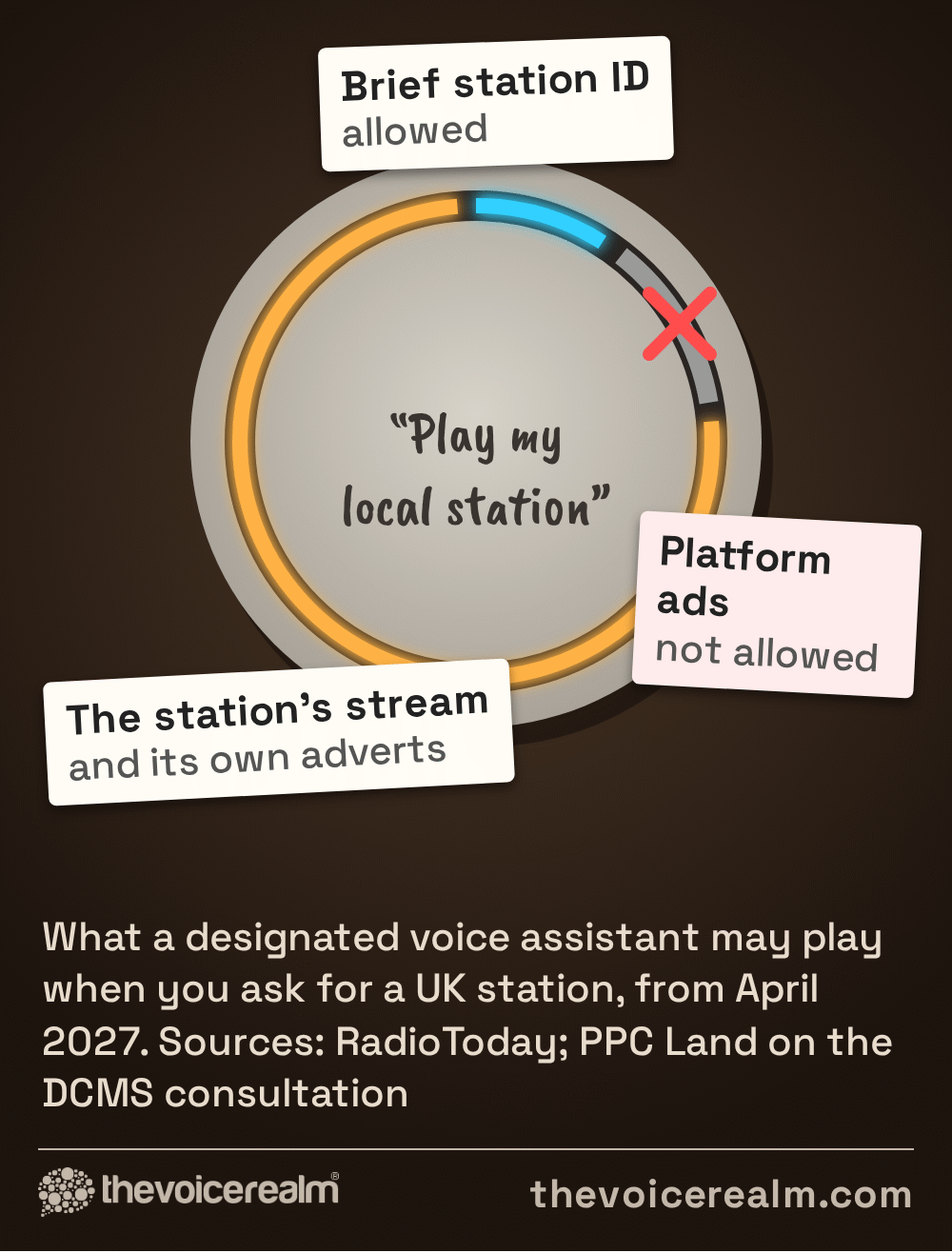
The consultation document, as PPC Land summarised it, was careful about what’s still allowed before or during the stream. A platform may play “a brief identification of the station or any third-party service used to play it”, and any adverts the station itself agrees to. Nothing else.
That protects the commercial break where most radio voiceover work lives. It also protects the station’s control over its own sound from the very first second, which matters more than it sounds.
© The Voice Realm
The first five seconds are the station’s front door
Think about what a listener hears after they ask for a station on a smart speaker. A short confirmation, then the stream, which might land in the middle of a song, a traffic report or an advert. For listeners who arrive this way, the station’s ident or a quick sweeper is often the first thing that says “you’re in the right place”.
Stations that take this seriously write short idents for exactly that moment: the station name, what it’s for, and a tone of voice that matches the programmes. Those are short scripts, often a handful of words, and they get played thousands of times. Getting the read right is a proper craft, and it’s voiceover work.
Station names matter too. A voice assistant has to understand what a listener says, and a station whose on-air voice says its name the same clear way every time is teaching its audience how to ask for it. That’s an old radio habit with a new reason behind it.
© The Voice Realm
Small stations get the same treatment
Ian Murray said he hoped the change would help stations grow online: “I also hope that it’ll encourage stations to invest in new content and services, allowing them to innovate and grow as they reach their audiences online.”
 VOICEMASTERACADEMYTwenty modules, one at a time.Breath controlHome studioCommercial techniqueAuditionsStart module oneNo experience needed.
For the big networks that might mean new apps and on-demand shows. For community and small commercial stations, it’s simpler. A listener in a sheltered housing flat in Fife or a student in Salford can now ask for their local station and get it, played properly, with no advert from a tech company stuck in front. Those stations suddenly have the same front door as the national brands, and many of them are still running idents recorded years ago by whoever was in the building that day.
A lot of British radio is made in the North West, around the studios at Salford Quays, and the stations there share a pool of local talent. Producers there often book voiceover artists in Manchester for imaging and promos, though home studios across the country now do the same work for stations they’ve never visited.

© The Voice Realm
The AI question, briefly
It’s worth noticing that the government chose to write the next generation of AI assistants into these rules on purpose. Radiocentre’s chief executive Matt Payton welcomed that: “This is a welcome step towards safeguarding radio’s future online. As more listening moves to smart speakers, audiences must be able to rely on these devices to play the radio stations they request.”
We won’t pretend this settles every worry voiceover artists have about AI. It doesn’t touch who voices the adverts. What it does is keep the station, and not the speaker, in charge of what plays, and stations are the ones who book people.
- Ask your speaker for your favourite stations. Listen to the first ten seconds of each. If what you hear is mid-advert with no ident, that’s a station that could use one, and a pitch you can make politely.
- Build a short ident reel. Five or six idents of three to eight seconds, for invented stations of different kinds: a community station, a classic hits brand, a speech station. Keep it under a minute.
- Learn to say station names cleanly. Clear, consistent, never thrown away at the end of a line. It’s the bit of the read a smart speaker’s listeners will copy.
- Know your numbers. Small stations often want a package of idents, sweepers and sponsor credits refreshed a few times a year. Have a price in mind before you ask.
What voiceover artists can do now
The work this opens up isn’t new. It’s imaging, idents, sponsor credits and the adverts in the break. What’s new is the reason for a station to look at its sound again, and an April date to aim for. A station manager with a renewed sense that every listener who asks for them by name will actually arrive is a station manager in a good mood to refresh things.
Short scripts reward precision. If you’ve recorded phone systems, you already know the skill: a few words, perfectly placed, with nothing extra on either side. Our guide to recording short phone prompts cleanly covers the same habits of clean starts, clean ends and a steady level, and the overlap with voices for phone menus and on-hold messages is closer than most people think. Both are about a voice that welcomes someone in the first second and tells them they’re in the right place.
When you pitch a small station, keep it friendly and short. Say what you heard when you asked for them, offer two or three sample idents written for them specifically, and be clear about what voiceover usually costs for a package of that size. Community stations run on goodwill and small budgets. They remember the people who made them sound professional.
© The Voice Realm
For the stations and brands that book voices
If you run a station, ask your own smart speaker for it tonight and listen. Then ask for a competitor. Whichever one sounds like a proper radio station in the first five seconds is the one a new listener stays with. If you advertise on radio, this is good news for the value of your spots: the audience that arrives by voice stays inside the station’s own break.
Our take
It’s rare for a regulation about technology platforms to have such a direct line to the people who make radio sound like radio. This one does. By keeping the speaker companies out of the stream and leaving only a brief identification in front of it, the rules keep the first seconds and the ad break where they belong, with the station.
For British voiceover artists, the practical upshot is modest and real. More stations will think about how they sound to someone who’s just said their name out loud to a speaker in a hallway. Some will decide their idents are tired. A few will want a new voice by spring. Be the one with a tidy reel and a friendly email when they do.
Sources: RadioToday, “Alexa and Siri face new rules to protect UK radio” (13 November 2026); PPC Land, “UK forces Alexa, Siri and Google Assistant to carry radio streams ad-free” (18 July 2026).
Ready to get booked?
See the jobs open right nowAbout Sarah Robbins
Sarah Robbins writes for The Voice Realm about finding voice over work, home studios, casting and the business side of voice acting.