Blog

Almost every new voice actor wants a deeper voice at some point. You hear a trailer read or a late-night radio host and think, that’s the sound, if I could just get my voice down there. This guide is for anyone who’s tried pushing their voice lower and ended up with a scratchy throat, or who wants to know what can really change and what can’t.
The short version: you can sound deeper, often noticeably deeper, without forcing a single note. Most of it comes from space, pace and the microphone, not from pressing your pitch into the floor. And the voice that books is the one you can keep up for a four-hour session, not the one you can hit once.
Pitch, room and weight: three things people hear as deep
When a listener says a voice is deep, they’re usually hearing a mix of things, and pitch is only one of them.
Pitch is how fast your vocal folds vibrate. It’s the note you’re speaking on. Everyone has a range, and the size and thickness of your folds sets where that range sits. You can move around inside it, but you can’t move the range itself much through practice.
Resonance is what happens to that note after it leaves your folds. The sound travels up through your throat, mouth and nose, and the shape of that space decides which parts of the sound get louder. A wide, relaxed throat and an open mouth make the lower parts of the sound ring out. A tight throat and a smiling, spread mouth push it brighter. This is the part you can train most.
Weight is how full the sound feels. A light, breathy voice and a solid, warm one can sit on exactly the same note.
Speech pathologist Allison Geller of Connected Speech Pathology, writing about clients who want a lower-sounding voice, puts it plainly: “Pitch is only one part of voice perception.” That’s good news, because pitch is the part that’s easiest to hurt yourself chasing.

© The Voice Realm
Find the note your voice already likes
Before you go looking for a lower voice, find where your voice sits when you’re not trying at all. Most people’s working pitch drifts up when they’re nervous, reading aloud or talking to a microphone, so it’s worth knowing your relaxed baseline.
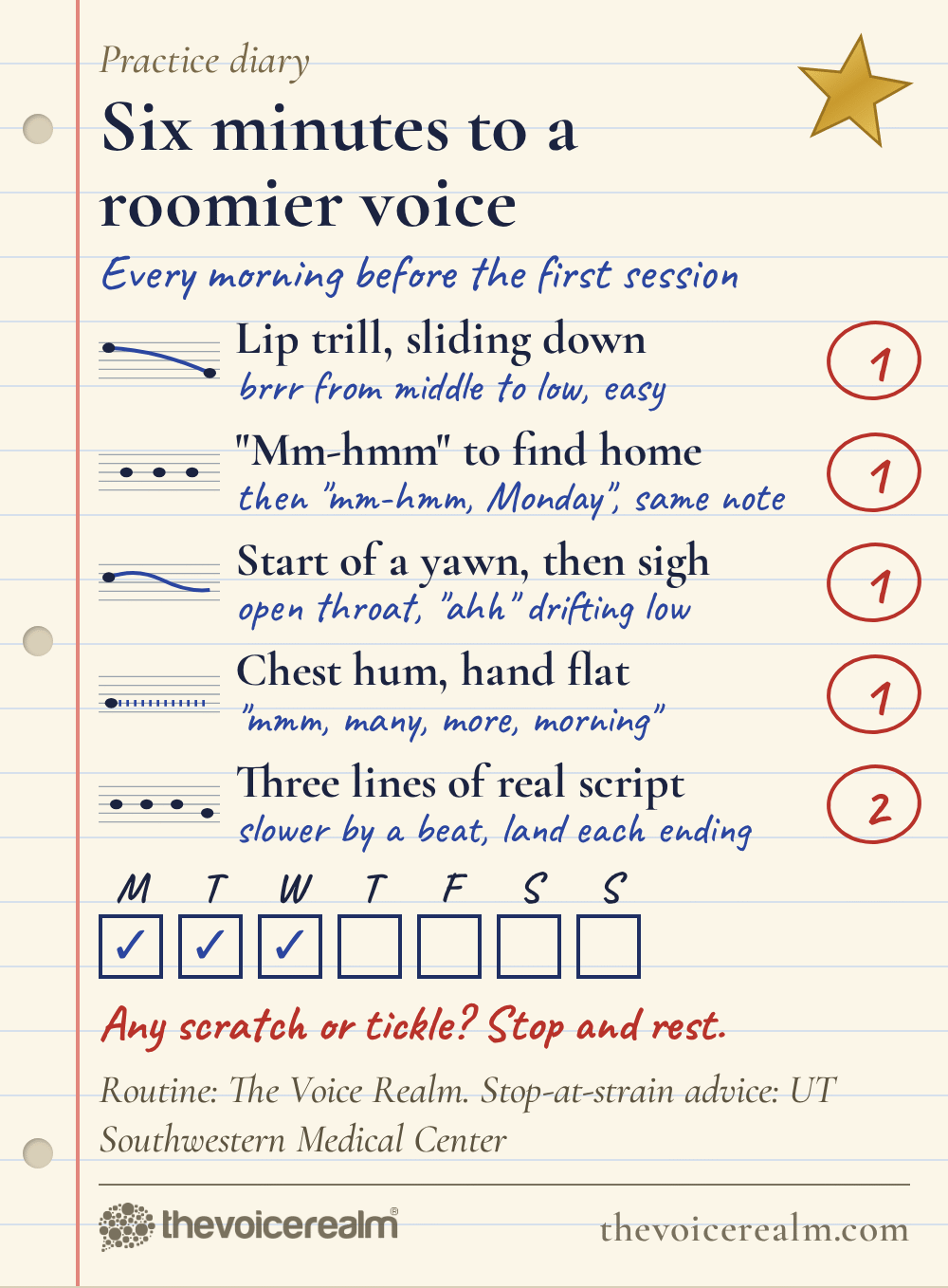
Here’s a quick way. Say “mm-hmm” the way you would if a friend said something you agreed with, without thinking about it. Do it three or four times. That easy, agreeing hum tends to land close to where your voice is comfortable. Now slide from the “mm” straight into a word: “mm-hmm, Monday.” “Mm-hmm, morning.” The word should come out on roughly the same note.
Record yourself reading a paragraph cold, then do the hum and read it again. A lot of people find their second read sits a little lower, simply because they’ve stopped reaching up for it. That’s not a trick. That’s your voice without the nerves.
If you want to go lower from there, go in small steps. Glide from your comfortable note down a little on a hum, settle, and speak a line there. If it still feels easy after a few minutes of talking, it’s a usable note. If you feel it in your throat, come back up.
Why pushing it down backfires
The common mistake is to press the voice down with effort: chin tucked, throat squeezed, breath held back, every line sitting on the bottom of the range. It can sound impressive for a sentence or two. Then it starts to crackle.
Voice doctors see this habit often. Writing for UChicago Medicine, the team behind the university’s Voice Center noted that “some people modify their voice by using more effort, creating a lower pitch to sound more authoritative.” UT Southwestern Medical Center’s voice care team lists the risk among the causes of voice problems: “Voice problems can also result from vocal misuse, such as speaking or singing too loudly or at an abnormally high or low pitch.”
Geller says the same from the training side: “Forcing a low note is the fastest way to tire or hurt your voice, so patience matters.”
There’s a practical cost too. A forced low voice tends to slide into creak at the end of every line, which is a sound most clients ask you to fix. If that’s familiar, our piece on that creak at the ends of your lines explains why it happens and how to keep air under the last word. And a voice that’s pushed down can’t move. The moment the script asks for a lift, a question or a laugh, there’s nowhere to go.
© The Voice Realm
Make more room above the vocal folds
This is where the real depth lives. You’re not changing the note. You’re changing the space it rings in.
Start with a yawn. Not a full jaw-cracking one, just the start of it, the moment where the back of your throat opens and your tongue drops. Feel that? Now sigh out on an “ahh” from that position, from a comfortable middle note gently downwards. Do it three or four times. Then say a line of script while keeping a little of that open feeling. Most people hear the difference straight away: rounder, warmer, lower, on the same pitch.
Next, put a hand flat on your upper chest and hum on “mmm” at your comfortable note. You should feel a buzz under your hand. Keep the hum going and open it into words, “mmm, many, more, morning,” trying to keep the buzz alive. That chest buzz is what people often mean when they say a voice has weight.
Watch your face, too. A wide smile shortens the space in front of the sound and brightens it, which is lovely for a retail read and works against you here. Relax the corners of your mouth and let your jaw hang a little looser than usual. You can still sound warm without grinning.
Low and tight
Chin tucked, throat squeezed, every line on the bottom note. Sounds big for ten seconds, then crackles and creaks, and your voice feels tired after one script.
Low and roomy
Comfortable note, open throat, loose jaw, slower pace. Sounds deeper for the whole session, and you can still lift for a question or a laugh.
Let the microphone do some of the work
A lot of the deep radio sound you hear is the microphone, not the person. Most voice-over mics are directional, and directional mics boost the low end of a voice as you move closer. It’s called the proximity effect.
Microphone maker LEWITT explains that when directional mics are placed close to a sound source, “the output signal is exaggerated at low frequencies,” and that this “is the reason that radio broadcasters often have such ‘deep’ sounding voices.” The closer you get, the bigger the boost.
That gives you a dial to play with. Moving in from a hand’s width to a few fingers away will add warmth and size to the same voice on the same note. It’s the right choice for an intimate read, a late-night promo or a gentle meditation script.

 VoiceEditSuiteNewIt edits like you would, and it gets better every file.Learns from numbers, never your audio. Never used to train AI.See how it works
It has a limit. Too close and the voice turns muddy and boomy, every breath gets louder and plosives start to thump. If a client asks you to brighten up, the first fix is often just to sit back a little. Our guide to working distance and mic angle covers where to start and how to move from there.

© The Voice Realm
Slow down and land your lines
Pace changes how deep a voice sounds more than most people expect. A fast read sounds lighter and higher, even on the same notes, because there’s no time for the sound to settle. Slow down by a beat, leave a little air between phrases, and the same voice sounds bigger and calmer.
The other habit to watch is the ending. Lots of people lift the last word of every sentence, as if they were asking a question. Each lift pulls the overall impression of your voice upwards. Try letting most statements finish on a gentle step down. Not a heavy drop, just a sense that the thought has landed.
Breath matters here as well. A voice that’s running out of air rises and tightens near the end of a line, so take a fuller breath before long sentences and spend it evenly. If breath is where you run short, our breathing guide for voice actors has exercises you can do in five minutes.
Morning voice, and other shortcuts
Plenty of voice actors notice they sound lower first thing in the morning, and some try to book sessions around it. It rarely works. That rough, low morning sound fades within an hour or two of talking, and it doesn’t match anything you record later in the day, so pickups become a headache. Warm up and record with the voice you’ll still have at three in the afternoon.
Other shortcuts are worse. Shouting a voice raw, smoking or straining through a cold will roughen your sound for a while, but UT Southwestern lists “excessive talking, screaming, coughing, smoking, or inhaling irritants” as forms of voice abuse, and a rough voice isn’t the same as a deep one. It just sounds tired. Look after the instrument you’ve got. Our longer guide to keeping your voice healthy for the long haul goes into sleep, hydration and recovery.

© The Voice Realm
Do deep voices really get booked more?
Less than you’d think. Some genres do lean low: movie trailers, sports promos, certain luxury car spots. But a huge share of everyday voice work, explainer videos, e-learning, phone systems, commercials for real people, asks for something else. Casting briefs say “warm,” “natural,” “friendly,” “conversational.” None of those mean low.
A voice that’s forced deep often reads as an announcer, which is the exact sound many of those briefs are trying to avoid. A voice that sits where it’s comfortable, opened up and slowed down a touch, sounds like a person. That’s what books.
So the useful question isn’t “how low can I go?” It’s “what’s the richest, warmest version of my own voice, and can I hold it for a whole session?” Geller’s line is a good one to keep on the wall: “A sustainable voice is more useful than an extreme one.” If you’re just starting out and want structured feedback on your natural range and reads, a coached course like Voice Master Academy will tell you faster than guessing alone.
© The Voice Realm
When to stop and get your voice checked
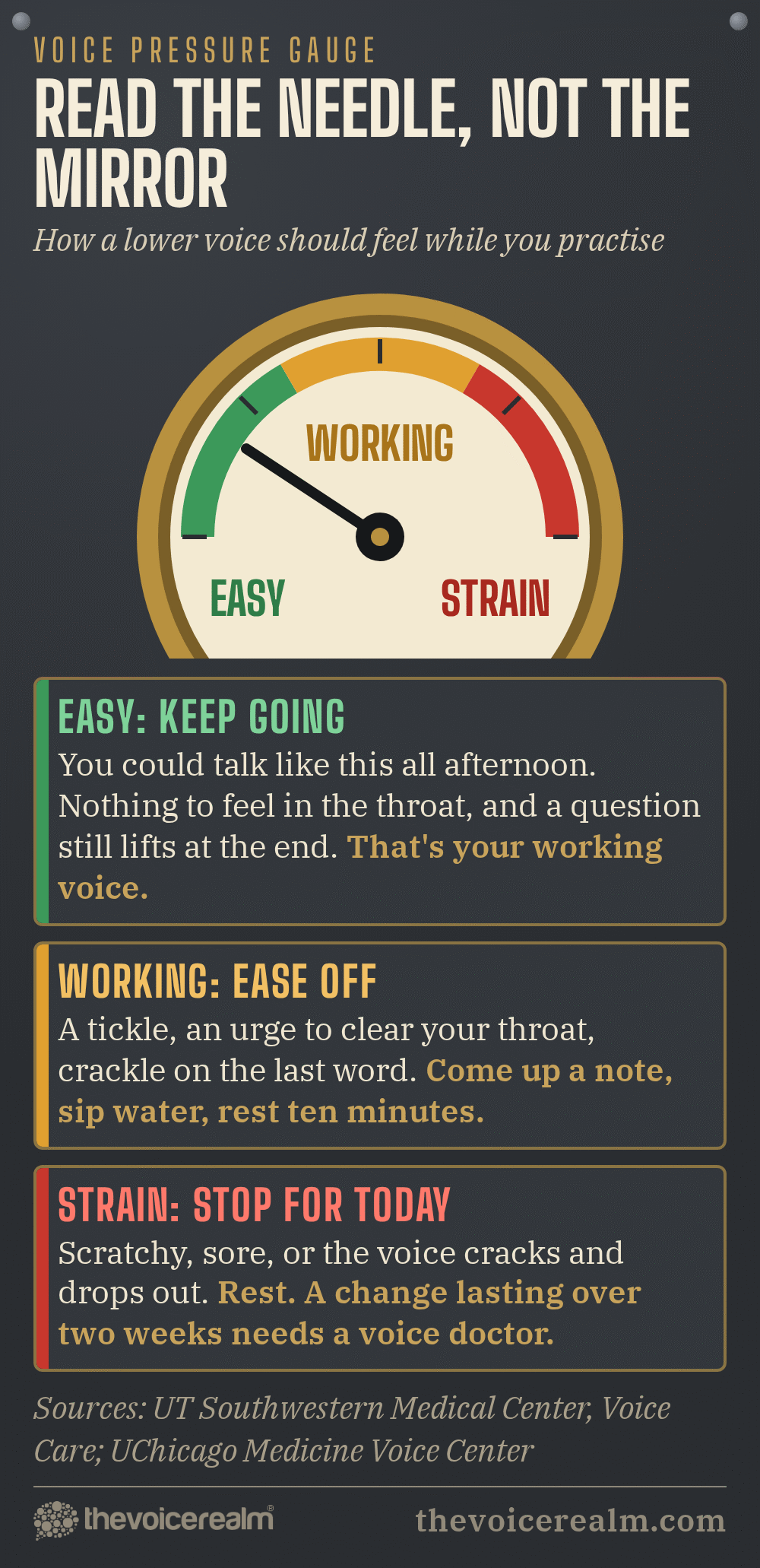
Practising a lower, roomier voice should feel easy. If it doesn’t, the practice is wrong, not your voice. Stop for the day if you feel scratchiness, a need to keep clearing your throat, or a tight, tired feeling that wasn’t there before you started.
If a change sticks around, don’t wait it out. UT Southwestern defines a voice problem as “any undesirable change in the voice that lasts longer than two weeks.” The UChicago Medicine team gives similar advice: “Hoarseness or voice changes that last longer than two to three weeks, outside of illness or excessive voice use, should be evaluated by an ear, nose and throat doctor; in particular, you’ll want to visit a doctor who specializes in the voice, known as a laryngologist.”
For a working voice actor, a laryngologist and a speech pathologist who specialises in voice are worth knowing before you need them. They can also tell you, with a camera and some listening, exactly where your comfortable range sits, which is the most useful number you’ll ever have if you want to sound deeper safely.
Sources: Allison Geller, Connected Speech Pathology, “How to Masculinize Your Voice Without Straining It”; Semirra Bayan, Derek Palmer, Sweta Soni and Meg Thorsen, UChicago Medicine, “Why it’s important to care for your voice”; UT Southwestern Medical Center, “Voice Care”; LEWITT, “What is the proximity effect?”
Ready to get booked?
See the jobs open right nowAbout Sarah Robbins
Sarah Robbins writes for The Voice Realm about finding voice over work, home studios, casting and the business side of voice acting.