Blog

Your bio is the paragraph a producer reads in the four seconds between pressing play on your demo and deciding whether to keep listening. Most voice actor bios waste those seconds. They’re long, they’re vague, and they say the same things everyone else says.
This guide is for voice actors at any stage, whether you’re writing your first profile or tidying one you wrote years ago. It covers how people actually read a bio, the three lines that do the real work, the words to cut, first person versus third, why your photo matters more than you’d think, and how to keep one bio in three lengths for the different places it’ll live.
Nobody reads it the way you wrote it
You wrote your bio top to bottom, choosing every word. Your reader will skim it in a few seconds, usually on a phone, often while listening to five other actors for the same job.
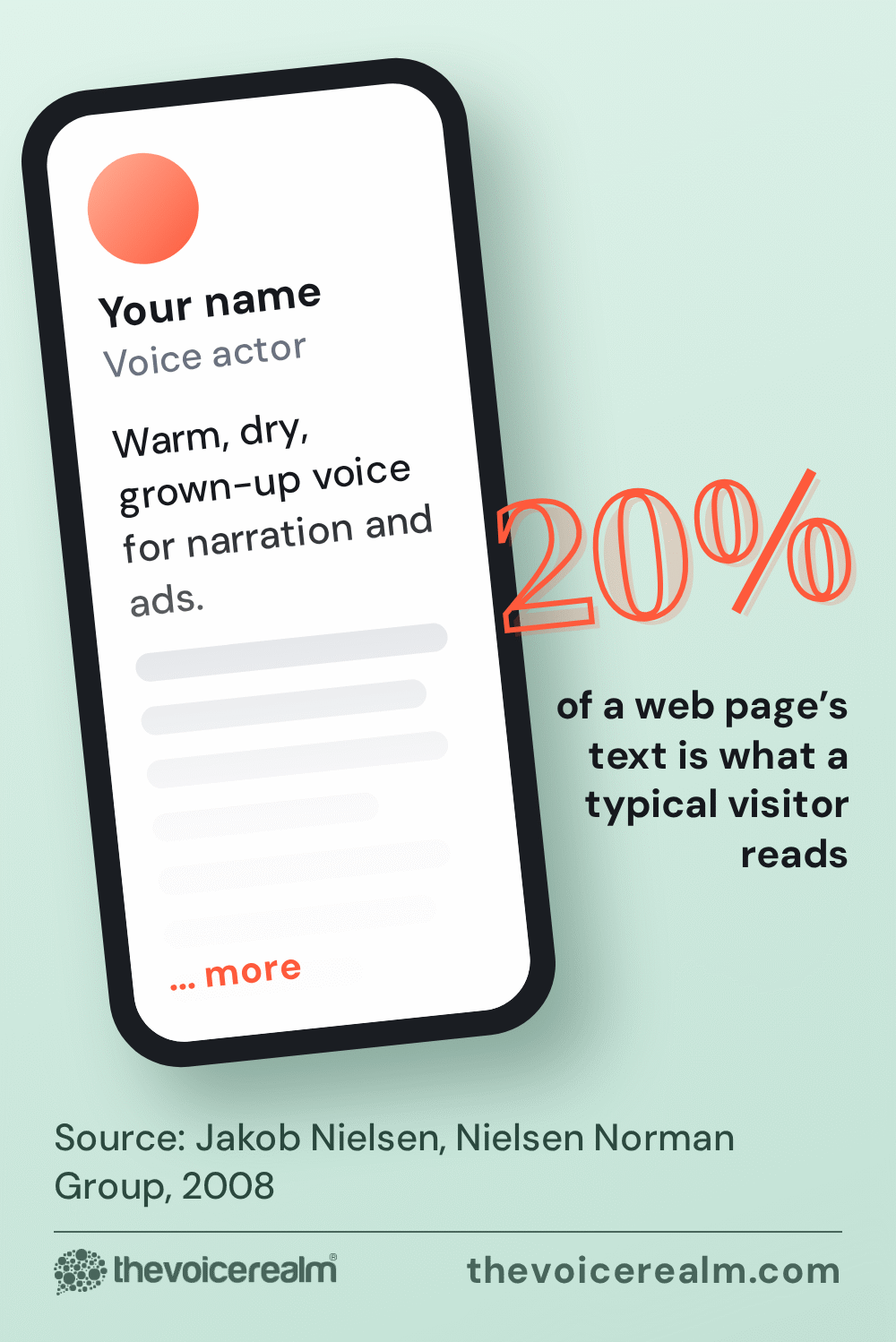
That isn’t a guess. Jakob Nielsen of the Nielsen Norman Group measured how people read web pages and found that “on the average Web page, users have time to read at most 28% of the words during an average visit.” The same study found something even more useful for a bio: “users read half the information only on those pages with 111 words or less.”
Put those together and the lesson is simple. Short text gets read. Long text gets sampled. If your bio runs to four paragraphs, the producer will see your first line, maybe a credit that catches their eye, and nothing else. So the first line has to carry the most weight, and everything after it has to earn its place.
Think of the opening sentence as the only one you’re sure they’ll read. If someone saw nothing else, would they know what you sound like and what you’re good for?
© The Voice Realm
Start with what you sound like
Your first line answers the question every buyer has: is this the voice I’m looking for? Lead with the sound, in words a non-expert would use when describing the voice they need.
Clients describe voices in plain terms. They want “warm,” “young and bright,” “a trustworthy dad,” “dry and funny,” “calm and grown up,” “upbeat but not cheesy.” They rarely write “versatile.” So borrow their words. Listen to your best demo with fresh ears, or better, ask three people who don’t work in voice to describe your sound in three words each. The words that come up twice belong in your first line.
Then add what kind of work that voice is right for. A sound with a purpose is far easier to hire than a sound on its own. “A bright, playful voice for kids’ animation and toy ads” tells a producer more in twelve words than a whole paragraph about your love of performing.
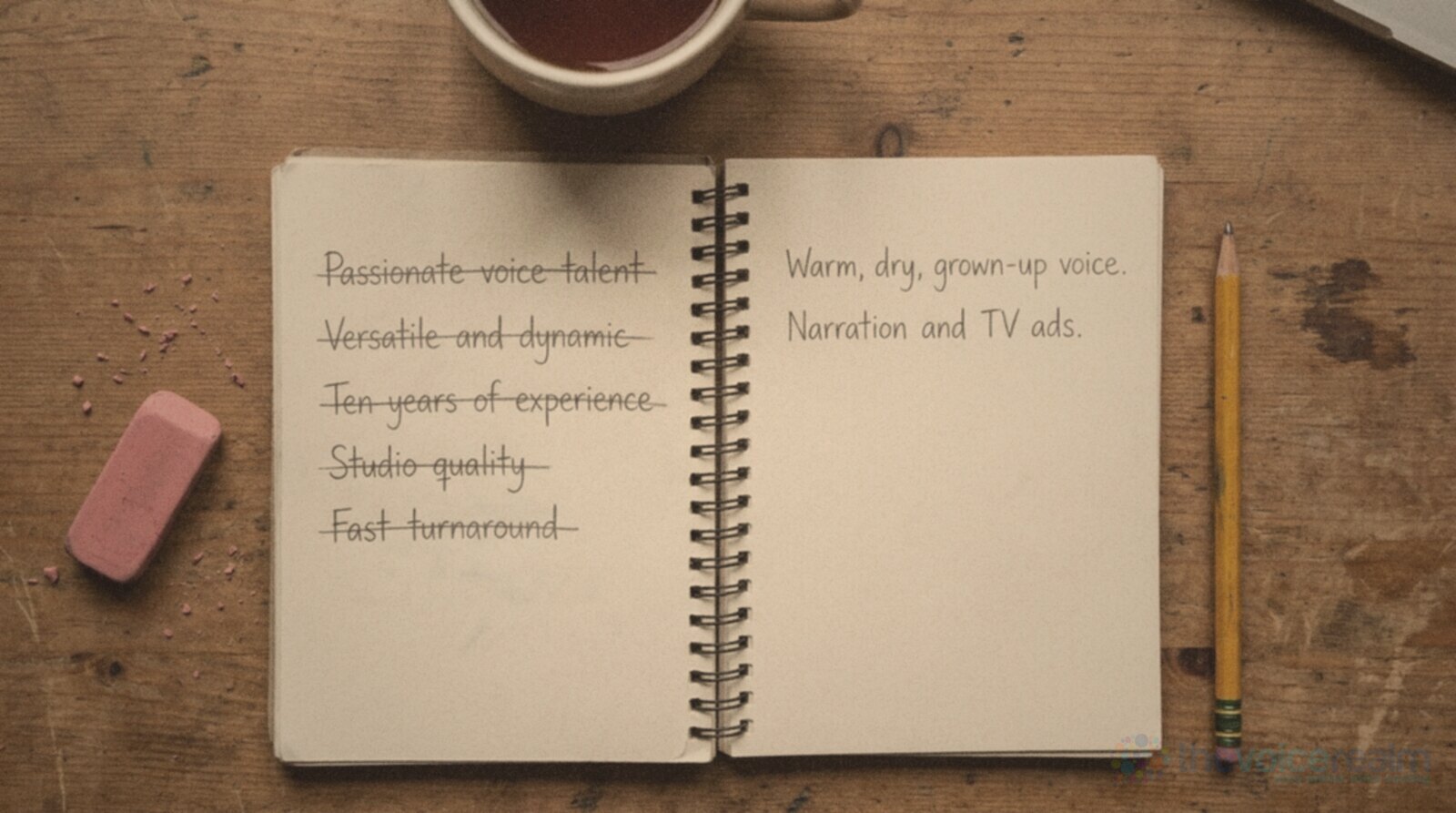
While you’re at it, cut the words that mean nothing to a buyer. Almost every bio has some of them:
- Passionate. Everyone is. It tells the reader nothing about how you sound.
- Versatile. Buyers hire a specific sound for a specific job. Show range in your demos, not in an adjective.
- Studio quality. It’s the minimum, not a feature. Name your set-up only if it’s unusual or useful.
- Fast turnaround. Vague. “Same-day auditions” or “files back within 24 hours” is a promise someone can plan around.
- Years of experience. A number of years says little. A credit or two says a lot more.
Then prove it, and point somewhere
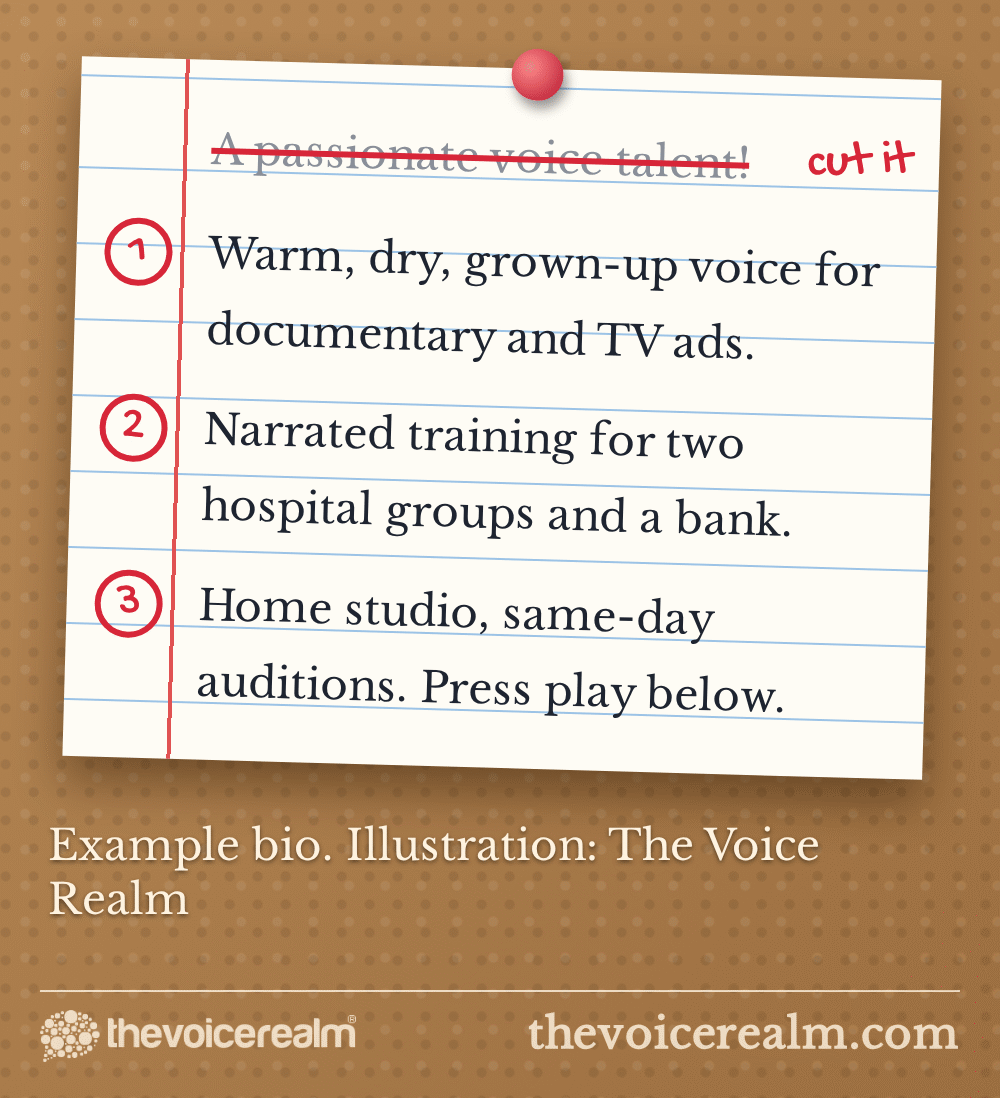
The second line is your proof. It answers the follow-up question: has this person done this kind of work before? Use your strongest relevant credit, or two at most. Name the type of client and the type of job, and use a brand name only where you’re allowed to. Plenty of work sits under a non-disclosure agreement, and a buyer would rather see “safety training for a national rail operator” than a name you shouldn’t have used.
No big credits yet? That’s fine. Use what’s true and specific. Training counts, so does a genre you’ve practised hard, and so do the skills a buyer cares about: you can read medical terms cleanly, you’ve narrated long-form, you can match a reference read, you’re comfortable being directed live. Specific beats impressive.
The third line tells the reader what to do next. Press play on a demo, book a session, ask for a custom audition, or get in touch. A bio that ends on your hobbies leaves the reader with nowhere to go. A bio that ends on an action keeps them listening.
© The Voice Realm
That’s the whole formula: what you sound like, proof you’ve done it, what to do now. Everything else is optional. If you add more, put it after these three lines, never before.
First person or third person?
There’s no single right answer, and you’ll see both on working actors’ sites. What matters is matching the voice of the bio to the place it lives.
First person
Reads like you talking to the client directly. Friendly and relaxed, and it suits your own website, social profiles and casting site profiles where a buyer is getting a feel for working with you.
Third person
Reads like an introduction from someone else. It suits agent pages, conference programmes, press releases and anything a producer will copy straight into their own documents.
Whichever you pick, stick with it all the way through. A bio that starts in third person and slides into “I” halfway reads like two people wrote it. And keep it in plain language. “I narrate e-learning” is friendlier than “Experienced in the provision of narration services.”
If you work under a stage name, use it consistently in every version too. We cover that choice in more detail in our piece on the name you work under.
© The Voice Realm
Your photo gets read before your words
On most profiles, your photo sits right beside your bio, and people look at faces before they read anything. They also judge them fast. In a Princeton University study by Janine Willis and Alexander Todorov, people made judgments about a stranger’s face, including whether they seemed trustworthy and likeable, within a tenth of a second. “We decide very quickly whether a person possesses many of the traits we feel are important, even though we have not exchanged a single word with them,” Todorov said.
 VoiceEditSuiteNewAuto Clean Up now learns how you breathe.Learns from numbers, never your audio. Never used to train AI.See how it works
That doesn’t mean you need a glamour shot. Voice buyers aren’t casting your face. They’re deciding whether you look like someone who’s professional, friendly and easy to work with. A clear, well-lit, current photo of you looking at the camera does that. A dark selfie, a group shot with your friends cropped out, or a photo from ten years ago does the opposite.
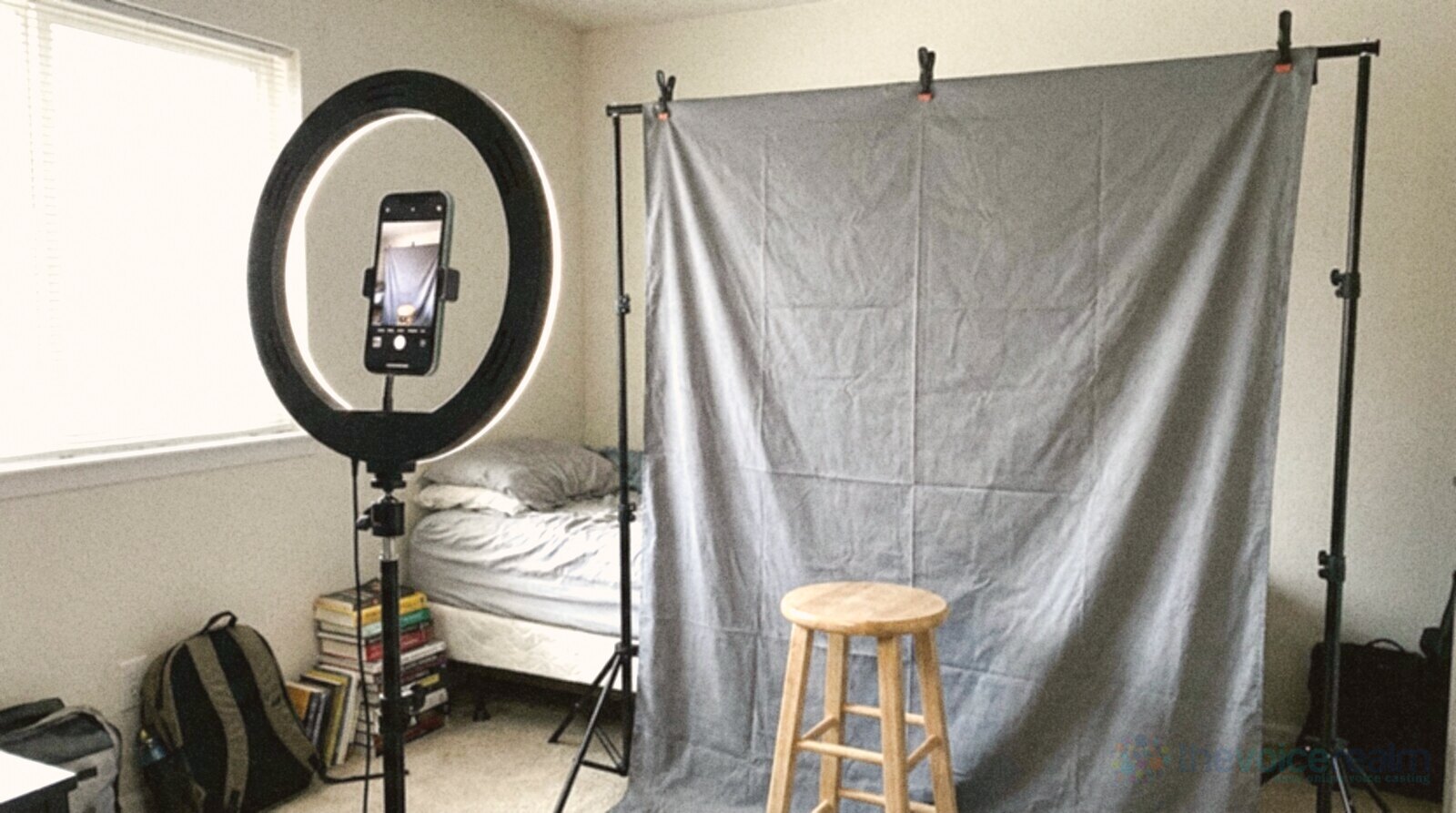
You can do this at home. Face a window for soft, even light, stand a little away from a plain wall, and have someone take a few dozen shots at eye level. Pick one where you look like yourself on a good day. Match the mood to your voice, too: a warm, grown-up narrator shouldn’t look like they’re about to do a stand-up set, and a playful character actor shouldn’t look like a bank manager.

© The Voice Realm
One bio, three lengths
Your bio lives in more places than you’d think, and each one has room for a different amount. Write all three versions once, keep them in one document, and copy from there every time.
The one-liner. Around fifteen words. Just your first line, the sound and the work. It’s for social media profiles, email signatures, conference name badges and anywhere with a tight character limit. If you only polish one version, polish this one.
The short bio. Around fifty to eighty words, comfortably inside the length that gets read. It’s the three-line formula with a touch more detail. Use it on casting site profiles, your website’s home page and in the first email to a new client.
The long bio. Around 150 to 200 words. Same opening, then more credits, your training, your studio, the languages or accents you work in, maybe one human detail. It belongs on your website’s About page, in agent submissions and anywhere a producer has asked for “a bit more about you.” Even here, the first two sentences should stand on their own, because many readers won’t go further.
Your social profiles deserve the same care. Our guide to building a voice over profile people actually follow covers the rest of the page around your bio.
© The Voice Realm
Keep it alive
A bio isn’t a one-off job. Read yours again every few months, and every time you book something you’re proud of. Swap in the new credit if it’s stronger than the old one. Check that the voice you describe is still the voice on your demos, because nothing loses a buyer faster than a bio that says “deep and gravelly” next to a demo that sounds young and bright.
That match is everything. Your bio’s job is to get someone to press play, and your demo’s job is to prove the bio right. If you’re refreshing one, look at the other. Our piece on a demo that earns the click is a good place to start.
If you’re new and still working out what your voice is right for, that’s worth sorting before you write a word. A coach can hear things you can’t, and Voice Master Academy runs training that helps new voice actors find their lane before they start marketing it.
Then sit down with a blank page, write three lines, and stop. You can always add more later. Most of the time, you won’t need to.
Sources: Jakob Nielsen, Nielsen Norman Group, “How Little Do Users Read?”, 2008; Princeton University, “Snap judgments decide a face’s character, psychologist finds”, 2006, on Willis and Todorov in Psychological Science.
Ready to get booked?
See the jobs open right nowAbout Sarah Robbins
Sarah Robbins writes for The Voice Realm about finding voice over work, home studios, casting and the business side of voice acting.