Blog

This guide is for freelance voice actors who keep getting the same message: “Any chance you could turn this around today?” Fast work is part of the job, and saying yes quickly wins clients. But if every job is a rush, you end up working nights for standard money. Here’s how to decide when a job really is a rush, what other freelancers charge for it, how to put it in writing so nobody’s surprised, and how to keep fast work from eating your week.
First, decide what “normal” is
You can’t charge for a rush until you’ve said what isn’t one. That means picking a standard turnaround and telling clients what it is, every time.
For most voice over work, the norm is about a day. Laura Schreiber, a working voice actor, explains it on her blog: “When we are talking about standard delivery, typically in voiceover it is assumed that it will be a 24 hour turnaround.” She adds that “if a client does not specify that they need it fast, it is pro forma that it will be within 24 hours.”
Tom Dheere, a voice actor and business coach who writes as the VO Strategist, uses a similar figure for corporate narration. On his site, he writes that a standard five-minute corporate script of about 750 words “requires a strict 24-hour turnaround time from a professional voice actor.”
Longer work needs longer. An hour of e-learning or a full audiobook chapter isn’t a one-day job, and your standard turnaround should grow with the script. A simple rule many freelancers use: up to five finished minutes within one working day, longer scripts by agreement.
Whatever you choose, write it down. Put it on your website, in your quote template and in your first reply to any new client. Once “standard” has a number, “rush” has a meaning.

© The Voice Realm
What actually counts as a rush
Not every fast job is a rush job. If a script lands on a quiet Tuesday morning and you happen to finish it by lunch, that’s just good service. Schreiber is clear on this point: “On quiet days in my studio when work comes in and I just happen to turn it over fast I never charge a fee.”
A rush is when the client’s deadline makes you change your plans. Schreiber describes it as a job that “is typically done in 4-6 hours and sometimes clients want or need you to stop what you are doing” and record straight away. The cost to you isn’t the recording time. It’s everything you had to move to make room.
Here’s a quick test. A job is a rush if meeting the deadline means any of these:
- You’ll push back another client’s work that was already booked.
- You’ll record outside your normal working hours, late at night, very early or at the weekend.
- You’ll cancel or cut short something personal, a family plan, a day off, sleep.
- You’ll skip your usual checks, such as listening back with fresh ears the next morning.
If none of those apply, it’s not a rush. Do it fast, enjoy the client’s surprise, and keep the goodwill.
What other freelancers charge
There isn’t one official rush fee for non-union voice over, but there are some clear patterns.
Schreiber describes a flat minimum: “It is industry standard to add at least a $50 RUSH FEE to RUSH jobs, especially when you have to put another job aside to do said rush job.” A flat fee is simple and works well for short jobs, where a percentage of a small fee wouldn’t cover the disruption.
Kim Handysides, a voice over artist who publishes a rate guide for e-learning clients on her site, describes a rush fee of between 20 and 50 percent on top of the job, for clients who need the audio within a couple of hours. A percentage scales better for bigger jobs, where moving a whole day of other work is a real cost.

© The Voice Realm
Other freelance trades work the same way. Nancy Matis, writing about translators’ pricing for the American Translators Association, notes that “Most clients will agree to pay more if they send a request on a Friday evening asking for delivery on Monday morning.” Her examples of extra charges for urgent work run from a quarter more up to double, depending on how much has to be dropped.
Union rates give a useful benchmark for unsocial hours too. The agreed Equity guide to working in UK commercials, which covers voice-over artists, says that “If you are required to work on a Sunday or public holiday, you should be paid an additional premium of not less than 50% of the BSF”, the basic session fee. Night sessions carry the same 50 percent extra.
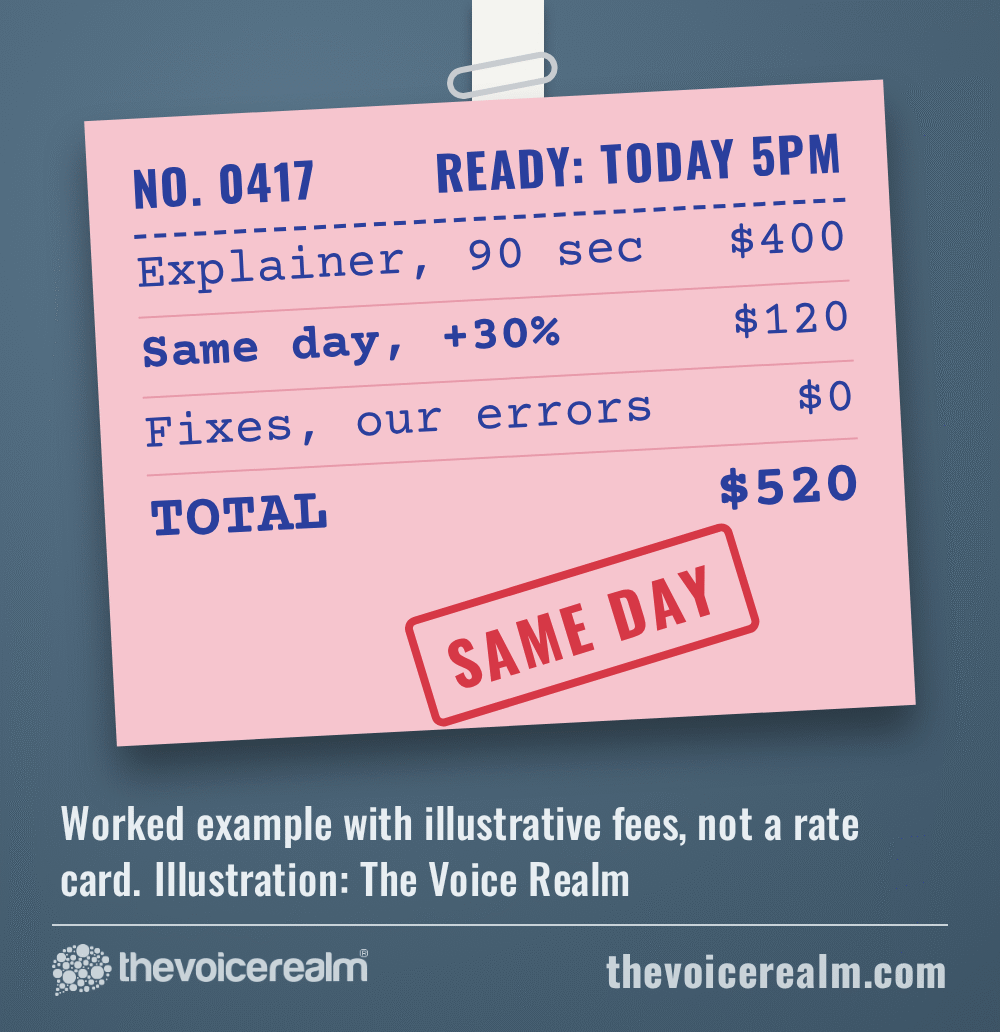
Put together, a sensible starting point for many freelancers looks like this: a flat minimum for small jobs, and 25 to 50 percent for same-day work, rising to as much as double for overnight or weekend delivery that wipes out other plans. Your market, your genre and your relationship with the client will move those numbers, and that’s fine. If you want a second opinion on the base fee before you add anything, the free Voice Edit Suite rate calculator is a quick check.
Put it in the quote before anyone asks
A rush fee that appears for the first time on an invoice feels like a trick, even when it’s fair. The same fee written into your quote feels like a service. The difference is entirely in the timing.
Schreiber’s approach is the one to copy. She says, “I am very clear about all of these terms in the initial booking email.” Clients who know the terms upfront can decide whether speed is worth paying for. Many will happily wait until tomorrow; others will pay without a second thought because their deadline is real.
Here’s a simple way to word it in a quote:
“Standard delivery is within one working day of the final script. Need it sooner? Same-day delivery adds 30 percent, and weekend or overnight delivery adds 50 percent, subject to my schedule.”
A sample line for your quote templatePost this quote
Notice the last few words. “Subject to my schedule” matters. A rush fee is a charge for priority, not a promise that you’ll always be available. Peter K. O’Connell, a voice actor, words it carefully on his FAQ page: “For urgent projects, I offer same-day or rush delivery when my schedule permits.”
 VOICEMASTERACADEMYTwenty modules, one at a time.Breath controlHome studioCommercial techniqueAuditionsStart module oneNo experience needed.
When you invoice, show the rush fee as its own line, with the turnaround it bought. Our guide to what goes on a voice over invoice covers the rest of that page, and if you need a refresher on building the base number, there’s a full walk through on quoting a job without underselling yourself.
© The Voice Realm
Revisions and pickups have their own clock
Rush pricing gets tangled when revisions come in. A client who books standard delivery and then sends script changes at six in the evening with a nine o’clock deadline the next morning has created a rush, even if the first delivery wasn’t one.
Decide in advance how you’ll handle that. Many voice actors include one round of small fixes for errors on their side at no charge, at their normal turnaround. Script changes from the client are new work, and if they need to be back the same day, the rush terms apply. Dheere notes in his scheduling guide that script changes after recording “require a dedicated pickup session that adds 12 to 24 hours to your delivery timeline.” That’s a fair expectation to set with any client.
If revisions are a regular sticking point, the free revision checker from Voice Edit Suite helps you sort what counts as a fix and what counts as a change before you reply.
When to waive it, and when to say no
A rush fee is a tool, not a rule. There are good reasons to drop it.
Waive it when the fast turnaround costs you nothing, as Schreiber does on quiet days. Waive it now and then for a long-standing client who’s always fair with you, and tell them you’ve done it (“No rush fee this time, happy to help”). That small favour is remembered far longer than the money.
Matis makes the same point about clients: “for the same client you might charge 50% more for a project once and drop rush fees one month later for the same request.” Your workload changes, and so can your price.
Saying no is the other skill. If a rush would mean a poor recording, a missed deadline for someone else, or a whole night without sleep before a morning session, it’s better to decline politely and offer the earliest time you can deliver properly. A client would rather have a clear “I can do it by ten tomorrow” than a rushed file that needs redoing.
© The Voice Realm
Rushes cost your voice as well as your evening
There’s a physical side to fast turnaround that’s easy to forget. Late night sessions after a full day of recording mean a tired voice, and a tired voice reads flatter and gives out sooner.
Alice Everdeen, a voiceover artist, puts it simply in a post on her site about the things she’s learned to turn down: “If you’re constantly working late into the night, it can be easy to burn out.” The US National Institute for Occupational Safety and Health makes the wider point in its training on long work hours: “Insufficient sleep, on the other hand, is associated with a broad range of health and safety risks.”

© The Voice Realm
We’ve written about what a short night does to your voice, and it’s worth reading before you agree to a midnight session. Part of what a rush fee pays for is the recovery time afterwards.
Some habits that help:
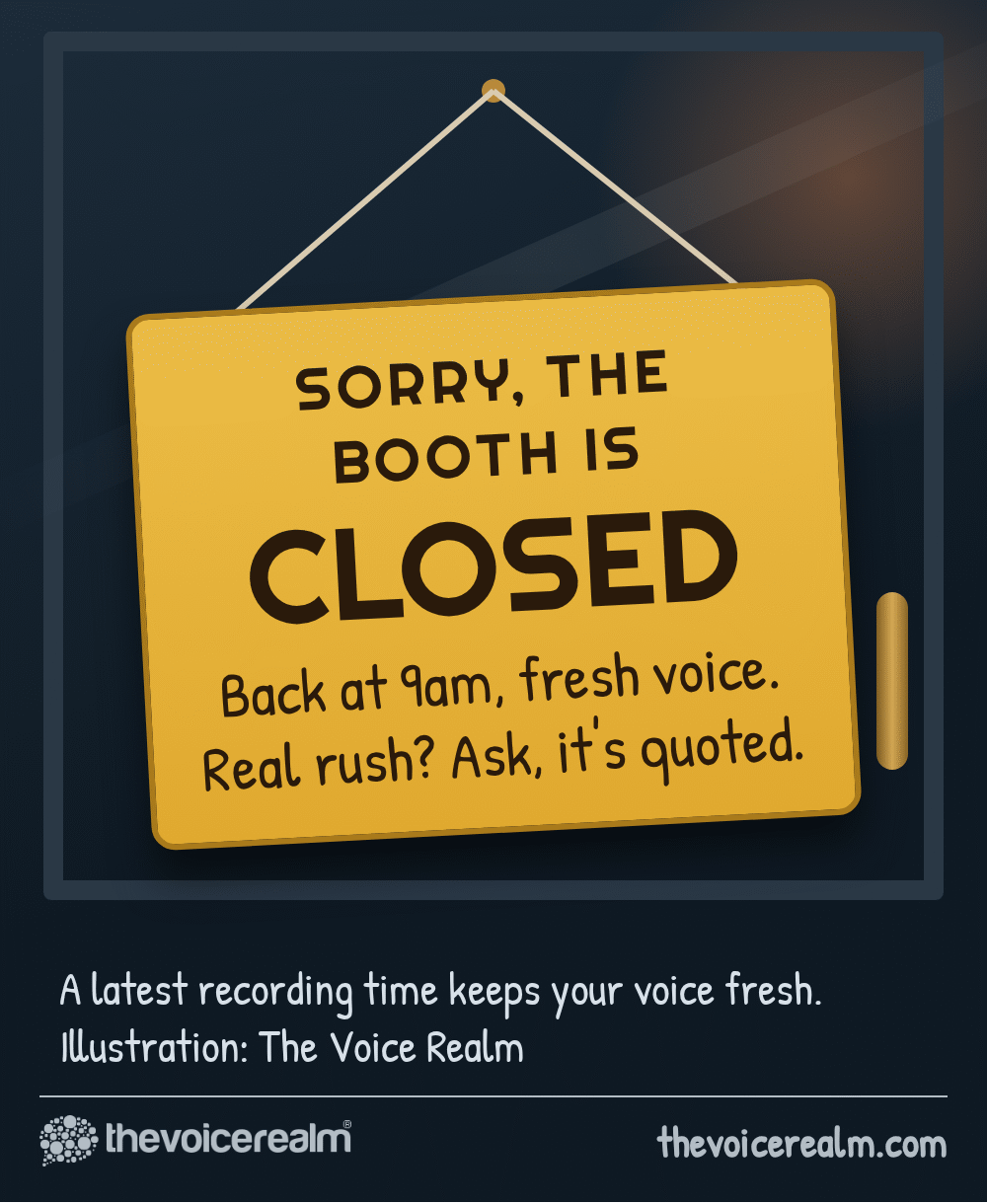
- Set a latest recording time and stick to it. After that hour, the earliest delivery is the next morning.
- Keep a small gap in your schedule most days. One open slot makes a genuine rush easy to fit without moving anyone else.
- Keep your voice warm and your studio ready, so a rush is recording time, not set-up time.
- Track how many rushes each client sends. If it’s every job, talk to them about a regular slot or a standing rate.
A rush policy you can write tonight
Open your quote template and add four lines. Your standard turnaround and what length of script it covers. Your same-day terms, as a flat minimum or a percentage. Your overnight and weekend terms. And the words “subject to my schedule”.
Then add the same terms to your website’s FAQ, so new clients see them before they ask. Next time someone writes “any chance of this today?”, you won’t have to think about the price, or apologise for it. You’ll just say yes, and send the terms.
Sources: Laura Schreiber, “FAQs about RUSH Jobs”; Tom Dheere, “Voice Over Turnaround Times: Scheduling Your Corporate B2B Video Production”; Kim Handysides, “eLearning Narration Rate Guide”; Nancy Matis, “When Should We Apply Extra Charges to Translation Projects?”, American Translators Association; Equity and the IPA, “Working in Commercials”; Peter K. O’Connell, “Voiceover FAQ: Rates, Usage and What to Expect”; Alice Everdeen, “10 Things to Say No to as a Voiceover Artist”; NIOSH, “Sleep is a Basic Need”.
Ready to get booked?
See the jobs open right nowAbout Sarah Robbins
Sarah Robbins writes for The Voice Realm about finding voice over work, home studios, casting and the business side of voice acting.